The full text of every card, in order, with the card itself under each one. Select a card to open it full size.
Card 01 of 09
You signed it. Did you read it?
- A lease. A prescription label. A ballot. A box that says I agree. Each one assumes you read it, understood it, and meant it. Reading the words is the easy part. Here is what the rest costs, in seven parts of ordinary life.
SCOPE One finding per card, with its limits printed on it and a link to the source. Most of these studies show a link, not a cause.
All sources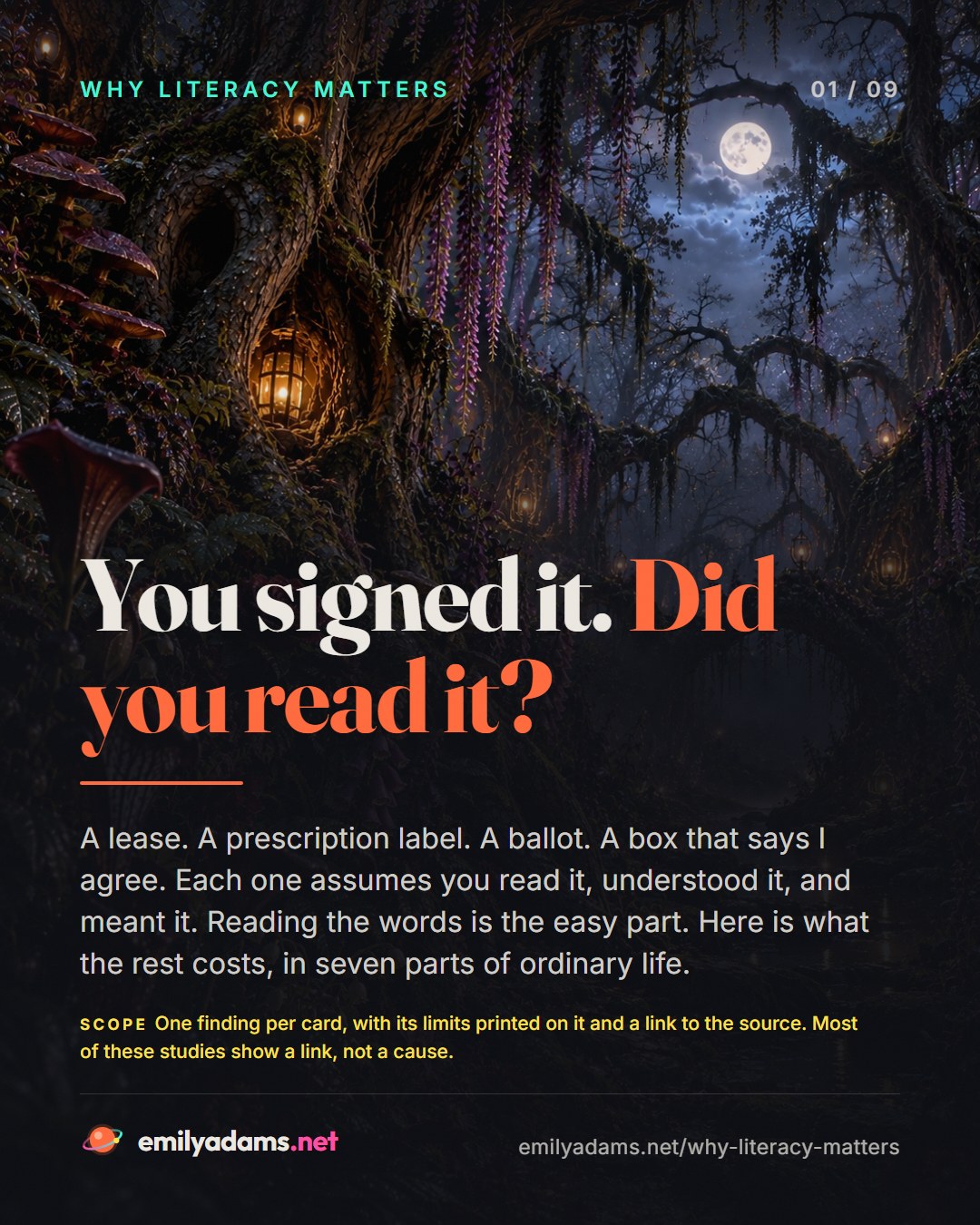
Card 02 of 09
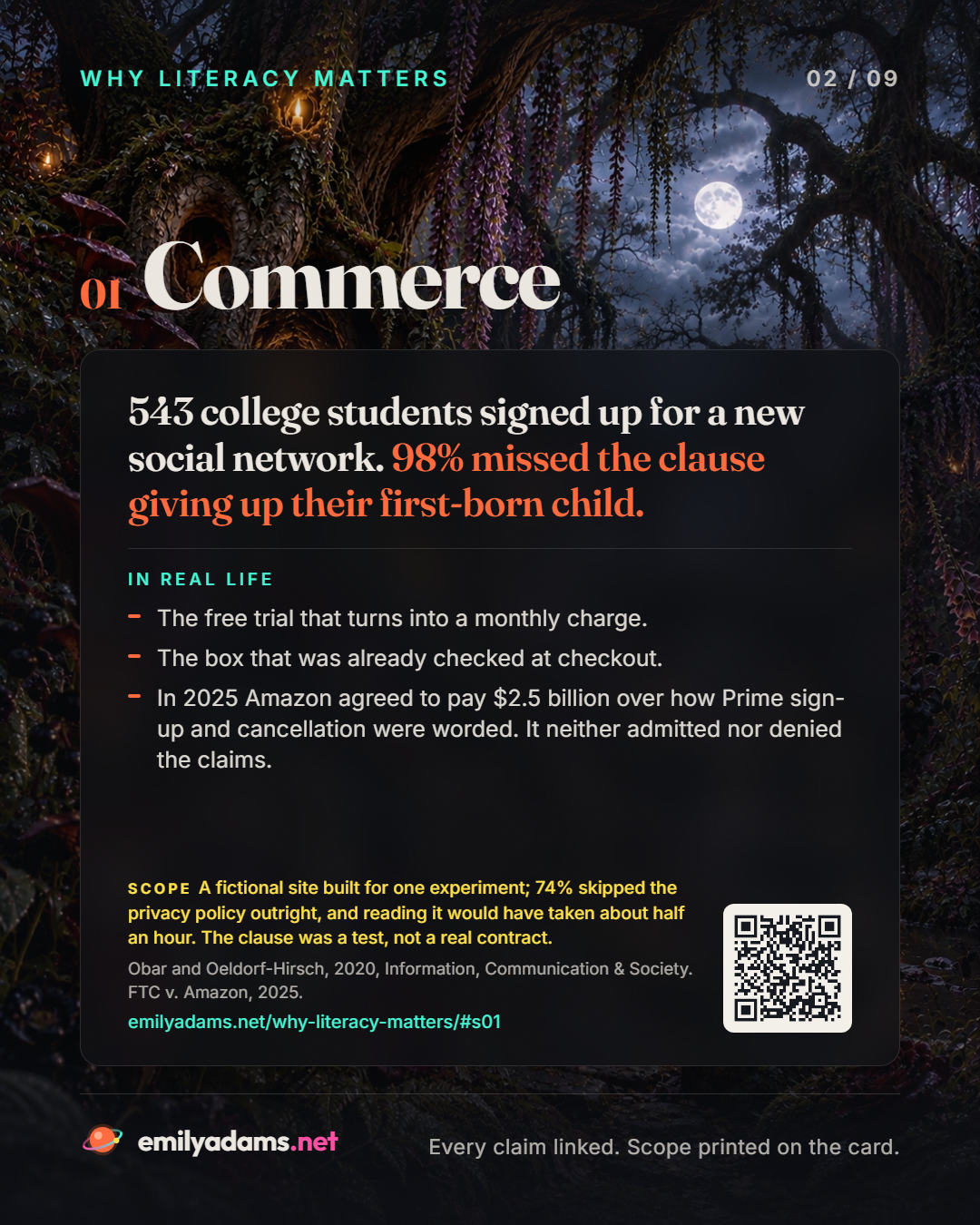
Commerce. 543 college students signed up for a new social network. 98% missed the clause giving up their first-born child.
- The free trial that turns into a monthly charge.
- The box that was already checked at checkout.
- In 2025 Amazon agreed to pay $2.5 billion over how Prime sign-up and cancellation were worded. It neither admitted nor denied the claims.
SCOPE A fictional site built for one experiment; 74% skipped the privacy policy outright, and reading it would have taken about half an hour. The clause was a test, not a real contract.
Sources and links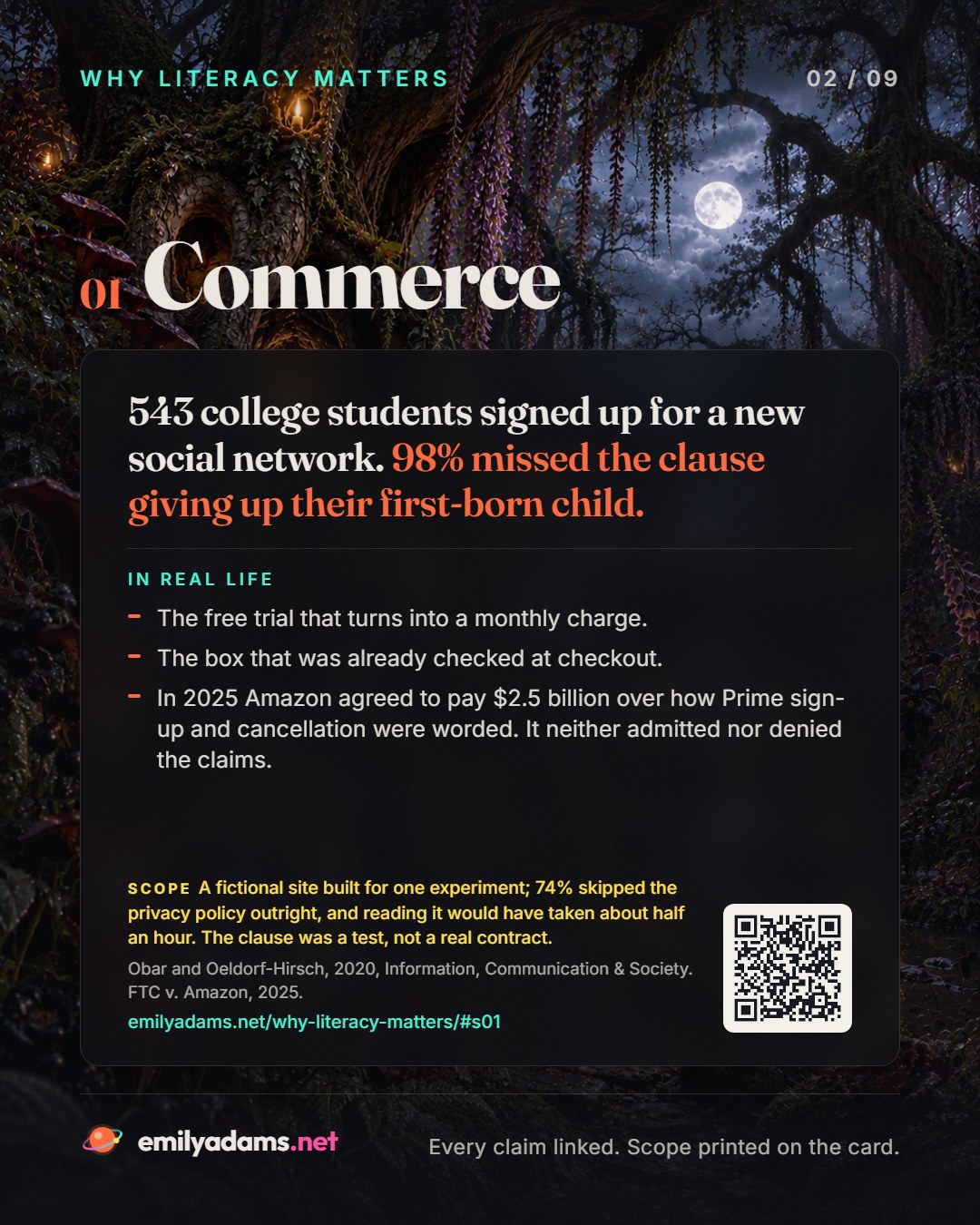
Card 03 of 09
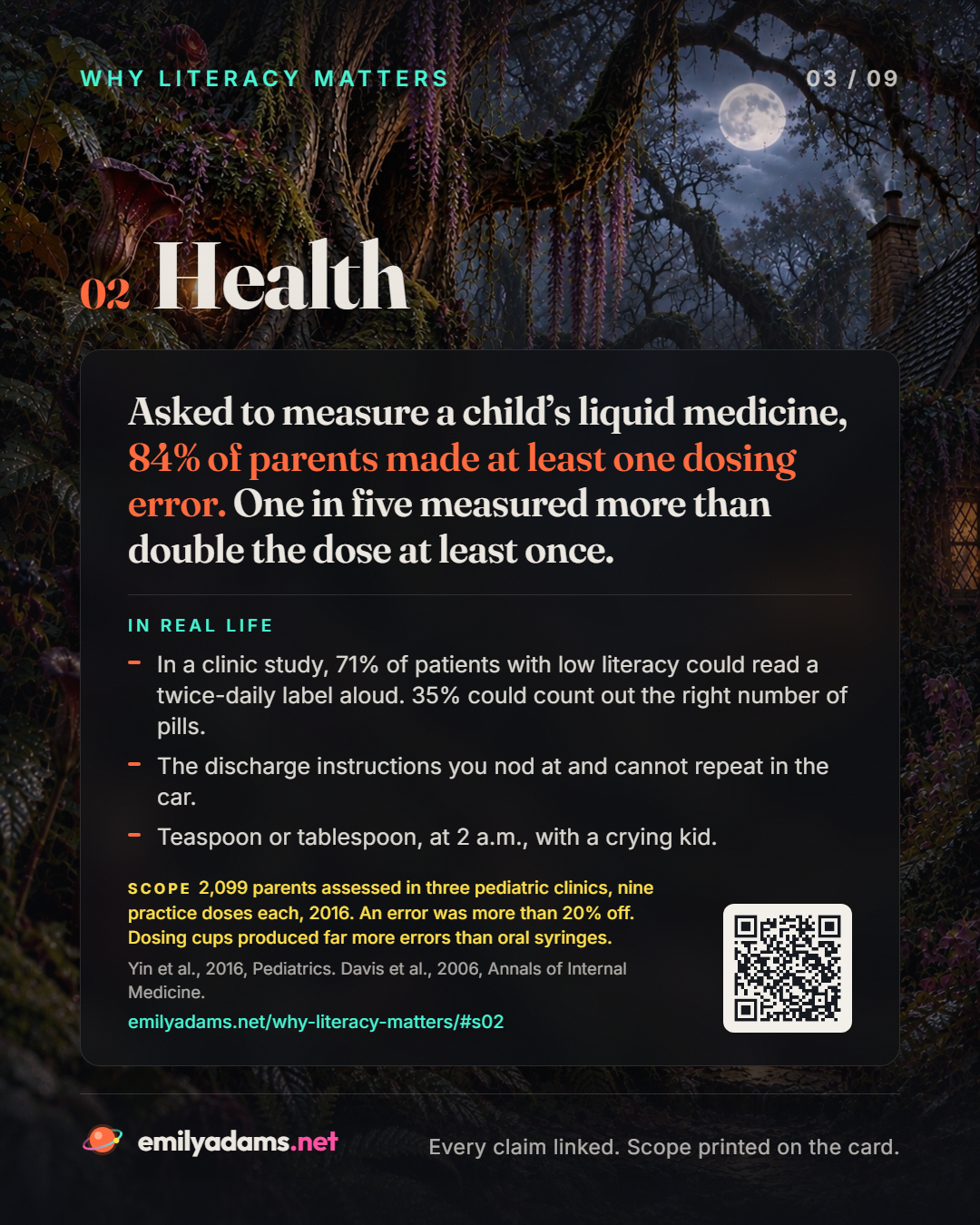
Health. Asked to measure a child’s liquid medicine, 84% of parents made at least one dosing error. One in five measured more than double the dose at least once.
- In a clinic study, 71% of patients with low literacy could read a twice-daily label aloud. 35% could count out the right number of pills.
- The discharge instructions you nod at and cannot repeat in the car.
- Teaspoon or tablespoon, at 2 a.m., with a crying kid.
SCOPE 2,099 parents assessed in three pediatric clinics, nine practice doses each, 2016. An error was more than 20% off. Dosing cups produced far more errors than oral syringes.
Sources and links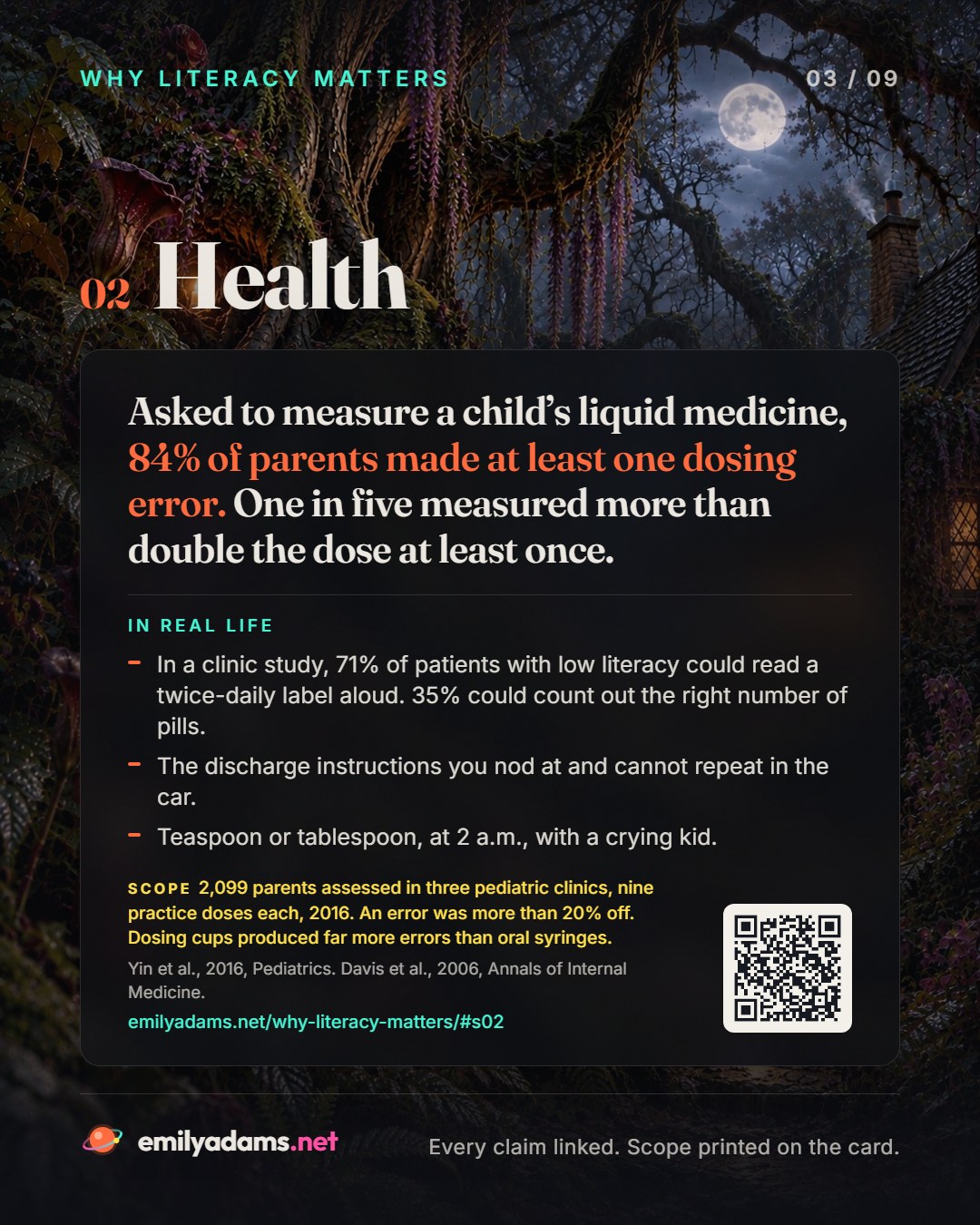
Card 04 of 09
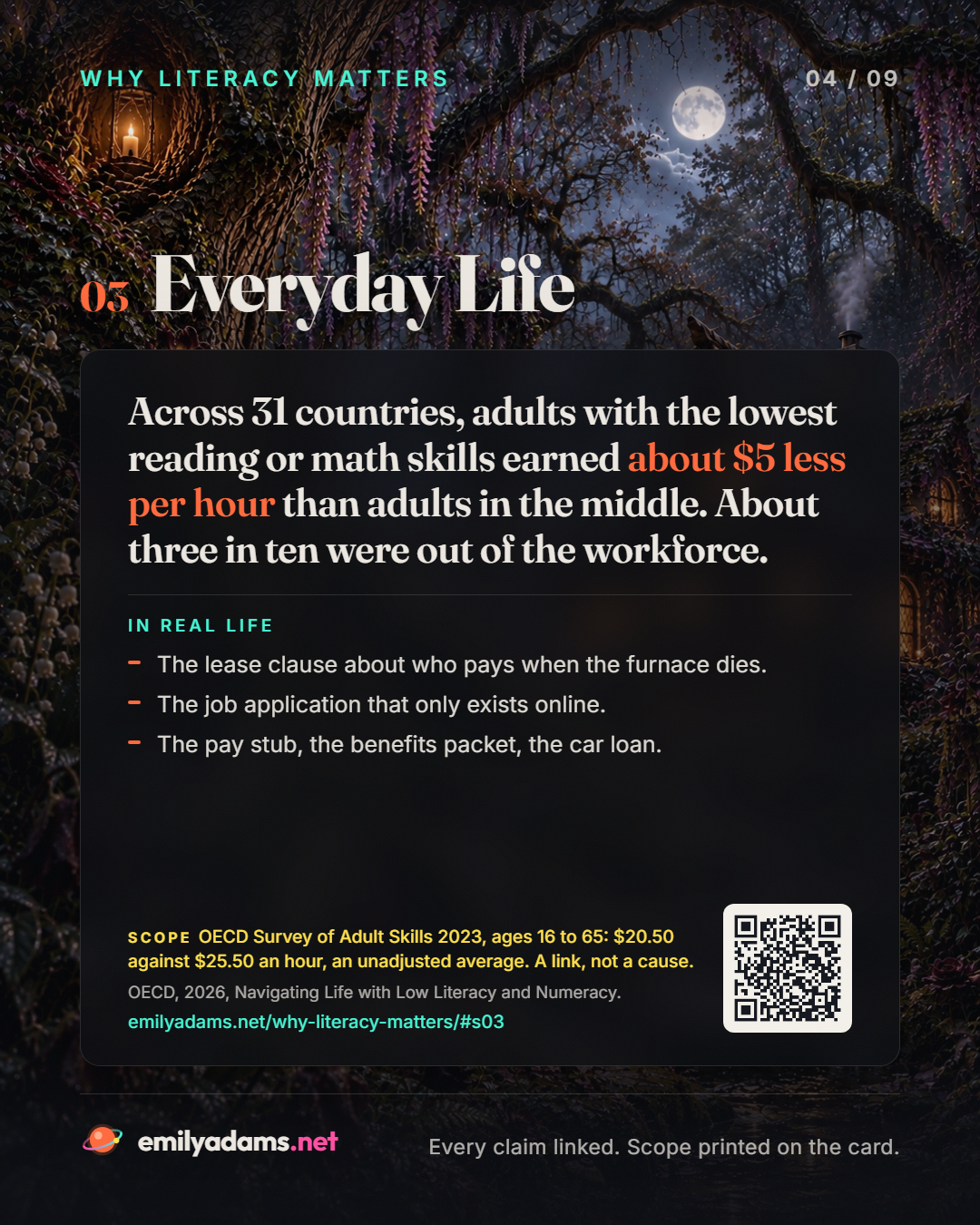
Everyday Life. Across 31 countries, adults with the lowest reading or math skills earned about $5 less per hour than adults in the middle. About three in ten were out of the workforce.
- The lease clause about who pays when the furnace dies.
- The job application that only exists online.
- The pay stub, the benefits packet, the car loan.
SCOPE OECD Survey of Adult Skills 2023, ages 16 to 65: $20.50 against $25.50 an hour, an unadjusted average. A link, not a cause.
Sources and links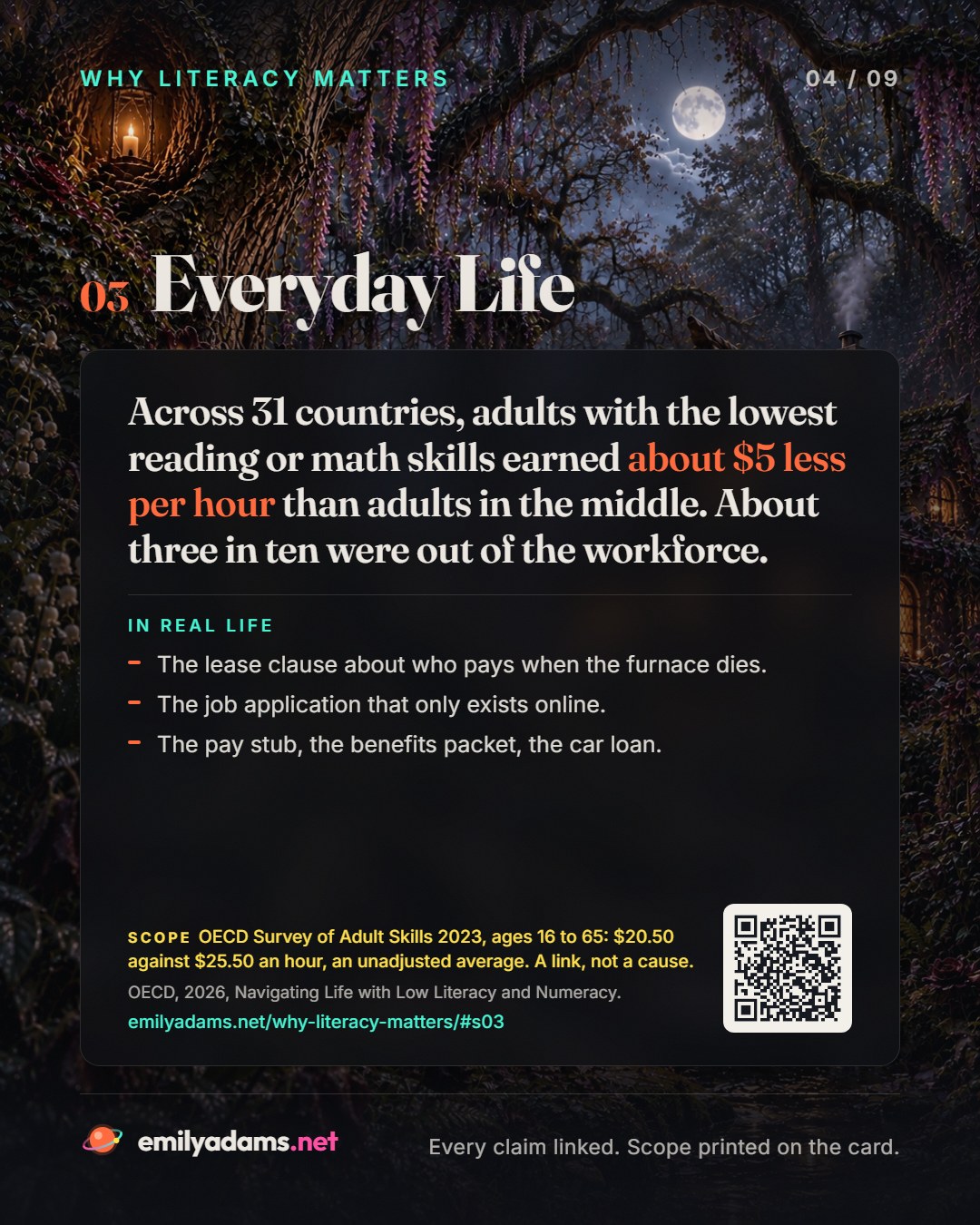
Card 05 of 09
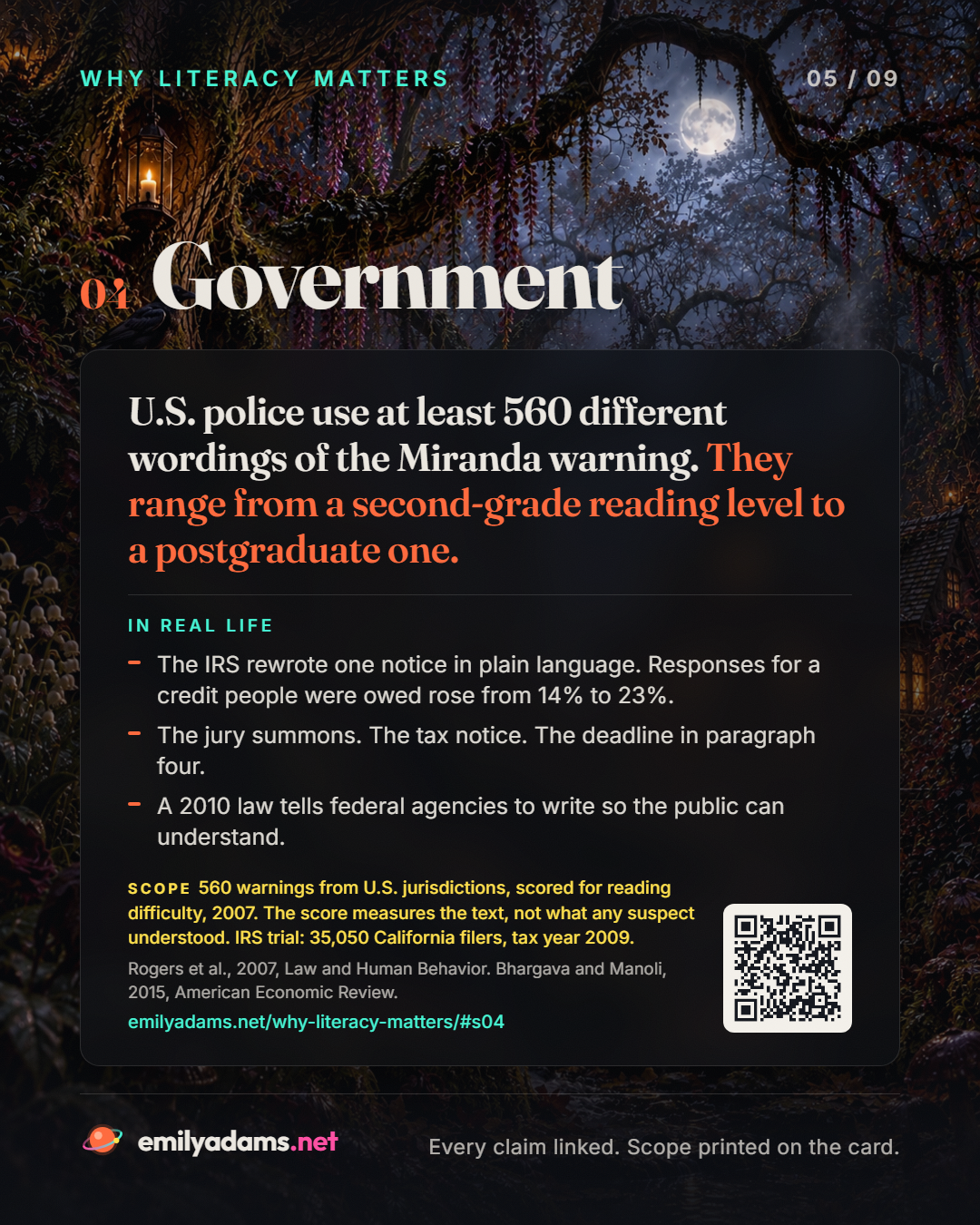
Government. U.S. police use at least 560 different wordings of the Miranda warning. They range from a second-grade reading level to a postgraduate one.
- The IRS rewrote one notice in plain language. Responses for a credit people were owed rose from 14% to 23%.
- The jury summons. The tax notice. The deadline in paragraph four.
- A 2010 law tells federal agencies to write so the public can understand.
SCOPE 560 warnings from U.S. jurisdictions, scored for reading difficulty, 2007. The score measures the text, not what any suspect understood. IRS trial: 35,050 California filers, tax year 2009.
Sources and links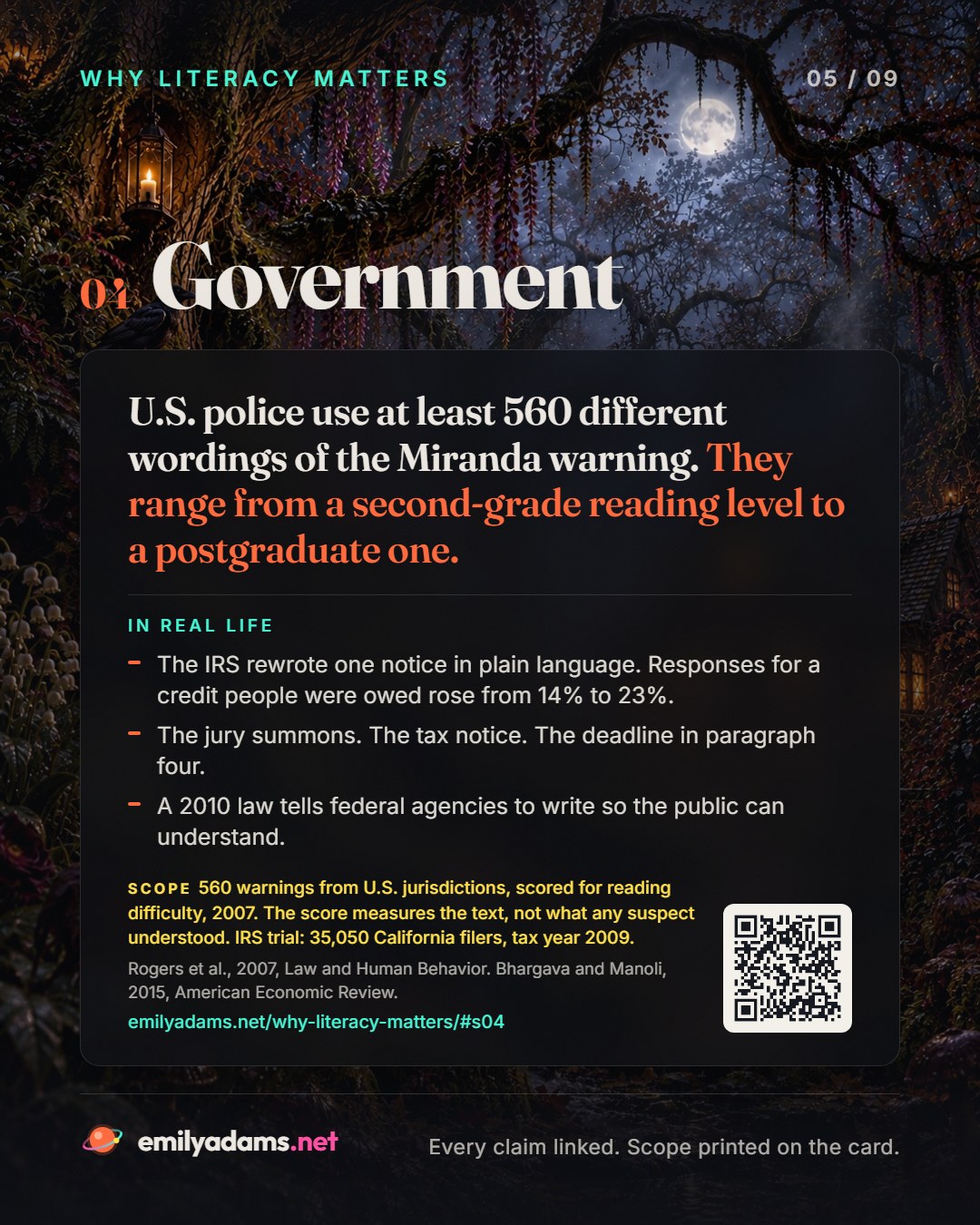
Card 06 of 09
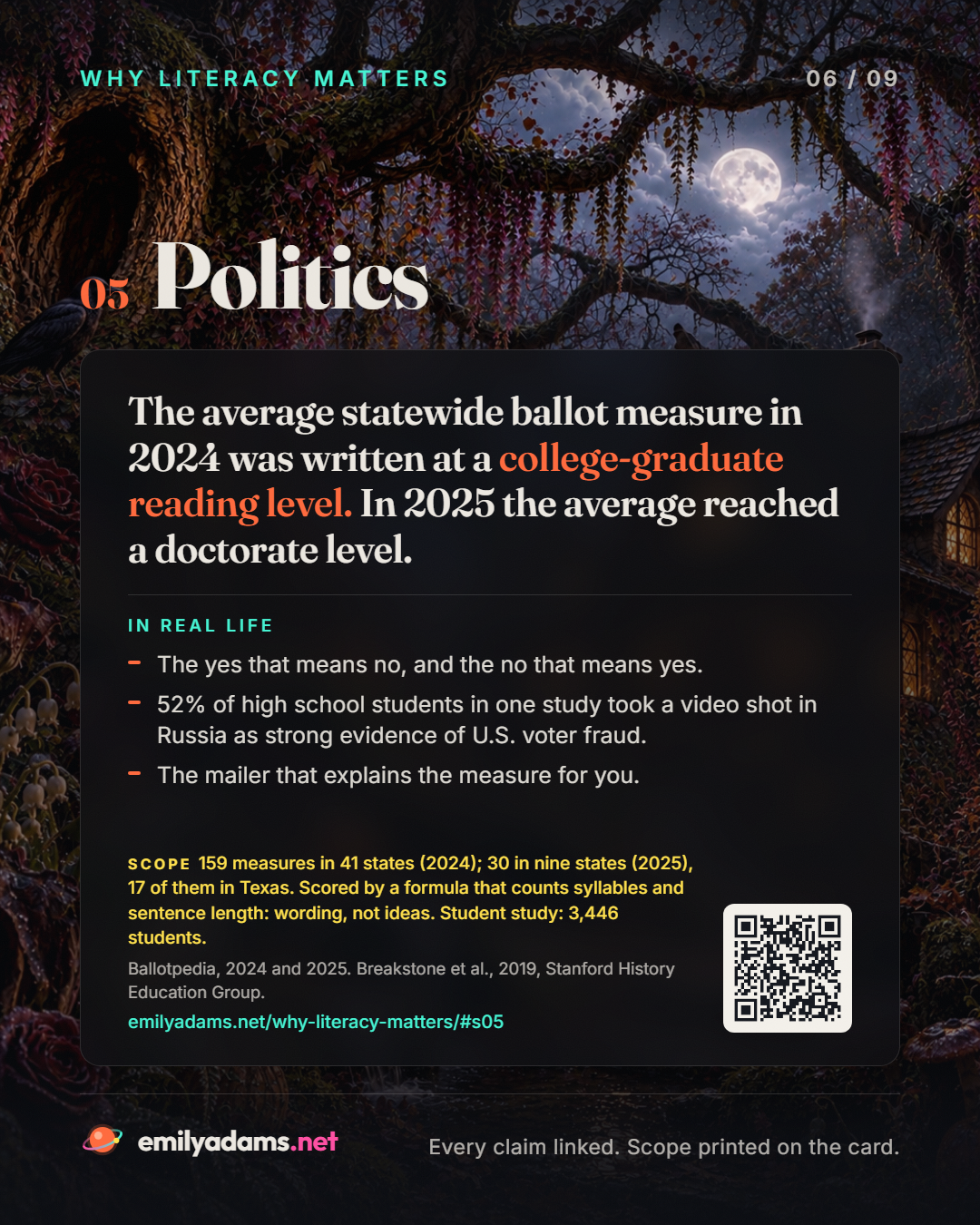
Politics. The average statewide ballot measure in 2024 was written at a college-graduate reading level. In 2025 the average reached a doctorate level.
- The yes that means no, and the no that means yes.
- 52% of high school students in one study took a video shot in Russia as strong evidence of U.S. voter fraud.
- The mailer that explains the measure for you.
SCOPE 159 measures in 41 states (2024); 30 in nine states (2025), 17 of them in Texas. Scored by a formula that counts syllables and sentence length: wording, not ideas. Student study: 3,446 students.
Sources and links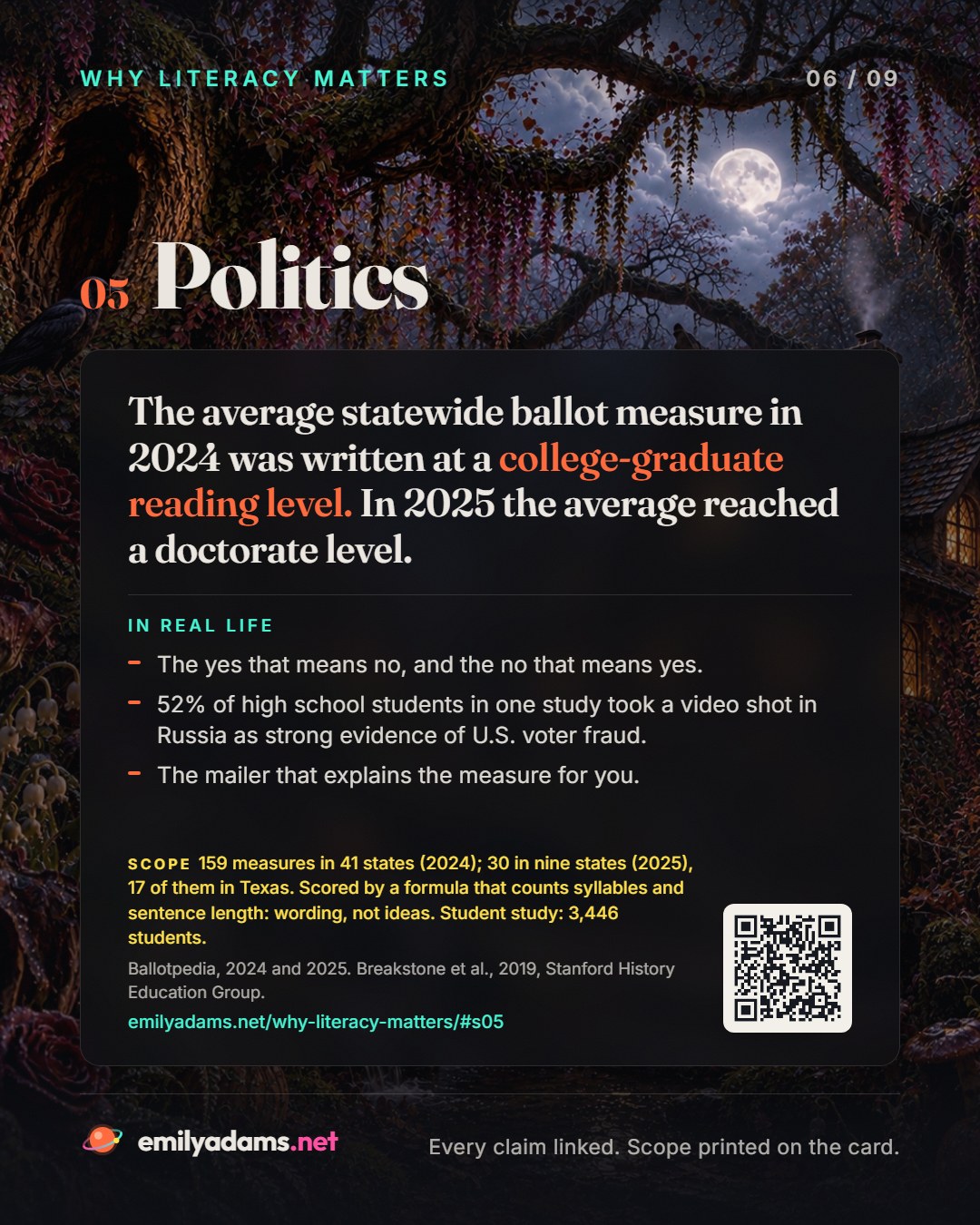
Card 07 of 09
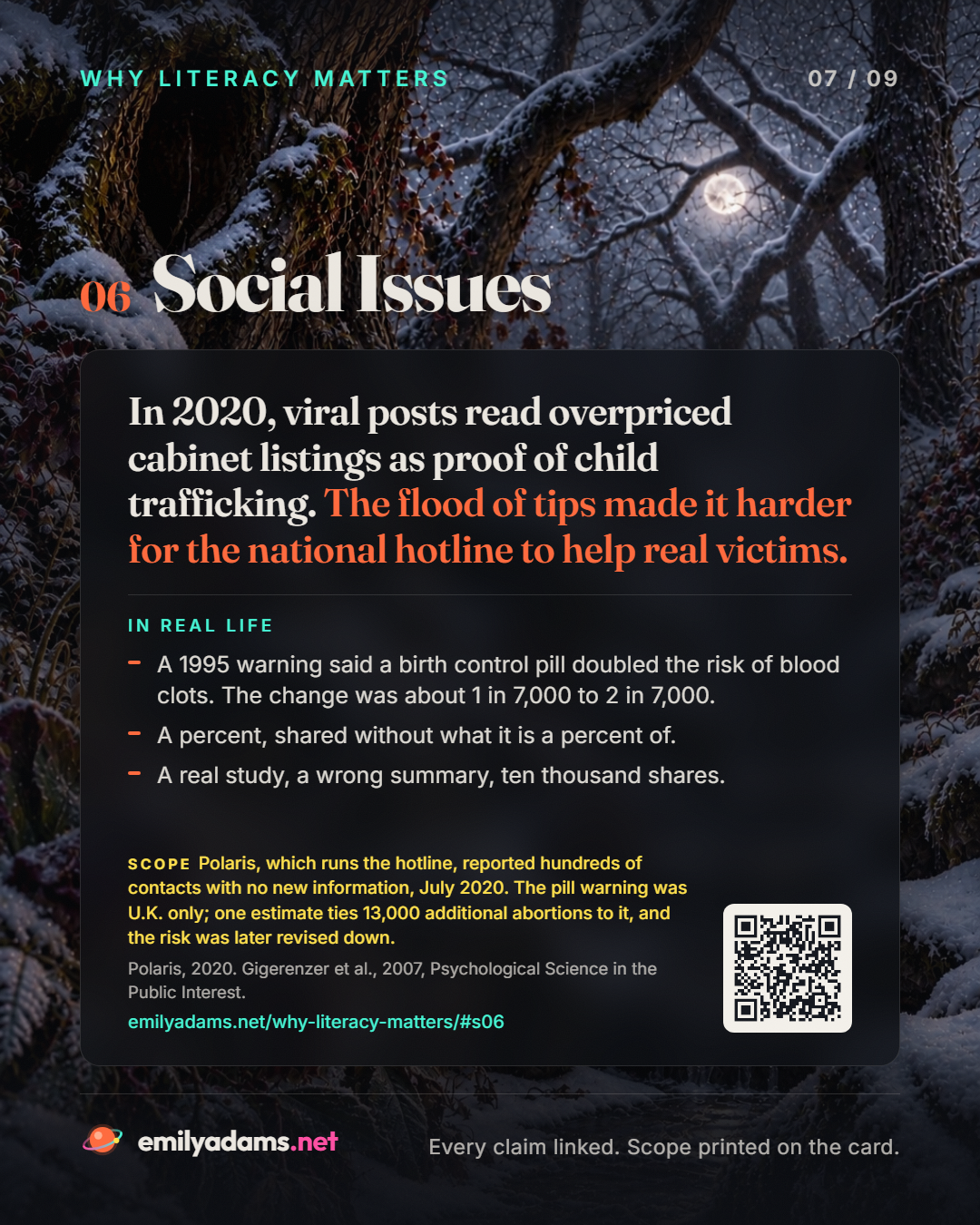
Social Issues. In 2020, viral posts read overpriced cabinet listings as proof of child trafficking. The flood of tips made it harder for the national hotline to help real victims.
- A 1995 warning said a birth control pill doubled the risk of blood clots. The change was about 1 in 7,000 to 2 in 7,000.
- A percent, shared without what it is a percent of.
- A real study, a wrong summary, ten thousand shares.
SCOPE Polaris, which runs the hotline, reported hundreds of contacts with no new information, July 2020. The pill warning was U.K. only; one estimate ties 13,000 additional abortions to it, and the risk was later revised down.
Sources and links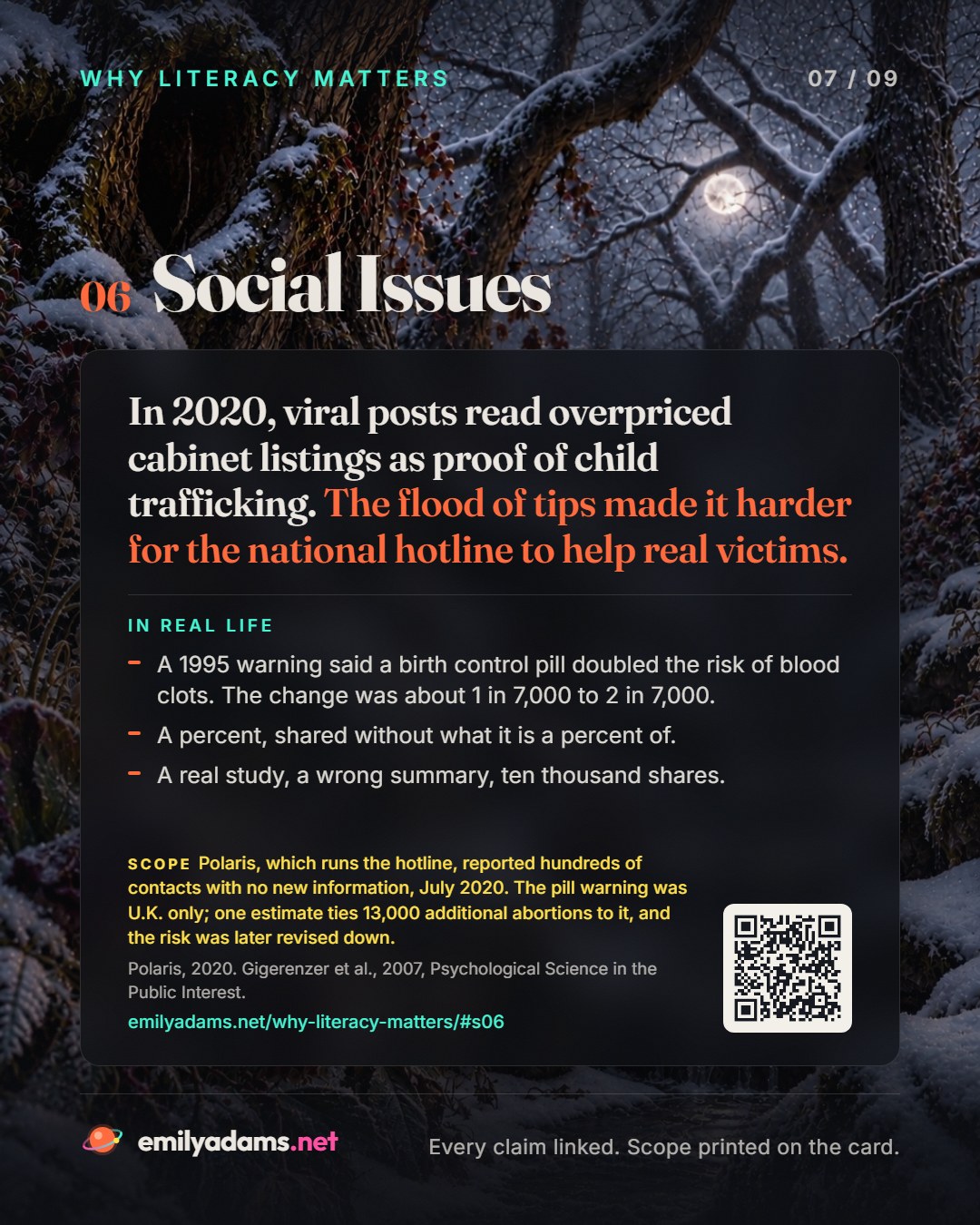
Card 08 of 09
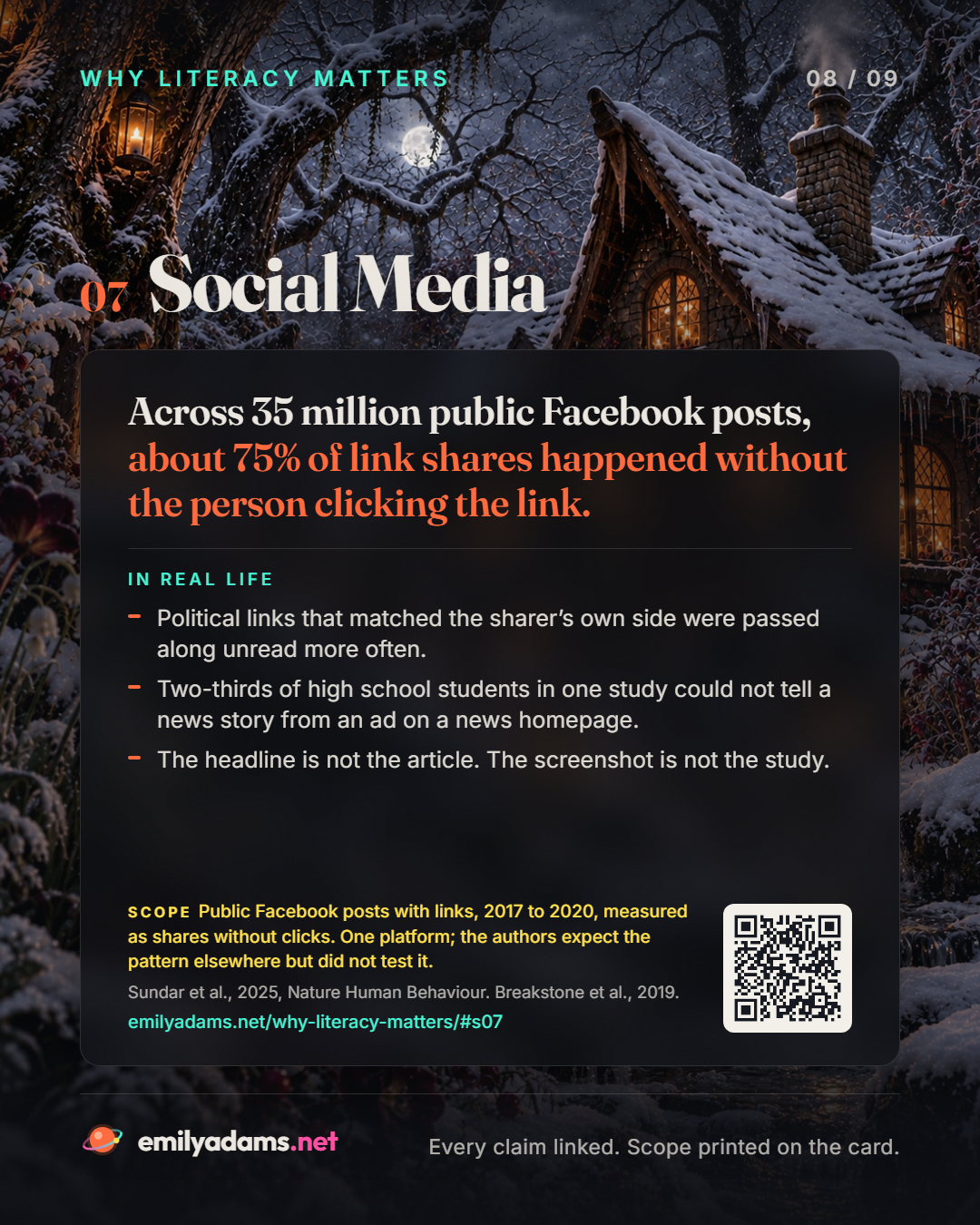
Social Media. Across 35 million public Facebook posts, about 75% of link shares happened without the person clicking the link.
- Political links that matched the sharer’s own side were passed along unread more often.
- Two-thirds of high school students in one study could not tell a news story from an ad on a news homepage.
- The headline is not the article. The screenshot is not the study.
SCOPE Public Facebook posts with links, 2017 to 2020, measured as shares without clicks. One platform; the authors expect the pattern elsewhere but did not test it.
Sources and links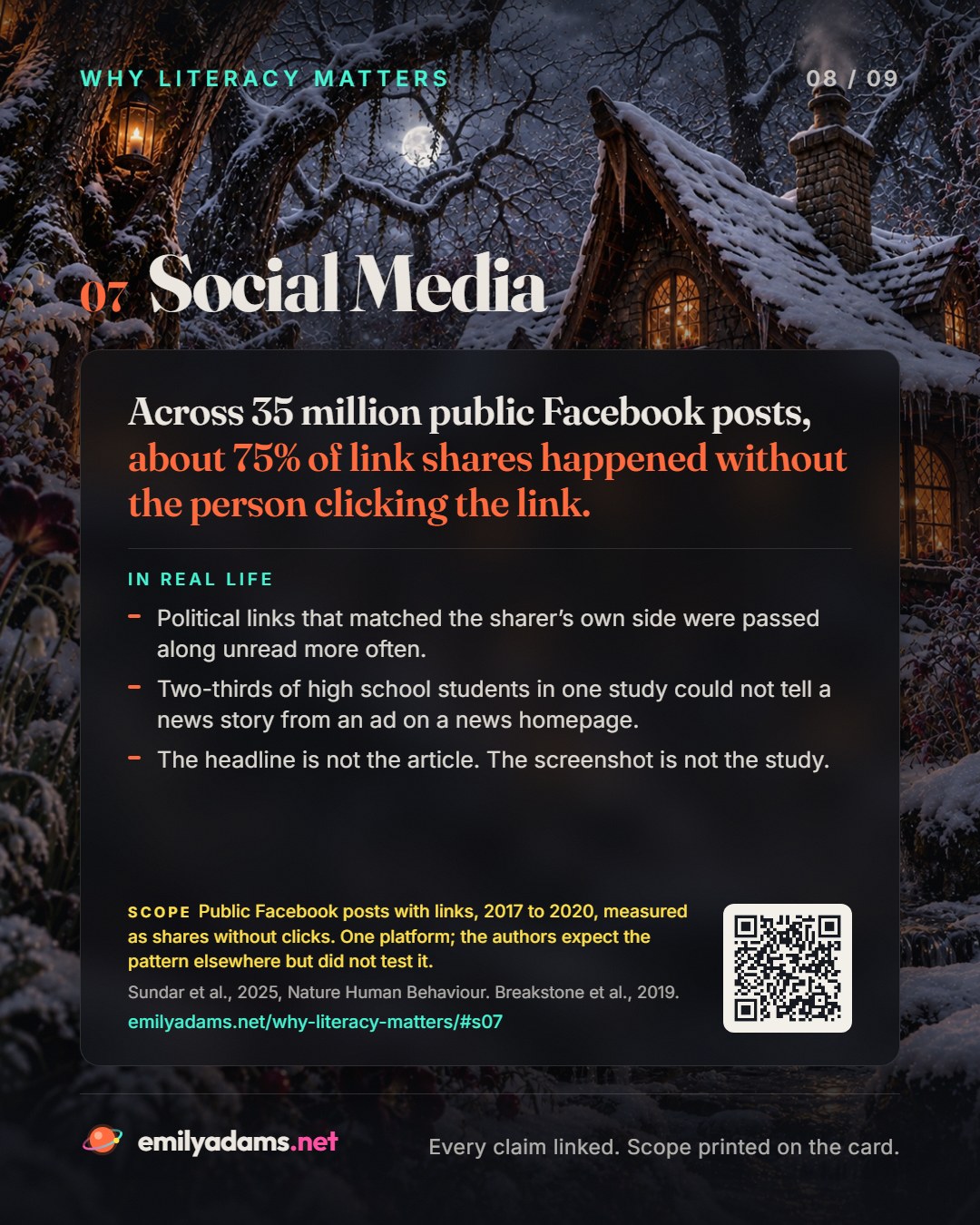
Card 09 of 09
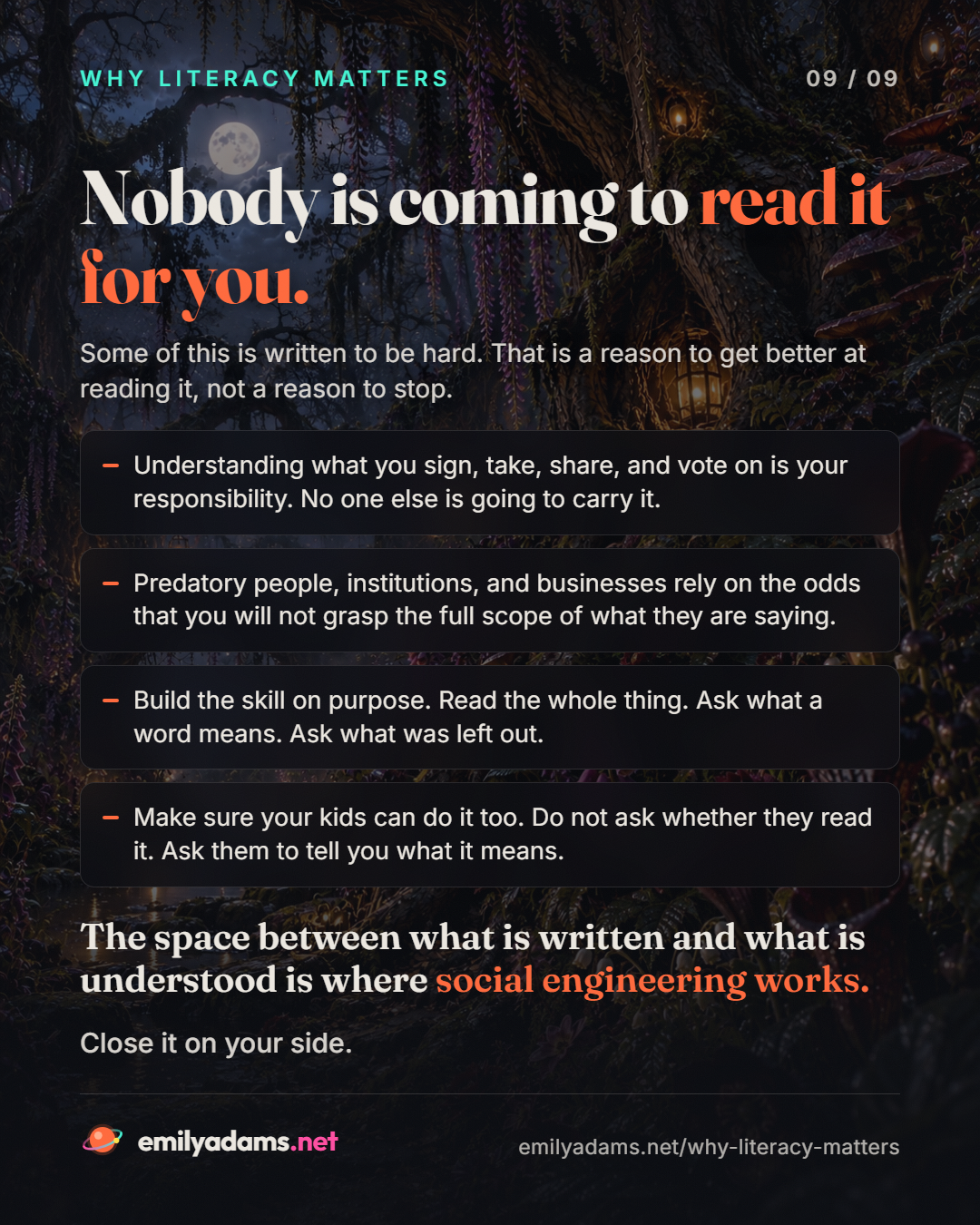
Nobody is coming to read it for you.
- Some of this is written to be hard. That is a reason to get better at reading it, not a reason to stop.
- Understanding what you sign, take, share, and vote on is your responsibility. No one else is going to carry it.
- Predatory people, institutions, and businesses rely on the odds that you will not grasp the full scope of what they are saying.
- Build the skill on purpose. Read the whole thing. Ask what a word means. Ask what was left out.
- Make sure your kids can do it too. Do not ask whether they read it. Ask them to tell you what it means.
The space between what is written and what is understood is where social engineering works. Close it on your side.
What these numbers cannot tell you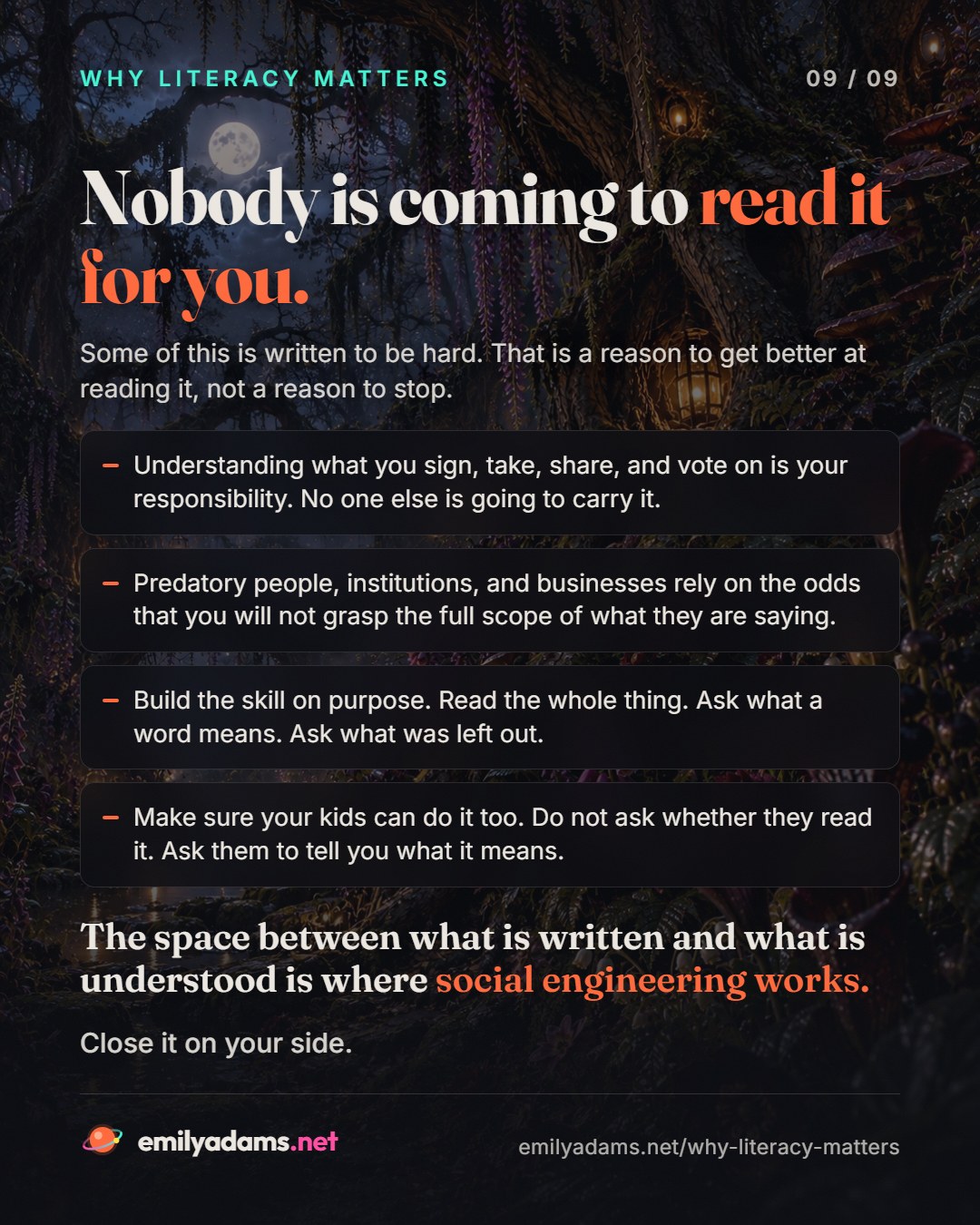
Closing card
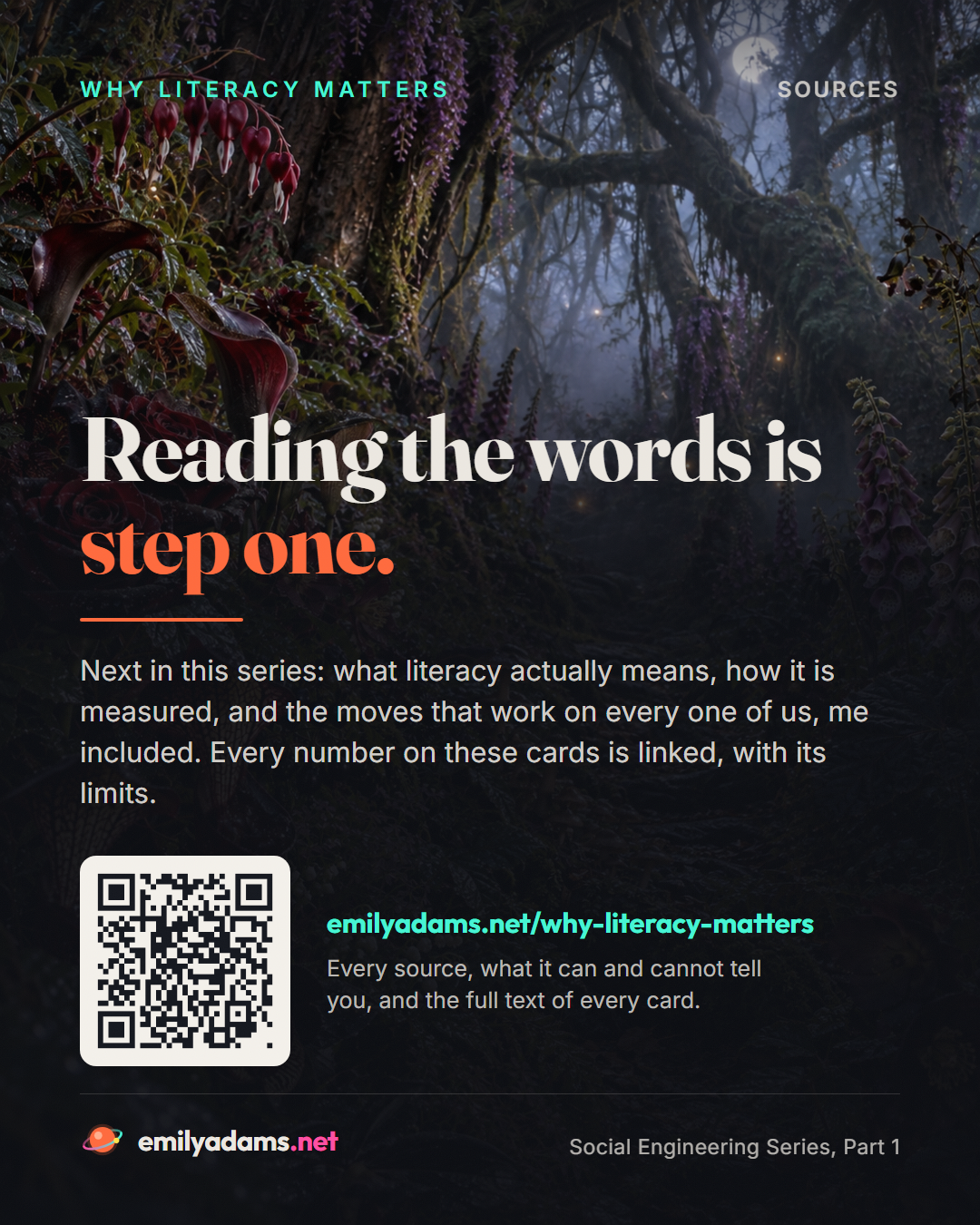
Reading the words is step one.
- Next in this series: what literacy actually means, how it is measured, and the moves that work on every one of us, me included. Every number on these cards is linked, with its limits.