Social Engineering Series, Part 2

What literacy means: the sources behind the cards.

A ten-slide series on what the word literacy covers. Most of us think it means being able to read the words. The people who measure it ask whether you can find what matters, understand it, weigh it, and act on it. This page has the definition, the test questions the cards describe, every study, and what each one cannot tell you.

Published October 9, 2026 · Emily Adams · Checked against the test’s own pages and the original studies

The Cards

The full text of every card, in order, with the card itself under each one. Select a card to open it full size.

Card 01 of 09
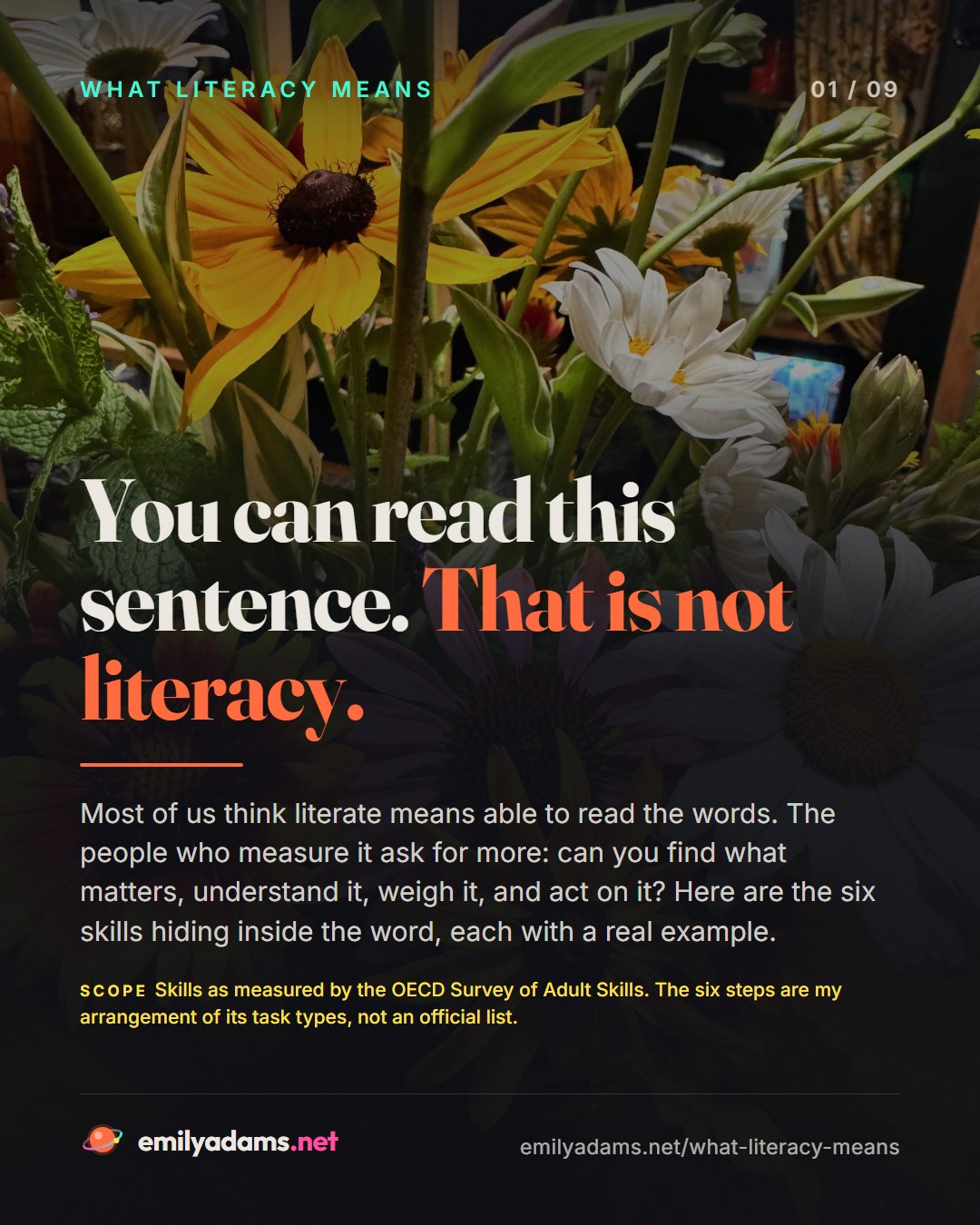
You can read this sentence. That is not literacy.
  • Most of us think literate means able to read the words. The people who measure it ask for more: can you find what matters, understand it, weigh it, and act on it? Here are the six skills hiding inside the word, each with a real example.
SCOPE Skills as measured by the OECD Survey of Adult Skills. The six steps are my arrangement of its task types, not an official list.
All sourcesCard 1
Card 02 of 09
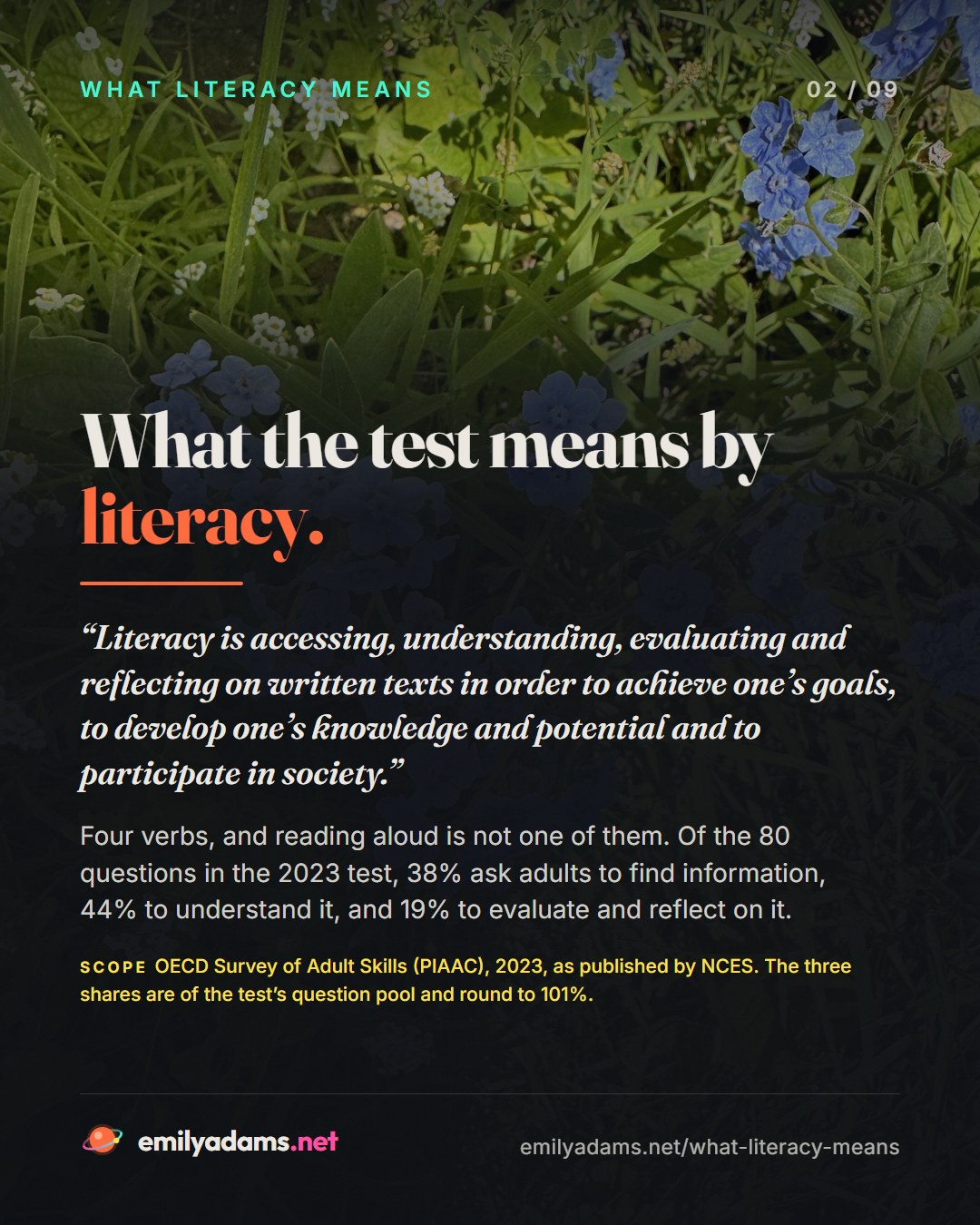
What the test means by literacy.
“Literacy is accessing, understanding, evaluating and reflecting on written texts in order to achieve one’s goals, to develop one’s knowledge and potential and to participate in society.”
  • Four verbs, and reading aloud is not one of them. Of the 80 questions in the 2023 test, 38% ask adults to find information, 44% to understand it, and 19% to evaluate and reflect on it.
SCOPE OECD Survey of Adult Skills (PIAAC), 2023, as published by NCES. The three shares are of the test’s question pool and round to 101%.
Sources and linksCard 2
Card 03 of 09
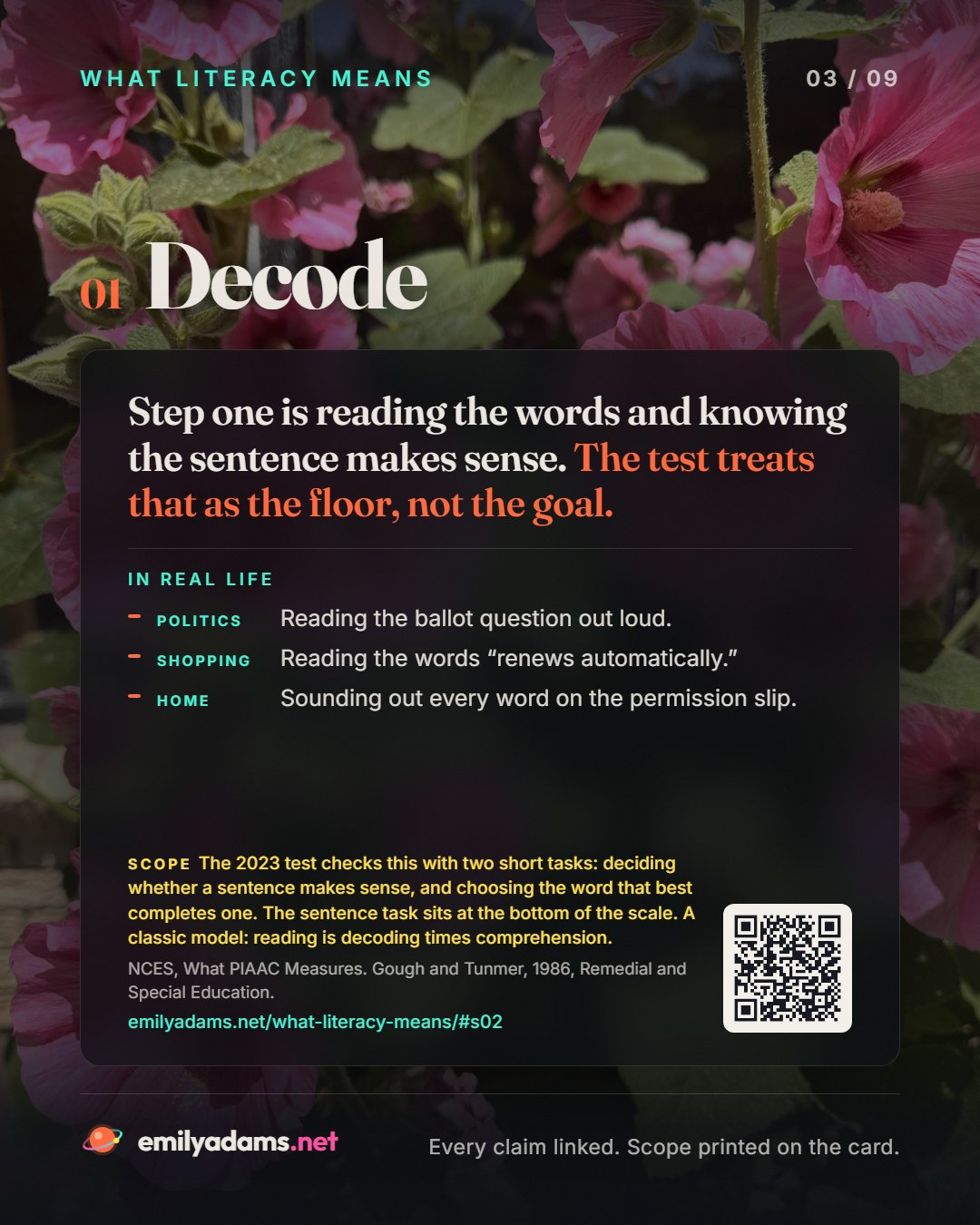
Decode. Step one is reading the words and knowing the sentence makes sense. The test treats that as the floor, not the goal.
  • PoliticsReading the ballot question out loud.
  • ShoppingReading the words “renews automatically.”
  • HomeSounding out every word on the permission slip.
SCOPE The 2023 test checks this with two short tasks: deciding whether a sentence makes sense, and choosing the word that best completes one. The sentence task sits at the bottom of the scale. A classic model: reading is decoding times comprehension.
Sources and linksCard 3
Card 04 of 09
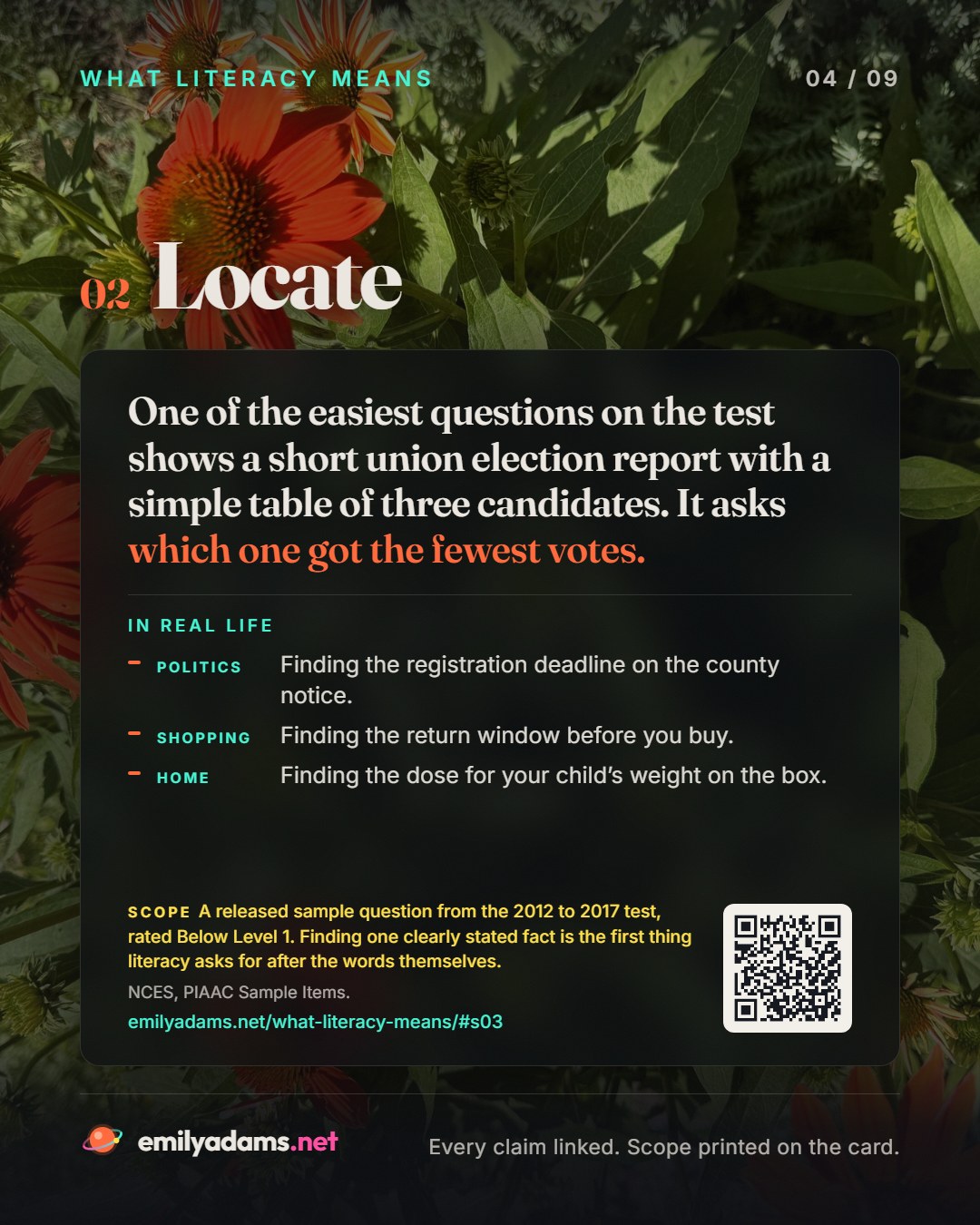
Locate. One of the easiest questions on the test shows a short union election report with a simple table of three candidates. It asks which one got the fewest votes.
  • PoliticsFinding the registration deadline on the county notice.
  • ShoppingFinding the return window before you buy.
  • HomeFinding the dose for your child’s weight on the box.
SCOPE A released sample question from the 2012 to 2017 test, rated Below Level 1. Finding one clearly stated fact is the first thing literacy asks for after the words themselves.
Sources and linksCard 4
Card 05 of 09
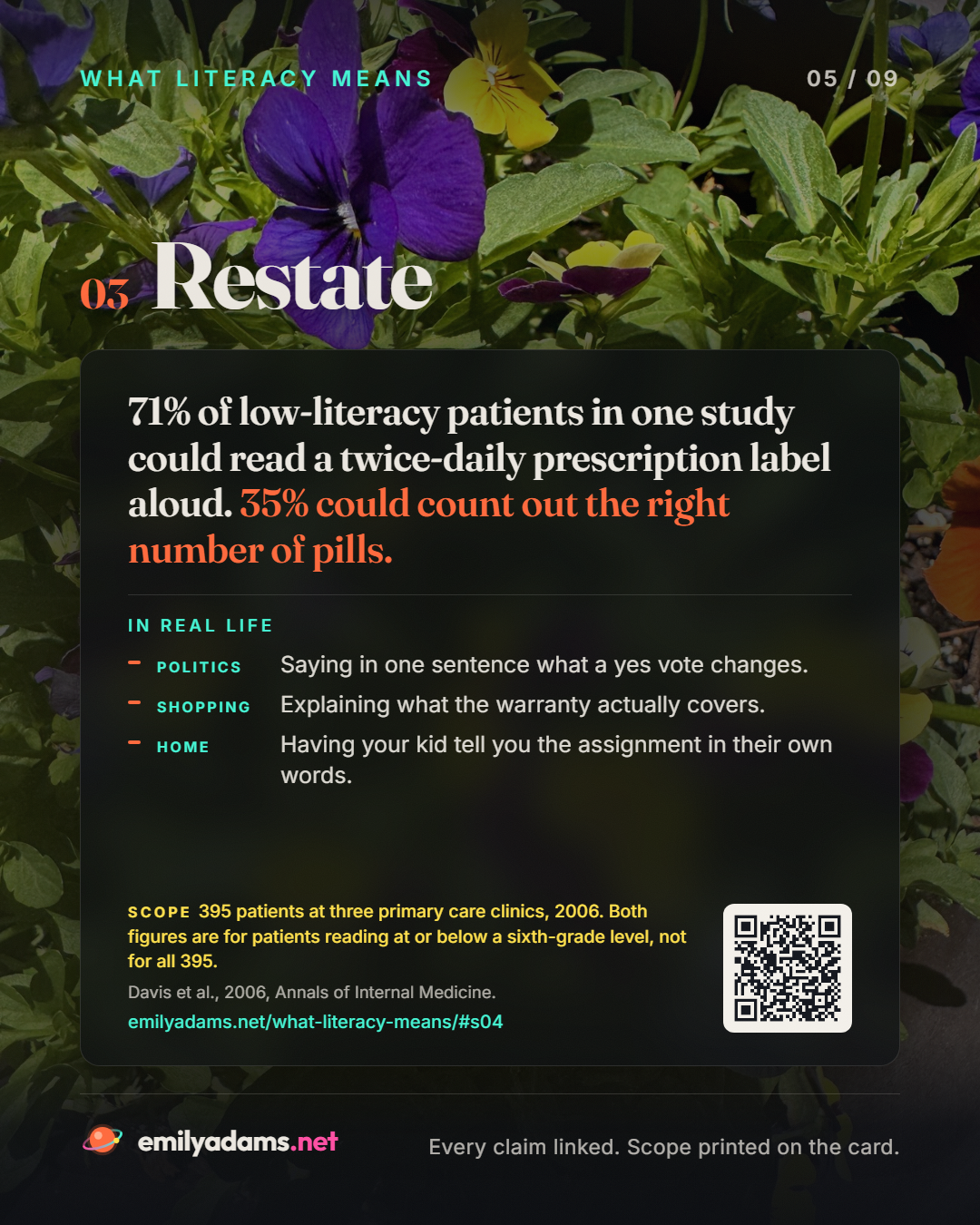
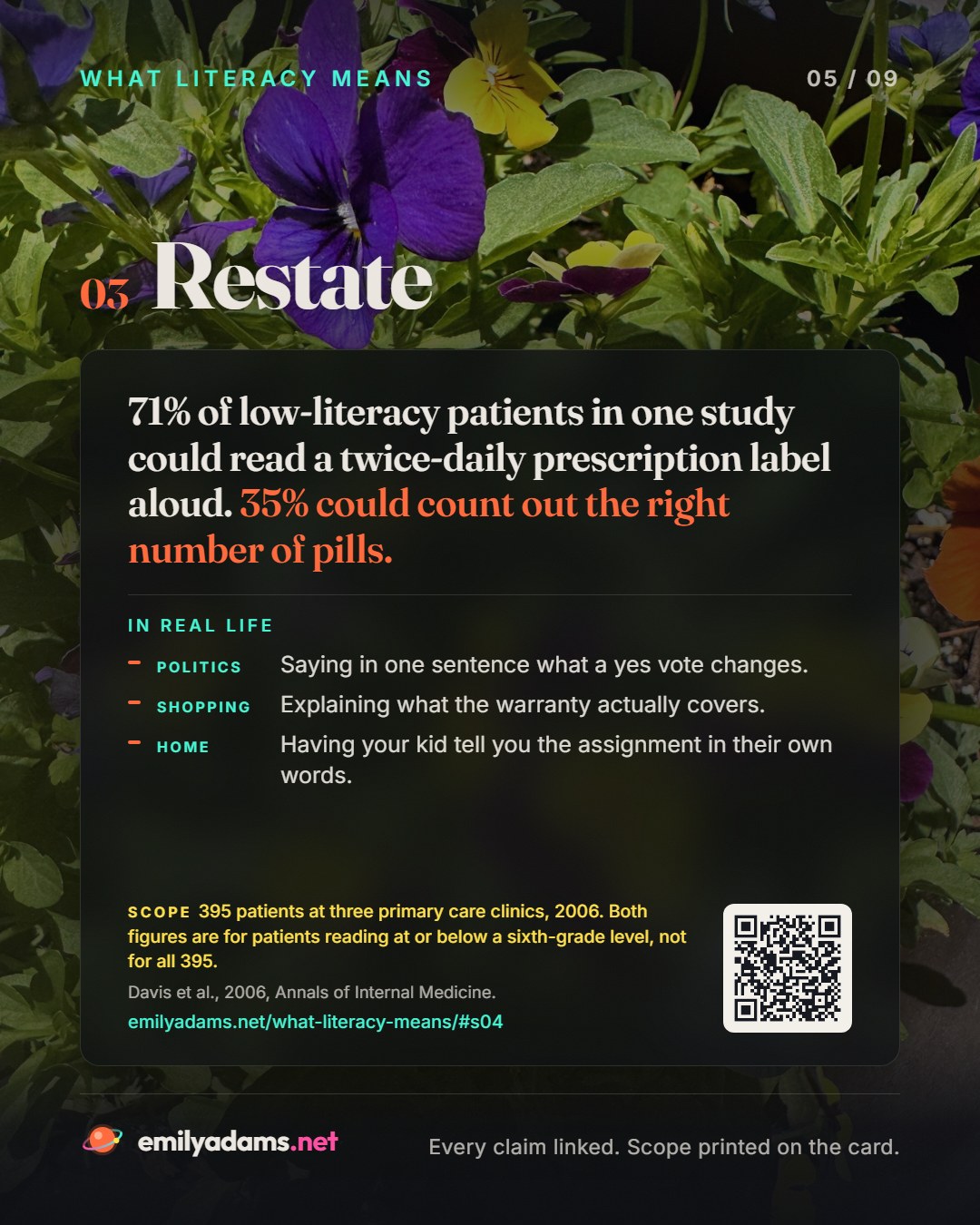
Restate. 71% of low-literacy patients in one study could read a twice-daily prescription label aloud. 35% could count out the right number of pills.
  • PoliticsSaying in one sentence what a yes vote changes.
  • ShoppingExplaining what the warranty actually covers.
  • HomeHaving your kid tell you the assignment in their own words.
SCOPE 395 patients at three primary care clinics, 2006. Both figures are for patients reading at or below a sixth-grade level, not for all 395.
Sources and linksCard 5
Card 06 of 09
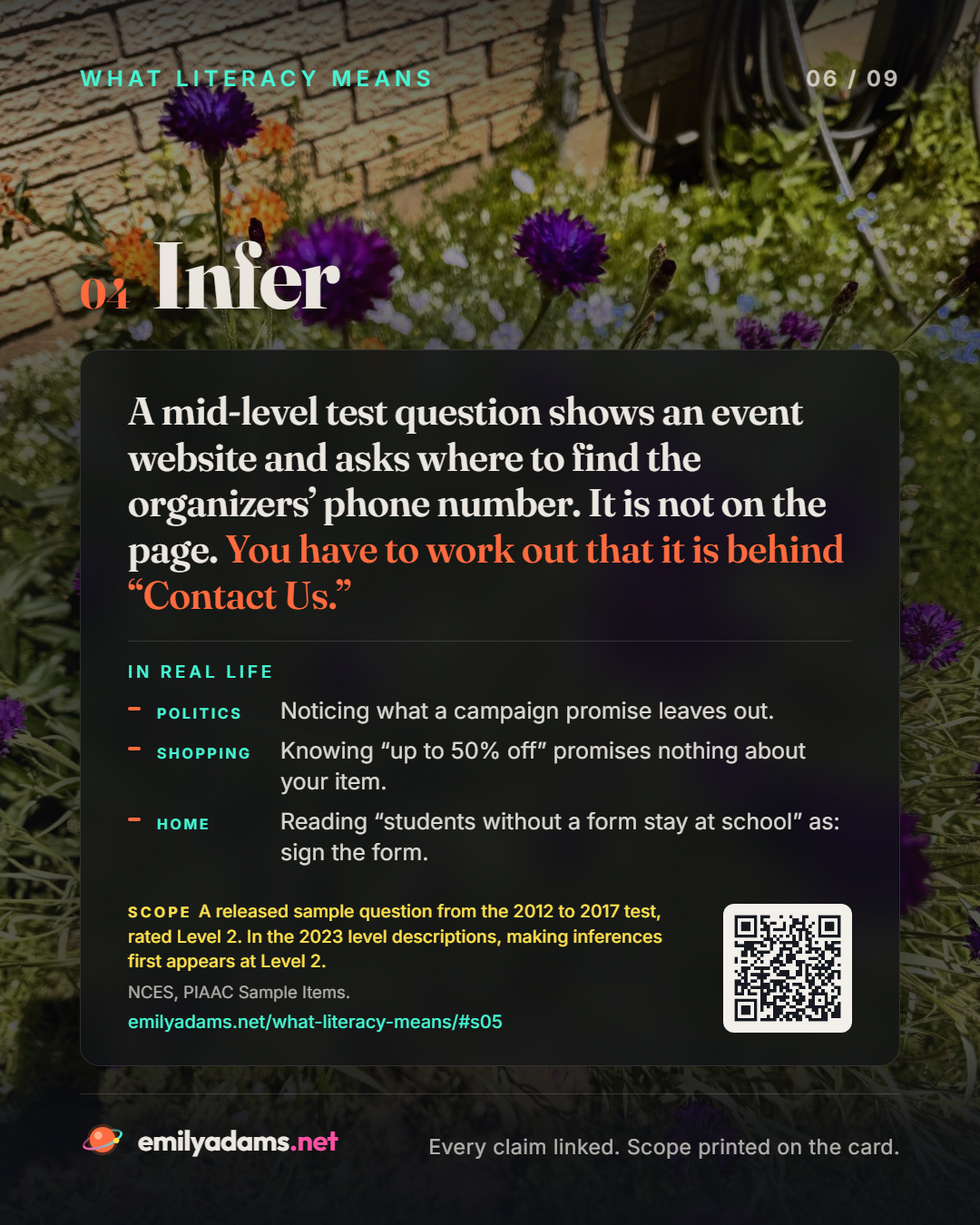
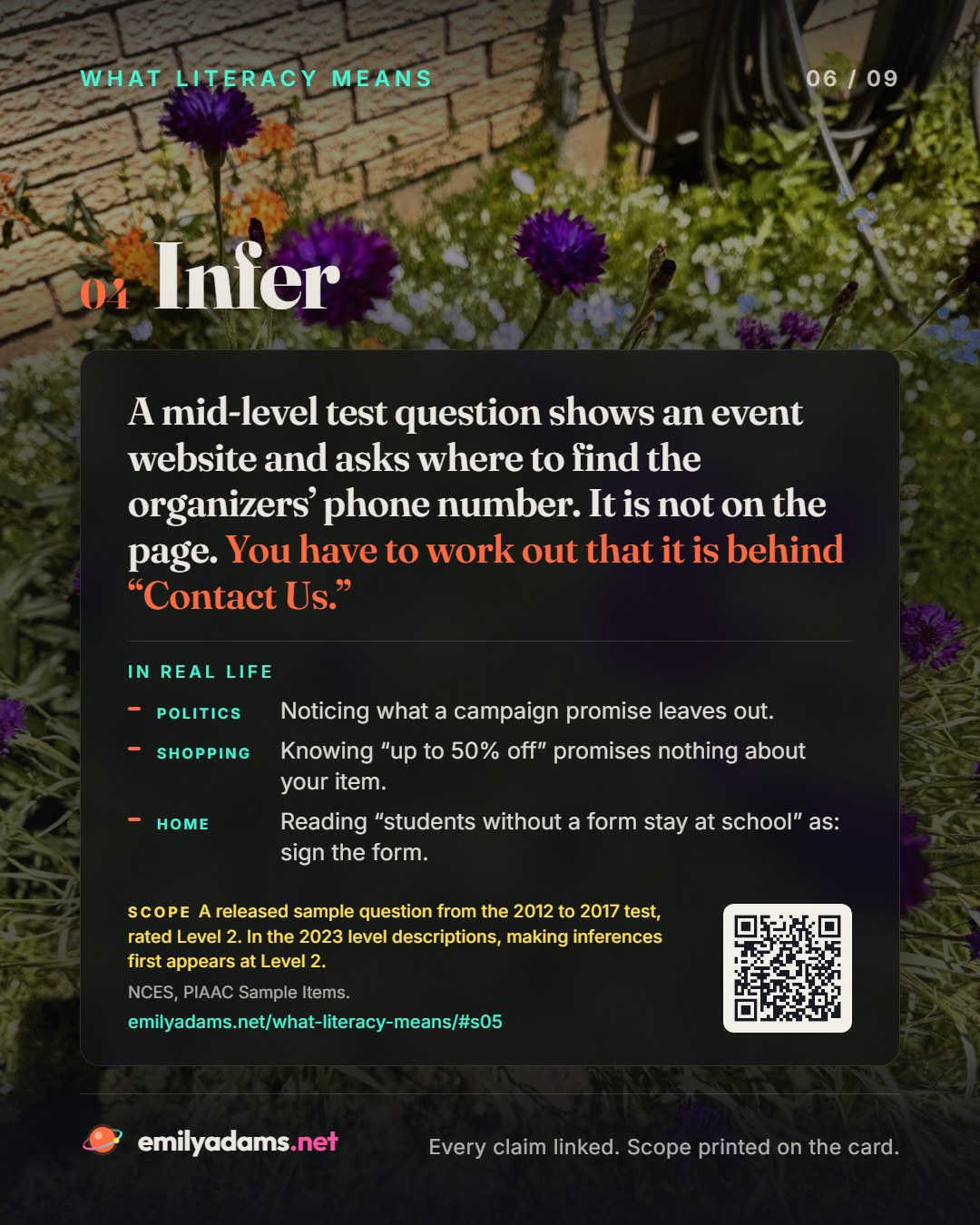
Infer. A mid-level test question shows an event website and asks where to find the organizers’ phone number. It is not on the page. You have to work out that it is behind “Contact Us.”
  • PoliticsNoticing what a campaign promise leaves out.
  • ShoppingKnowing “up to 50% off” promises nothing about your item.
  • HomeReading “students without a form stay at school” as: sign the form.
SCOPE A released sample question from the 2012 to 2017 test, rated Level 2. In the 2023 level descriptions, making inferences first appears at Level 2.
Sources and linksCard 6
Card 07 of 09
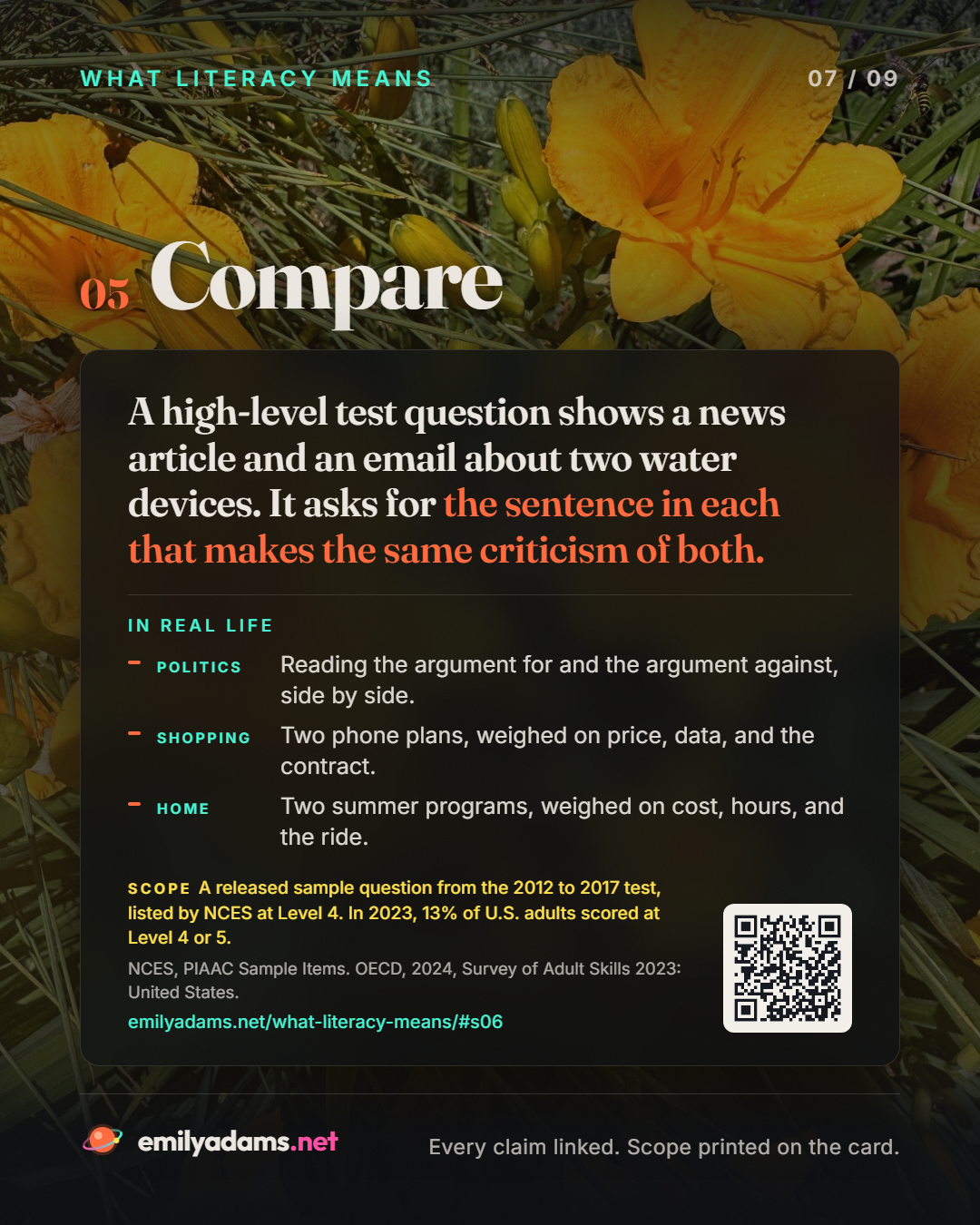
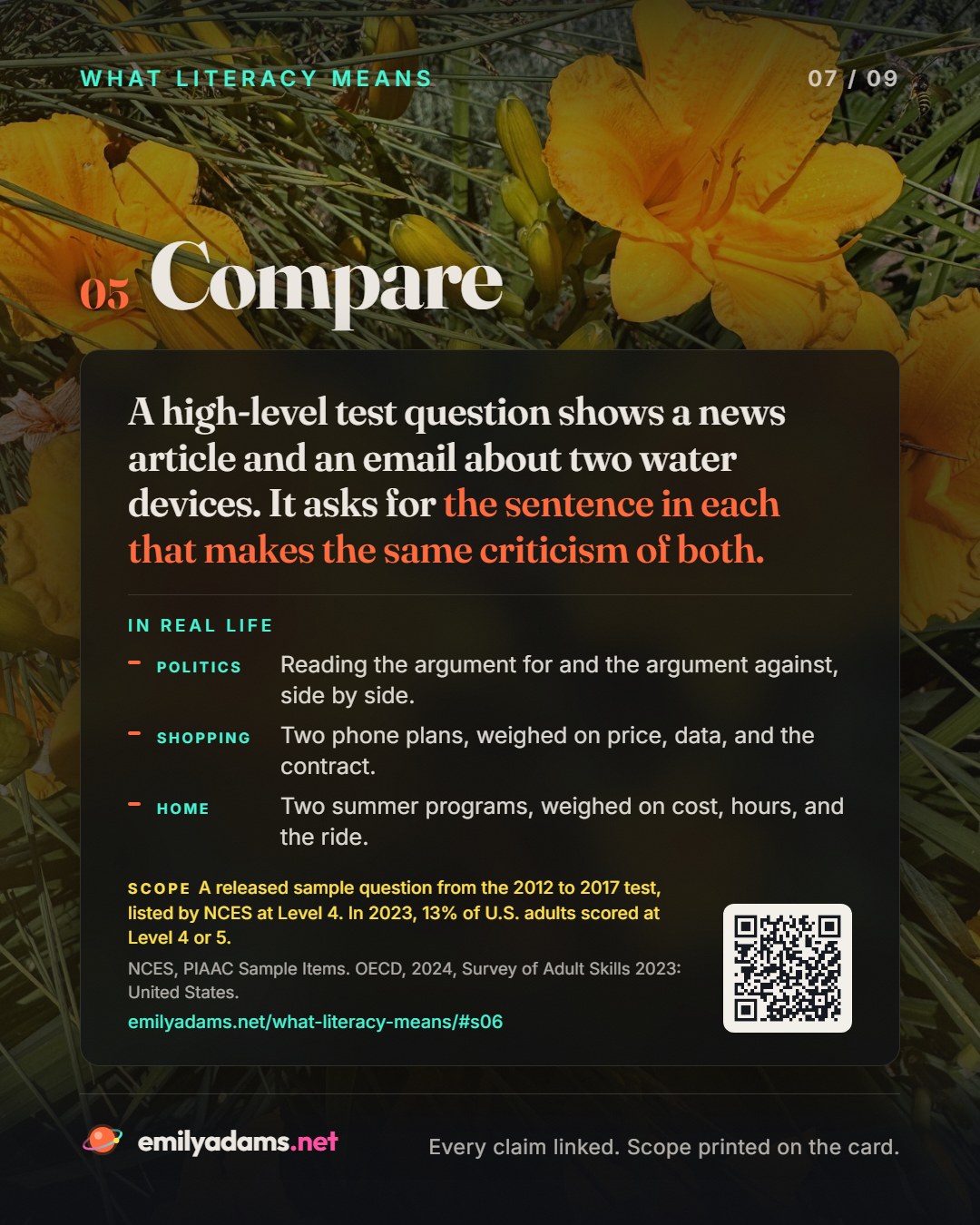
Compare. A high-level test question shows a news article and an email about two water devices. It asks for the sentence in each that makes the same criticism of both.
  • PoliticsReading the argument for and the argument against, side by side.
  • ShoppingTwo phone plans, weighed on price, data, and the contract.
  • HomeTwo summer programs, weighed on cost, hours, and the ride.
SCOPE A released sample question from the 2012 to 2017 test, listed by NCES at Level 4. In 2023, 13% of U.S. adults scored at Level 4 or 5.
Sources and linksCard 7
Card 08 of 09
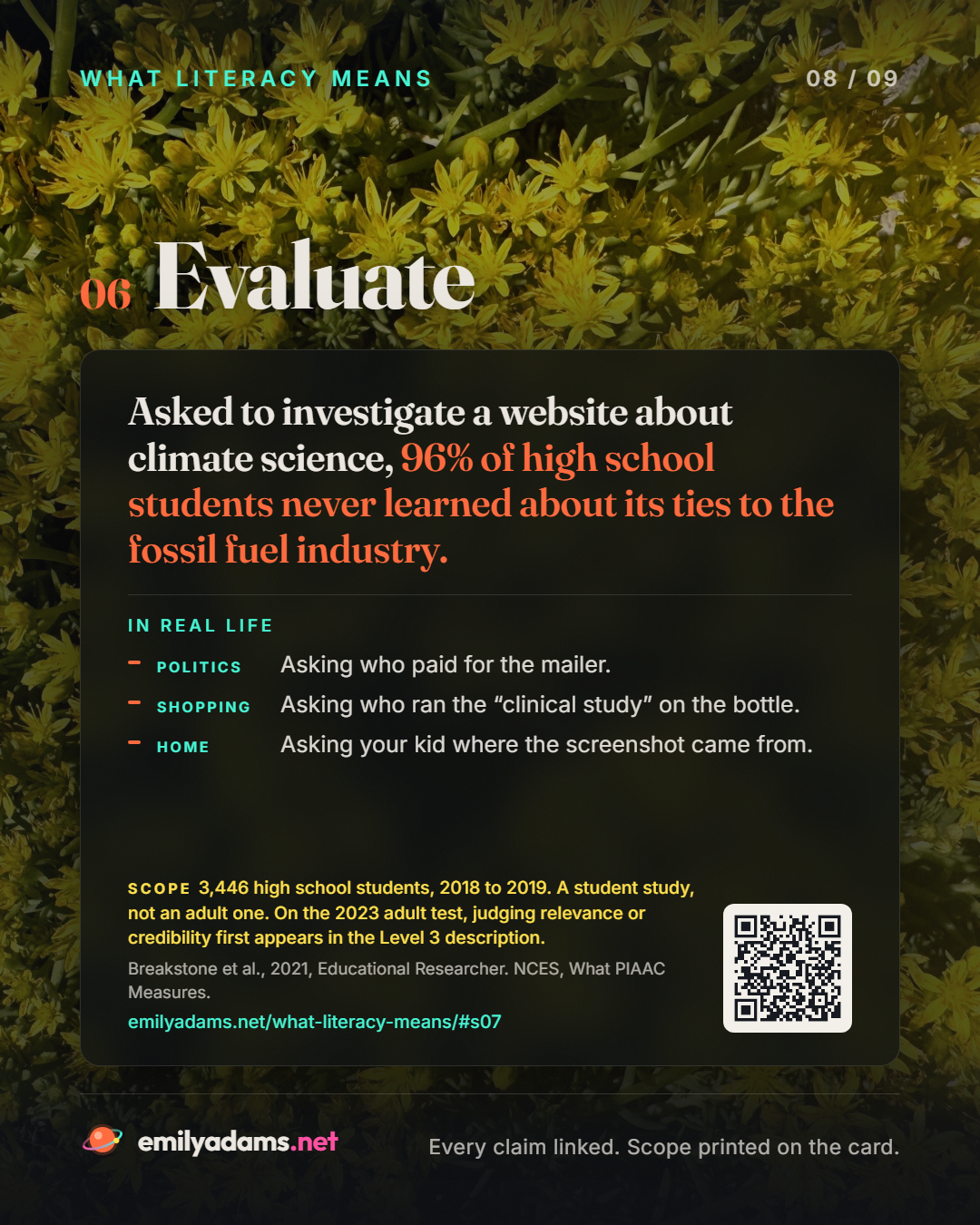
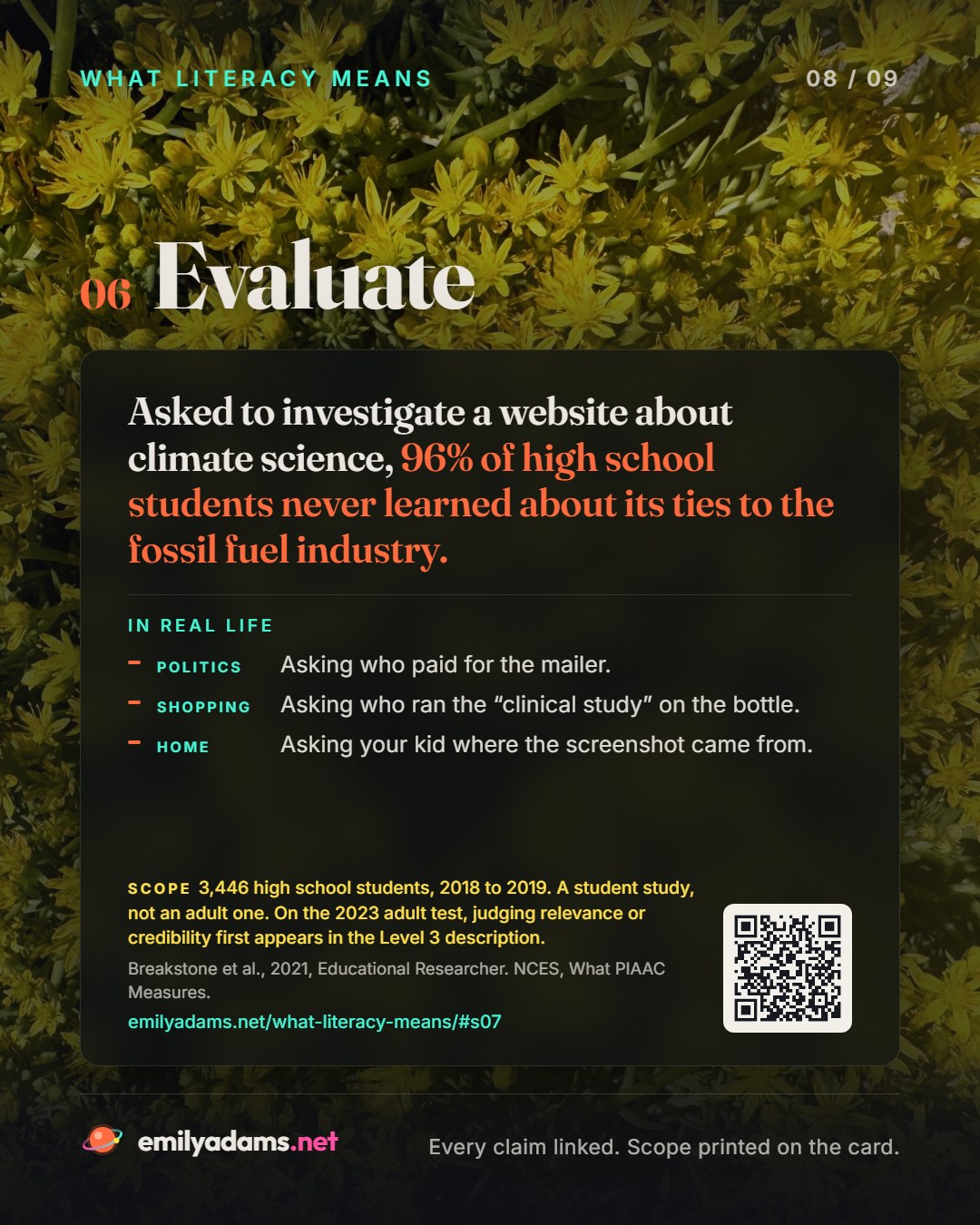
Evaluate. Asked to investigate a website about climate science, 96% of high school students never learned about its ties to the fossil fuel industry.
  • PoliticsAsking who paid for the mailer.
  • ShoppingAsking who ran the “clinical study” on the bottle.
  • HomeAsking your kid where the screenshot came from.
SCOPE 3,446 high school students, 2018 to 2019. A student study, not an adult one. On the 2023 adult test, judging relevance or credibility first appears in the Level 3 description.
Sources and linksCard 8
Card 09 of 09
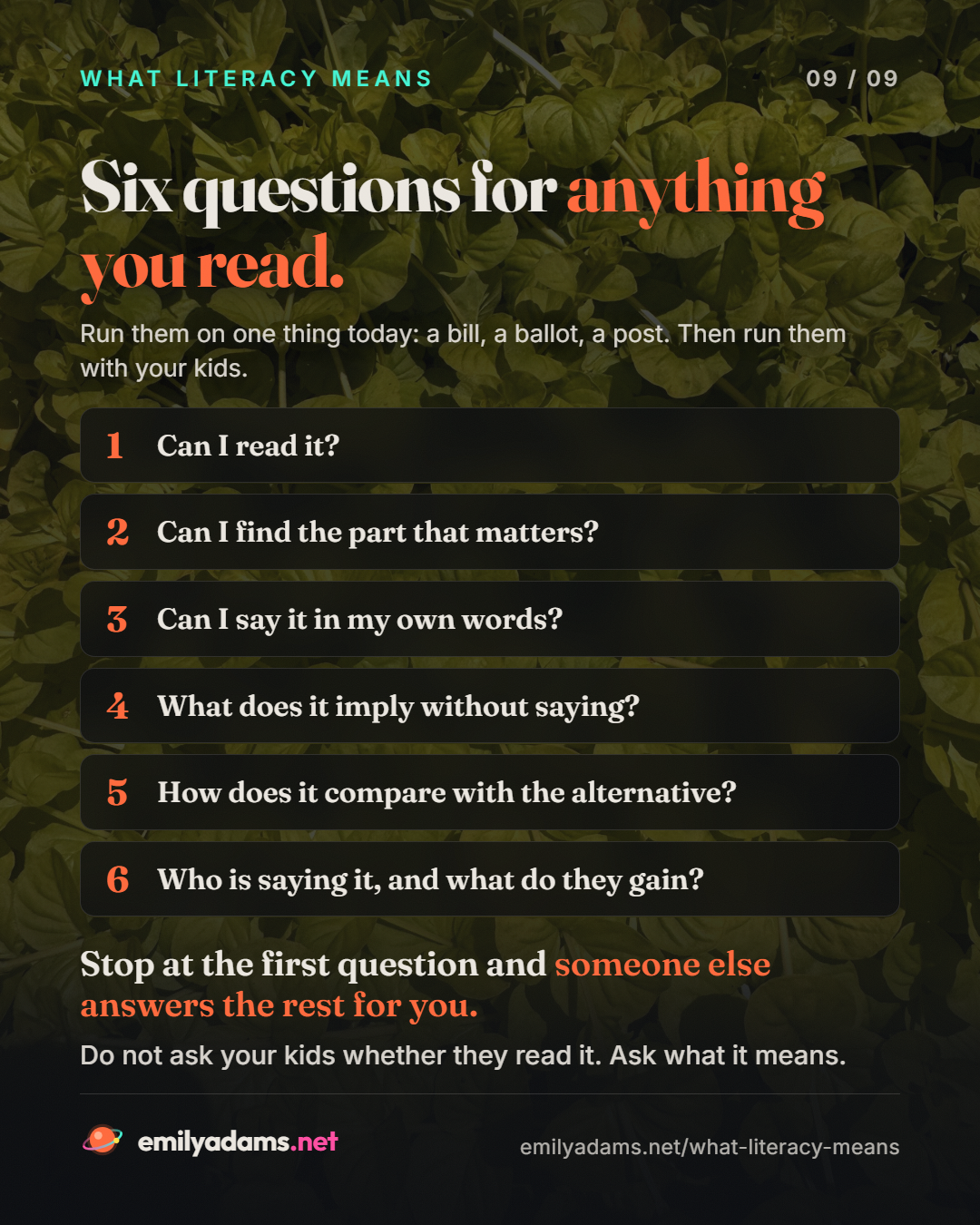
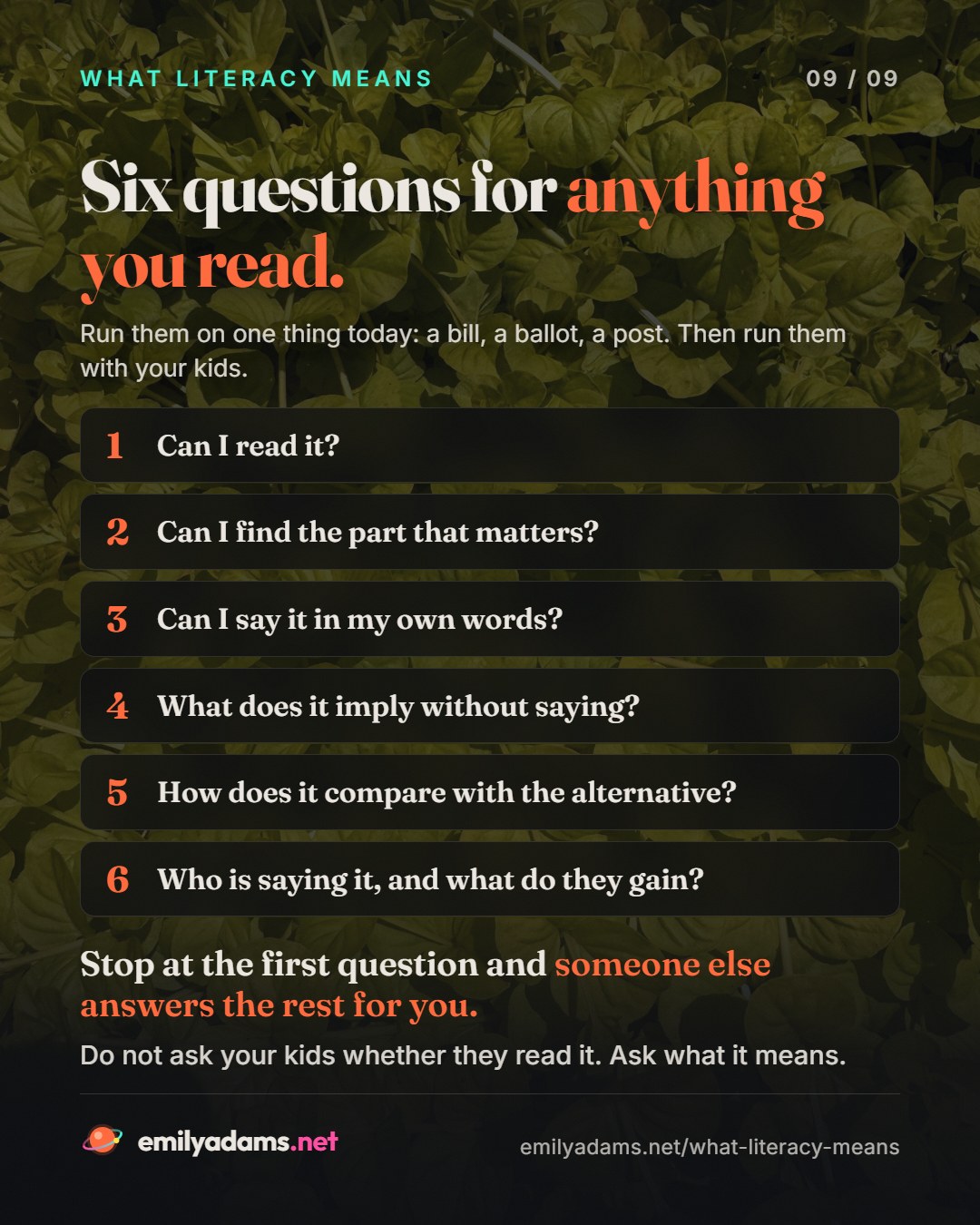
Six questions for anything you read.
  • Run them on one thing today: a bill, a ballot, a post. Then run them with your kids.
  • Can I read it?
  • Can I find the part that matters?
  • Can I say it in my own words?
  • What does it imply without saying?
  • How does it compare with the alternative?
  • Who is saying it, and what do they gain?
Stop at the first question and someone else answers the rest for you. Do not ask your kids whether they read it. Ask what it means.
What these cards cannot tell youCard 9
Closing card
Next: how literacy gets measured.
  • Part three is the scoring: the levels behind the headlines about adult literacy, what each one means, and where the country lands. Every source on these cards is linked, with its limits.
Closing card

The Sources

Grouped by card. Each source has a summary of what it says, a scope line saying how far it reaches, and a link to the original.

Card 2

The Definition

On card 2

What PIAAC Measures: Literacy

National Center for Education Statistics · NCES, U.S. Department of Education; the framework is the OECD’s for the 2023 Survey of Adult Skills

The Program for the International Assessment of Adult Competencies (PIAAC) is the OECD’s test of adult skills, given in the United States by NCES. Its 2023 framework defines literacy as accessing, understanding, evaluating and reflecting on written texts in order to achieve one’s goals, to develop one’s knowledge and potential and to participate in society. Of the 80 literacy questions in the test’s final pool, 38% ask adults to access information, 44% to understand it, and 19% to evaluate and reflect on it.

Scope  This is one test’s definition, written for adults ages 16 to 65 and for everyday texts. The percentages describe the mix of questions in the pool, not how adults performed, and they round to 101%.
Card 3

Decode

On card 3

What PIAAC Measures: Reading Components

National Center for Education Statistics · NCES, U.S. Department of Education

Alongside the main questions, the 2023 test includes two short reading-component tasks. In one, a single sentence appears and the adult says whether it makes sense. In the other, the adult reads a short article and picks, from two underlined words, the one that best completes each sentence. In 2023 these results are folded into the literacy scale, where they add precision at the low end; the sentence task is classified Below Level 1.

Scope  The cards call this step Decode. That is my label, not the test’s.
On card 3

Decoding, Reading, and Reading Disability

Gough and Tunmer, 1986 · Remedial and Special Education, 7(1), 6 to 10

The paper behind the “simple view of reading.” Its abstract puts the idea in one line: reading equals the product of decoding and comprehension. Because it is a product, strong decoding with weak comprehension still yields weak reading.

Scope  A theoretical model from research on children learning to read. I read the abstract, not the full paper. The card uses it only for the idea that decoding is necessary and not sufficient.
Card 4

Locate

On card 4

PIAAC Sample Items: Election Results

National Center for Education Statistics · NCES, released sample question from the 2012 to 2017 test, rated Below Level 1

The reader sees a short report of a union election with a simple table identifying the three candidates, and is asked which candidate received the fewest votes.

Scope  One released question, chosen by the test’s publishers to illustrate the easiest level. It is from the earlier version of the test.
Card 5

Restate

On card 5

Literacy and Misunderstanding Prescription Drug Labels

Davis and colleagues, 2006 · Annals of Internal Medicine, 145(12), 887 to 894

395 English-speaking adults at three primary care clinics were asked to read and explain prescription labels. Among patients reading at or below a sixth-grade level, 70.7% correctly stated the instruction to take two tablets by mouth twice daily, but 34.7% could show how many pills that meant in a day.

Scope  Both percentages are of the low-literacy group, not of all 395 patients. The clinics, in Shreveport, Jackson, and Chicago, served mostly indigent patients, and actual drug-taking was not measured.
Card 6

Infer

On card 6

PIAAC Sample Items: Lakeside Fun Run

National Center for Education Statistics · NCES, released sample question from the 2012 to 2017 test, rated Level 2

The reader sees a simulated website for a community fun run and is asked to identify the link that leads to the organizers’ phone number. The number is not on the opening page. The correct response is to choose Contact Us.

Scope  One released question from the earlier version of the test. The cards call the skill Infer. In the 2023 level descriptions, making inferences first appears at Level 2.
Card 7

Compare

On card 7

PIAAC Sample Items: The Level 4 Literacy Question

National Center for Education Statistics · NCES, released sample question from the 2012 to 2017 test, listed at Level 4

The reader sees a newspaper article and an email about two devices for getting clean water, and is asked to select one sentence in the article and one in the email that describe a criticism common to both devices.

Scope  One released question from the earlier version of the test, chosen to illustrate a high level. In the 2023 level descriptions, comparing pieces of information first appears at Level 3.
On card 7

Survey of Adult Skills 2023: United States

OECD, 2024 · OECD country note, December 10, 2024

In 2023, 13% of U.S. adults scored at Levels 4 or 5 in literacy, against an OECD average of 12%.

Scope  Adults ages 16 to 65. Part three of this series covers the levels in full.
Card 8

Evaluate

On card 8

Students’ Civic Online Reasoning: A National Portrait

Breakstone and colleagues, 2021 · Educational Researcher, 50(8), 505 to 515; first released as a Stanford History Education Group report in 2019

3,446 high school students, a sample matched to the national profile, completed six tasks. Asked to investigate a website that presented itself as a source of factual reports on climate science, 96% never learned about the organization’s ties to the fossil fuel industry. Two-thirds could not tell news stories from ads on a news site’s home page.

Scope  High school students tested from June 2018 to May 2019. The figures describe teenagers at that time, not adults and not current students.

What These Cards Cannot Tell You

The six skills are my arrangement. The test names three kinds of task: access, understand, and evaluate and reflect. It measures word-level reading separately. I split those into six steps because that is easier to teach and to practice. Restate and Infer both sit inside what the test calls understanding.
The test questions are from the earlier version. The sample questions described on the cards were released from the 2012 to 2017 test. The 2023 test uses the same scale with updated questions.
A sample question is an illustration. Each one was chosen by the test’s publishers to show what a level looks like. One question does not define a level, and a person at a level does not get every question at that level right.
The Evaluate finding is about teenagers. It comes from a study of high school students in 2018 and 2019. It is on the card because it shows the skill clearly, not because it measures adults.
The everyday lines are examples. The Politics, Shopping, and Home lines under each finding are situations where the skill shows up. They are illustrations, not findings.

Why I split one word into six.

When I say someone can read, I usually mean they can say the words on the page. For a long time I thought that was the same as being literate. It is not, and the people who measure literacy have never said it was.

Their definition has four verbs: accessing, understanding, evaluating, and reflecting. I broke those into six steps because I wanted something I could actually use at my own kitchen table. Can you read it. Can you find the part that matters. Can you say it in your own words. What does it imply. How does it compare. Who is saying it, and what do they gain.

Most of us stop somewhere in the middle and do not notice, because the words went by without any trouble. That is exactly the spot where a contract, a label, or a post can walk right past you.

It is my job to get further up that list, and it is my job to make sure my kids can too. Asking whether they read it tells me nothing. Asking them to tell me what it means tells me everything.