Grouped by card. Each source has a summary of what it says, a scope line saying how far it reaches, and a link to the original.
Card 3
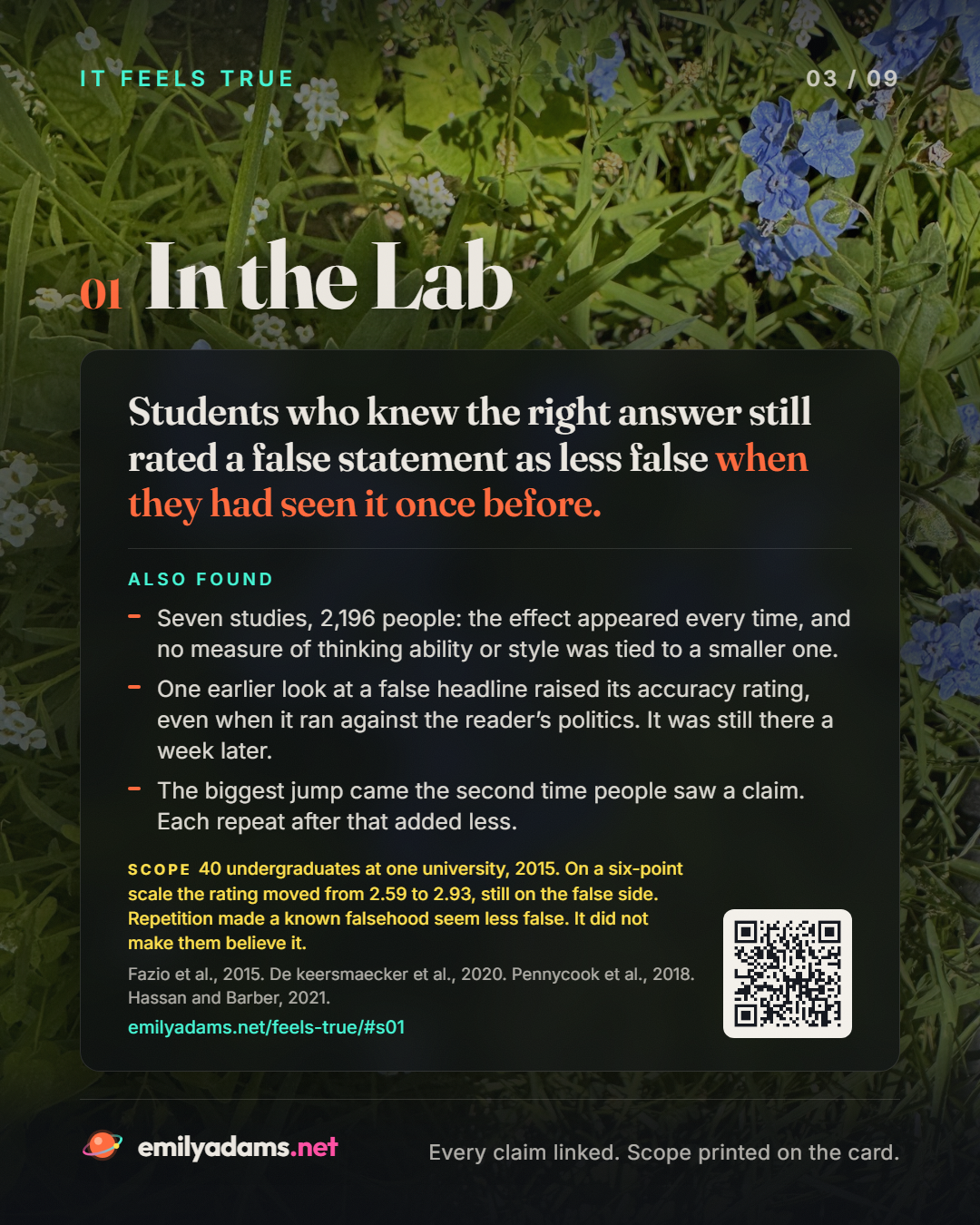
In the Lab
On card 3
Knowledge Does Not Protect Against Illusory Truth
Fazio, Brashier, Payne and Marsh, 2015 · Journal of Experimental Psychology: General, 144(5), 993 to 1002
Two experiments with 40 Duke University undergraduates each. Students first read a set of statements and rated how interesting each one was, then rated a larger set for truth on a six-point scale, then took a knowledge check. False statements they had read earlier were rated as more likely to be true than new ones, including statements that contradicted answers the same students got right on the knowledge check. One example in the paper is a statement that a sari is the short pleated skirt worn by Scots.
Scope Two samples of 40 students at one university. The shift is small: for falsehoods the students demonstrably knew were false, the average rating moved from 2.59 to 2.93 on a scale where 3 means possibly false. Knowing the answer still mattered far more than repetition did. The card says repetition made a known falsehood seem less false. It does not say anyone came to believe it.
On card 3
Investigating the Robustness of the Illusory Truth Effect Across Individual Differences in Cognitive Ability, Need for Cognitive Closure, and Cognitive Style
De keersmaecker and colleagues, 2020 · Personality and Social Psychology Bulletin, 46(2), 204 to 215
Seven studies with a combined 2,196 participants. Every study showed the effect, and the authors found no evidence that any of the cognitive measures they tested changed its size. Those measures included intelligence tests, the need for quick and firm answers, and a preference for intuitive or deliberate thinking.
Scope Cognitive ability itself was measured in three of the seven studies, with 606 participants. The finding is no relationship in either direction, which is not proof that no difference exists. All participants lived in Western countries, and six of the seven samples were online workers.
On card 3
Prior Exposure Increases Perceived Accuracy of Fake News
Pennycook, Cannon and Rand, 2018 · Journal of Experimental Psychology: General, 147(12), 1865 to 1880
Three online studies using real false and true news headlines shown in a social media format. Seeing a false headline once raised its later accuracy rating: 1.77 against 1.65 on a four-point scale in the second study, with 949 participants. The effect held for headlines that ran against the reader’s politics and was still present one week later.
Scope The effects are small and belief stayed low: false headlines averaged under 2 on a scale where 4 is very accurate. The paper found no effect for statements almost everyone knows are absurd; a 2019 paper by some of the same authors disputes that limit.
On card 3
The Effects of Repetition Frequency on the Illusory Truth Effect
Hassan and Barber, 2021 · Cognitive Research: Principles and Implications, 6, article 38
Two experiments showed statements between 1 and 27 times, then asked for truth ratings a week later. Ratings kept rising with more repetitions, but the largest jump came from the second encounter, with smaller gains after that.
Scope Small analyzed samples of 51 and 57 online participants, after many dropped out between sessions. Trivia statements only. The gains shrink, but the authors do not report a ceiling.
On card 1
Frequency and the Conference of Referential Validity
Hasher, Goldstein and Toppino, 1977 · Journal of Verbal Learning and Verbal Behavior, 16(1), 107 to 112
The study usually credited with first measuring the effect. Participants rated how sure they were that each of 60 statements was true or false across several sessions, and rated validity rose for the statements that repeated.
Scope I read the abstract, not the paper, so the cards use it only for the date.
On card 1
Systematic Review and Meta-Analysis of the Evidence for an Illusory Truth Effect and Its Determinants
Ye and colleagues, 2026 · Nature Communications, 17, article 3270
A synthesis of 182 studies and 31,184 participants, published between 1977 and 2025. After correcting for the tendency of small studies to report larger effects, the pooled effect was g = 0.37, which the authors describe as small, with results varying a good deal from study to study.
Scope I read the abstract, not the full paper.
Card 4
The New Name
On card 4
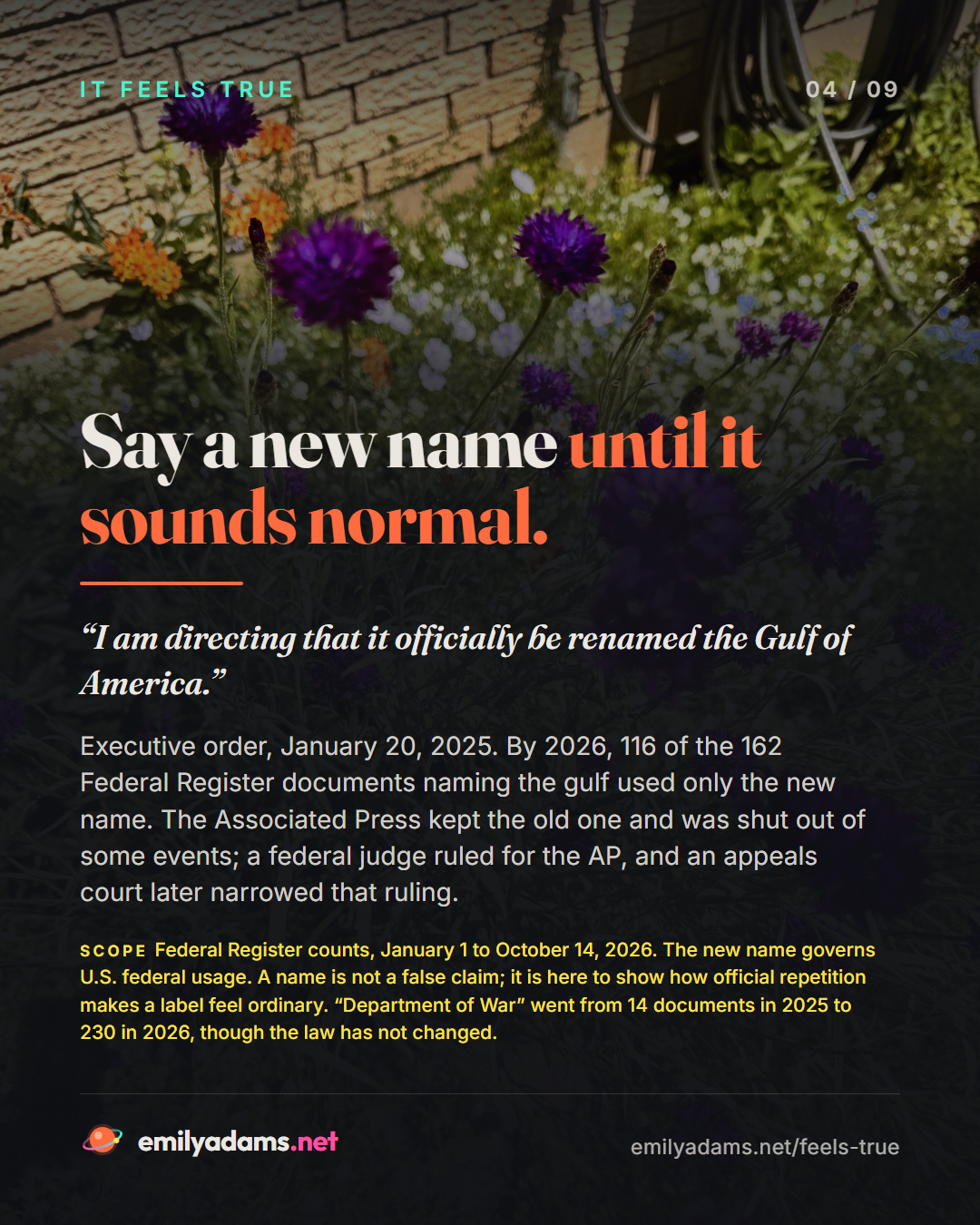
Restoring Names That Honor American Greatness
Executive Order 14172, 2025 · Signed January 20, 2025. Federal Register, 90 FR 8629
Section 4: “I am directing that it officially be renamed the Gulf of America.” The order directs guidance to ensure all federal references use the new name, including agency maps, contracts, documents, and communications. A proclamation declaring “Gulf of America Day” followed on February 9, 2025.
Scope The order applies to the area of the U.S. continental shelf out to the boundary with Mexico and Cuba. It governs U.S. federal usage; other countries are not bound by it.
On card 4
How Often Each Name Appears in Federal Documents
Federal Register counts, 2025 and 2026 · Exact-phrase searches of the Federal Register public database, run October 14, 2026
January 20 to December 31, 2025: 73 documents used only “Gulf of America,” 62 used both names, and 44 used only “Gulf of Mexico.” January 1 to October 14, 2026: 116 used only the new name, 29 used both, and 17 used only the old one. For comparison, “Gulf of Mexico” appeared in 262 documents in the same months of 2024.
Scope A count of documents, not of mentions. The search was run by my research assistant against the public database; anyone can repeat it with the link.
On card 4
Associated Press v. Budowich
U.S. District Court, 2025 · U.S. District Court for the District of Columbia, No. 1:25-cv-00532, memorandum order of April 8, 2025, Judge Trevor N. McFadden
The White House limited the Associated Press’s access after it kept using “Gulf of Mexico.” A deputy chief of staff wrote that the AP “continues to ignore the lawful geographic name change.” The judge granted the AP a preliminary injunction, writing that the government cannot shut doors to journalists “because of their viewpoints.”
Scope In June 2025 the D.C. Circuit stayed the injunction for the Oval Office, Air Force One, and similar restricted spaces, leaving it in place for larger events. I found no final ruling on the merits.
Background context
Restoring the United States Department of War
Executive Order 14347, 2025 · Signed September 5, 2025. Federal Register, 90 FR 43893; Military Times, June 11, 2026
The order authorizes “Department of War” as an “additional secondary title” for the Department of Defense. The name appeared in 14 Federal Register documents in 2025 and 230 in 2026 through October 14. Military Times reported in June 2026 that the legal name remains the Department of Defense until Congress acts.
Scope Congress has moved toward making the name official; check its status before repeating the card’s line about the law.
Card 5
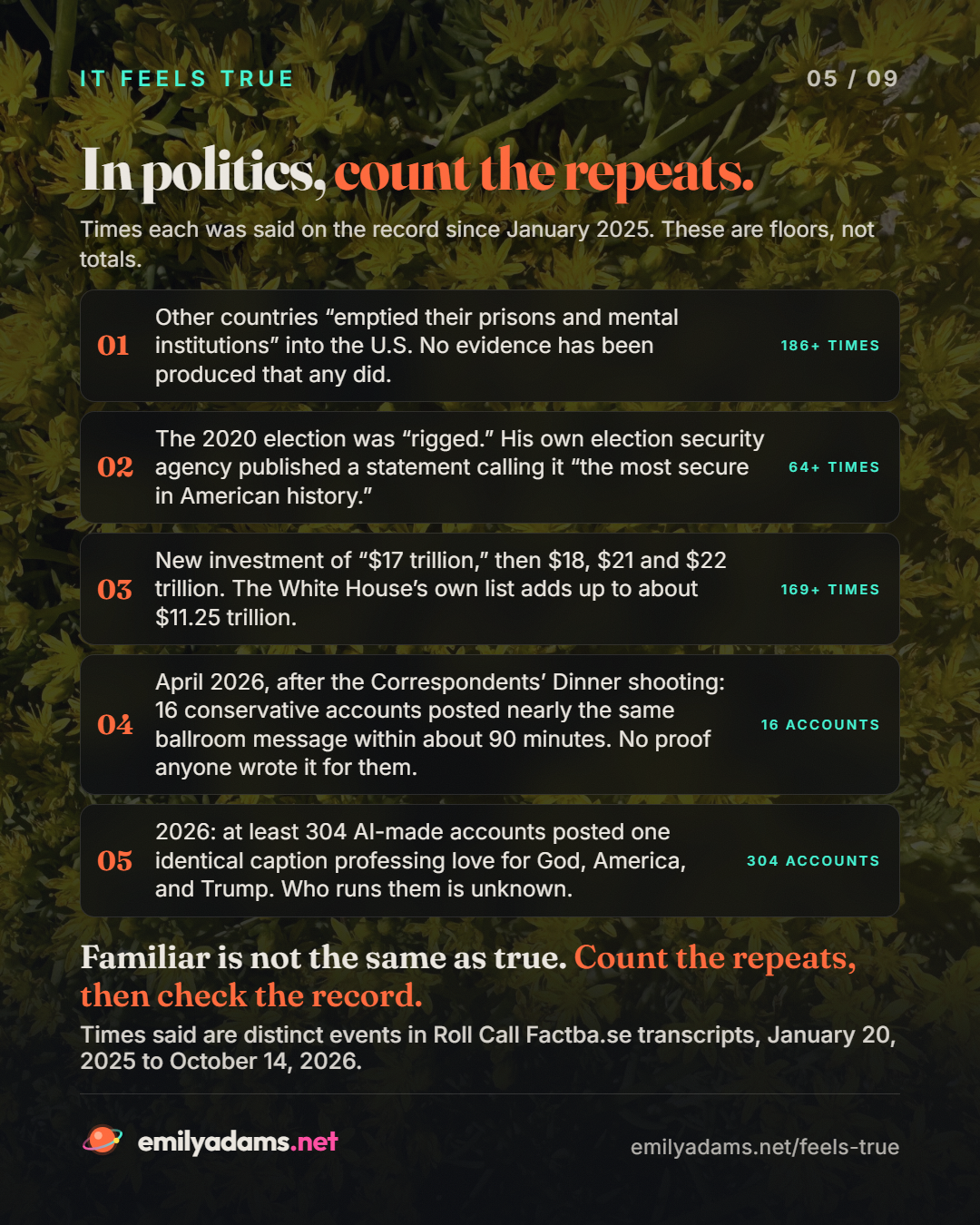
Count the Repeats
On card 5
How the Counts Were Made
Roll Call Factba.se, 2025 and 2026 · Searches of Roll Call Factba.se transcripts and its Truth Social archive, run October 14, 2026
Factba.se publishes searchable transcripts of the president’s speeches, interviews, and remarks. For each claim, my research assistant counted distinct events, January 20, 2025 to October 14, 2026, where he said the key words in a passage on that topic. The prisons claim appeared at least 186 times (66 in 2026). The rigged-election claim, at least 64 times (30 in 2026). The investment figure, at least 169 times (96 in 2026).
Scope These are floors, not totals: not every appearance is transcribed, and keyword filters can miss a passage or admit a stray one. A count of events is not a count of times the words were spoken.
On card 5
“Emptied Their Prisons and Mental Institutions”
PolitiFact, 2024; CNN, 2025 · PolitiFact (Maria Ramirez Uribe), November 4, 2024; CNN (Daniel Dale), December 27, 2025
PolitiFact rated the claim that countries are emptying their prisons into the United States Pants on Fire: “There is no evidence this is happening.” CNN’s Daniel Dale listed it among the president’s most repeated false claims of 2025 and reported that no proof was ever produced. Recent examples, from transcripts: June 10, 2026, “jails and mental institutions from all over the world were emptied out”; June 23, 2026, “Some of the countries had no prison population left.”
Scope This is no evidence, not proof of the opposite: no one can show that no released prisoner ever crossed a border. The card says no evidence has been produced.
On card 5
The 2020 Election
CISA, 2020; PolitiFact, 2026 · Joint statement published by the Cybersecurity and Infrastructure Security Agency, November 12, 2020; PolitiFact, September 29, 2026; NPR, February 10, 2026
The joint statement of the federal and state election infrastructure councils, published by the president’s own election security agency in his first term, began: “The November 3rd election was the most secure in American history.” Biden won 306 electoral votes to 232. In 2026 the FBI took more than 650 boxes of 2020 material from Fulton County, Georgia; NPR’s review of the state’s files found one of the search affidavit’s five claims partially substantiated, and a 2024 state report said the problems found did not affect the accuracy of the results.
Scope Foreign influence efforts and isolated administrative errors in 2020 are documented. What the record contradicts is that the outcome was changed. The president says new evidence is coming.
On card 5
“$17 Trillion” to “$22 Trillion” in New Investment
The White House; PolitiFact, 2026 · whitehouse.gov/investments, read October 14, 2026; PolitiFact, September 29, 2026
The figure he gives has climbed from $17 trillion in 2025 to $21 and $22 trillion in September 2026. The White House’s own investments page lists 277 commitments; added up, they come to about $11.25 trillion. PolitiFact rated “$22 trillion coming into this country” False and noted that even the White House list includes multi-year goals and pledges that may not happen.
Scope The sum is my research assistant’s addition of the page’s own list. Pledged investment is hard to verify even at the lower figure; the card shows only the gap between the spoken number and the government’s own list.
On card 5
Conservative Accounts Posted Nearly the Same Ballroom Message
Snopes, 2026 · Snopes (Joey Esposito), April 29, 2026, rated True; The Washington Post, April 27, 2026
After the shooting at the White House Correspondents’ Dinner on April 25, 2026, Snopes documented 16 accounts posting essentially the same message about building the White House ballroom within about 90 minutes, from 9:28 to 10:55 p.m. Eastern. The wording was similar, not identical, for example “That White House Ballroom Is Looking Better and Better” and “BUILD the WHITE HOUSE BALLROOM NOW!”
Scope Snopes found no direct evidence of coordination or payment. One commentator alleged that influencers are paid and coordinate in group chats; that is an allegation, and one conservative commentator said publicly that no one has ever paid her to post. The card says no proof anyone wrote it for them.
On card 5
Hundreds of AI Avatar Accounts with One Caption
The New York Times, 2026 · The New York Times (Tiffany Hsu), April 17, 2026, as carried by the Hawaii Tribune-Herald
The Times tracked at least 304 TikTok accounts with AI-generated faces, all using the same caption professing love for God, America, and Trump, plus more found by researchers on other platforms. Experts could not say who was behind them. The Republican National Committee said it was not involved.
Scope These are AI-made accounts, not real influencers, and their operator is unknown.
Card 6
At the Store
On card 6
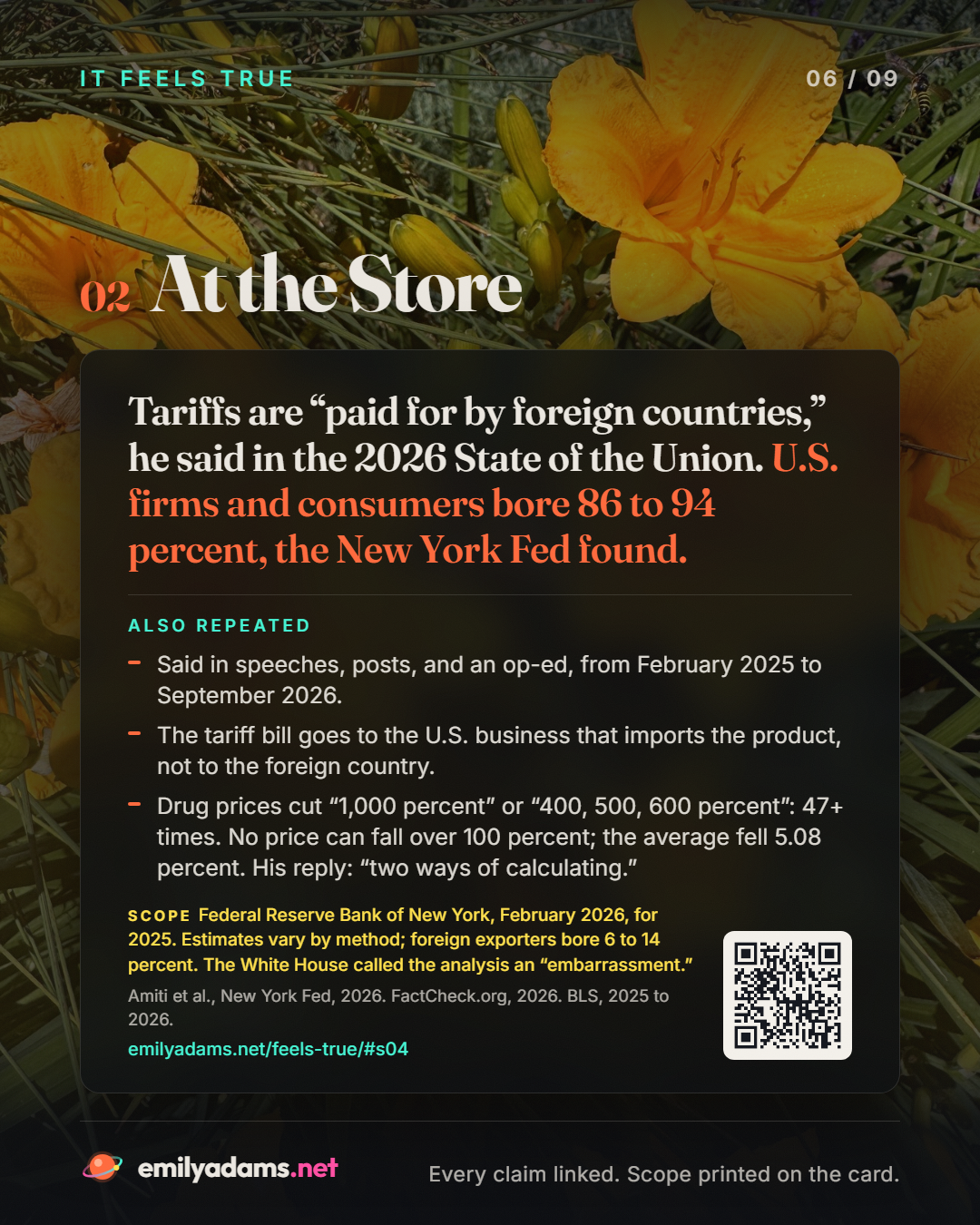
Who Is Paying for the 2025 U.S. Tariffs?
Amiti, Flanagan, Heise and Weinstein, 2026 · Liberty Street Economics, Federal Reserve Bank of New York, February 12, 2026
Economists at the New York Fed estimated the share of the 2025 tariffs borne by U.S. firms and consumers: 94 percent from January to August, 92 percent in September and October, and 86 percent in November. Foreign exporters bore 6, 8, and 14 percent. Their conclusion: “U.S. firms and consumers continue to bear the bulk of the economic burden.”
Scope Estimates vary by method and period, so the card says 86 to 94 percent, not all of it. The White House’s economic adviser called the analysis an “embarrassment,” as quoted by FactCheck.org.
On card 6
FactChecking Trump’s State of the Union Address
FactCheck.org, 2026 · FactCheck.org, February 25, 2026
In the State of the Union on February 24, 2026, the president described “the tariffs, paid for by foreign countries.” FactCheck.org reported that many economists dispute this and cited the New York Fed work. It also found “no evidence of a broad decrease in U.S. drug prices.” The same claim about tariffs appears in transcripts and posts from February 2025 through September 2026, and in an op-ed published under his name on January 30, 2026.
Scope The Supreme Court struck down the emergency tariffs on February 20, 2026; new tariffs under other laws followed. The card is about who pays, not about which tariffs are in force.
On card 6
Consumer Price Index: Prescription Drugs
Bureau of Labor Statistics, 2025 and 2026 · U.S. city average, not seasonally adjusted, series CUUR0000SEMF01
The index for prescription drugs was 572.655 in January 2025 and 543.556 in September 2026, a fall of 5.08 percent. The president has said drug prices are being cut by “1,000 percent” or by “400, 500, 600 percent” in at least 47 events since July 2025. Since January 2026 he has said there are “two ways of calculating.” His own example in May 2026, a drug that went from $966 to $168, is a cut of 82.6 percent; the old price was 475 percent higher than the new one.
Scope Specific drugs under the new deals did fall sharply. The index is an average across all prescriptions, so the card says the average fell about 5 percent, not that no prices fell.
Card 7
At Home
On card 7
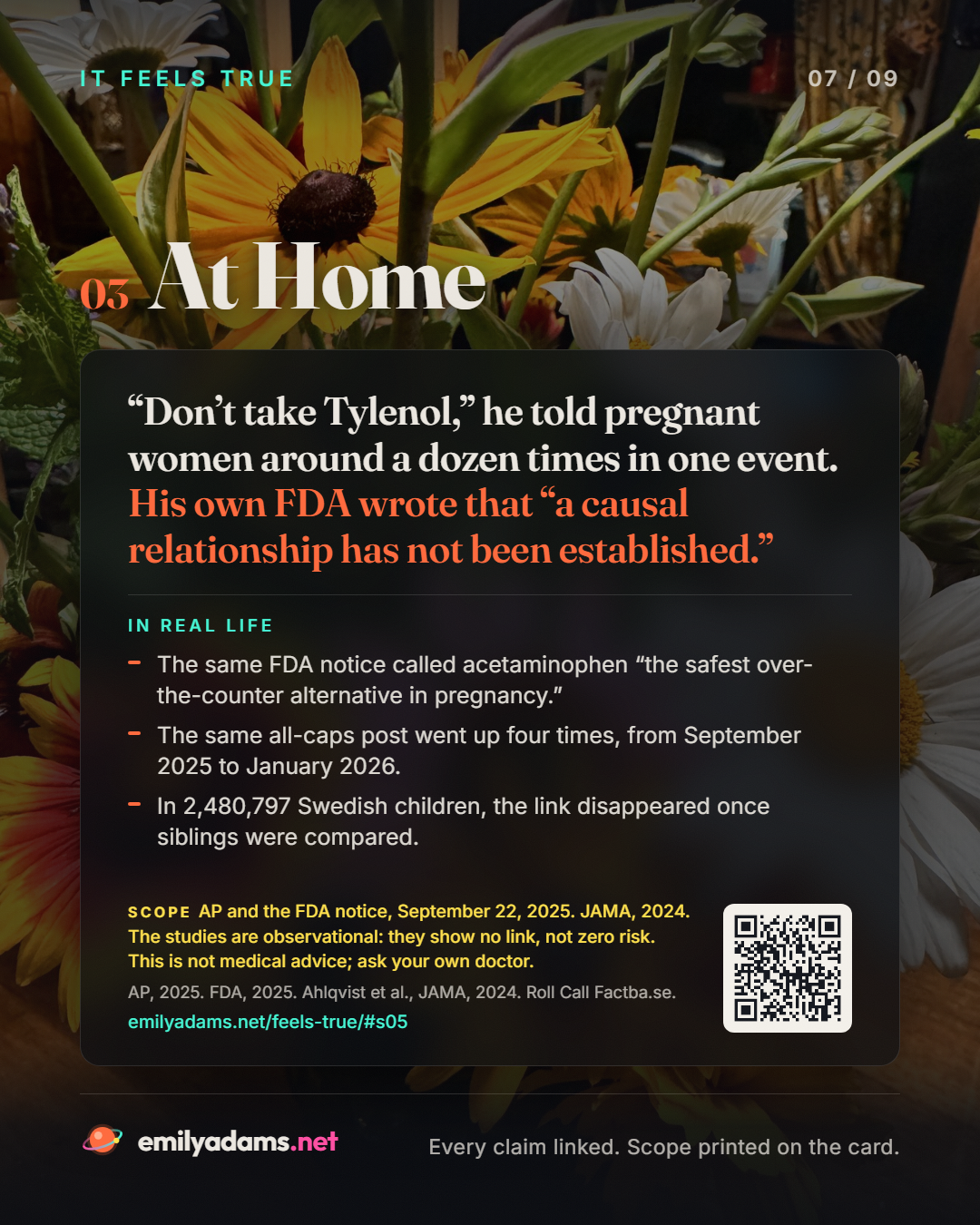
Trump Administration Suggests Tylenol During Pregnancy Causes Autism, a Link Experts Say Is Unproven
Associated Press, 2025 · Associated Press (Ali Swenson and Amanda Seitz), September 22, 2025, as carried by the Anchorage Daily News
At a White House event on September 22, 2025, the president told pregnant women “Don’t take Tylenol” around a dozen times, AP reported. Experts called the link unproven. The press secretary said the administration does not believe “popping more pills is always the answer.” The same all-caps post, word for word, was published or reposted on his account four times between September 26, 2025 and January 5, 2026.
Scope AP’s count is approximate. My research assistant’s count of the exact words in the official transcript was 11.
On card 7
Notice to Physicians on the Use of Acetaminophen During Pregnancy
U.S. Food and Drug Administration, 2025 · FDA, September 22, 2025, signed by Commissioner Martin A. Makary
The notice asks clinicians to consider minimizing acetaminophen for routine low-grade fevers in pregnancy. It also says “a causal relationship has not been established,” that “there are contrary studies in the scientific literature,” and that acetaminophen “is the safest over-the-counter alternative in pregnancy.”
Scope The FDA said it had started the process for a label change. The notice is guidance to doctors, not a finding that the drug causes autism.
On card 7
Acetaminophen Use During Pregnancy and Children’s Risk of Autism, ADHD, and Intellectual Disability
Ahlqvist and colleagues, 2024 · JAMA, 331(14), 1205 to 1214
2,480,797 children born in Sweden from 1995 to 2019, of whom 185,909 were exposed to acetaminophen before birth. Without comparing siblings, there was a slight association with autism (hazard ratio 1.05). Comparing siblings, which accounts for shared family factors, there was none (0.98). The authors concluded that earlier associations may have come from family factors, not the drug.
Scope Observational data: it shows no detectable link, not zero risk. One author reported fees from law firms. This is not medical advice; ask your own doctor.
Background context
The CDC’s Autism and Vaccines Page
CDC, 2026; Hviid and colleagues, 2019 · cdc.gov, last updated July 22, 2026; Annals of Internal Medicine, 170(8), 513 to 520
The CDC’s page now opens by calling the statement “vaccines do not cause autism” not evidence-based. A study of 657,461 Danish children found no increased autism risk for children who received the MMR vaccine (hazard ratio 0.93).
Scope Background for card 7; not on the card. The study is one of many the page now sets aside.
Card 8
What Helps
On card 8
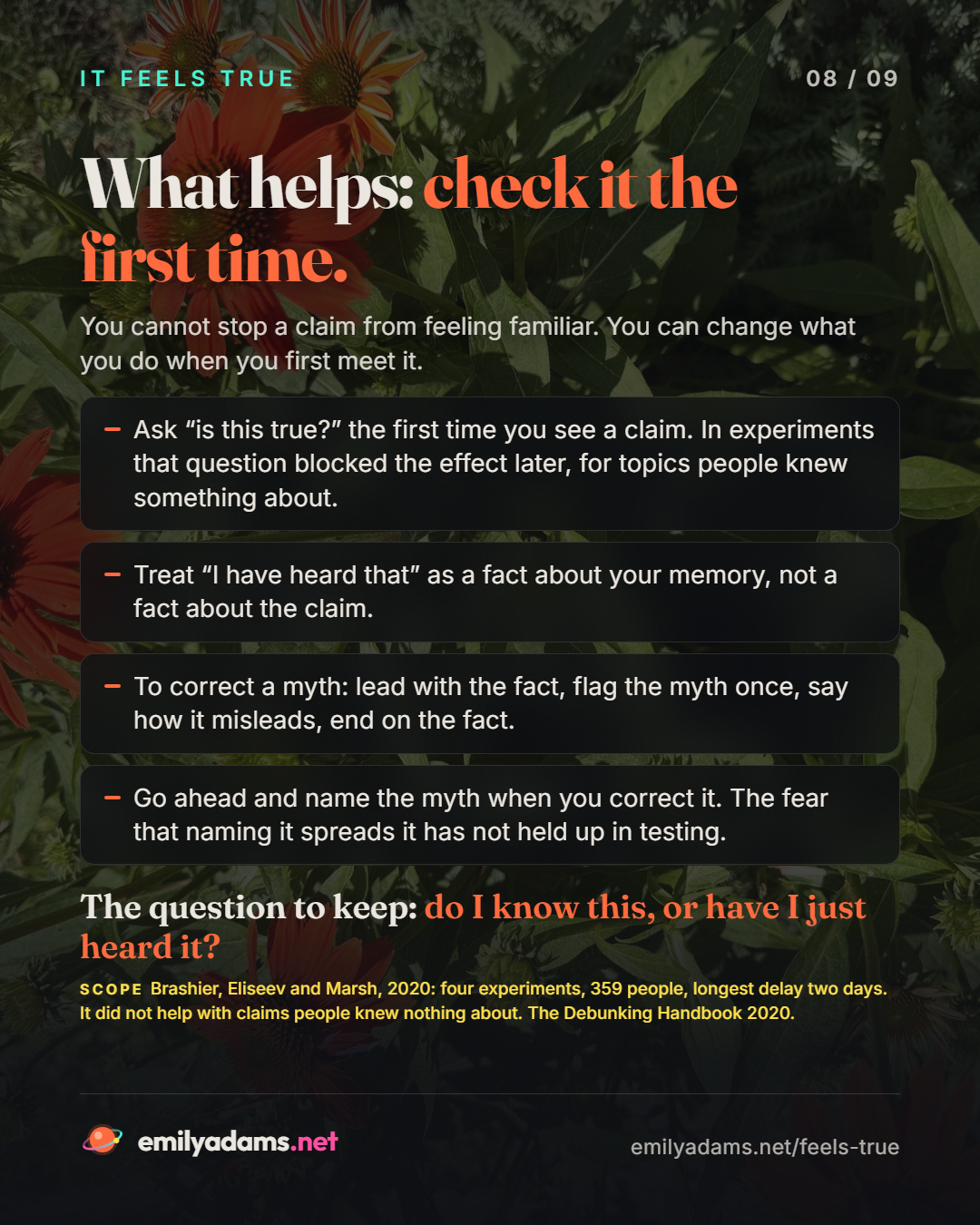
An Initial Accuracy Focus Prevents Illusory Truth
Brashier, Eliseev and Marsh, 2020 · Cognition, 194, article 104054
Four experiments with 359 participants. One group rated each statement for truth the first time they saw it; the other rated how interesting it was. Later, the group that had rated for truth showed no repetition effect for falsehoods they had the knowledge to catch.
Scope Checking for truth at first sight did nothing for claims people knew nothing about. The longest delay tested was two days, three of the four samples were students at one university, and in one experiment the key result did not reach significance.
On card 8
The Debunking Handbook 2020
Lewandowsky and colleagues, 2020 · A consensus guide by 22 researchers
The handbook recommends building a correction in up to four parts: state the fact, warn that a myth is coming and mention it once, explain how the myth misleads, and end by restating the fact.
Scope Guidance distilled from research as of 2020, written by many of the researchers whose studies it cites. It says even detailed corrections wear off over time.
On card 8
Can Corrections Spread Misinformation to New Audiences? Testing for the Elusive Familiarity Backfire Effect
Ecker, Lewandowsky and Chadwick, 2020 · Cognitive Research: Principles and Implications, 5, article 41
Three experiments with 1,718 participants tested whether a correction that introduces people to a false claim leaves them more misinformed a week later than people who saw nothing. Overall it did not.
Scope One of the three experiments found a small backfire on one measure, which did not repeat in the other two. The claims were invented for the study, and the samples were online workers.