Social Engineering Series, Part 8

Who even knows anymore: the sources behind the cards.

A ten-slide series on the last move in the playbook: so many claims, reversals, and fakes that people give up on knowing what is true. This page has the studies, the transcripts, and the reporting behind every card, with dates, links, and what each one cannot tell you, plus a reading check you can try yourself.

Published October 15, 2026 · Emily Adams · Checked against the original studies, transcripts, and the reporting

The Cards

The full text of every card, in order, with the card itself under each one. Select a card to open it full size.

Card 01 of 09
Too much to check. So you stop checking.
  • That is the last move. So many claims, reversals, and fakes that people give up on knowing what is true. You do not have to believe anything for it to work. Giving up is enough.
SCOPE Every example ahead is from 2025 and 2026, with dates. The research on this move is newer and smaller than for the others, and the cards say so.
All sourcesCard 1
Card 02 of 09
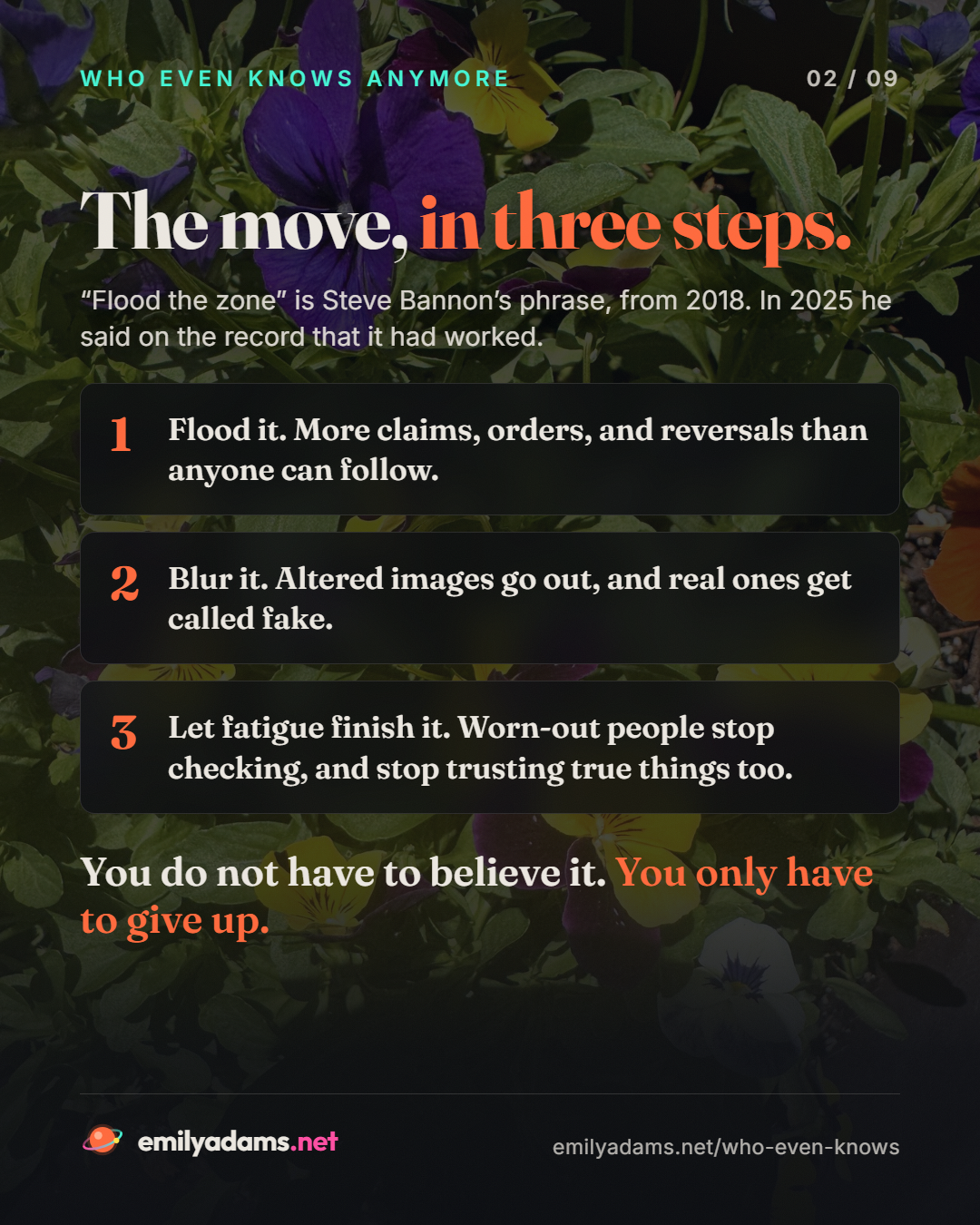
The move, in three steps.
  • “Flood the zone” is Steve Bannon’s phrase, from 2018. In 2025 he said on the record that it had worked.
  • Flood it. More claims, orders, and reversals than anyone can follow.
  • Blur it. Altered images go out, and real ones get called fake.
  • Let fatigue finish it. Worn-out people stop checking, and stop trusting true things too.
You do not have to believe it. You only have to give up.
What these cards cannot tell youCard 2
Card 03 of 09
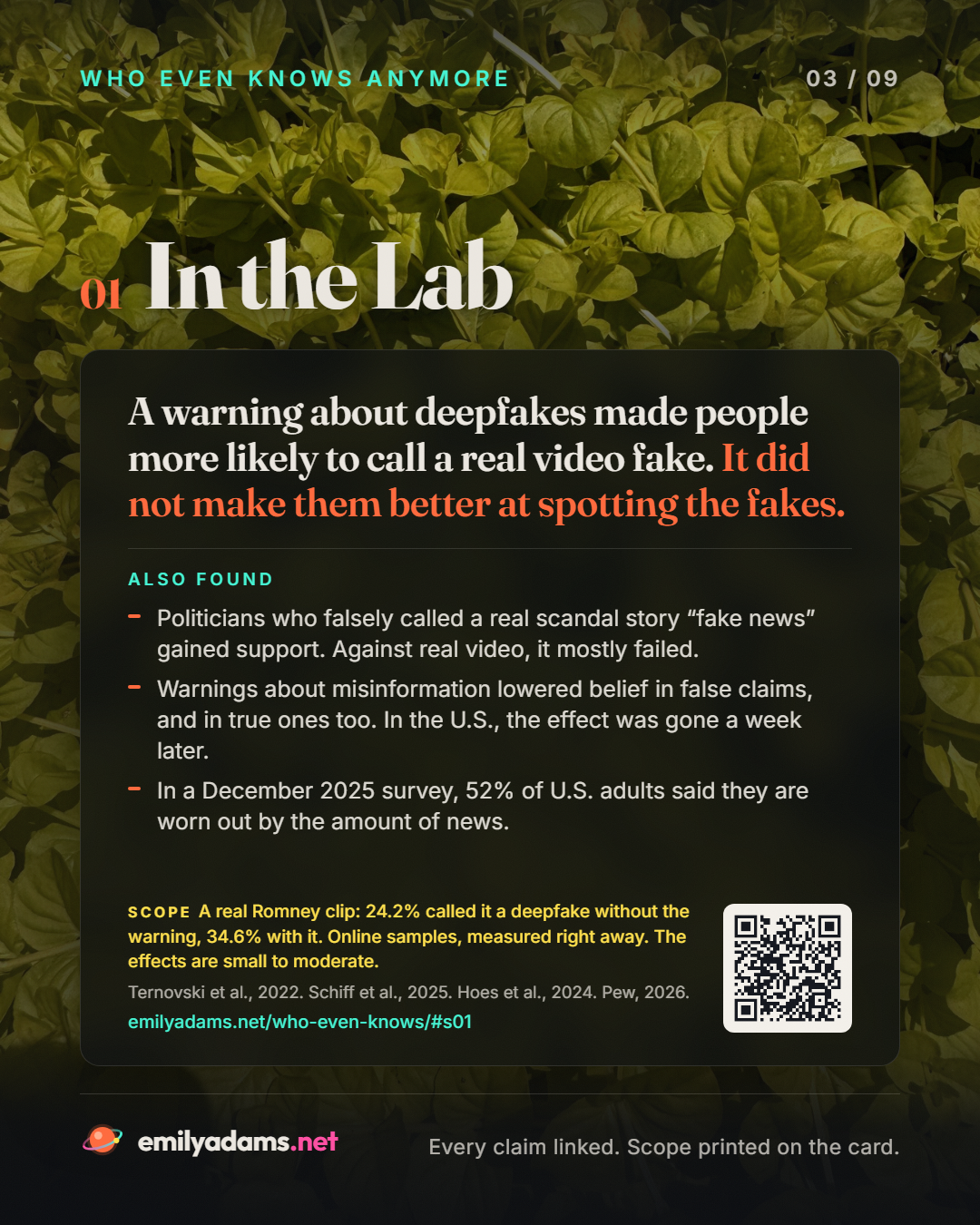
In the Lab. A warning about deepfakes made people more likely to call a real video fake. It did not make them better at spotting the fakes.
  • Politicians who falsely called a real scandal story “fake news” gained support. Against real video, it mostly failed.
  • Warnings about misinformation lowered belief in false claims, and in true ones too. In the U.S., the effect was gone a week later.
  • In a December 2025 survey, 52% of U.S. adults said they are worn out by the amount of news.
SCOPE A real Romney clip: 24.2% called it a deepfake without the warning, 34.6% with it. Online samples, measured right away. The effects are small to moderate.
Sources and linksCard 3
Card 04 of 09
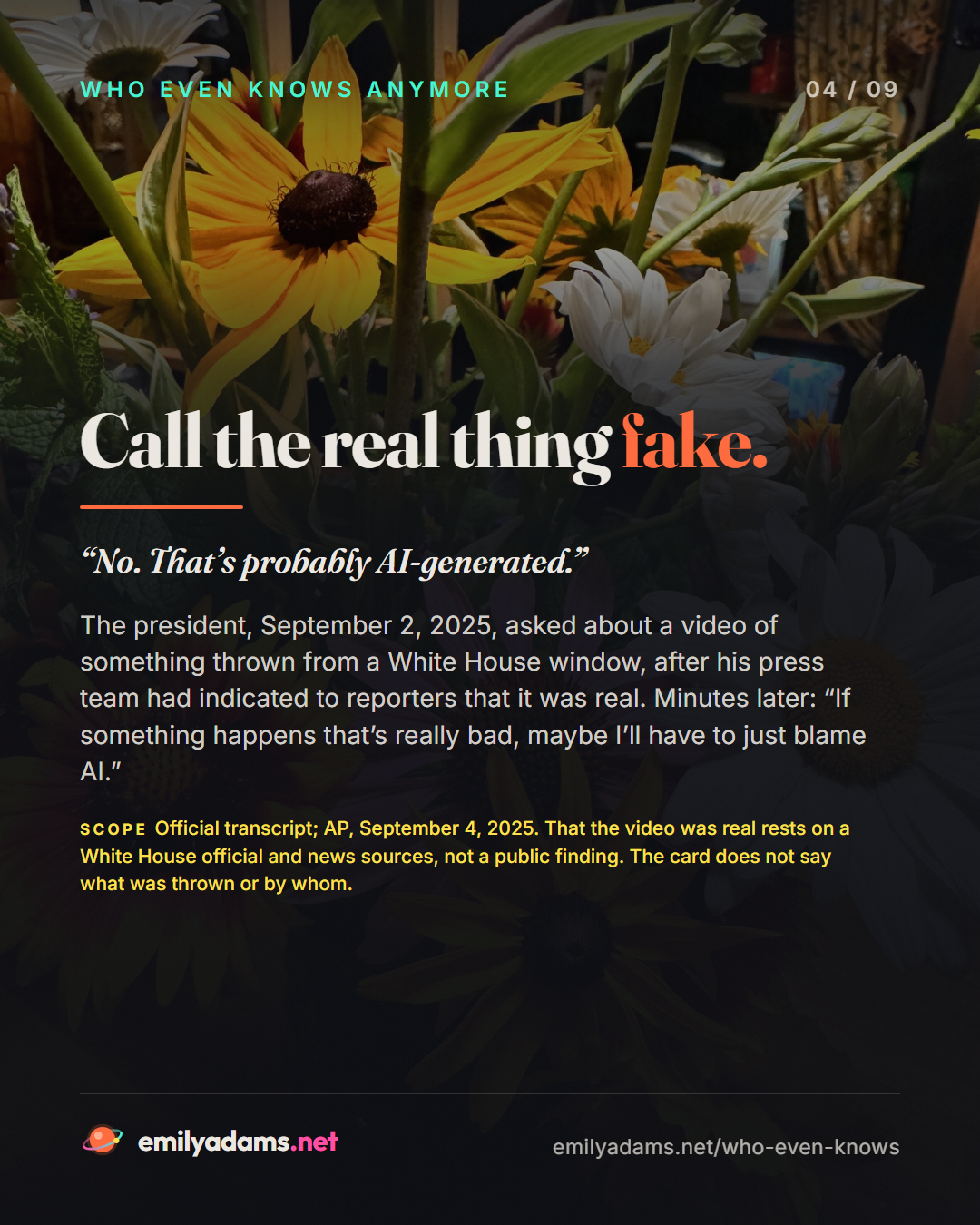
Call the real thing fake.
“No. That’s probably AI-generated.”
  • The president, September 2, 2025, asked about a video of something thrown from a White House window, after his press team had indicated to reporters that it was real. Minutes later: “If something happens that’s really bad, maybe I’ll have to just blame AI.”
SCOPE Official transcript; AP, September 4, 2025. That the video was real rests on a White House official and news sources, not a public finding. The card does not say what was thrown or by whom.
Sources and linksCard 4
Card 05 of 09
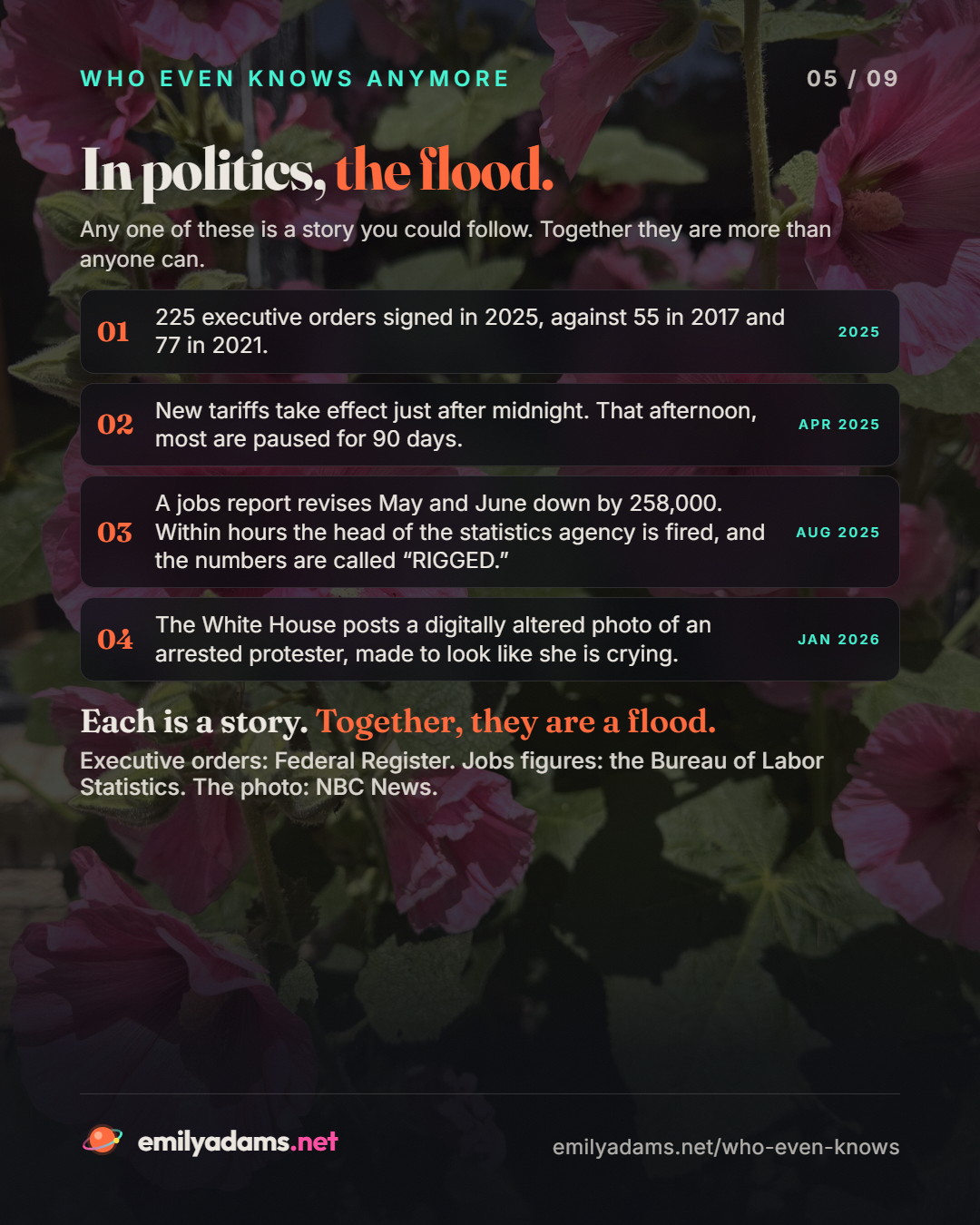
In politics, the flood.
  • Any one of these is a story you could follow. Together they are more than anyone can.
  • 225 executive orders signed in 2025, against 55 in 2017 and 77 in 2021. 2025
  • New tariffs take effect just after midnight. That afternoon, most are paused for 90 days. Apr 2025
  • A jobs report revises May and June down by 258,000. Within hours the head of the statistics agency is fired, and the numbers are called “RIGGED.” Aug 2025
  • The White House posts a digitally altered photo of an arrested protester, made to look like she is crying. Jan 2026
Each is a story. Together, they are a flood. Executive orders: Federal Register. Jobs figures: the Bureau of Labor Statistics. The photo: NBC News.
Sources and linksCard 5
Card 06 of 09
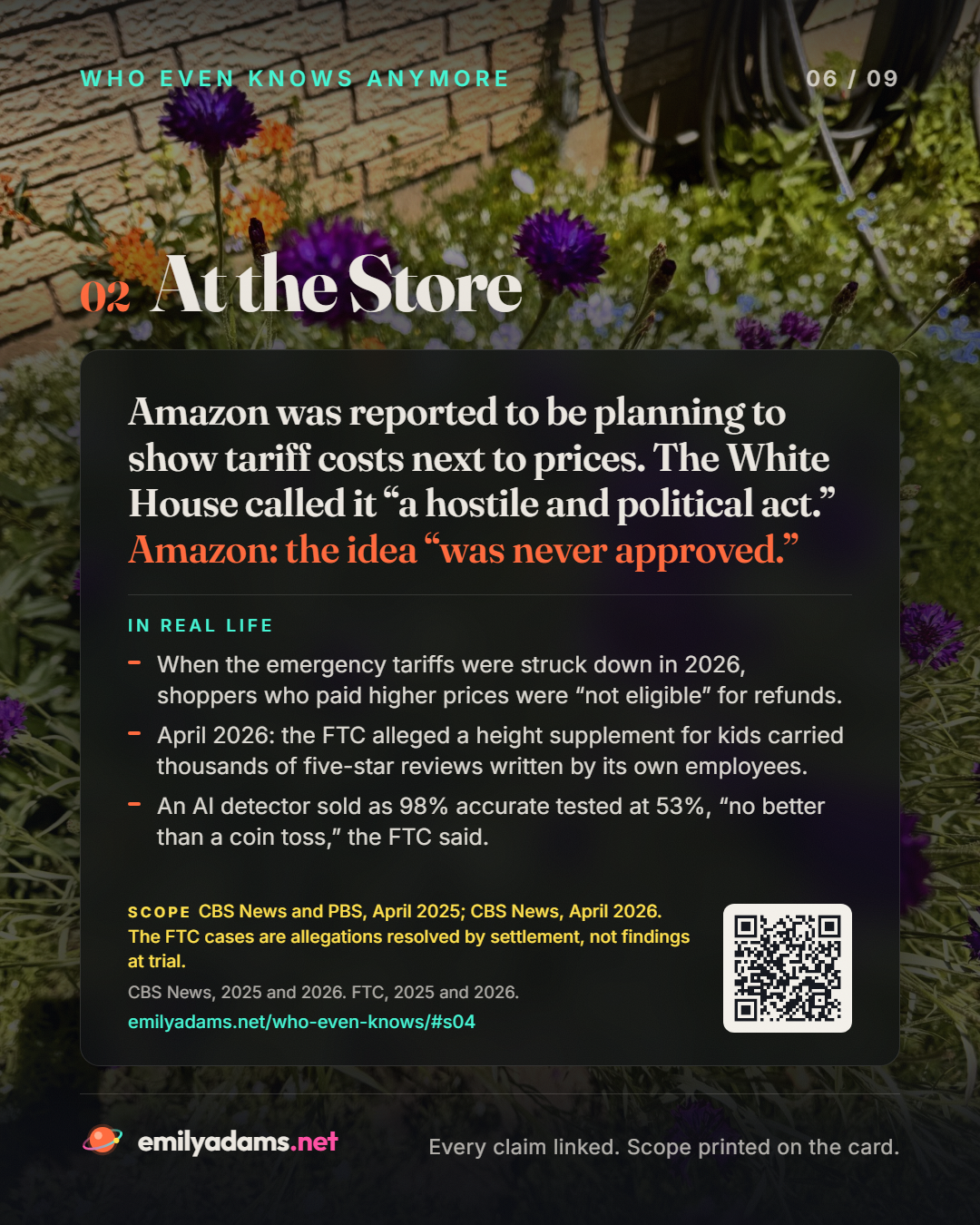
At the Store. Amazon was reported to be planning to show tariff costs next to prices. The White House called it “a hostile and political act.” Amazon: the idea “was never approved.”
  • When the emergency tariffs were struck down in 2026, shoppers who paid higher prices were “not eligible” for refunds.
  • April 2026: the FTC alleged a height supplement for kids carried thousands of five-star reviews written by its own employees.
  • An AI detector sold as 98% accurate tested at 53%, “no better than a coin toss,” the FTC said.
SCOPE CBS News and PBS, April 2025; CBS News, April 2026. The FTC cases are allegations resolved by settlement, not findings at trial.
Sources and linksCard 6
Card 07 of 09
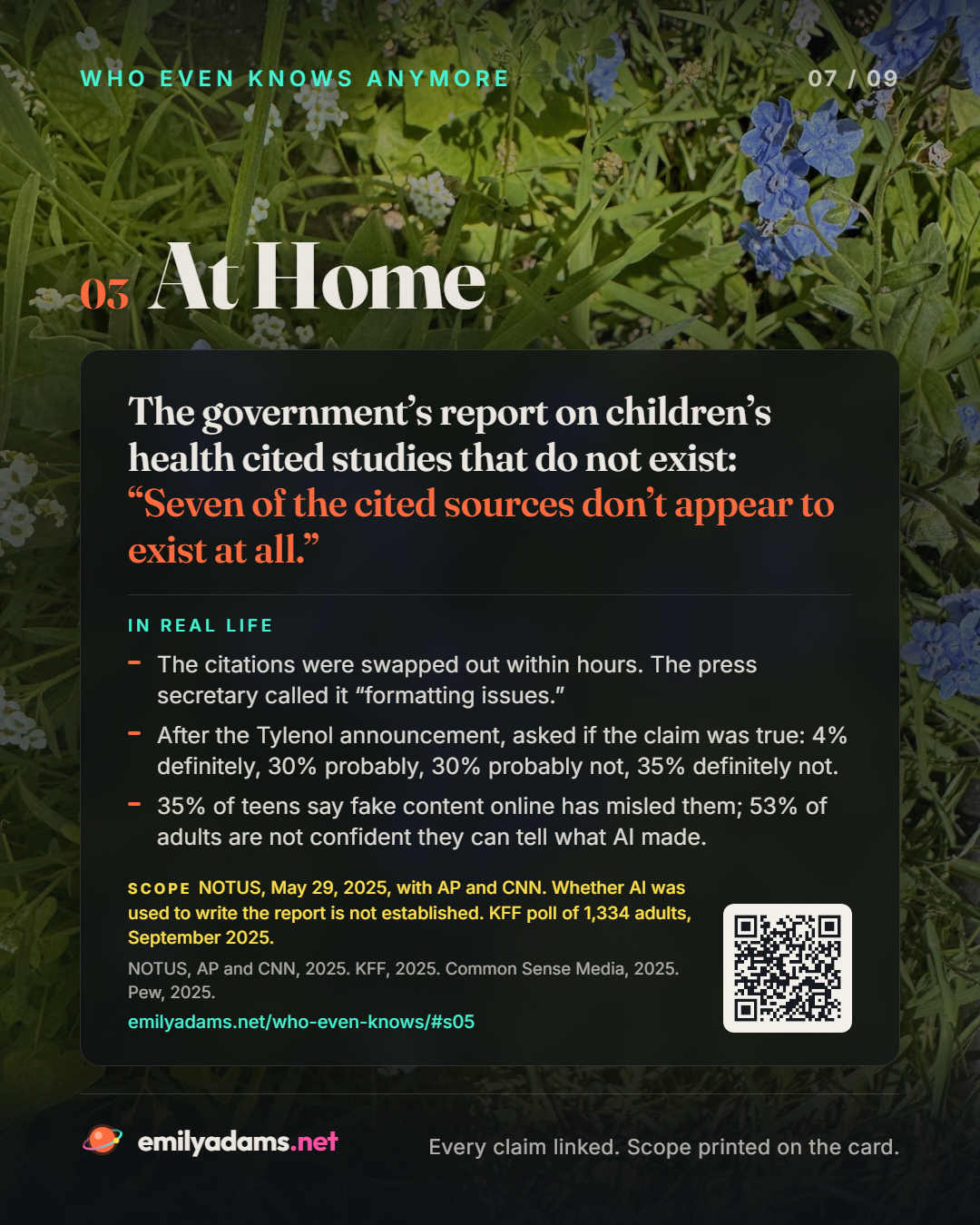
At Home. The government’s report on children’s health cited studies that do not exist: “Seven of the cited sources don’t appear to exist at all.”
  • The citations were swapped out within hours. The press secretary called it “formatting issues.”
  • After the Tylenol announcement, asked if the claim was true: 4% definitely, 30% probably, 30% probably not, 35% definitely not.
  • 35% of teens say fake content online has misled them; 53% of adults are not confident they can tell what AI made.
SCOPE NOTUS, May 29, 2025, with AP and CNN. Whether AI was used to write the report is not established. KFF poll of 1,334 adults, September 2025.
Sources and linksCard 7
Card 08 of 09
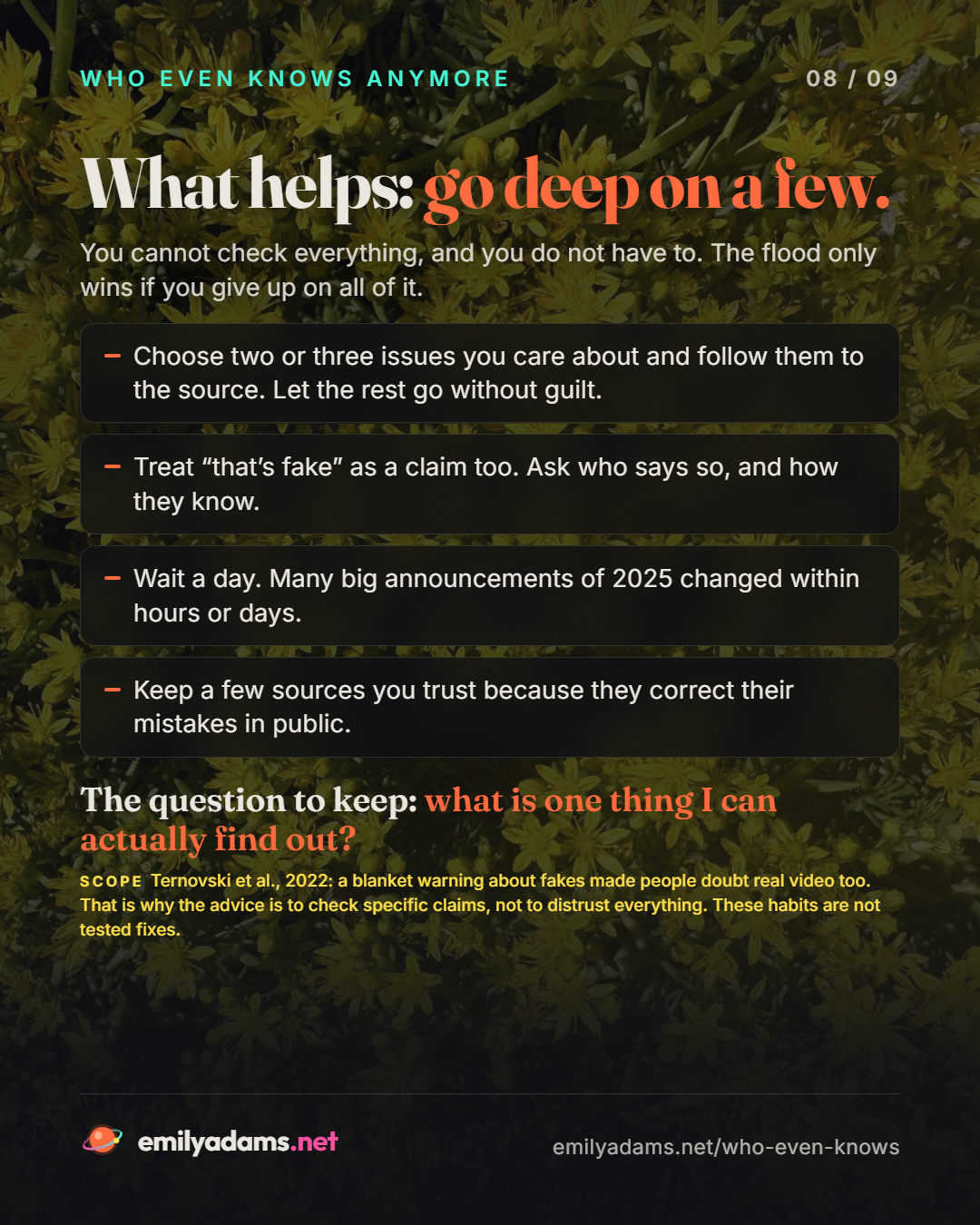
What helps: go deep on a few.
  • You cannot check everything, and you do not have to. The flood only wins if you give up on all of it.
  • Choose two or three issues you care about and follow them to the source. Let the rest go without guilt.
  • Treat “that’s fake” as a claim too. Ask who says so, and how they know.
  • Wait a day. Many big announcements of 2025 changed within hours or days.
  • Keep a few sources you trust because they correct their mistakes in public.
The question to keep: what is one thing I can actually find out?
SCOPE Ternovski et al., 2022: a blanket warning about fakes made people doubt real video too. That is why the advice is to check specific claims, not to distrust everything. These habits are not tested fixes.
Sources and linksCard 8
Card 09 of 09
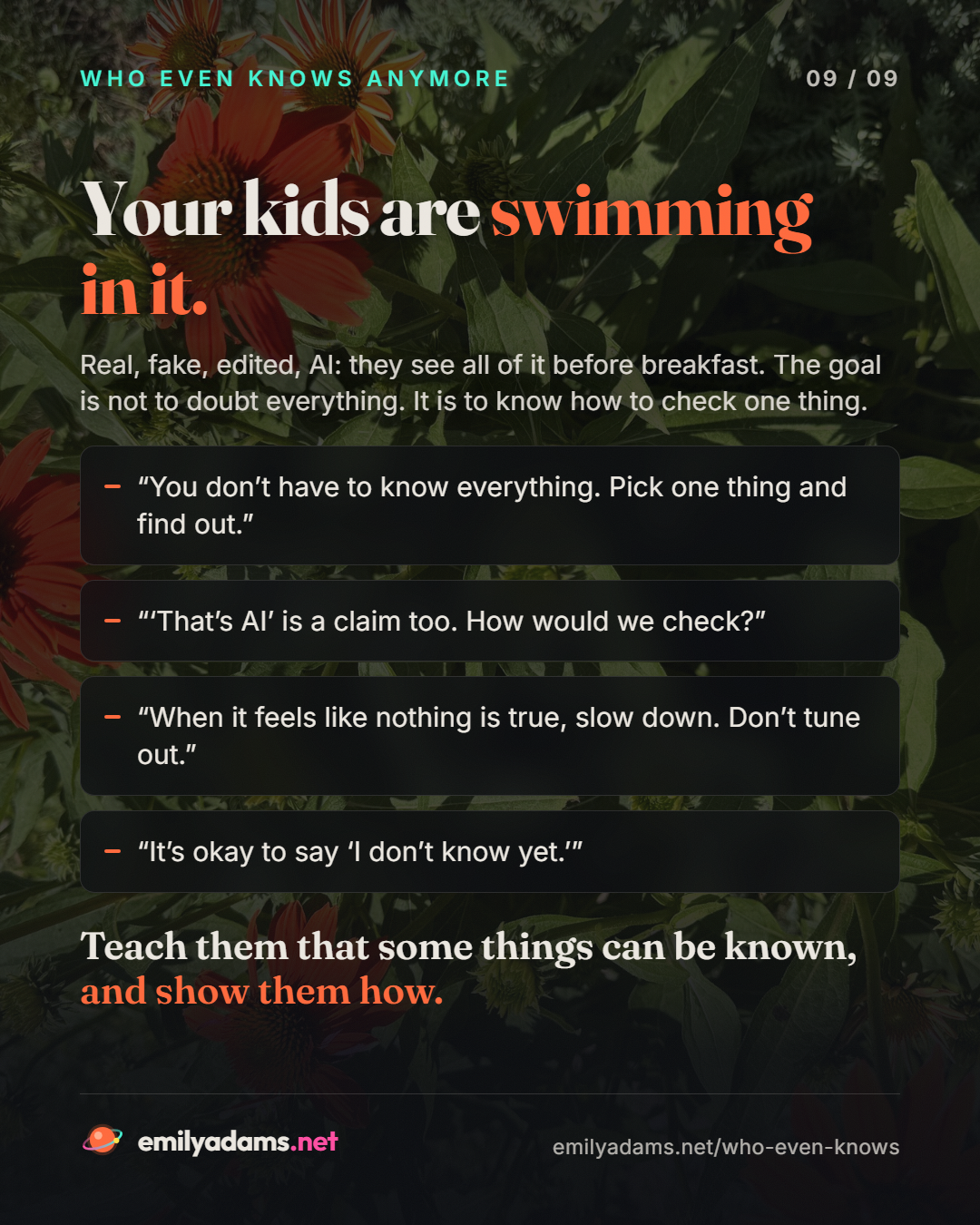
Your kids are swimming in it.
  • Real, fake, edited, AI: they see all of it before breakfast. The goal is not to doubt everything. It is to know how to check one thing.
  • “You don’t have to know everything. Pick one thing and find out.”
  • “‘That’s AI’ is a claim too. How would we check?”
  • “When it feels like nothing is true, slow down. Don’t tune out.”
  • “It’s okay to say ‘I don’t know yet.’”
Teach them that some things can be known, and show them how.
What these cards cannot tell youCard 9
Closing card
That is the playbook. Now you can see it.
  • Five moves: the joke, the repeat, the team, the dose, and the flood. Every part of the series, with its sources and a reading check, is at emilyadams.net.
Closing card

The Sources

Grouped by card. Each source has a summary of what it says, a scope line saying how far it reaches, and a link to the original.

Card 3

In the Lab

On card 3

The Negative Consequences of Informing Voters About Deepfakes: Evidence from Two Survey Experiments

Ternovski, Kalla and Aronow, 2022 · Journal of Online Trust and Safety, 1(2)

Two preregistered online experiments in 2020. A short warning that deepfakes can make people appear to say things they never said made viewers more likely to call a real video fake (up 0.73 points on a 7-point scale in the first study), without making them any better at spotting an actual fake. With a real 2002 video of Mitt Romney, the share who said it was a deepfake rose from 24.2% to 34.6% after the warning.

Scope  Convenience samples, the warning placed right above the video, and judgments made immediately. The authors caution against applying it to every kind of deepfake information.
On card 3

The Liar’s Dividend: Can Politicians Claim Misinformation to Evade Accountability?

Schiff, Schiff and Bueno, 2025 · American Political Science Review, 119(1), 71 to 90

Five preregistered experiments with 15,287 Americans. After reading about a real scandal involving one of four real politicians, two from each party, people who then saw the politician falsely claim it was fake news rated the politician higher. Against a real video of the scandal, the same claim mostly failed. General trust in the media did not fall.

Scope  The rebuttals were hypothetical and shown right after the scandal, which the authors call a best case for the liar. The scandals were offensive remarks, not crimes.
On card 3

Prominent Misinformation Interventions Reduce Misperceptions but Increase Scepticism

Hoes and colleagues, 2024 · Nature Human Behaviour, 8(8), 1545 to 1553

Preregistered experiments with 6,127 people in the United States, Poland, and Hong Kong. Fact-checks, media literacy tips, and news coverage about misinformation all lowered belief in false claims, and most also lowered belief in true ones. In the United States, the effects had disappeared a week later.

Scope  Small, short-lived effects in online samples, about misinformation warnings in general, not deepfakes.
On card 3

Americans’ Complicated Relationship With News

Pew Research Center, 2026 · Pew-Knight Initiative, February 11, 2026

A survey of 3,560 U.S. adults, December 8 to 14, 2025: 52% say they are worn out by the amount of news, 34% are not, and 14% are not sure. 60% have cut back on how much news they get.

Scope  Self-reports. Because this survey offered a “not sure” answer, it is not directly comparable with Pew’s earlier readings.
Background context

Deep Fakes: A Looming Challenge for Privacy, Democracy, and National Security

Chesney and Citron, 2019 · California Law Review, 107, 1753 to 1820

The law review article that named the “liar’s dividend”: as the public learns that video and audio can be faked, people caught on real recordings can more easily claim the evidence is fake. The authors wrote that the dividend grows in proportion to success in teaching the public about deepfakes (page 1785).

Scope  A legal analysis and prediction from before cheap video generators, with no data. The studies above are the tests.
Card 4

Call the Real Thing Fake

On card 4

Remarks and an Exchange With Reporters, September 2, 2025

The White House, 2025 · Official transcript, DCPD-202500885, govinfo.gov

Asked about a video showing something thrown from an upstairs White House window: “No. That’s probably AI-generated.” Asked if it was fake: “Well, it’s got to be, because I know every window up there.” Later in the same exchange: “If something happens that’s really bad, maybe I’ll have to just blame AI,” followed by “But there’s truth to it, because I see so many phony things.”

Scope  The transcript is the source for every quotation on the card.
On card 4

The President Blamed AI and Embraced Doing So. Is It Becoming the New “Fake News”?

Associated Press, 2025 · Associated Press (Laurie Kellman), September 4, 2025, as carried by KSAT

AP reported that the answer came after the president’s press team had indicated to reporters that the video was real. It quotes the digital forensics expert Hany Farid on the risk once anything can be dismissed as fake: “then nothing has to be real.”

Scope  That the video was real rests on an unnamed White House official, news sources, and one forensic expert, not a public finding. Nobody on the record has said what was thrown or by whom, and the card does not either.
Card 5

In Politics, the Flood

On card 5

“Flood the Zone”

Semafor, 2025; Michael Lewis, 2018 · Semafor (Ben Smith), February 9, 2025; Bloomberg View column by Michael Lewis, February 9, 2018

The phrase comes from Steve Bannon, quoted by Michael Lewis in 2018 as saying the way to deal with the media was to flood the zone (his full line includes a profanity). In February 2025 Bannon told Semafor that a news story had slid off the air within two days because the president had flooded the zone with other actions, and that it had worked.

Scope  Bannon held no administration post in 2025. This is his account, not a statement of anyone else’s intent.
On card 5

Executive Orders by Year

Federal Register, 2017 to 2025 · Federal Register public database, counts by signing date

225 executive orders were signed in calendar 2025, 26 of them on January 20 and 143 in the first 100 days. In the first calendar year of earlier terms: 55 in 2017, 77 in 2021, 39 in 2009.

Scope  Numbered executive orders only, not memoranda or proclamations, so the total number of presidential actions is higher. A count shows volume, not confusion.
On card 5

A Timeline of the Tariff Actions

Associated Press, 2025 · Associated Press, as carried by PBS NewsHour, updated May 26, 2025

Higher tariffs on dozens of countries took effect just after midnight on April 9, 2025. That afternoon most were paused for 90 days, with a 10% baseline kept and the rate on China raised.

Scope  Rates changed often enough that every figure needs its date.
On card 5

The July 2025 Jobs Report, and the Firing

Bureau of Labor Statistics and Truth Social, 2025 · BLS Employment Situation, August 1, 2025; the president’s posts of August 1, 2025

The report showed 73,000 jobs added in July and revised May and June down by a combined 258,000, which BLS called larger than normal. That afternoon the president posted that he had directed his team to fire the commissioner, Erika McEntarfer, and later that the “Jobs Numbers were RIGGED.” She had been confirmed by the Senate 86 to 8 in January 2024.

Scope  Revisions are routine, and nothing in the record shows the numbers were manipulated or that a commissioner could change them. The reading check below is about this case.
On card 5

White House Shares an Altered Photo of an Arrested Minnesota Protester

NBC News, 2026 · NBC News, January 23, 2026

NBC reported that on January 22, 2026, the White House posted an image it had digitally altered to make a civil rights attorney arrested over a protest appear to be crying. The Homeland Security secretary had posted the original photo, in which she looks ahead calmly, the same day.

Scope  Whether AI was used is not established, so the card says digitally altered. The card describes the image and does not reproduce it; her criminal case is separate.
Card 6

At the Store

On card 6

White House Calls Reports That Amazon Might Display Tariff Prices “a Hostile and Political Act”

CBS News and PBS, 2025 · CBS News and PBS NewsHour, April 29, 2025

After a report that Amazon would show tariff costs next to prices, the press secretary called it “a hostile and political act.” Amazon said its team for a low-cost store had considered listing import charges on some products, and that “This was never approved and is not going to happen.”

Scope  The label was considered for one Amazon store, not its main site, and never shipped.
On card 6

How to File for a Tariff Refund

CBS News, 2026 · CBS News, April 20, 2026

After the Supreme Court ruled on February 20, 2026 that the emergency law did not authorize the tariffs, Customs and Border Protection opened a refund portal for importers. Consumers are “not eligible to submit claims for a tariff refund.”

Scope  Refunds go to the importers who paid the duties. Whether any of that reaches shoppers is up to the companies.
On card 6

TruHeight: Deceptive Advertising and Fake Reviews

Federal Trade Commission, 2026 · FTC press releases, April 13 and July 15, 2026

The FTC alleged that a height supplement marketed for children and teens carried “several thousand five-star reviews” that “were actually written by company employees,” under a federal rule against fake reviews that took effect in October 2024. A final order in July 2026 set a $4 million judgment, partially suspended after payment of $750,000.

Scope  Allegations resolved by settlement, not findings at trial. I found trade-press coverage but no major news story.
On card 6

Workado: An AI Detector Advertised as 98% Accurate

Federal Trade Commission, 2025 · FTC press release, April 28, 2025

A company advertised its tool for detecting AI-written text as 98 percent accurate; independent testing on general content found 53 percent. The FTC’s consumer protection director said it “did no better than a coin toss.”

Scope  A settled case. It is on the card because even the tools sold to tell real from fake can be unreliable.
Card 7

At Home

On card 7

The MAHA Report’s Citation Errors

NOTUS, 2025 · NOTUS (Emily Kennard and Margaret Manto), May 29, 2025; Associated Press and CNN, May 29, 2025

The administration’s report on children’s health cited studies that do not exist: “Seven of the cited sources don’t appear to exist at all.” A Columbia epidemiologist listed as an author of one said it was not a real paper. Within hours the White House posted a version with all seven citations replaced, and the press secretary, as reported by AP and CNN, called the problems “formatting issues.”

Scope  Whether AI was used to write the report is not established, and the card does not say it was. NOTUS said it was not immediately clear the replacement citations support the claims.
On card 7

KFF Tracking Poll on Health Information and Trust: The Tylenol-Autism Claim

KFF, 2025 · KFF, October 9, 2025

1,334 adults surveyed September 23 to 29, 2025, the week after the announcement about Tylenol in pregnancy. 77% had heard the claim. Asked whether it is true: 4% definitely true, 30% probably true, 30% probably false, 35% definitely false. KFF found most adults uncertain.

Scope  Adults in general, not parents specifically. Part 5 covers the evidence on Tylenol itself.
On card 7

Teens Misled by Fake Content, and Adults Unsure They Can Tell

Common Sense Media, 2025; Pew Research Center, 2025 · Common Sense Media, January 29, 2025; Pew Research Center, September 17, 2025

In a survey of 1,045 teens aged 13 to 18, 35% said fake content online had misled them and 22% had shared something they later learned was fake. Separately, Pew found 53% of U.S. adults are not too or not at all confident they can tell whether pictures, videos, or text were made by AI or by people.

Scope  The teen survey was conducted in spring 2024 and published in 2025; both are self-reports, not tested skills.
Check Your Reading

Read the article below, then try the six questions. Each one uses a different reading skill from part two, in rough order of difficulty. Write your answer down before you open the strong answer.

Read this first

Bureau of Labor Statistics tells the US what’s up with the economy: Trump firing its top official may undercut trust in its data

Thomas A. Stapleford, University of Notre Dame · The Conversation · August 8, 2025 · about 1,100 words · free to read
  1. DecodeRead the words and know what they mean here. · Level 1

    Paragraph 19 says the commissioner’s appointment is “at will.” What does that mean?

    See a strong answer

    The president can legally remove the commissioner at any time, even though the job comes with a four-year term.

    Paragraphs 18 and 19

  2. LocateFind a specific piece of information in the text. · Level 1 to 2

    When was the Bureau of Labor Statistics founded, and on what day was its commissioner fired?

    See a strong answer

    It was founded in 1884. The commissioner was fired on August 1, 2025, the same day a report showed weakness in the job market.

    Paragraphs 1 and 3

  3. RestateSay what it means in your own words. · Level 2

    In one or two sentences of your own, what is the article’s main point?

    See a strong answer

    The BLS produces numbers the whole country relies on, and firing its head after a weak report could undercut trust in that data, even though one person could not simply fake the numbers. The bigger risk is that the data becomes less trusted and less useful.

    Paragraphs 2, 14, 20 and 29

  4. InferWork out what the text implies but does not say. · Level 3

    Paragraph 5 says the numbers are routinely revised, and paragraphs 20 and 21 say a large civil-service staff produces them. What can you conclude about whether a big downward revision shows the numbers were rigged?

    See a strong answer

    A revision by itself is not evidence of rigging: revisions are normal, and no single official can change the numbers. The article never puts those two points together; you have to.

    Paragraphs 5, 20 and 21

  5. CompareSet two ideas, claims, or sources side by side. · Level 3

    Paragraphs 20 to 23 and 29 compare two kinds of risk. What are they, and which does the author think is more likely?

    See a strong answer

    One is outright faking of the numbers, which he calls very difficult and unlikely to fool economists. The other is shaping the data indirectly, by making it harder to get, cutting resources, closing data series, or nudging the methods, which could make the statistics much less useful. He worries more about the second.

    Paragraphs 20 to 23 and 29

  6. EvaluateJudge how far to trust it, and what to check. · Level 4 and up

    Paragraph 15 says the Department of Labor disbanded its advisory committees, stating they “had fulfilled their intended purpose.” How would you check that quotation, and why does it matter?

    See a strong answer

    Open the article the author links, look for a termination notice in the Federal Register, and check the BLS advisory committee page. Similar “fulfilled” wording may come from a different department’s notice about its own panels. Who said something matters as much as what was said, especially in a story about trust.

    Paragraph 15

Connect it to the cards: card 5 shows the firing as one wave in the flood. This article slows down on that one wave, which is the habit card 8 recommends. Download the printable worksheet (PDF), with room to write and an answer key. Want more practice? Play Between the Lines: read a current news article, answer twelve questions, and see your reading level.

What These Cards Cannot Tell You

The research on this move is young. Most of it dates from 2020 on, uses online samples, and measures reactions right away. The effects are small to moderate, and some faded within a week.
Not everything is fake, and the cards are not saying so. The point of the research is that blanket doubt hurts true information too. The advice is to check specific things, not to distrust everything.
Volume is not intent. The cards show how much happened and in what order. Steve Bannon described flooding the zone as a strategy; that is his account, and the cards make no claim about anyone else’s intent.
Some facts here rest on reporting. That the White House window video was real rests on an unnamed official and news sources. The press secretary’s “formatting issues” is as reported by AP and CNN.
The FTC cases are allegations. They were settled, not tried.
The lines for kids are mine. The four sentences on card 9 are things I would say at my own table. They are not findings.

Why this one is the hardest.

Every other move needs you to believe something. This one only needs you to stop trying. When the news moves faster than anyone can follow, and real and fake look the same, giving up can feel like the sane response.

What stayed with me from the research is that warnings can backfire. Telling people that anything could be fake made them doubt real video, without making them better at catching fakes. So the answer cannot be to doubt everything. It has to be learning how to check one thing well.

That is where this series started: reading is a set of skills, and skills can be practiced. Pick a few things you care about, follow them all the way to the source, and let the rest go without guilt. That is what I want my kids to know they can do.