Grouped by card. Each source has a summary of what it says, a scope line saying how far it reaches, and a link to the original.
Card 3
In the Lab
On card 3
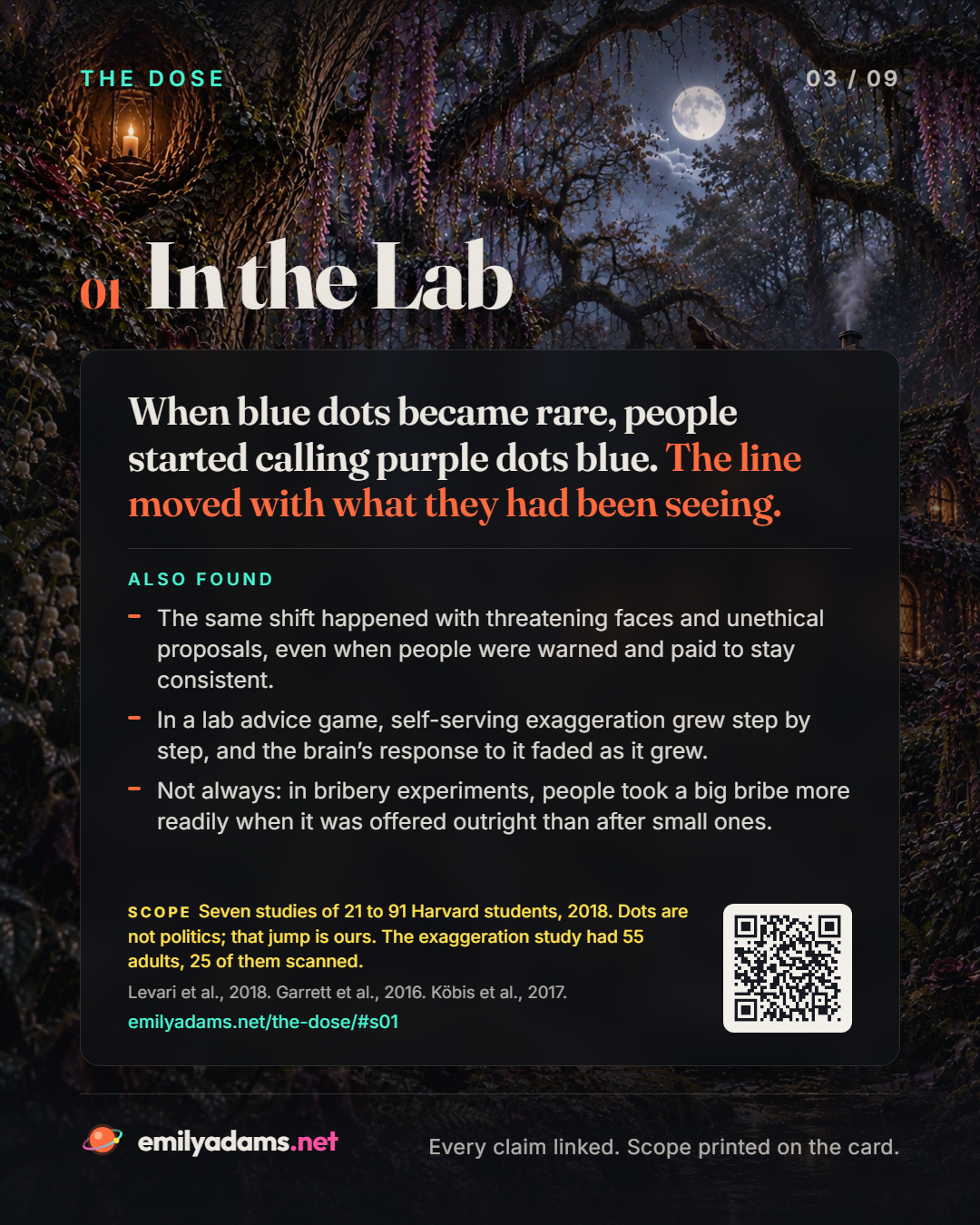
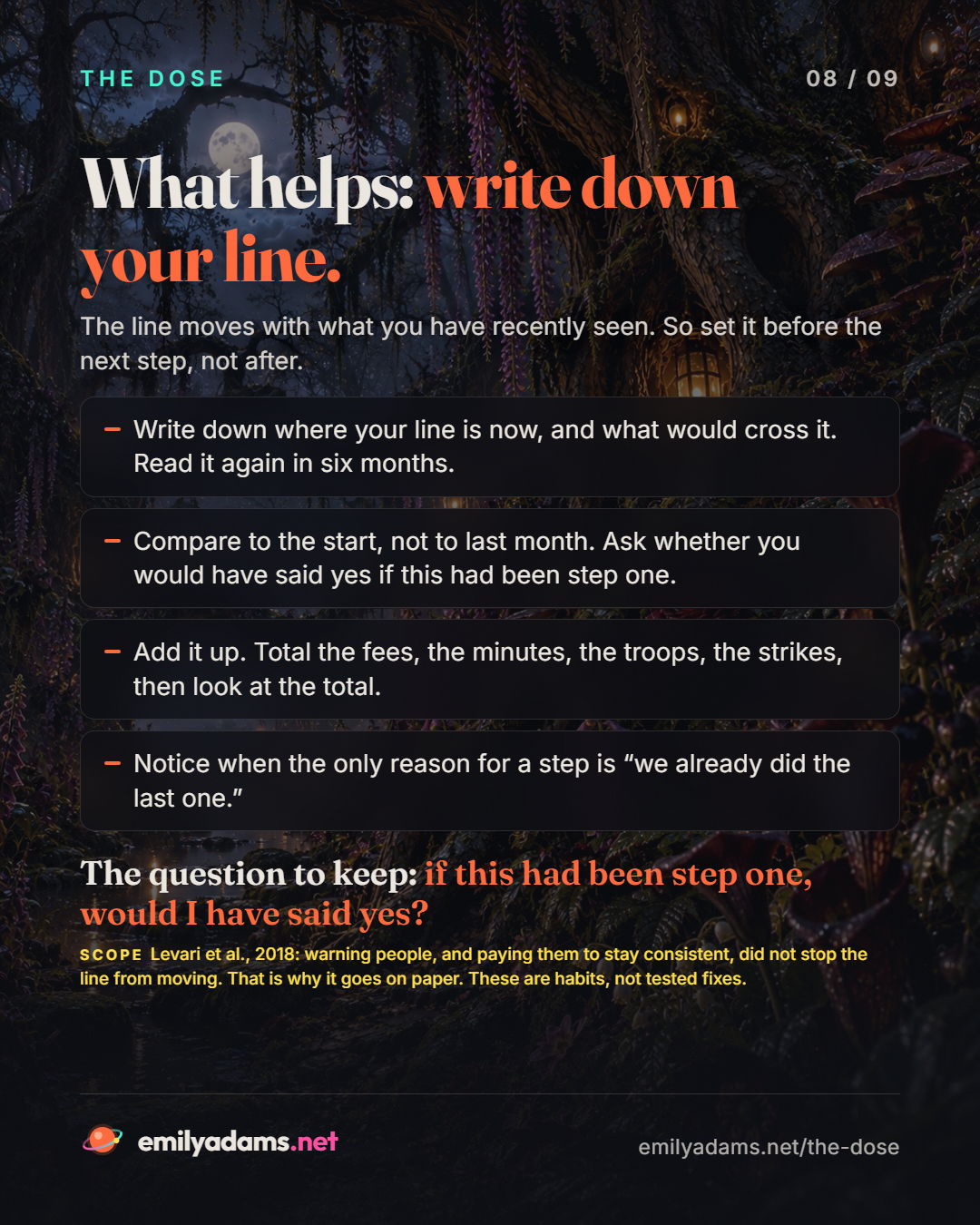
Prevalence-Induced Concept Change in Human Judgment
Levari and colleagues, 2018 · Science, 360(6396), 1465 to 1467
Seven studies with Harvard students. People judged dots as blue or not blue, faces as threatening or not, and research proposals as ethical or not. When blue dots, threatening faces, or unethical proposals became rare, people widened the category: purple dots became blue, neutral faces threatening, ambiguous proposals unethical. The shift held when people were warned it would happen and when they were paid to stay consistent, and it worked the same whether the change was gradual or sudden. When blue dots became more common, the category shrank.
Scope Small student samples, 21 to 91 per study, with artificial tasks. The paper is about how judgments track what people have recently seen. Applying it to politics or prices is my inference, not the paper’s finding.
On card 3
The Brain Adapts to Dishonesty
Garrett, Lazzaro, Ariely and Sharot, 2016 · Nature Neuroscience, 19(12), 1727 to 1732
Adults advised a partner about how much money was in a jar of pennies. When exaggerating helped the advisor, the exaggeration grew from trial to trial. In the 25 people scanned, the amygdala’s response to their own self-serving dishonesty faded over time, and the size of the fade predicted the size of the next increase.
Scope One lab study in London: 55 adults in the main experiment, 25 of them scanned, and a second experiment with 25. Small stakes, no chance of being caught. It is about exaggerating a number, not serious wrongdoing.
On card 3
The Road to Bribery and Corruption: Slippery Slope or Steep Cliff?
Köbis, van Prooijen, Righetti and Van Lange, 2017 · Psychological Science, 28(3), 297 to 306
Four experiments with a bribery game found the opposite of a slippery slope for serious corruption: people were more likely to take a large bribe when it was offered outright than after first taking small ones. The authors describe the route to corruption as “a steep cliff rather than a slippery slope.”
Scope I read the abstract, not the full paper, so no numbers are printed. It is on the card because the evidence on small steps is mixed and the card should say so.
Background context
Compliance Without Pressure: The Foot-in-the-Door Technique
Freedman and Fraser, 1966 · Journal of Personality and Social Psychology, 4(2), 195 to 202
The classic small-step study. Homeowners first asked to do something small were far more likely to agree later to a very large “Drive Carefully” sign in their yard: 76.0% against 16.7% of those asked cold.
Scope Later reviews find the average effect is small, and a 2013 direct replication in Poland and Ukraine found no significant effect. That is why it is background here, not on the card.
Background context
Rapidly Declining Remarkability of Temperature Anomalies May Obscure Public Perception of Climate Change
Moore, Obradovich, Lehner and Baylis, 2019 · Proceedings of the National Academy of Sciences, 116(11), 4905 to 4910
In 2.18 billion posts on Twitter, what people treated as remarkable weather was set by the weather of roughly 2 to 8 years earlier. The authors call it evidence of the “boiling frog” effect, as a metaphor.
Scope Twitter users are not a representative sample, and the study measures how much people post about weather, not what they believe.
Card 4
One Boat, Then an Armed Conflict
On card 4
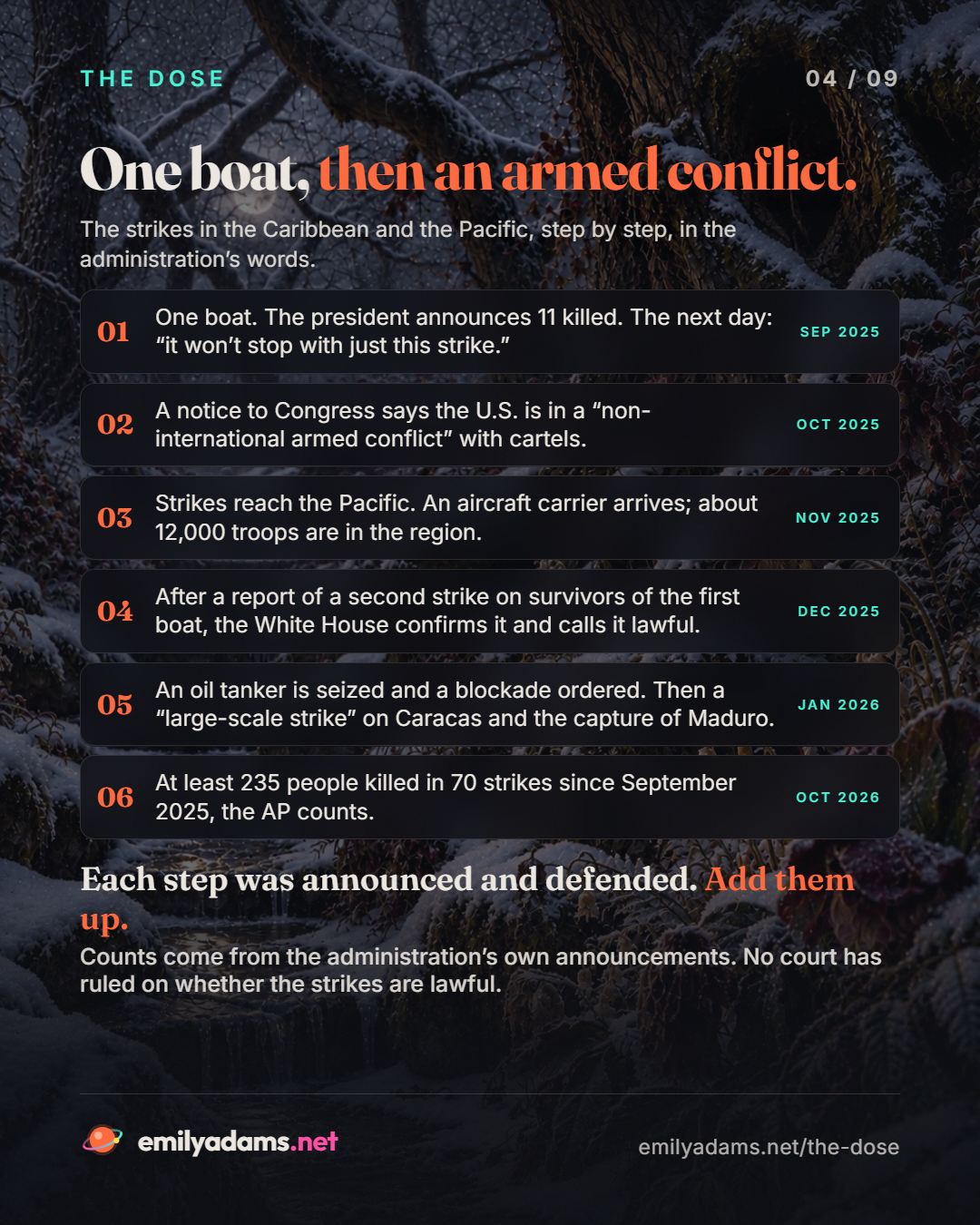
The First Strike, September 2, 2025
Associated Press and CBS News, 2025 · Associated Press, September 3, 2025, as carried by ABC7; CBS News, September 3, 2025
The president announced a strike on a boat in the southern Caribbean, said 11 people were killed, and said the boat was operated by Tren de Aragua. AP noted the video did not show how many people were aboard or any clear drug stash. The next day Defense Secretary Pete Hegseth said on Fox and Friends that “it won’t stop with just this strike.”
Scope The administration has offered little evidence about who was aboard the boats, and the card does not say what any boat carried.
On card 4
The Notice to Congress: “Non-International Armed Conflict”
NBC News and CBS News, 2025 · NBC News and CBS News, October 2, 2025
A notice to Congress said the president had determined that designated cartels are non-state armed groups whose actions amount to an armed attack, that “the United States is in a non-international armed conflict” with them, and that those killed are unlawful combatants. A White House spokesperson said the president “acted in line with the law of armed conflict.”
Scope The wording is as quoted by NBC and CBS; I could not open the notice itself.
On card 4
A Timeline of U.S. Military Escalation Against Venezuela
Associated Press, 2025 and 2026 · Associated Press, January 3, 2026, as carried by PBS NewsHour
The AP timeline runs from the first strike to strikes in the Eastern Pacific from October 21, 2025; the aircraft carrier Gerald R. Ford ordered in on October 24 and arriving November 16, with about 12,000 troops in the region; an oil tanker seized December 10; a blockade of “sanctioned oil tankers” ordered December 16; and on January 3, 2026, a “large-scale strike” across Caracas and the capture of Nicolás Maduro. By then, AP counted 35 known boat strikes and at least 115 people killed, per the administration’s announcements.
Scope Counts are from the administration’s own announcements, with almost no independent verification.
On card 4
White House Confirms Second September 2 Strike
NBC News, 2025 · NBC News, December 1, 2025; The Washington Post, November 28, 2025
After The Washington Post reported, citing anonymous sources, that a second strike killed two survivors of the first boat, the White House confirmed the second strike: “Secretary Hegseth authorized Adm. Bradley to conduct these kinetic strikes,” and said the admiral acted within his authority and the law. The Pentagon called the Post’s account of the order “completely false.”
Scope What order was given is disputed and rests on anonymous sources; the card says only that the White House confirmed the strike and called it lawful.
On card 4
Strikes Continue: At Least 235 Killed in 70 Strikes
Associated Press, 2026 · Associated Press, October 5, 2026, as carried by CBS News
A strike on October 4, 2026 killed 4 people, bringing AP’s count to at least 235 people killed in 70 strikes since September 2025. Along the way the count was at least 37 (October 2025), 61 (late October), 95 (December), and 199 (May 2026). Congress voted down limits on the strikes by narrow margins, including a 50 to 50 Senate vote broken by the vice president in January 2026.
Scope Other trackers count higher; I used AP’s count. No court has ruled on whether the strikes are lawful, and the card does not call them lawful or unlawful.
Card 5
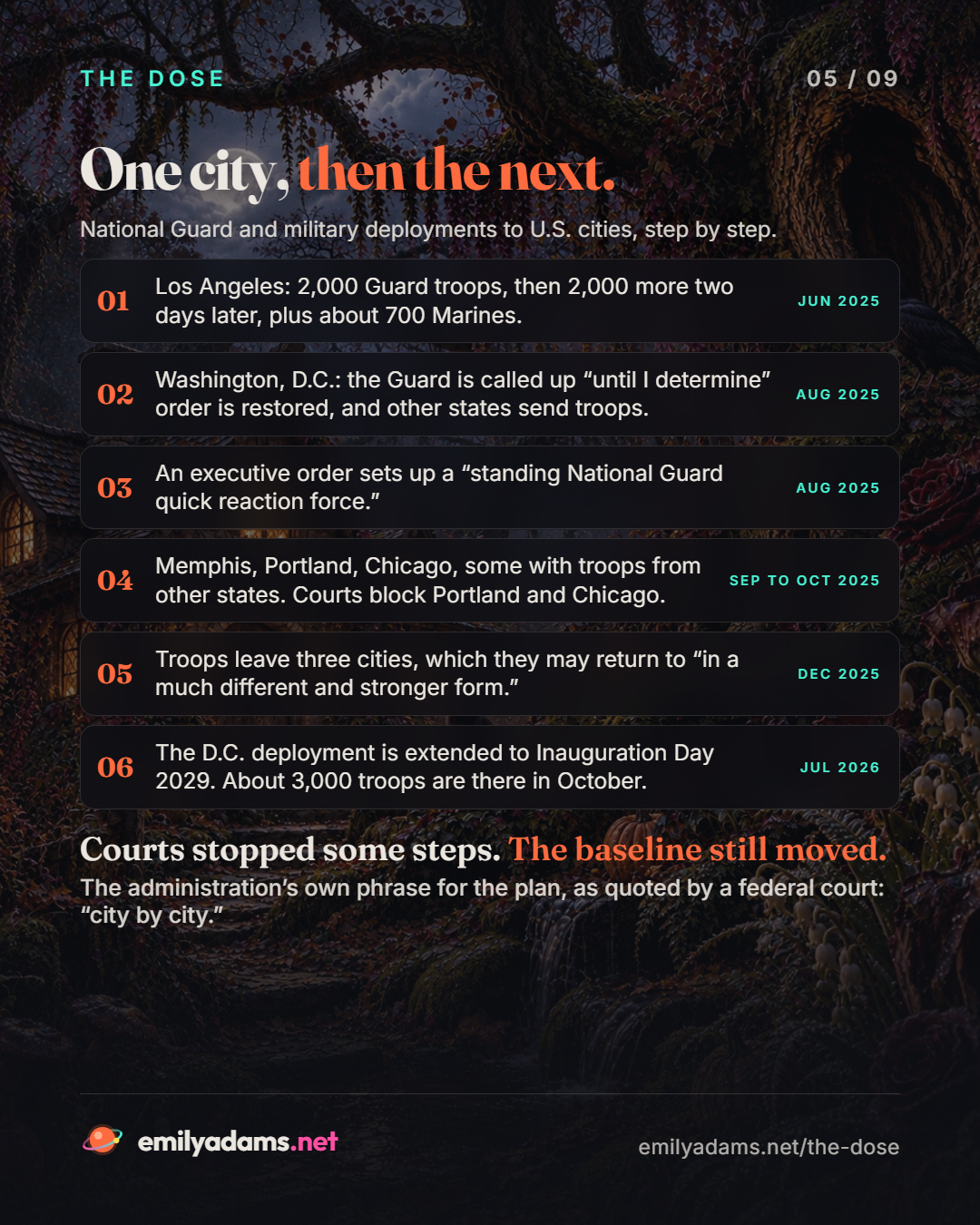
One City, Then the Next
On card 5
Los Angeles and Washington, D.C.: The First Orders
The White House, 2025 · The White House, presidential memoranda of June 7 and August 11, 2025, and Executive Order 14339 of August 25, 2025
June 7, 2025: a memorandum federalized “at least 2,000” California Guard for 60 days over the governor’s objection; two days later came 2,000 more and about 700 Marines. August 11: the D.C. Guard was mobilized “until I determine that conditions of law and order have been restored,” and other states were invited to send troops. August 25: an executive order called for trained civil-disturbance units in every state’s Guard and a “standing National Guard quick reaction force.”
Scope The link is the D.C. memorandum; the June 7 memorandum and the August 25 order are on the same White House archive. Troop numbers are as published at each step.
On card 5
Portland, Chicago, and the Courts
NPR and the Supreme Court, 2025 · NBC News, October 2025; Supreme Court of the United States, Trump v. Illinois, December 23, 2025; NPR, December 23, 2025
Guard troops were federalized for Portland (200) and Chicago (at least 300) in September and October 2025, with troops from California and Texas sent across state lines. Federal trial courts blocked both. On December 23, 2025, the Supreme Court, 6 to 3, declined to let the Chicago deployment go ahead while the case continued.
Scope The Supreme Court’s order was interim and limited to the law used in Illinois. It did not decide the D.C. deployment, which rests on different law, and courts also sided with the administration at several steps.
On card 5
Withdrawal From Three Cities
CNN, 2025 · CNN, December 31, 2025, as carried by KEYT
The president announced the Guard would leave Chicago, Los Angeles, and Portland, adding that troops could return “perhaps in a much different and stronger form.” The withdrawals were completed in January 2026.
Scope This is a step back, and the card says so: courts stopped some steps.
On card 5
Washington, D.C., Extended to 2029
NPR and AP, 2026 · NPR, July 14, 2026; Associated Press, August 4 and October 2, 2026
The Pentagon confirmed the D.C. deployment would continue to Inauguration Day 2029, with nearly 5,000 troops during the summer of 2026. In August the Pentagon estimated about $1.4 billion to keep an average of 2,500 there through January 2029. AP reported about 3,000 troops in October 2026.
Scope Troop numbers changed through the year; each one is printed with its date and outlet.
Background context
“City by City”
Federal court record, 2025 · As quoted in a federal court opinion in the Illinois case, from an administration statement of October 6, 2025
The administration’s own phrase for the plan, “city by city,” was quoted by a federal court in the Illinois case. The link is the Supreme Court’s docket for that case, which includes the lower-court record.
Scope I read the phrase as quoted by the court, not in the original statement.
Card 6
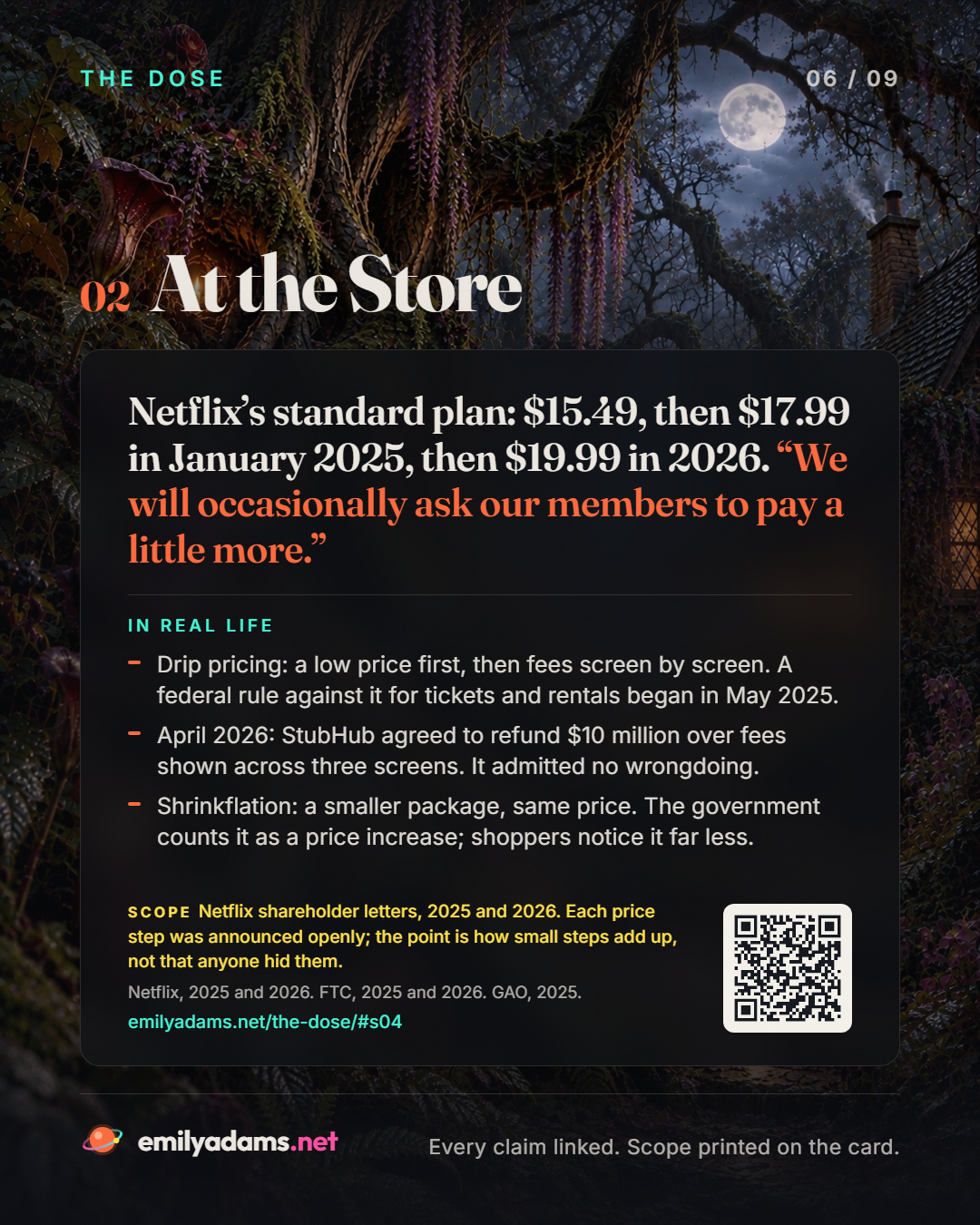
At the Store
On card 6
Shareholder Letters, January 2025 and April 2026
Netflix, 2025 and 2026 · Netflix, Exhibit 99.1 to Forms 8-K filed with the SEC, January 21, 2025 and April 16, 2026
In January 2025 Netflix raised its U.S. standard plan from $15.49 to $17.99 a month, telling shareholders “we will occasionally ask our members to pay a little more.” By 2026 the standard plan was $19.99, and the plan with ads had gone from $6.99 to $7.99 to $8.99.
Scope Each step was announced openly. The card is about how small steps add up, not about anything hidden. I could not confirm the month of the 2026 increase, so the card says 2026.
On card 6
The Junk Fees Rule, and StubHub
Federal Trade Commission, 2025 and 2026 · FTC press releases, May 2025 and April 2026
A federal rule requiring the full price up front for live-event tickets and short-term lodging took effect on May 12, 2025. In April 2026 StubHub agreed to refund $10 million to settle FTC charges that it revealed fees across three screens at checkout.
Scope These are the FTC’s allegations; StubHub did not admit wrongdoing.
On card 6
Shrinkflation and How Shoppers Respond
Government Accountability Office, 2025 · GAO-25-107451, July 31, 2025; Bureau of Labor Statistics
The Bureau of Labor Statistics counts a smaller package at the same price as a price increase. GAO reviewed the research and found studies in which shoppers were about two to five times more responsive to a price increase than to an equal cut in package size.
Scope I did not print specific product examples, because the ones I found came from secondary sources.
Card 7
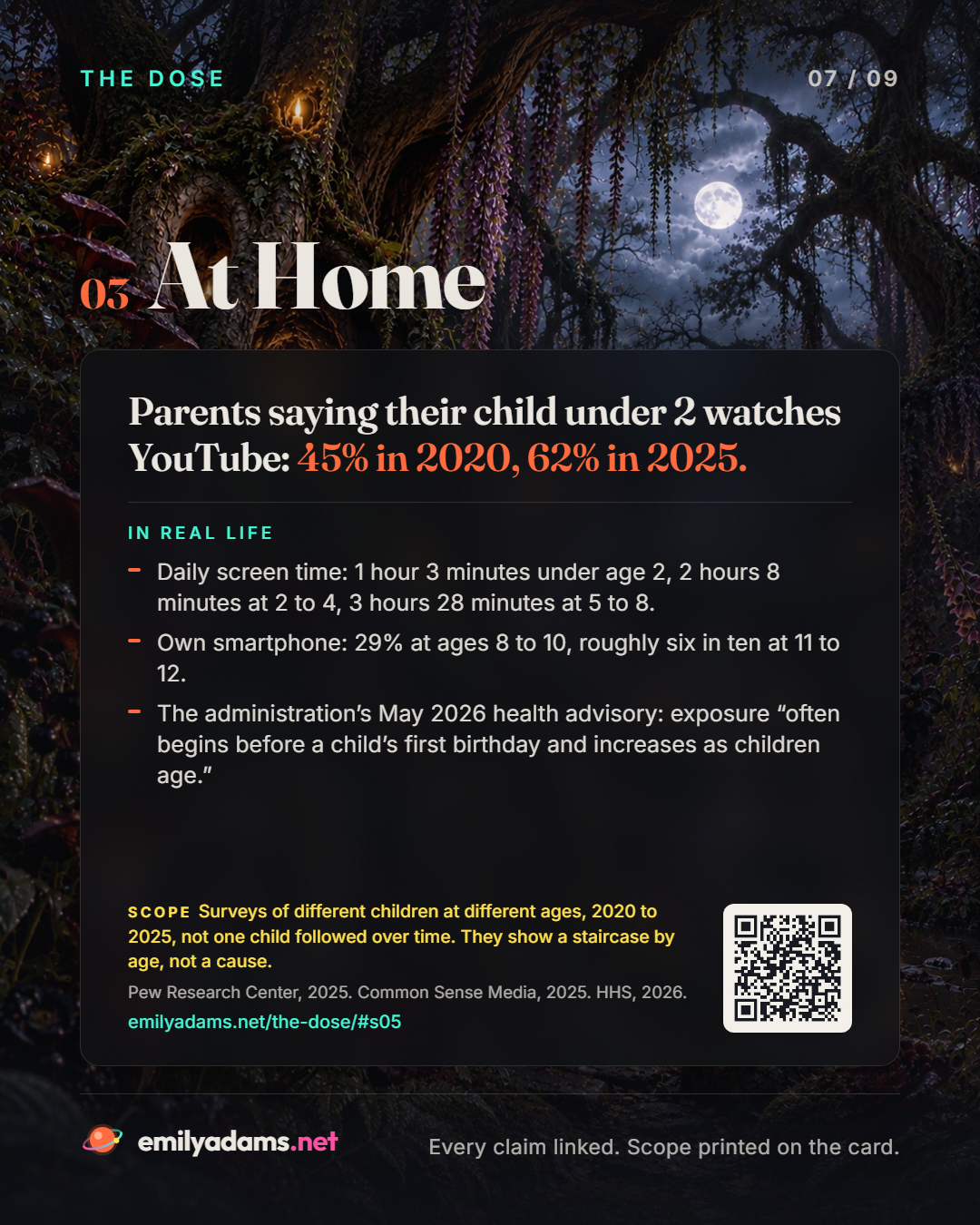
At Home
On card 7
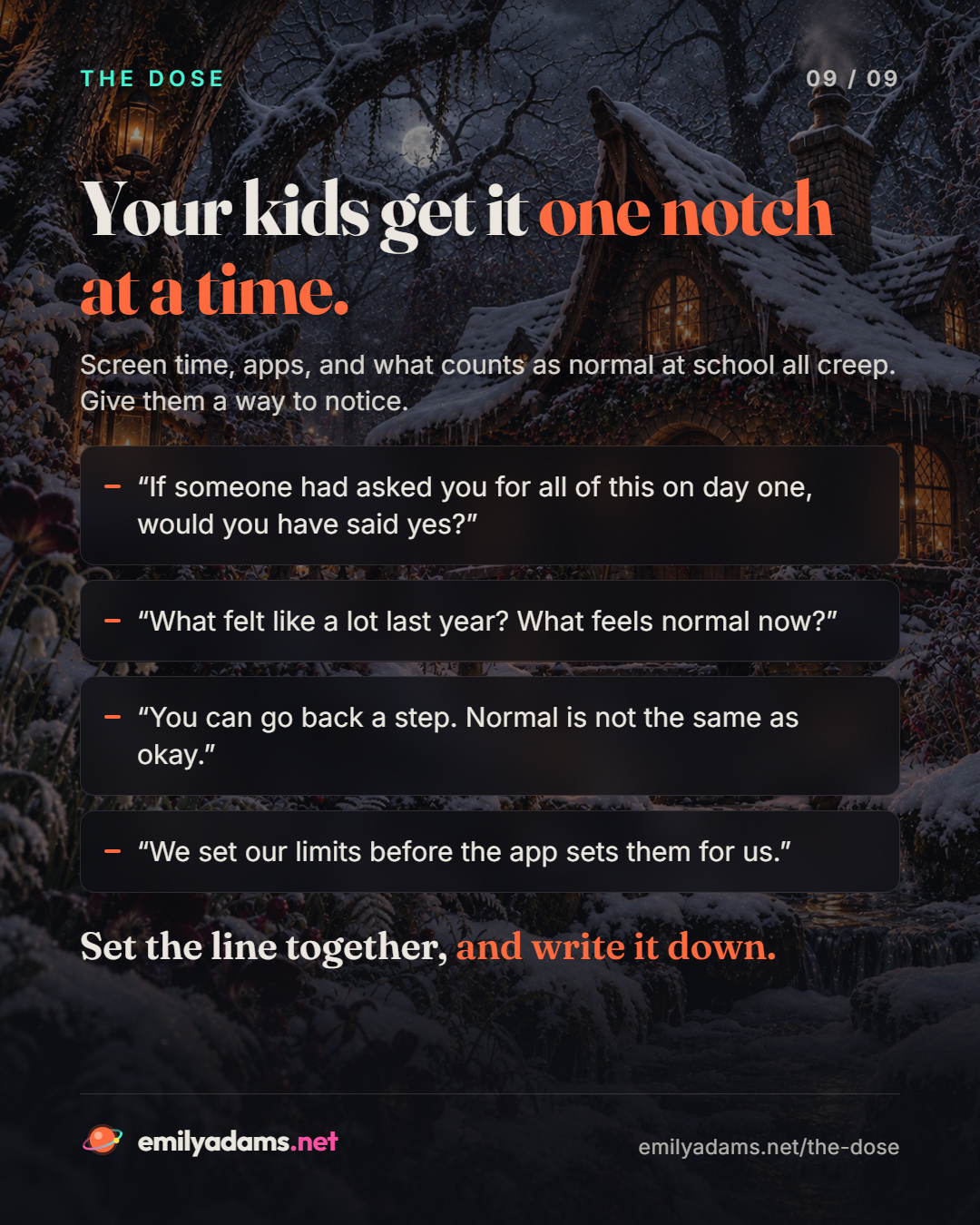
How Parents Manage Screen Time for Kids
Pew Research Center, 2025 · Pew Research Center, October 8, 2025
A survey of 3,054 parents of children 12 and under, May 2025. Among parents of a child under 2, the share who say the child watches YouTube rose from 45% in 2020 to 62% in 2025. 29% of parents of 8- to 10-year-olds and roughly six in ten parents of 11- and 12-year-olds say the child has a smartphone.
Scope Parent reports. The 2020 survey asked about children 11 and younger; Pew says results are largely unchanged when restricted the same way.
On card 7
The 2025 Common Sense Census: Media Use by Kids Zero to Eight
Common Sense Media, 2025 · Common Sense Media, February 26, 2025
A nationally representative survey of 1,578 parents, August 2024. Average daily screen time: 1 hour 3 minutes under age 2, 2 hours 8 minutes at ages 2 to 4, and 3 hours 28 minutes at 5 to 8. Forty percent of children have a tablet by age 2.
Scope A survey of different children at different ages, not one child followed over time.
On card 7
Surgeon General’s Warning on the Harms of Screen Use
U.S. Department of Health and Human Services, 2026 · HHS advisory, May 20, 2026
The advisory says exposure “often begins before a child’s first birthday and increases as children age.” Its section for families suggests limits that could be none under 18 months, under one hour a day under age 6, and two hours a day for ages 6 to 18.
Scope An advisory, not a regulation. There was no confirmed Surgeon General when it was issued; news reports say HHS officials developed it.
Background context
Does the Feed Push People Toward Extremes?
Hosseinmardi and colleagues, 2024; Chen and colleagues, 2023 · Proceedings of the National Academy of Sciences, 2024; Science Advances, 2023
The strongest studies of YouTube found little evidence that the recommendation algorithm pushes adult users step by step toward extreme content; most extreme viewing came from people who already sought it out.
Scope These studies are of adults. I found no 2025 or 2026 audit of what feeds show teen accounts, so the home card is about time and habits, not content.