Social Engineering Series, Part 6

That is so me: the sources behind the cards.

A ten-slide series on the third move in the playbook: turn a claim into a team, so that questioning it feels like turning on your own people. This page has the studies, the transcripts, and the data behind every card, with dates, links, and what each one cannot tell you, plus a reading check you can try yourself.

Published October 15, 2026 · Emily Adams · Checked against the original studies, transcripts, and the data

The Cards

The full text of every card, in order, with the card itself under each one. Select a card to open it full size.

Card 01 of 09
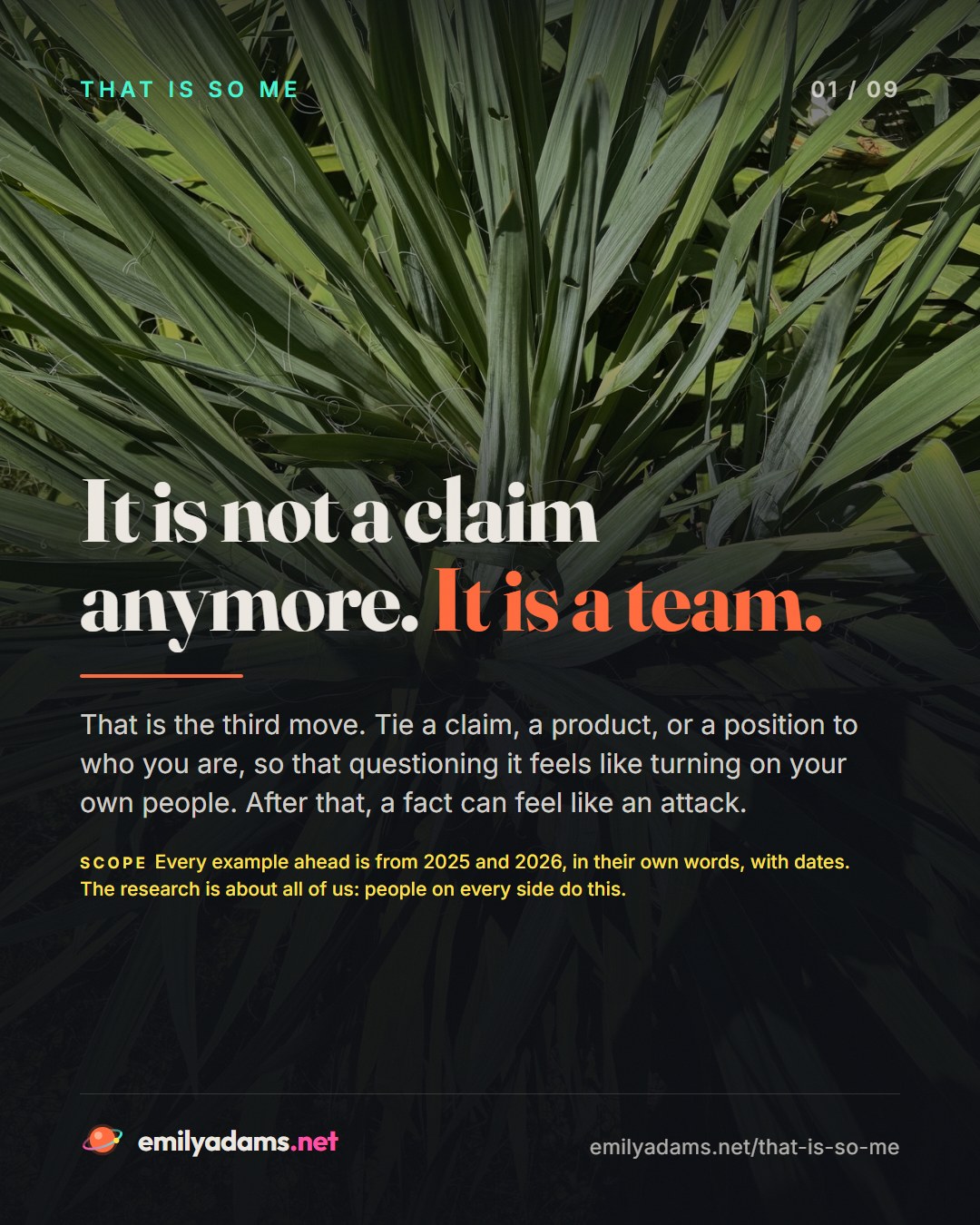
It is not a claim anymore. It is a team.
  • That is the third move. Tie a claim, a product, or a position to who you are, so that questioning it feels like turning on your own people. After that, a fact can feel like an attack.
SCOPE Every example ahead is from 2025 and 2026, in their own words, with dates. The research is about all of us: people on every side do this.
All sourcesCard 1
Card 02 of 09
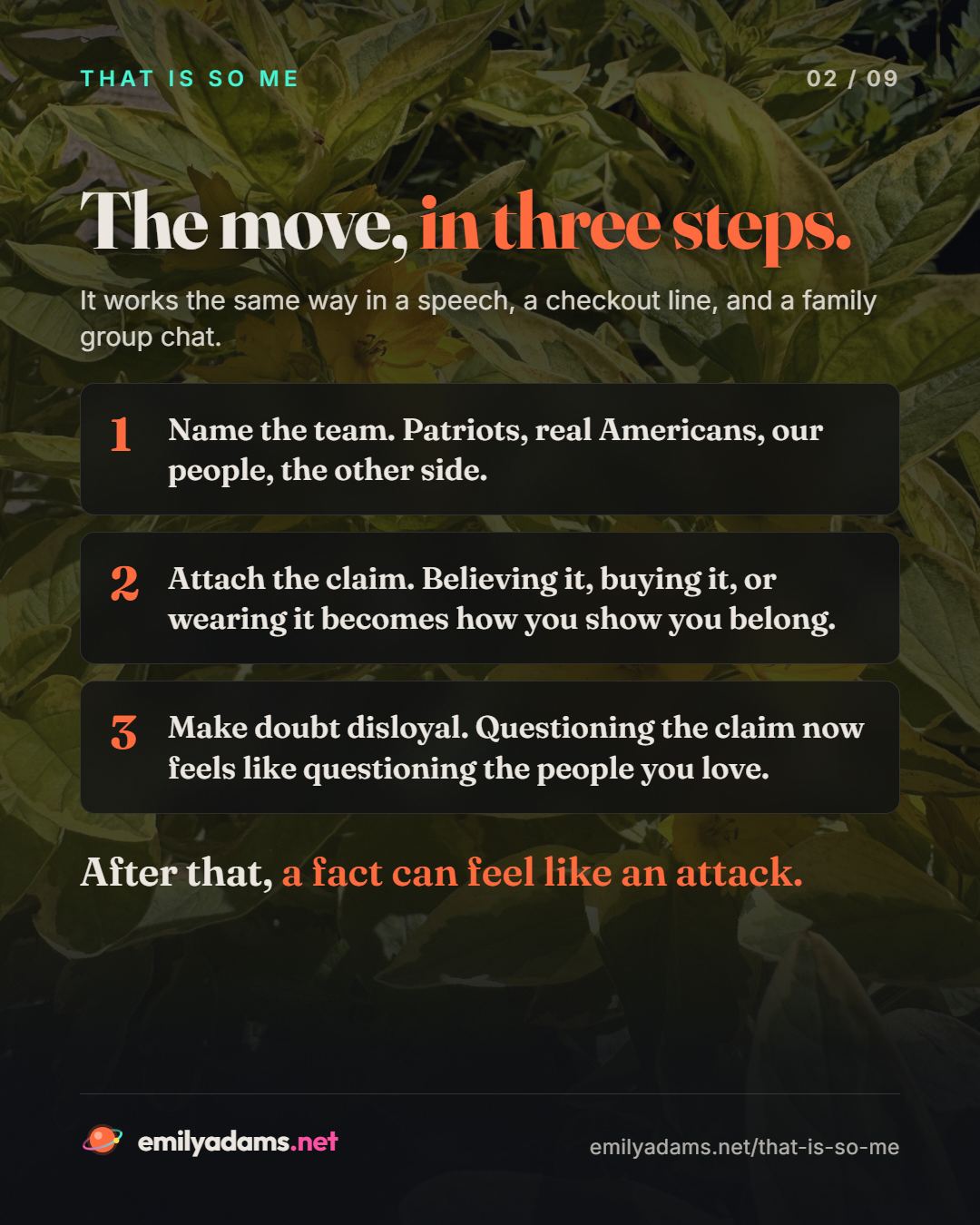
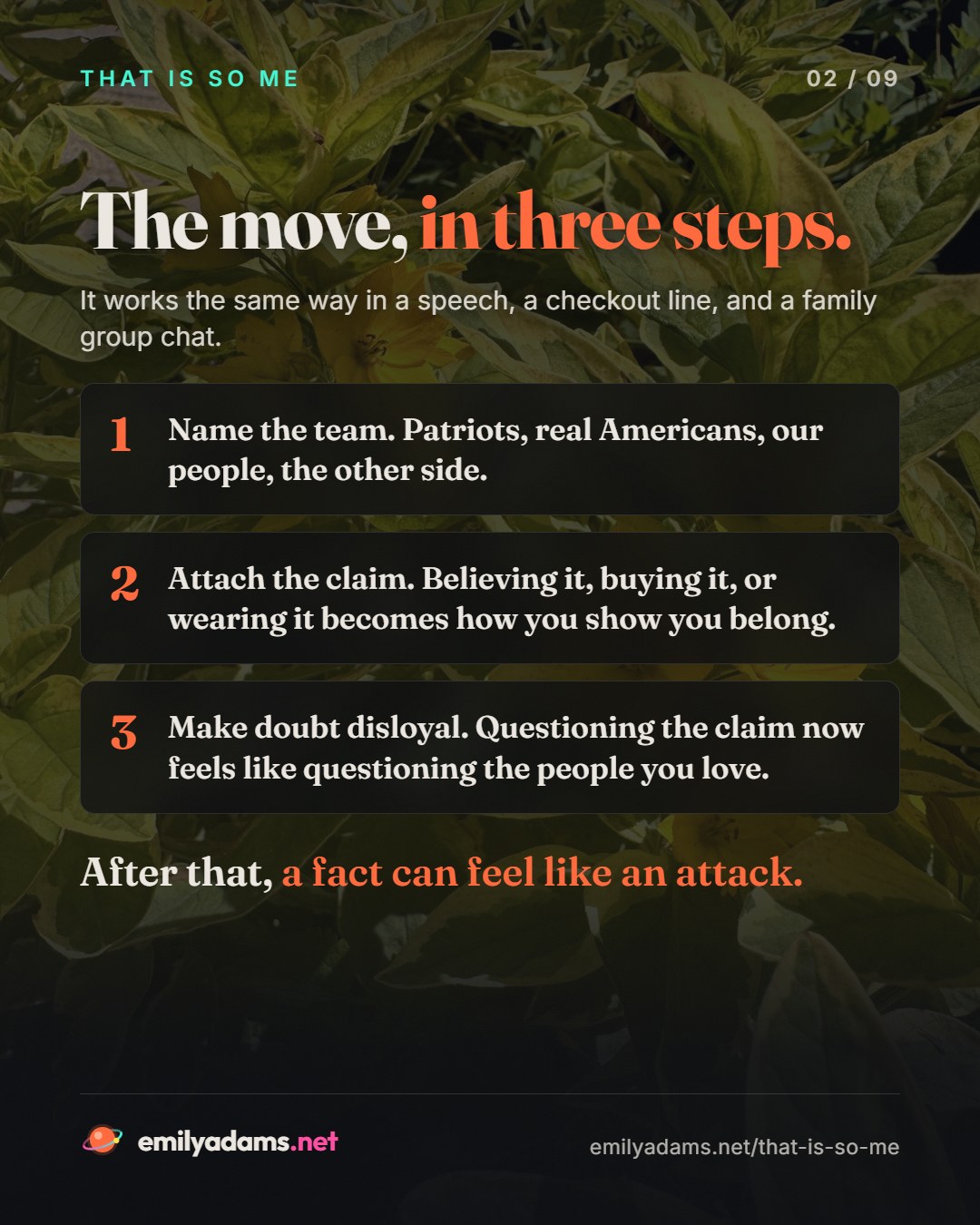
The move, in three steps.
  • It works the same way in a speech, a checkout line, and a family group chat.
  • Name the team. Patriots, real Americans, our people, the other side.
  • Attach the claim. Believing it, buying it, or wearing it becomes how you show you belong.
  • Make doubt disloyal. Questioning the claim now feels like questioning the people you love.
After that, a fact can feel like an attack.
What these cards cannot tell youCard 2
Card 03 of 09
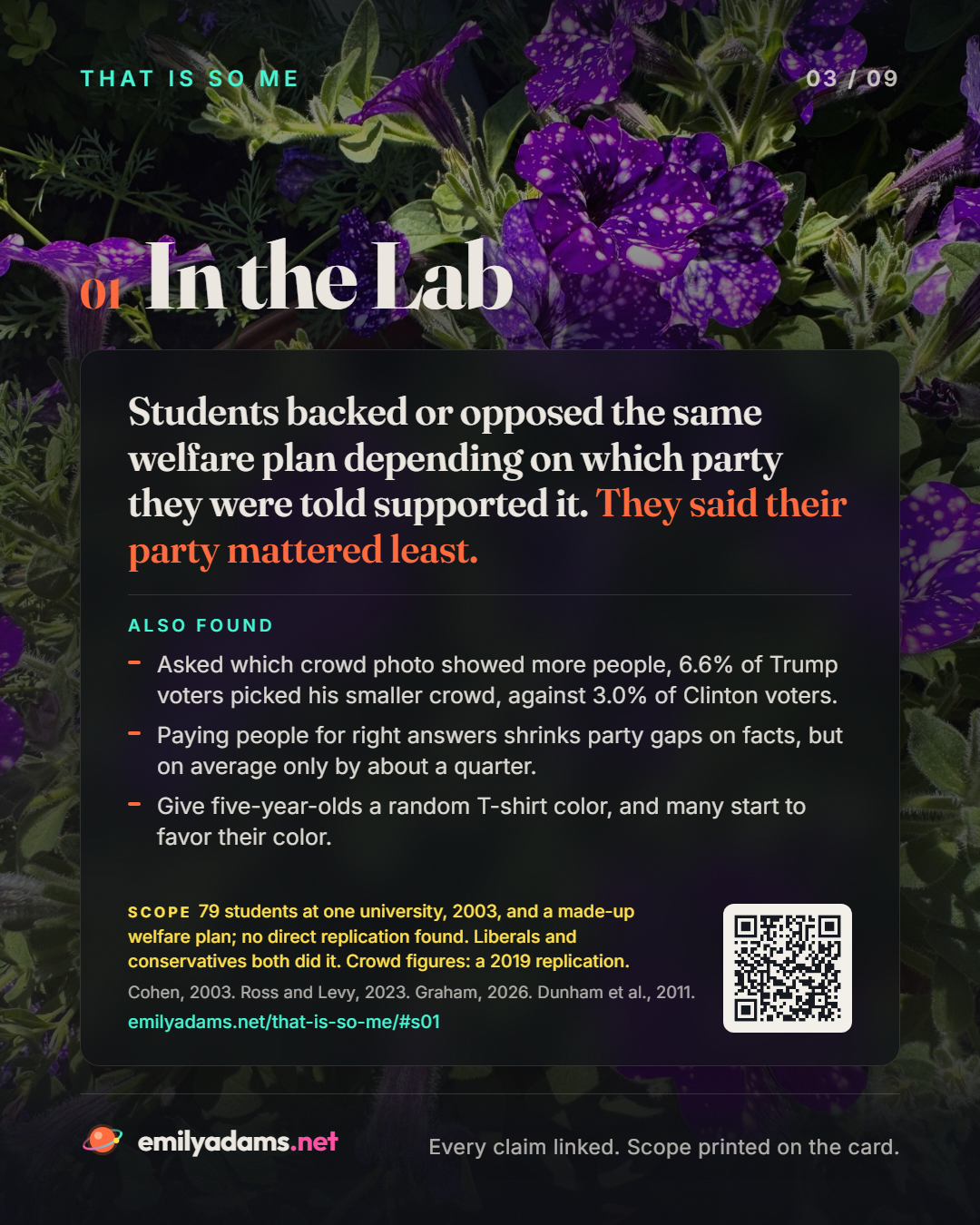
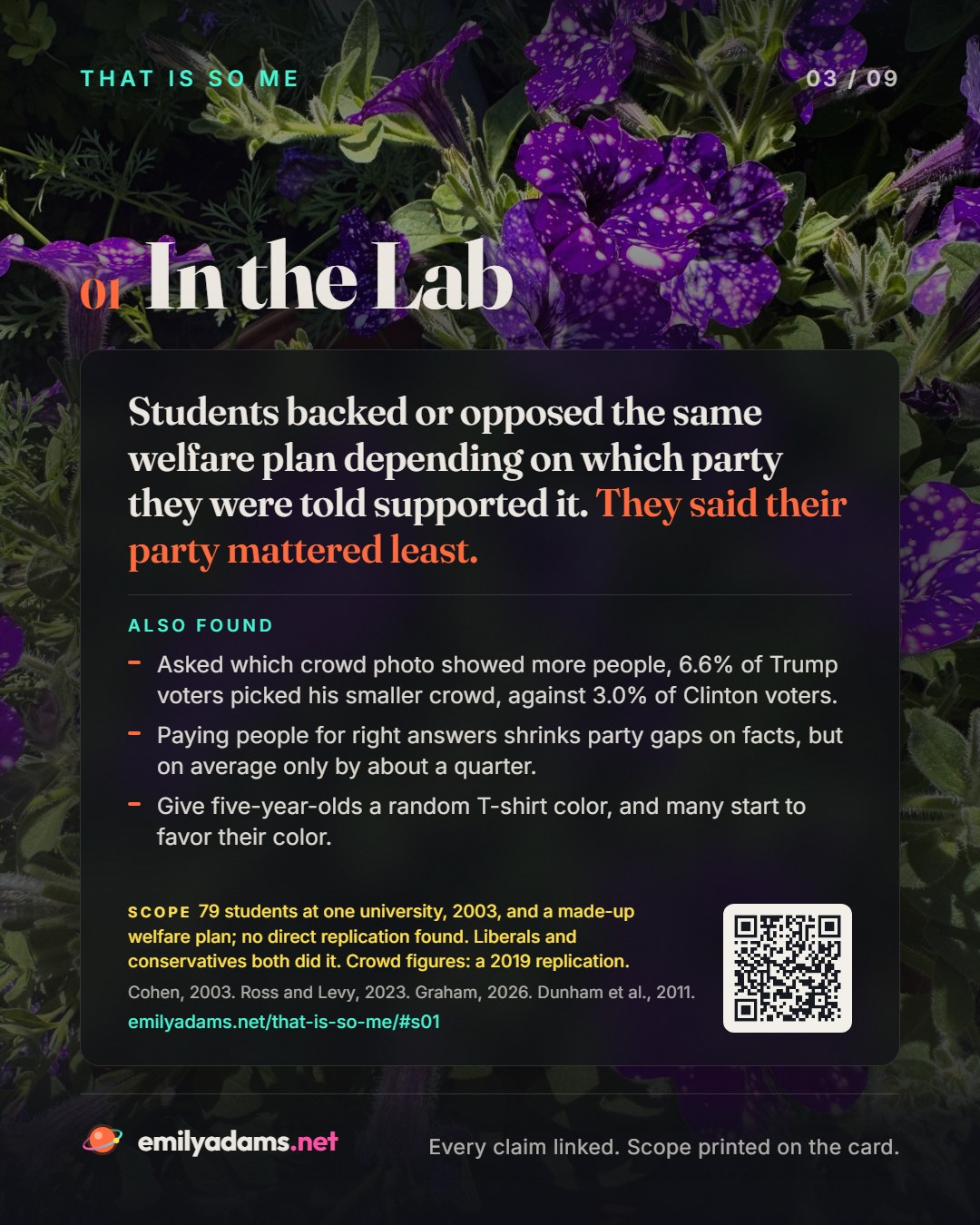
In the Lab. Students backed or opposed the same welfare plan depending on which party they were told supported it. They said their party mattered least.
  • Asked which crowd photo showed more people, 6.6% of Trump voters picked his smaller crowd, against 3.0% of Clinton voters.
  • Paying people for right answers shrinks party gaps on facts, but on average only by about a quarter.
  • Give five-year-olds a random T-shirt color, and many start to favor their color.
SCOPE 79 students at one university, 2003, and a made-up welfare plan; no direct replication found. Liberals and conservatives both did it. Crowd figures: a 2019 replication.
Sources and linksCard 3
Card 04 of 09
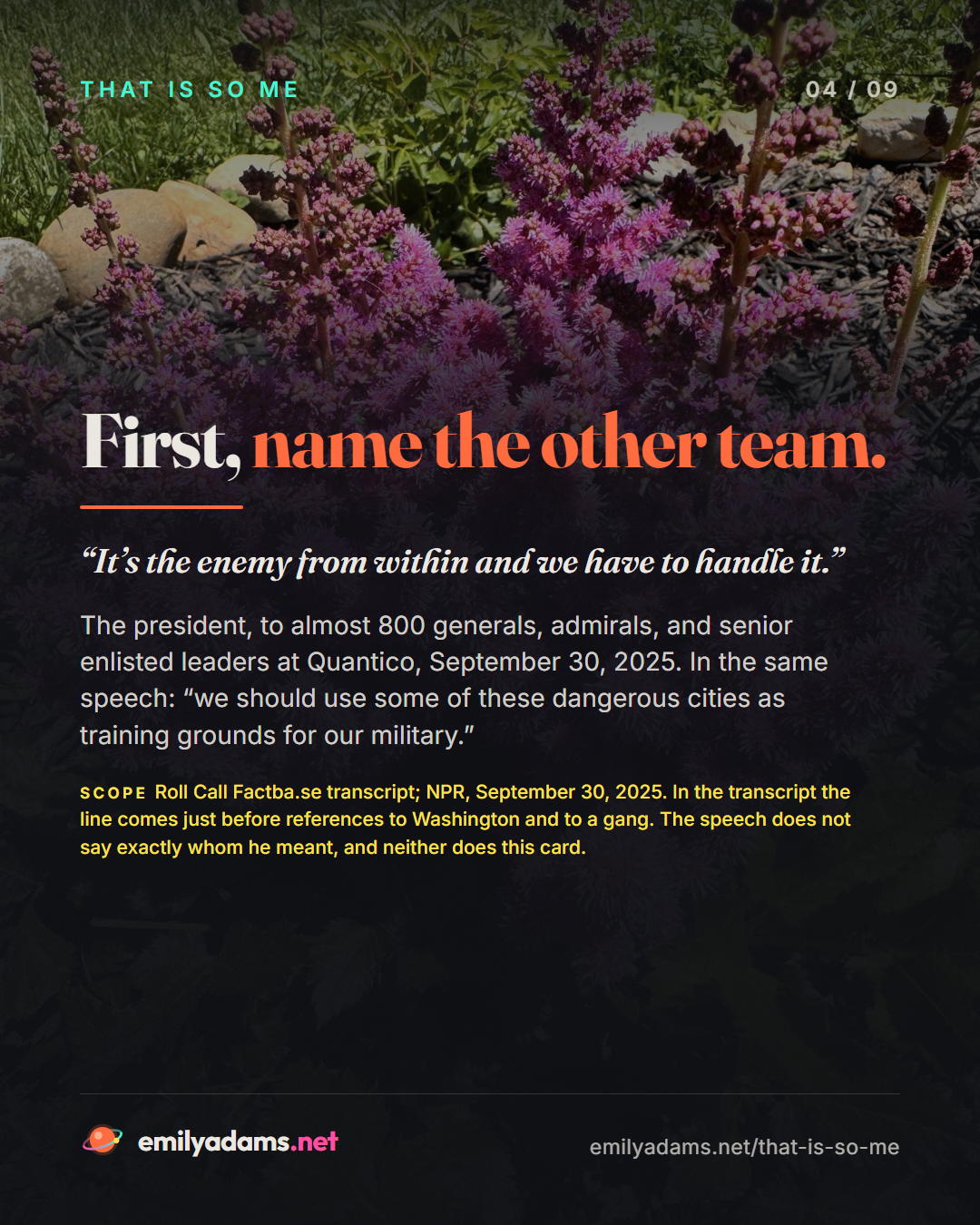
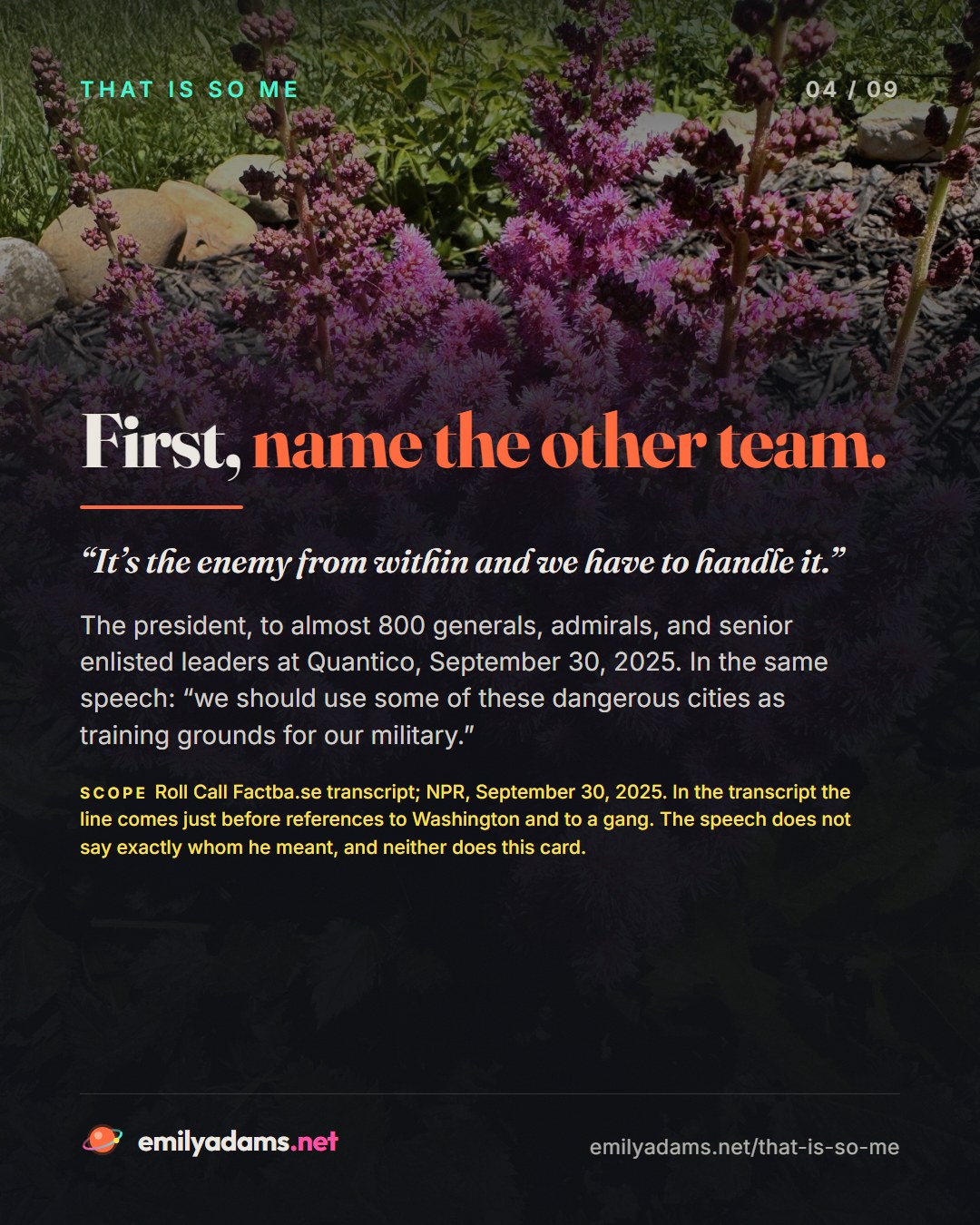
First, name the other team.
“It’s the enemy from within and we have to handle it.”
  • The president, to almost 800 generals, admirals, and senior enlisted leaders at Quantico, September 30, 2025. In the same speech: “we should use some of these dangerous cities as training grounds for our military.”
SCOPE Roll Call Factba.se transcript; NPR, September 30, 2025. In the transcript the line comes just before references to Washington and to a gang. The speech does not say exactly whom he meant, and neither does this card.
Sources and linksCard 4
Card 05 of 09
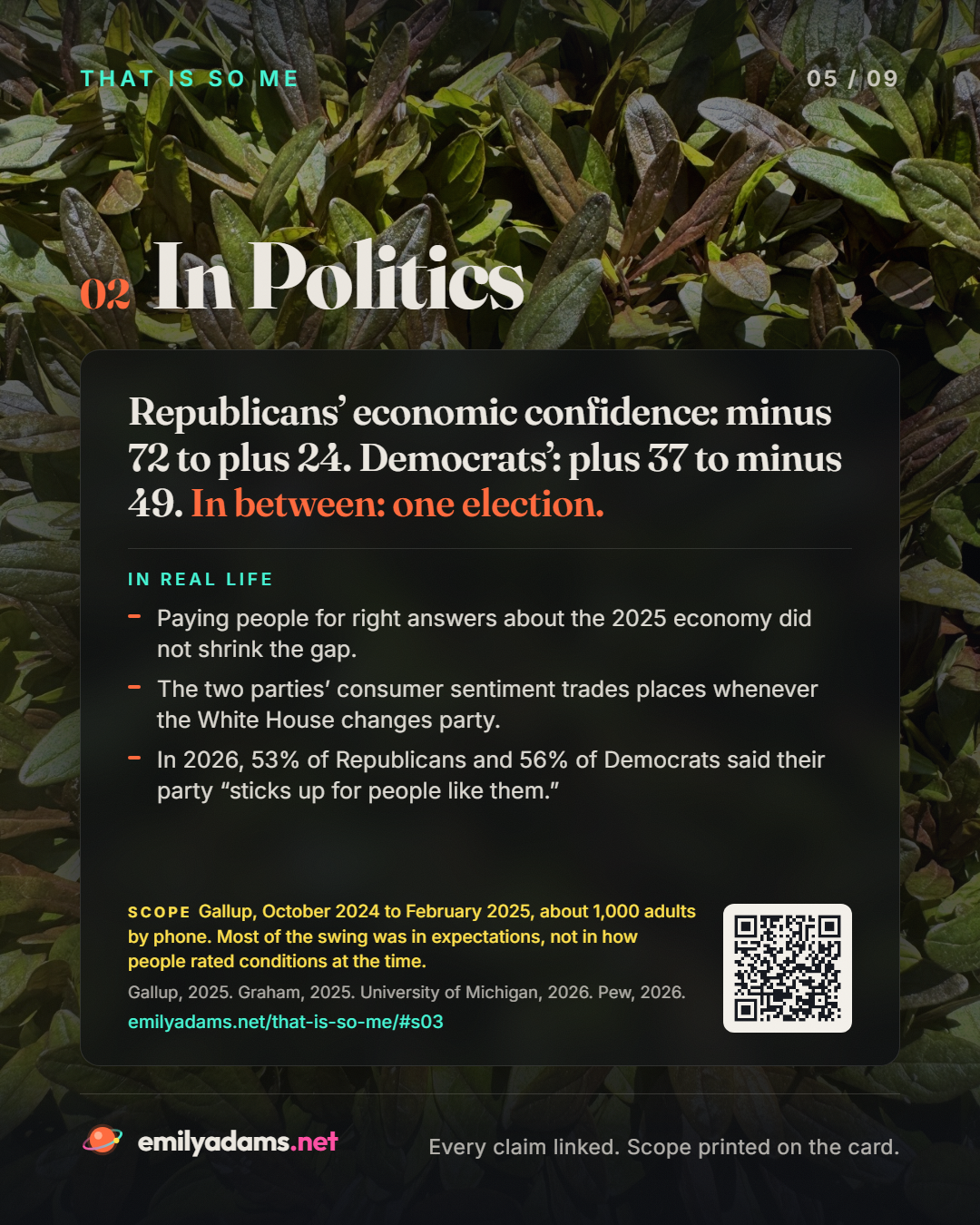
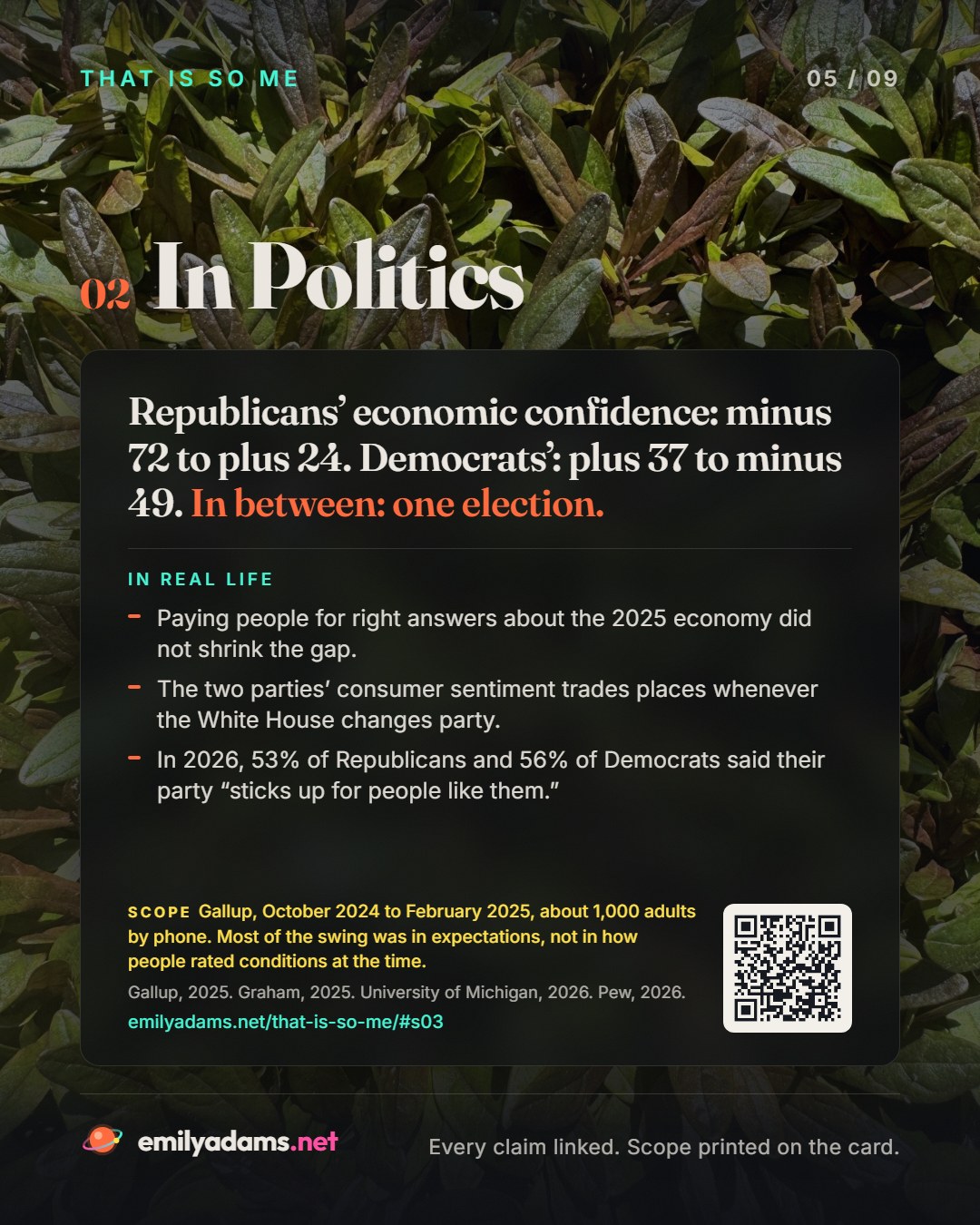
In Politics. Republicans’ economic confidence: minus 72 to plus 24. Democrats’: plus 37 to minus 49. In between: one election.
  • Paying people for right answers about the 2025 economy did not shrink the gap.
  • The two parties’ consumer sentiment trades places whenever the White House changes party.
  • In 2026, 53% of Republicans and 56% of Democrats said their party “sticks up for people like them.”
SCOPE Gallup, October 2024 to February 2025, about 1,000 adults by phone. Most of the swing was in expectations, not in how people rated conditions at the time.
Sources and linksCard 5
Card 06 of 09
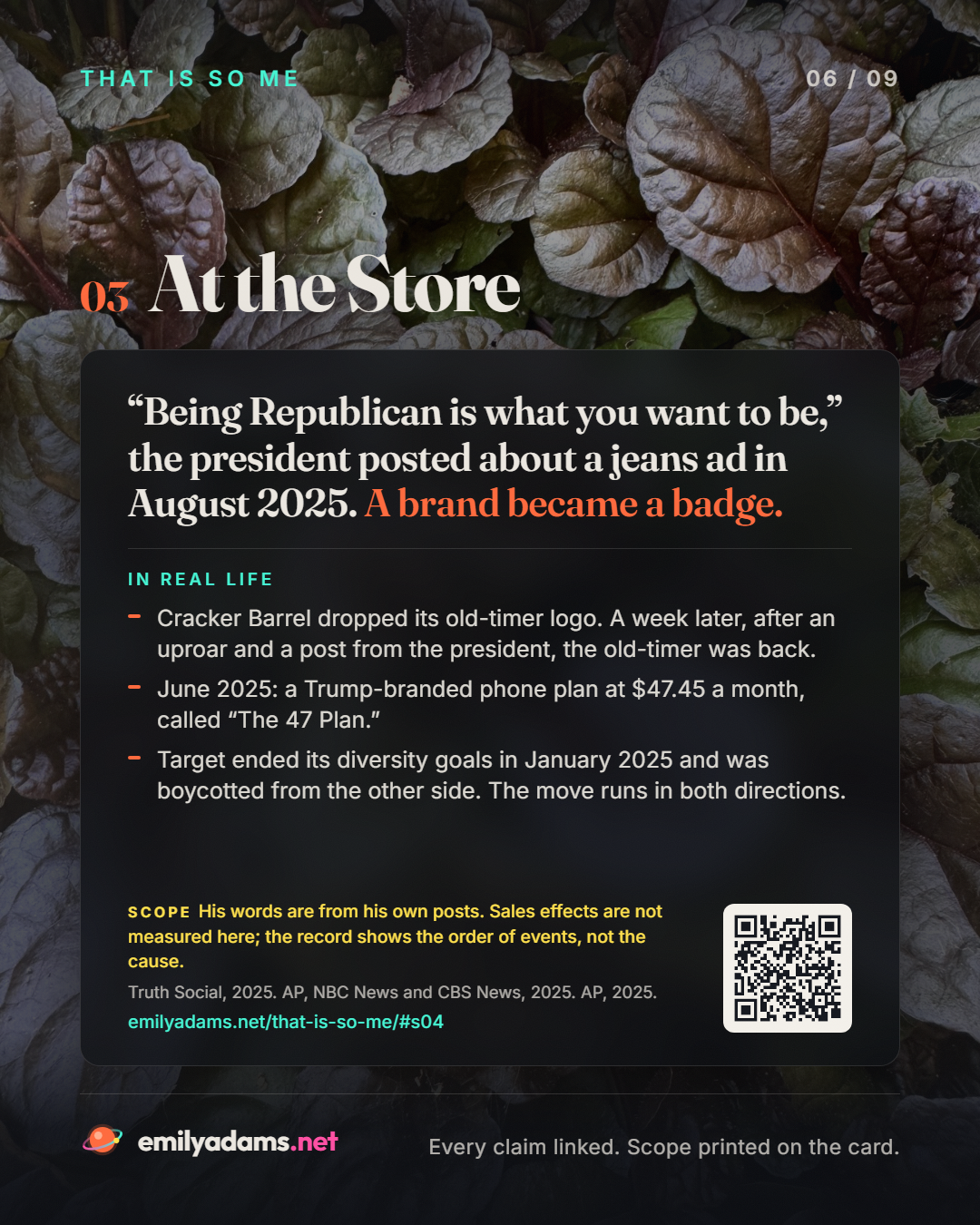
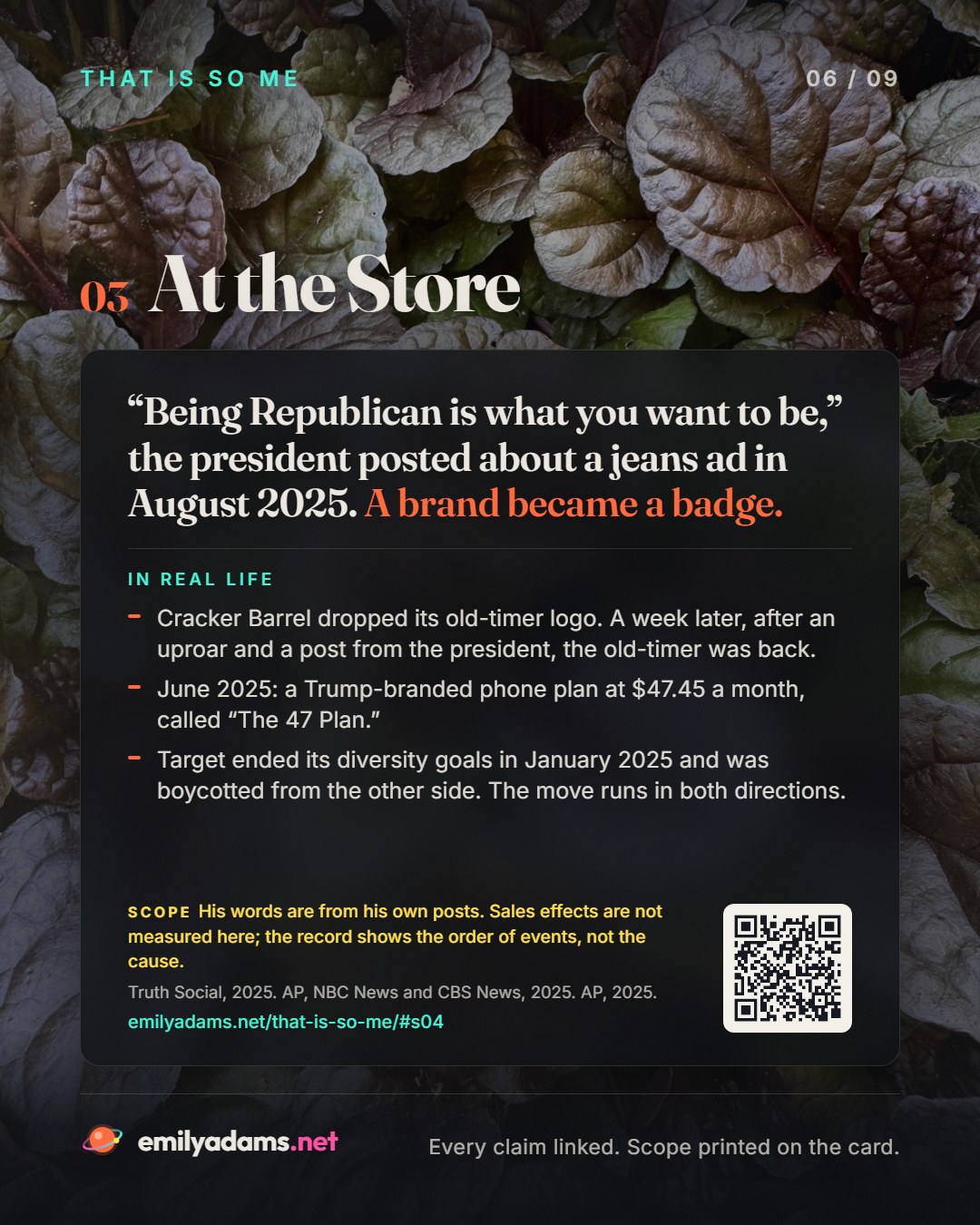
At the Store. “Being Republican is what you want to be,” the president posted about a jeans ad in August 2025. A brand became a badge.
  • Cracker Barrel dropped its old-timer logo. A week later, after an uproar and a post from the president, the old-timer was back.
  • June 2025: a Trump-branded phone plan at $47.45 a month, called “The 47 Plan.”
  • Target ended its diversity goals in January 2025 and was boycotted from the other side. The move runs in both directions.
SCOPE His words are from his own posts. Sales effects are not measured here; the record shows the order of events, not the cause.
Sources and linksCard 6
Card 07 of 09
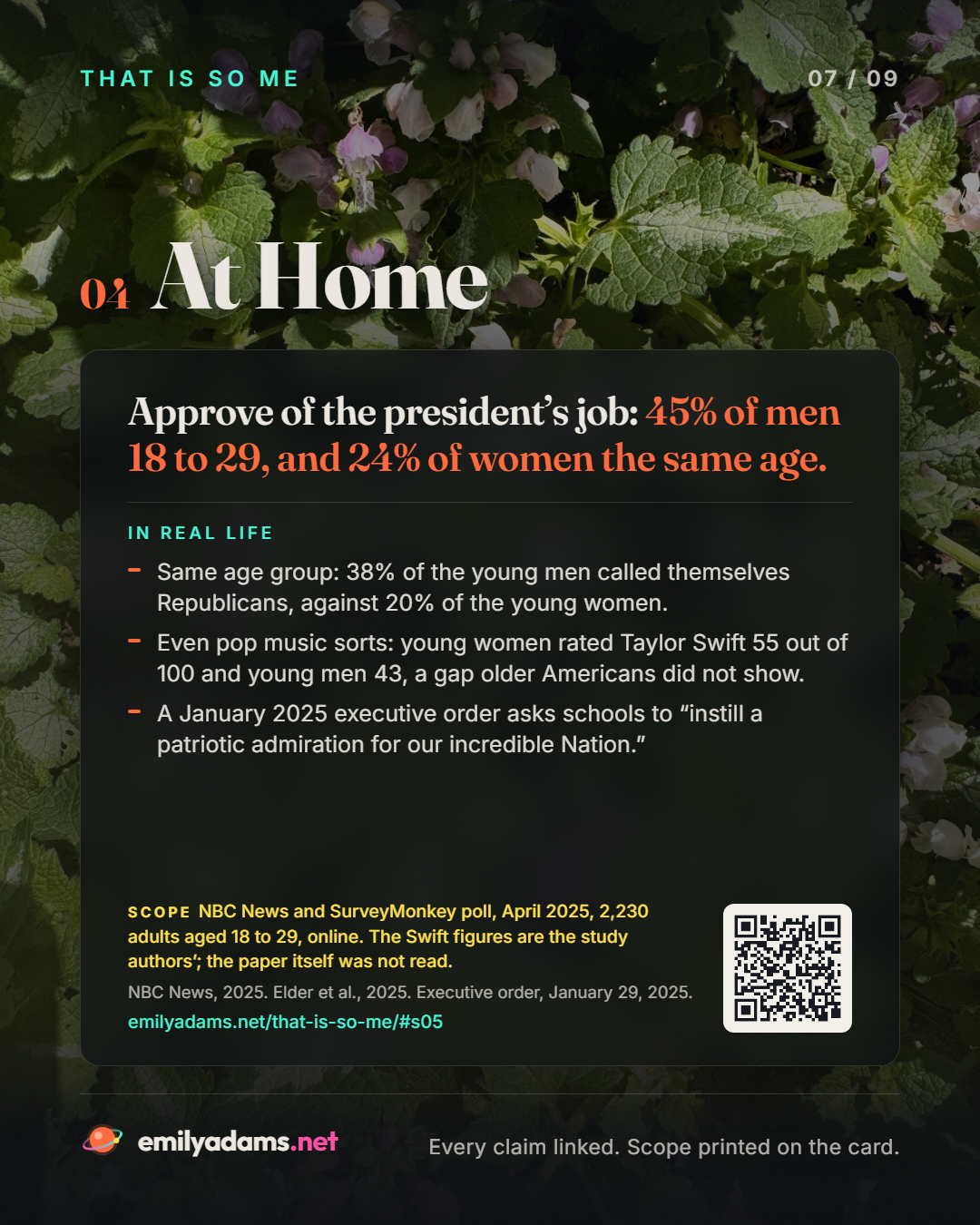
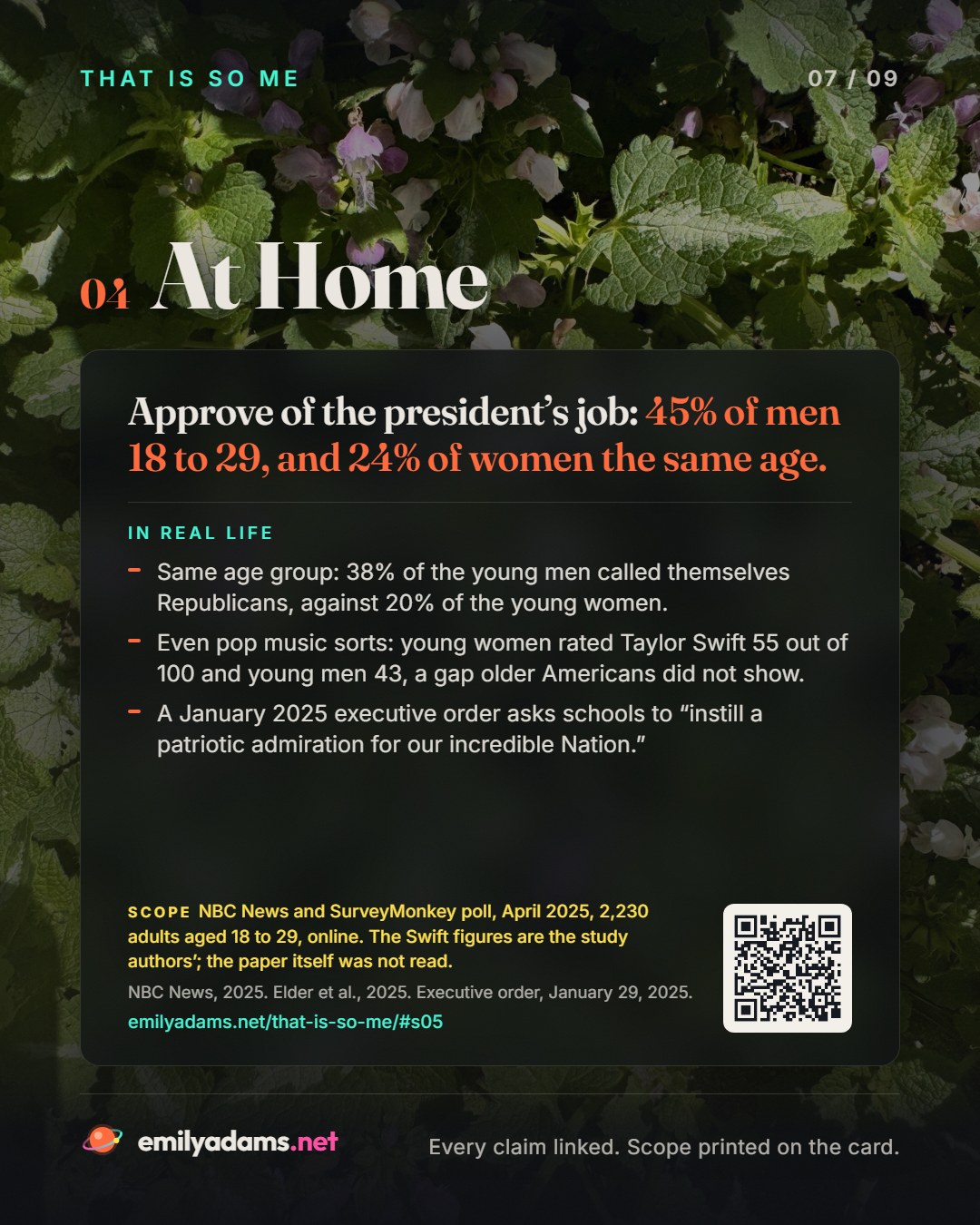
At Home. Approve of the president’s job: 45% of men 18 to 29, and 24% of women the same age.
  • Same age group: 38% of the young men called themselves Republicans, against 20% of the young women.
  • Even pop music sorts: young women rated Taylor Swift 55 out of 100 and young men 43, a gap older Americans did not show.
  • A January 2025 executive order asks schools to “instill a patriotic admiration for our incredible Nation.”
SCOPE NBC News and SurveyMonkey poll, April 2025, 2,230 adults aged 18 to 29, online. The Swift figures are the study authors’; the paper itself was not read.
Sources and linksCard 7
Card 08 of 09
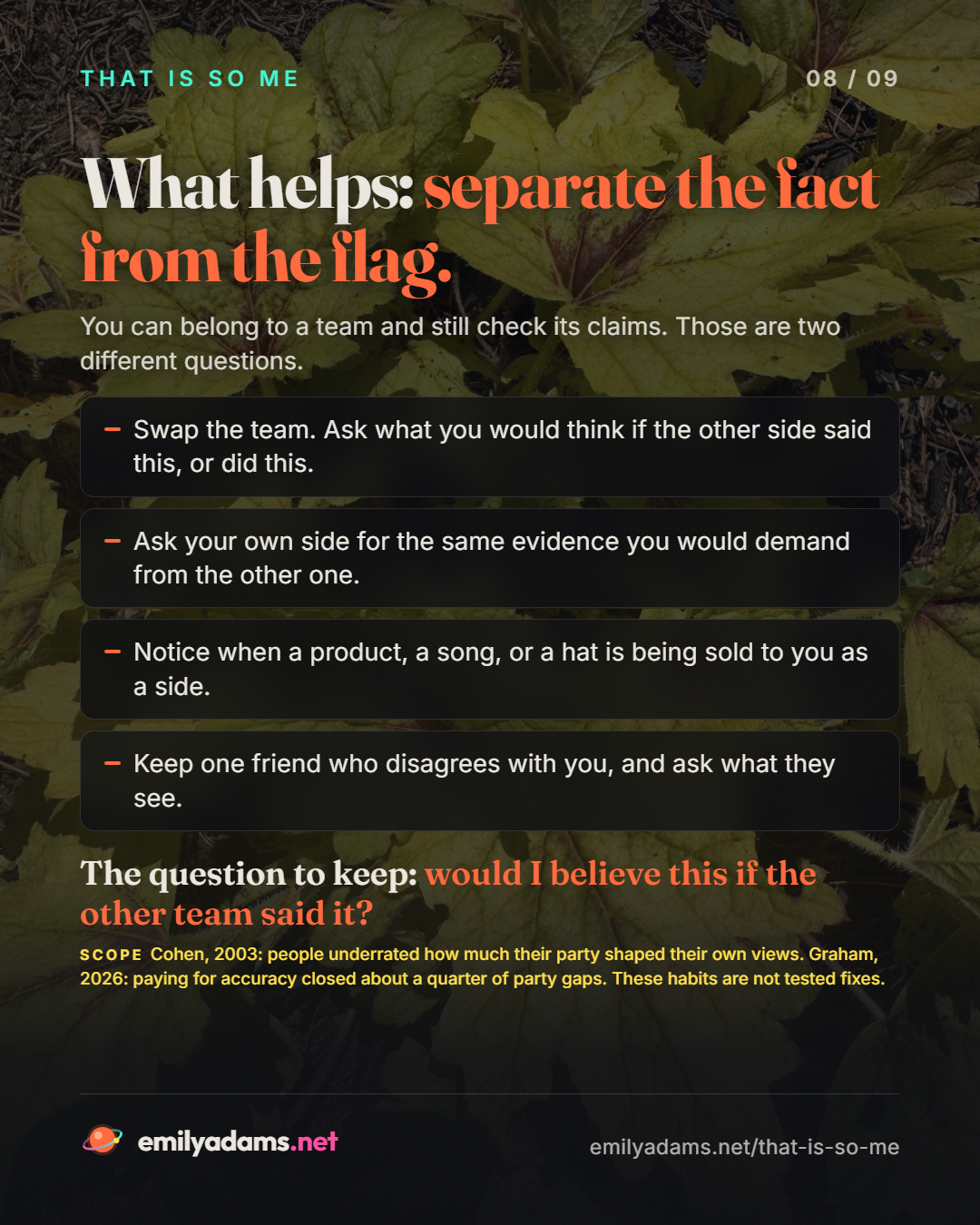
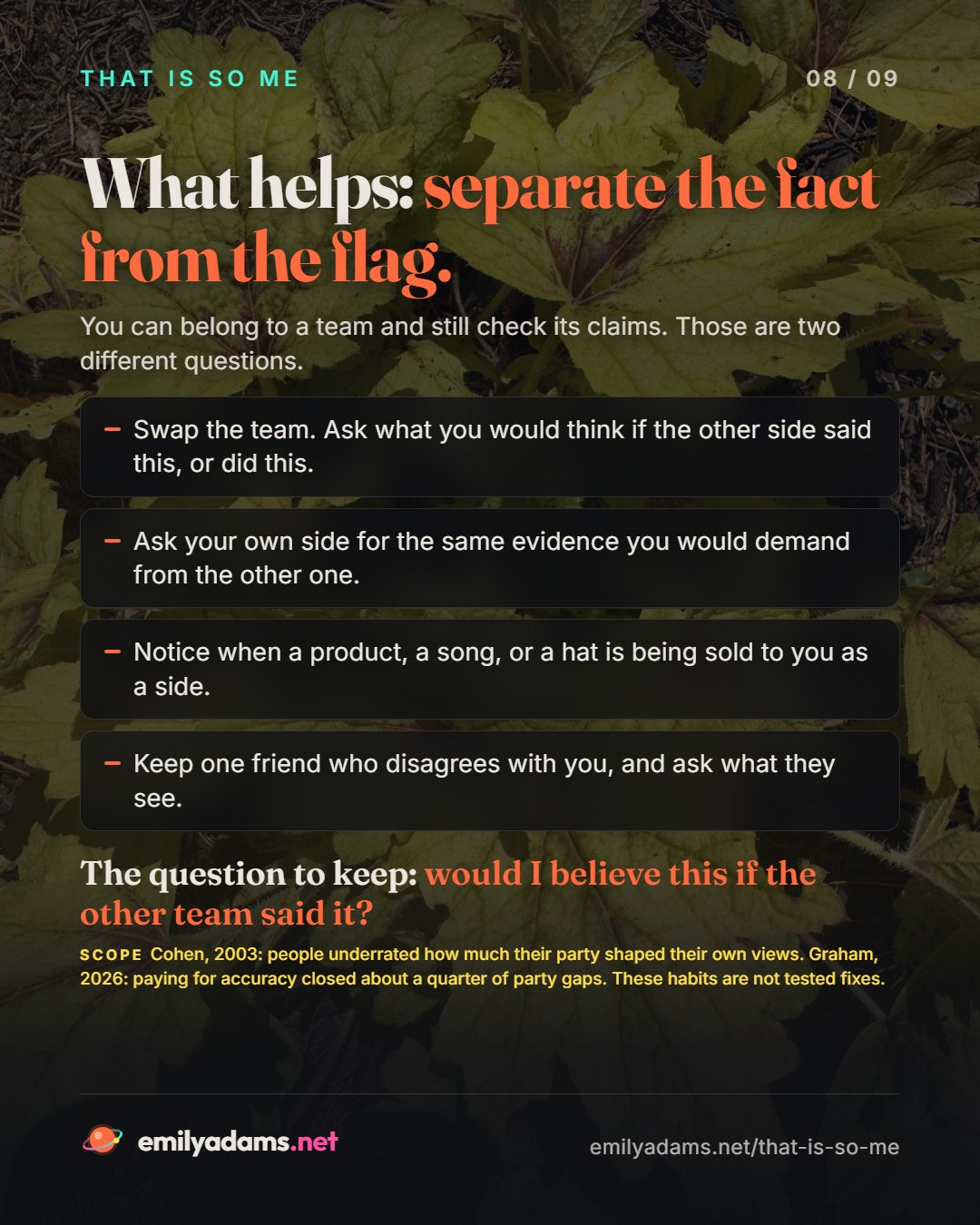
What helps: separate the fact from the flag.
  • You can belong to a team and still check its claims. Those are two different questions.
  • Swap the team. Ask what you would think if the other side said this, or did this.
  • Ask your own side for the same evidence you would demand from the other one.
  • Notice when a product, a song, or a hat is being sold to you as a side.
  • Keep one friend who disagrees with you, and ask what they see.
The question to keep: would I believe this if the other team said it?
SCOPE Cohen, 2003: people underrated how much their party shaped their own views. Graham, 2026: paying for accuracy closed about a quarter of party gaps. These habits are not tested fixes.
Sources and linksCard 8
Card 09 of 09
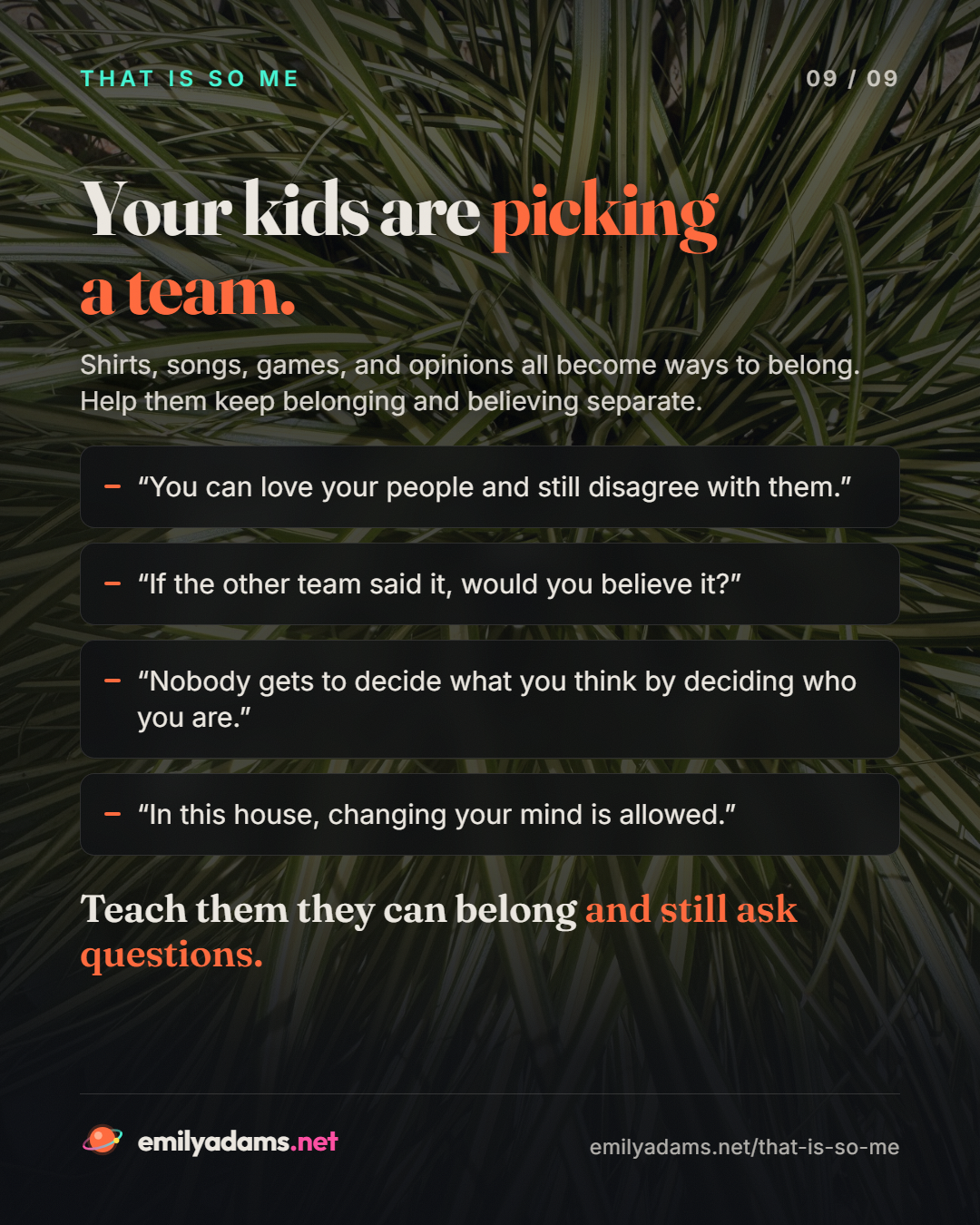
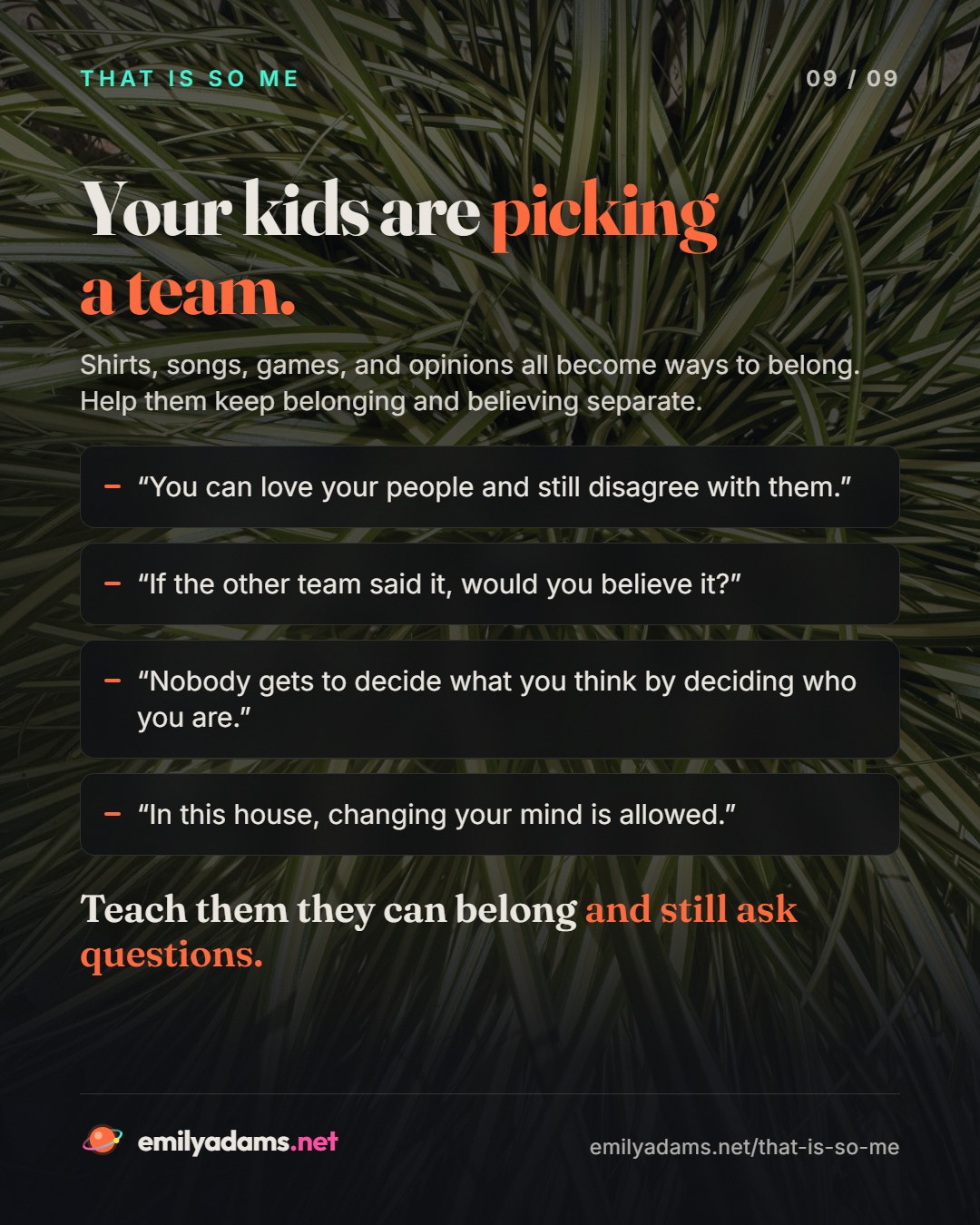
Your kids are picking a team.
  • Shirts, songs, games, and opinions all become ways to belong. Help them keep belonging and believing separate.
  • “You can love your people and still disagree with them.”
  • “If the other team said it, would you believe it?”
  • “Nobody gets to decide what you think by deciding who you are.”
  • “In this house, changing your mind is allowed.”
Teach them they can belong and still ask questions.
What these cards cannot tell youCard 9
Closing card
Next: the dose.
  • Part seven is escalation: one small step at a time, so each step makes the next one feel normal. Every source on these cards is linked, with its limits.

Closing card

The Sources

Grouped by card. Each source has a summary of what it says, a scope line saying how far it reaches, and a link to the original.

Card 3

In the Lab

On card 3

Party Over Policy: The Dominating Impact of Group Influence on Political Beliefs

Cohen, 2003 · Journal of Personality and Social Psychology, 85(5), 808 to 822

Liberal and conservative college students read about a welfare plan that was either generous or harsh, and were told it had the backing of 95% of House Democrats and 10% of Republicans, or the reverse. Their support depended almost entirely on which party they were told backed it, not on what the plan did: on a 7-point scale, liberals rated it 5.46 when told Democrats backed it and 3.15 when told Democrats opposed it, and conservatives showed the mirror image. Asked what influenced them, they rated the details of the plan highest and their party lowest.

Scope  Small student samples at one university, a made-up policy, and a very lopsided party signal. I found no direct replication. Liberals and conservatives both did it.
On card 3

Expressive Responding in Support of Donald Trump: An Extended Replication of Schaffner and Luks (2018)

Ross and Levy, 2023 · Collabra: Psychology, 9(1), article 68054

A preregistered replication, run in October 2019 with 954 adults online. Shown two unlabeled photos of the 2009 and 2017 inaugurations and asked which had more people, 6.6% of Trump voters and 3.0% of Clinton voters chose the photo with fewer people; 6.9% of Republicans and 3.6% of Democrats did. The original 2018 study found the same pattern at a larger size.

Scope  The task can only catch one side giving a loyal wrong answer, because the right answer favored Obama’s crowd. The replication found less than half the original rate.
On card 3

Partisan Expressive Responding: Lessons from Two Decades of Research

Graham, 2026 · American Political Science Review, published online March 3, 2026

A reanalysis of 44 studies with about 71,000 respondents. Methods meant to strip out loyal answers, such as paying for correct ones, shrank measured party bias on facts by about 25% on average. The rest of the gap stayed. The effect was no larger among strong partisans or the more educated.

Scope  The size depends on the topic and the design. The safe line: paying for accuracy shrinks party gaps, but on average only by about a quarter.
On card 3

Consequences of “Minimal” Group Affiliations in Children

Dunham, Baron and Carey, 2011 · Child Development, 82(3), 793 to 811

Mostly five-year-olds were randomly put in a red or a blue group by a coin and given a matching T-shirt, with no competition and no reason to prefer either color. They liked their own group’s children more, gave them more, and remembered more good things they did.

Scope  140 children across three experiments from one lab, mostly middle class, and some effects were marginal.
Card 4

First, Name the Other Team

On card 4

Address to Senior Military Leaders, Quantico, September 30, 2025

Roll Call Factba.se, 2025 · Roll Call Factba.se transcript, from video

The president told the assembled leaders, “it’s the enemy from within and we have to handle it,” and in the same speech, “We’re under invasion from within, no different than a foreign enemy,” and “we should use some of these dangerous cities as training grounds for our military.”

Scope  In the transcript the “enemy from within” line comes just before references to Washington and to the Tren de Aragua gang, and the “invasion” line sits in a passage about the border. The speech does not define the phrase, so the card quotes it and does not say whom he meant.
On card 4

Trump Defends Use of the U.S. Military Against the “Enemy Within”

NPR, 2025 · NPR, September 30, 2025

NPR reported that almost 800 generals, admirals, and senior enlisted leaders were ordered to attend on short notice. The president framed the deployments as fighting crime in very unsafe places.

Scope  NPR notes that federal law limits the use of troops for law enforcement, with exceptions.
Card 5

In Politics

On card 5

Economic Confidence Index Steady in February

Gallup, 2025 · Gallup (Mary Claire Evans), February 21, 2025

Gallup’s Economic Confidence Index runs from minus 100 to plus 100. Republicans went from minus 72 in October 2024 to plus 24 in February 2025; Democrats went from plus 37 to minus 49. Gallup called it “a near-complete reversal.” Poll of 1,004 adults by phone, February 3 to 16, 2025.

Scope  Most of the swing was in expectations for the economy; ratings of current conditions were much closer across the parties.
On card 5

Expressive Responding and the Economy: The Case of Trump’s Return to Office

Graham, 2025 · Journal of Experimental Political Science, published online October 27, 2025

A preregistered test with 2,831 people in April 2025. Half were paid $2 for each correct guess about growth, unemployment, and inflation figures not yet published. “Partisan bias did not shrink as a result.”

Scope  One online sample and three statistics. It speaks to whether the flip was sincere, not whether anyone’s view was accurate.
On card 5

Sentiment, Web-Based Data Collection, and Partisanship

University of Michigan, 2026 · University of Michigan Surveys of Consumers, July 10, 2026

In May 2026 consumer sentiment was 32.8 for Democrats, 84.6 for Republicans, and 40.6 for independents. Under a Democratic president in June 2022, it was the other way around. The report says the two parties’ relative positions switch when the White House changes party.

Scope  Earlier research found that such swings in stated sentiment did not change what households actually spent.
On card 5

Why Americans Identify as Republicans and Democrats, and Why They Don’t

Pew Research Center, 2026 · Pew Research Center (Steven Shepard), October 2, 2026

A survey of 9,750 adults, May 26 to June 1, 2026. 53% of Republicans and 56% of Democrats gave “my party sticks up for people like me” as a major reason for their party. Larger shares cited the harm they see in the other party’s policies.

Scope  Self-reported reasons, which the 2003 study above suggests people may not judge well.
Card 6

At the Store

On card 6

“Being Republican Is What You Want to Be”

Truth Social, 2025; NBC News, 2025 · The president’s post of August 4, 2025; NBC News, July 28, 2025

After an American Eagle jeans ad with the actress Sydney Sweeney drew criticism and praise, the president posted that she was a registered Republican with the “HOTTEST” ad out there, and that “Being WOKE is for losers, being Republican is what you want to be.” NBC News covered the ad and the backlash before his post.

Scope  I did not print any sales or stock figures, because the ones I found came from secondary sources. A share price move is not evidence of lasting sales.
On card 6

Cracker Barrel’s Logo, Reversed in a Week

AP, NBC News and CBS News, 2025 · Associated Press, August 21, 2025; NBC News, August 26 and September 9, 2025; CBS News, August 2025

Cracker Barrel unveiled a new logo without the old man leaning on a barrel and drew an online uproar. On August 26, 2025, the president posted that the company should “go back to the old logo, admit a mistake,” and that evening, NBC and CBS reported, the company said the old-timer would stay. On September 9 it suspended restaurant remodels.

Scope  The backlash began before the president’s post, so the card gives the order of events, not the cause.
On card 6

Trump Mobile and “The 47 Plan”

CBS News, 2025; AP, 2026 · CBS News, June 16, 2025; Associated Press, January 6, 2026, as carried by PBS

A Trump-branded wireless service launched in June 2025 with a plan at $47.45 a month, named for his count as the 45th and 47th president, and promised a gold phone. AP reported in January 2026 that the phone had not shipped and that its “built in the United States” promise had been softened.

Scope  The company uses the Trump name under license. No sales figures were found; the identity is in the branding, not in a measured result.
On card 6

Target: Boycotted From the Other Side

Associated Press, 2025 · Associated Press, January 24 and 31, 2025, as carried by PBS

Target ended its diversity goals in January 2025, and civil rights activists called a boycott. By its own report, comparable sales fell 3.8% in the first quarter of 2025.

Scope  AP also cites competition and other causes; the boycott’s share of the drop is not measured. It is on the card to show the move runs in both directions.
Card 7

At Home

On card 7

Young Men and Women Are Taking the Gender Gap to Staggering New Levels

NBC News, 2025 · NBC News (Ben Kamisar and Bridget Bowman), April 27, 2025

NBC News Stay Tuned poll with SurveyMonkey, April 11 to 20, 2025, including 2,230 adults aged 18 to 29. Among them, 45% of men and 24% of women approved of the president’s job performance; 38% of men and 20% of women called themselves Republicans.

Scope  An online panel; the margin of error for the 18 to 29 group is plus or minus 2.7 points and wider for each gender. I read NBC’s article, not the poll’s full results.
On card 7

Mirrorball Politics: How Taylor Swift Reflects America’s Partisan and Gender Divides

Elder, Greene, Gulati and Lizotte, 2025 · Social Science Quarterly, 106(7), e70108; the authors in The Conversation, January 21, 2026

Views of Taylor Swift are sharply split by party, even after accounting for age, gender, and other factors. On a 100-point scale, young women averaged 55 and young men 43, a gap the authors did not find among older Americans.

Scope  The 55 and 43 are the authors’ figures as they reported them; I did not read the paper, which would give the survey’s dates and size. A survey at one point in time cannot say which way the influence runs.
On card 7

Ending Radical Indoctrination in K-12 Schooling

Executive Order, 2025 · The White House, January 29, 2025

The order says parents trust schools to “instill a patriotic admiration for our incredible Nation” and objects to children being “compelled to adopt identities as either victims or oppressors.” It reestablishes a commission to promote patriotic education.

Scope  I quote only the patriotism line. I found no reporting on how the order has changed classrooms.

Check Your Reading

Read the article below, then try the six questions. Each one uses a different reading skill from part two, in rough order of difficulty. Write your answer down before you open the strong answer.

Read this first

The only thing limiting Taylor Swift’s popularity is partisan polarization

Laurel Elder, Jeff Gulati, Mary-Kate Lizotte and Steven Greene · The Conversation · January 21, 2026 · about 720 words · free to read
  1. DecodeRead the words and know what they mean here. · Level 1

    Paragraph 20 says pop stars have become “partisan litmus tests.” What is a litmus test here?

    See a strong answer

    A single quick sign used to tell which side someone is on. Liking or disliking Swift gets treated as a shortcut to your politics.

    Paragraph 20

  2. LocateFind a specific piece of information in the text. · Level 1 to 2

    On the 100-point scale, how did young women and young men rate Swift, and was the gap the same for older Americans?

    See a strong answer

    Young women averaged 55 and young men 43. The authors say the gap was not present among older Americans.

    Paragraph 8

  3. RestateSay what it means in your own words. · Level 2

    In one or two sentences of your own, what is the article’s main point?

    See a strong answer

    How people feel about Taylor Swift now lines up with party and, among young people, with gender, so liking her has become one more way to signal which side you are on. That is part of a wider trend in which everyday tastes become political badges and shared spaces shrink.

    Paragraphs 2 to 6 and 20

  4. InferWork out what the text implies but does not say. · Level 3

    Young women averaged 55 and young men 43 on a 100-point scale. Does that mean most young men dislike Swift?

    See a strong answer

    No. 43 is a little below the middle of the scale and 55 a little above it. The numbers show a gap between averages, not a split between love and hate, and many young men may simply be neutral. The headline-style line in paragraph 4, “young men don’t,” is stronger than the numbers.

    Paragraphs 4 and 8

  5. CompareSet two ideas, claims, or sources side by side. · Level 3

    Paragraphs 13 to 15 and 18 compare views of Swift with views of a politician. What do the authors say the two have in common?

    See a strong answer

    Hostile sexism, negative attitudes toward women and a sense that men should dominate, predicts negative views of Swift and also predicted negative views of Kamala Harris in 2024, as earlier research found for Hillary Clinton in 2016.

    Paragraphs 13 to 15 and 18

  6. EvaluateJudge how far to trust it, and what to check. · Level 4 and up

    Paragraph 15 says the backlash “is not about her lyrics or her image. It’s about what she represents.” What kind of statement is that, and what would you need to check it?

    See a strong answer

    It is the authors’ interpretation of why people dislike her, which goes beyond what a survey can show. The survey shows that hostile sexism goes along with negative views; it does not show why each person feels that way, and the article does not say whether people were asked about her lyrics or image. To check, you would need the paper itself (the article does not give the survey’s name, dates, or size) and data on the reasons people give.

    Paragraph 15, with paragraphs 3 and 14

Connect it to the cards: the president’s August 2025 post on card 6 also called Swift a “Woke singer.” That is the same sorting, from the other side. Download the printable worksheet (PDF), with room to write and an answer key. Want more practice? Play Between the Lines: read a current news article, answer twelve questions, and see your reading level.

What These Cards Cannot Tell You

Everyone does this. The lab studies found the same pull on liberals and conservatives. The examples are from the current administration because that is what my kids are hearing; the move is not one side’s.
The cards do not say whom he meant. The speech does not define “the enemy from within,” so the card quotes it with its date and setting and stops there.
Some of the party gap is loyalty, and most is not. Paying people for right answers closes about a quarter of party gaps on facts, on average. The rest seems to be what people really believe.
Sales and stocks are not causes. The store card gives the order of events. Brands moved after uproars from more than one side, and no sales effect is measured here.
The home numbers are one poll and one study. The gender gap figures come from one online poll of young adults; the Swift figures are the study authors’ as reported.
The lines for kids are mine. The four sentences on card 9 are things I would say at my own table. They are not findings.

Why this one is so hard to argue with.

The first three moves work on what you believe. This one works on who you are. Once a claim is part of a team, a fact that cuts against it does not feel like information. It feels like an insult to people you love.

What stayed with me from the research is the 2003 study. The students followed their party on a plan that went against their own stated values, and then told the researchers their party had mattered least. Nobody thinks it is happening to them.

That is why the advice on card 8 is about swapping the team: would I believe this if the other side said it? I want my kids to be able to belong somewhere and still ask that question, out loud, at our table.