Social Engineering Series, Part 3

How literacy is measured: the sources behind the cards.

A ten-slide series on the numbers behind the headlines about adult literacy. In 2023, 28% of U.S. adults scored at the lowest levels of an international reading test. That is true, and it does not mean what most posts say it means. This page has the level descriptions, every figure, and the limits on each one.

Published October 9, 2026 · Emily Adams · Figures checked against NCES and OECD publications

The Cards

The full text of every card, in order, with the card itself under each one. Select a card to open it full size.

Card 01 of 09
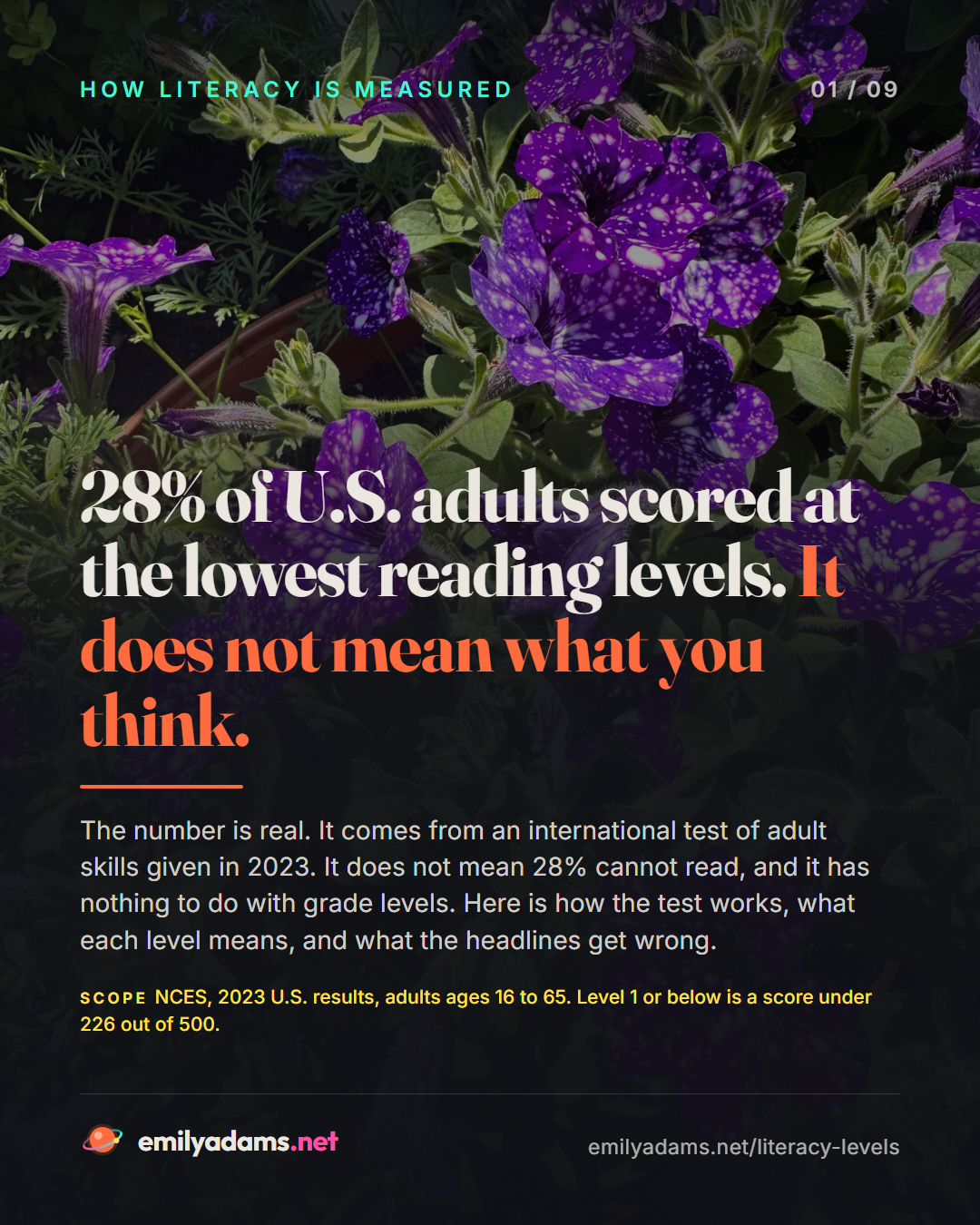
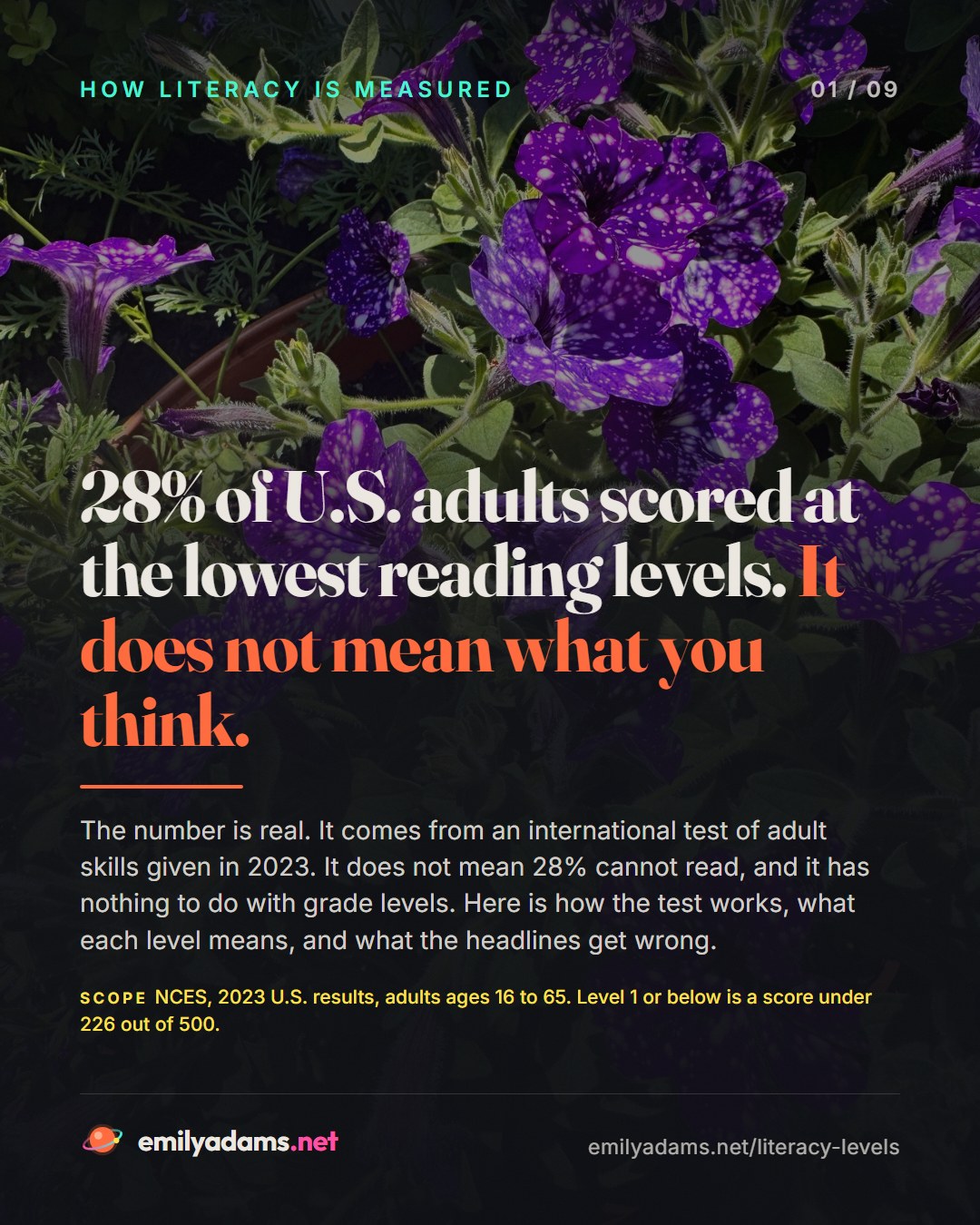
28% of U.S. adults scored at the lowest reading levels. It does not mean what you think.
  • The number is real. It comes from an international test of adult skills given in 2023. It does not mean 28% cannot read, and it has nothing to do with grade levels. Here is how the test works, what each level means, and what the headlines get wrong.
SCOPE NCES, 2023 U.S. results, adults ages 16 to 65. Level 1 or below is a score under 226 out of 500.
Sources and linksCard 1
Card 02 of 09
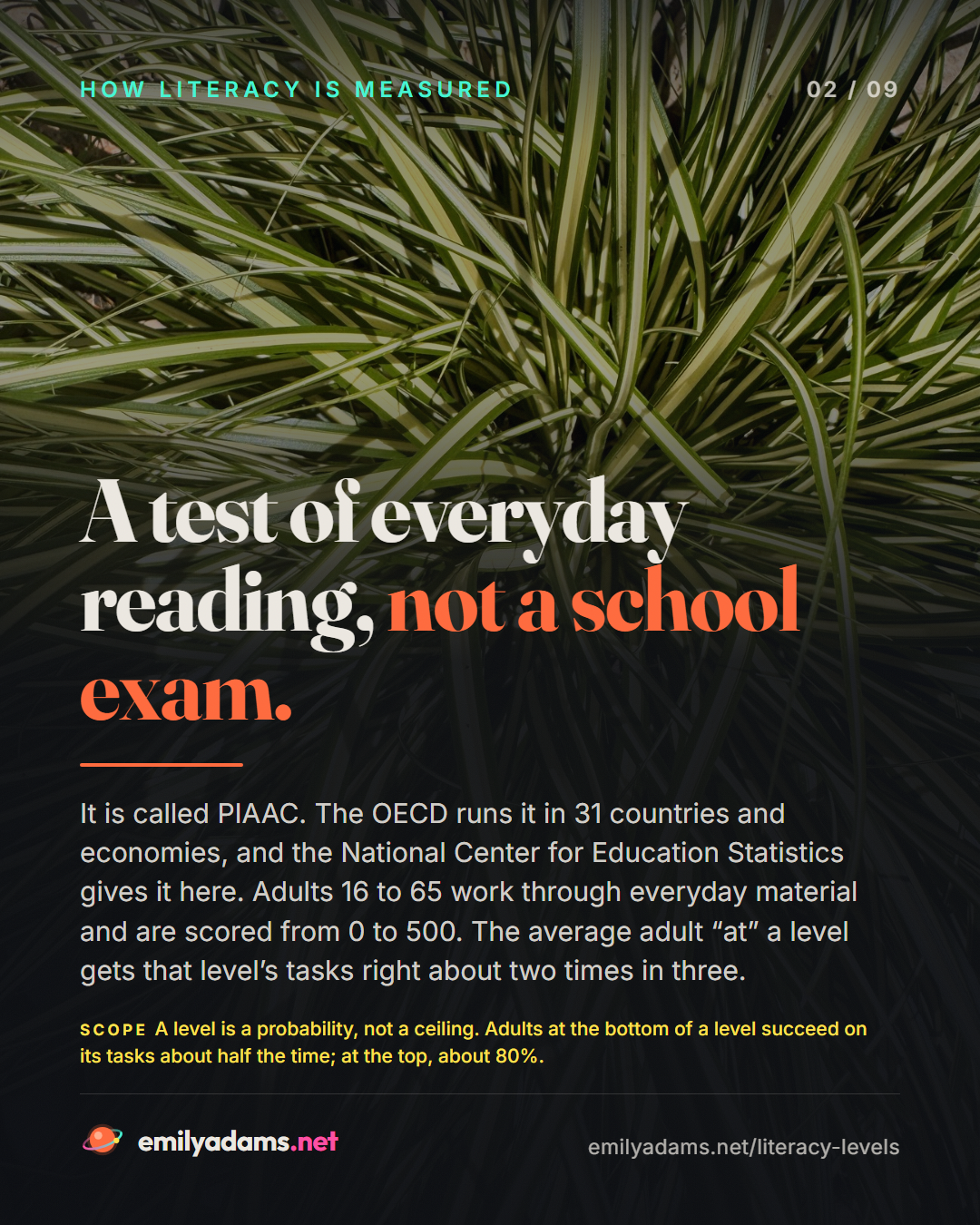
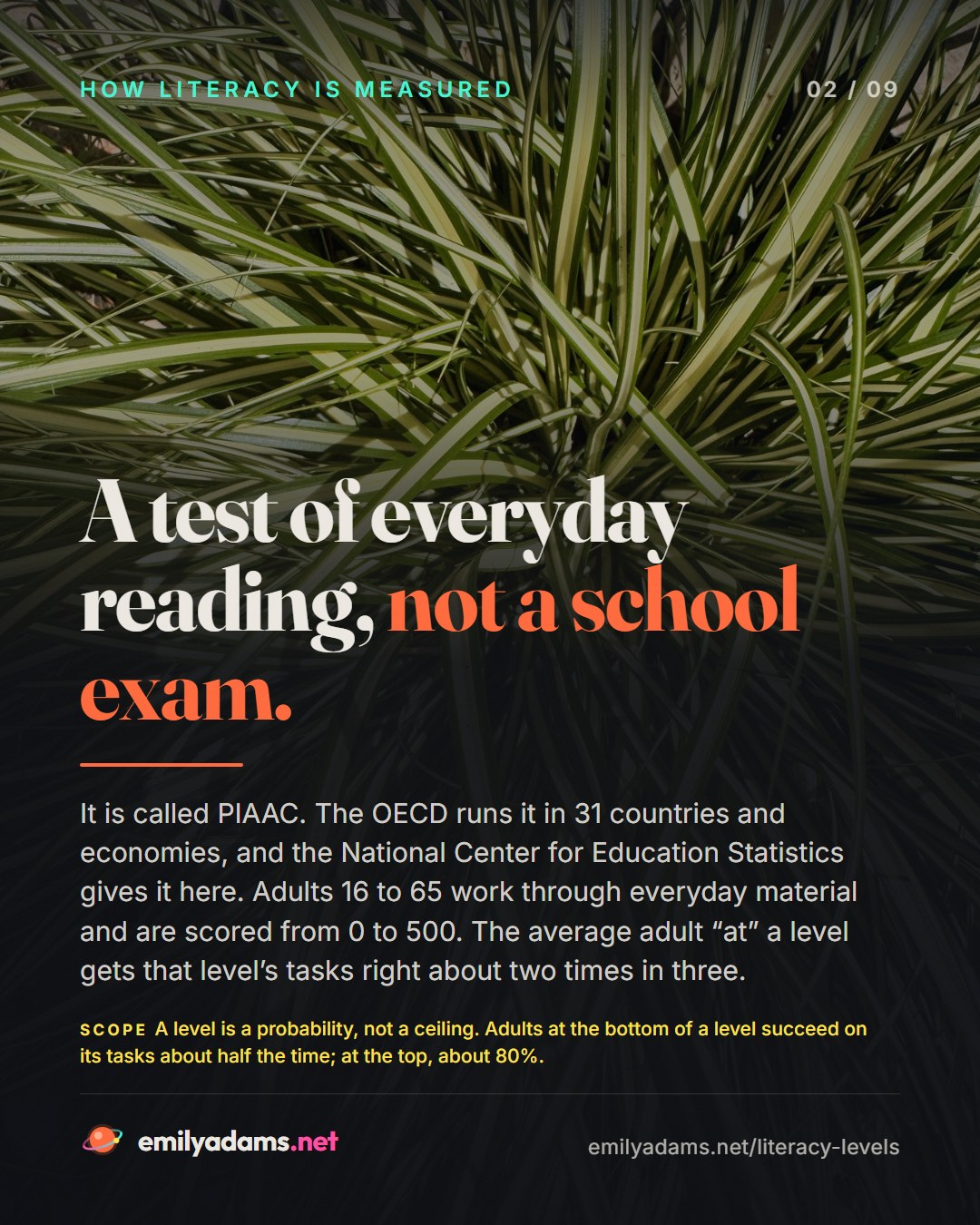
A test of everyday reading, not a school exam.
  • It is called PIAAC. The OECD runs it in 31 countries and economies, and the National Center for Education Statistics gives it here. Adults 16 to 65 work through everyday material and are scored from 0 to 500. The average adult “at” a level gets that level’s tasks right about two times in three.
SCOPE A level is a probability, not a ceiling. Adults at the bottom of a level succeed on its tasks about half the time; at the top, about 80%.
Sources and linksCard 2
Card 03 of 09
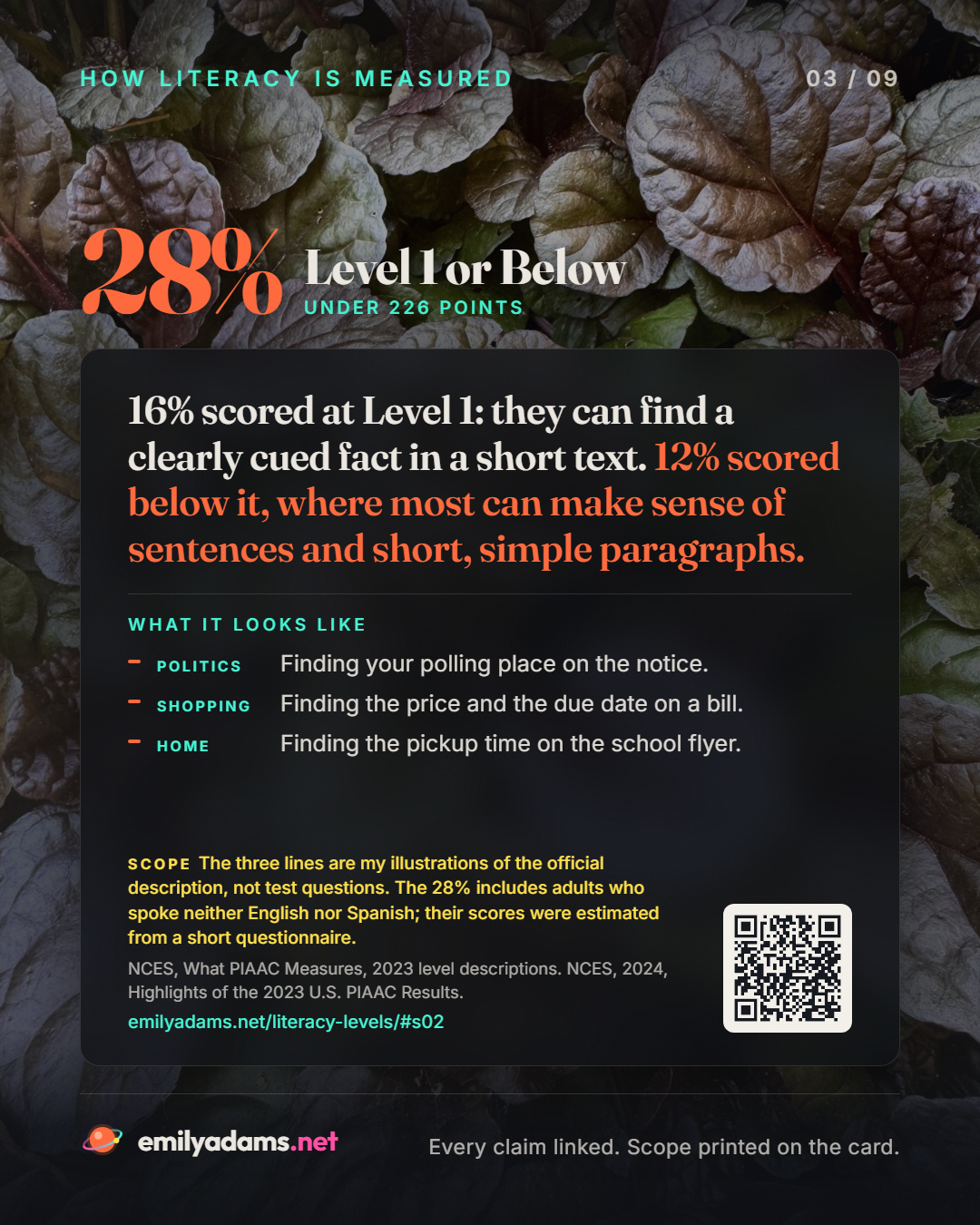
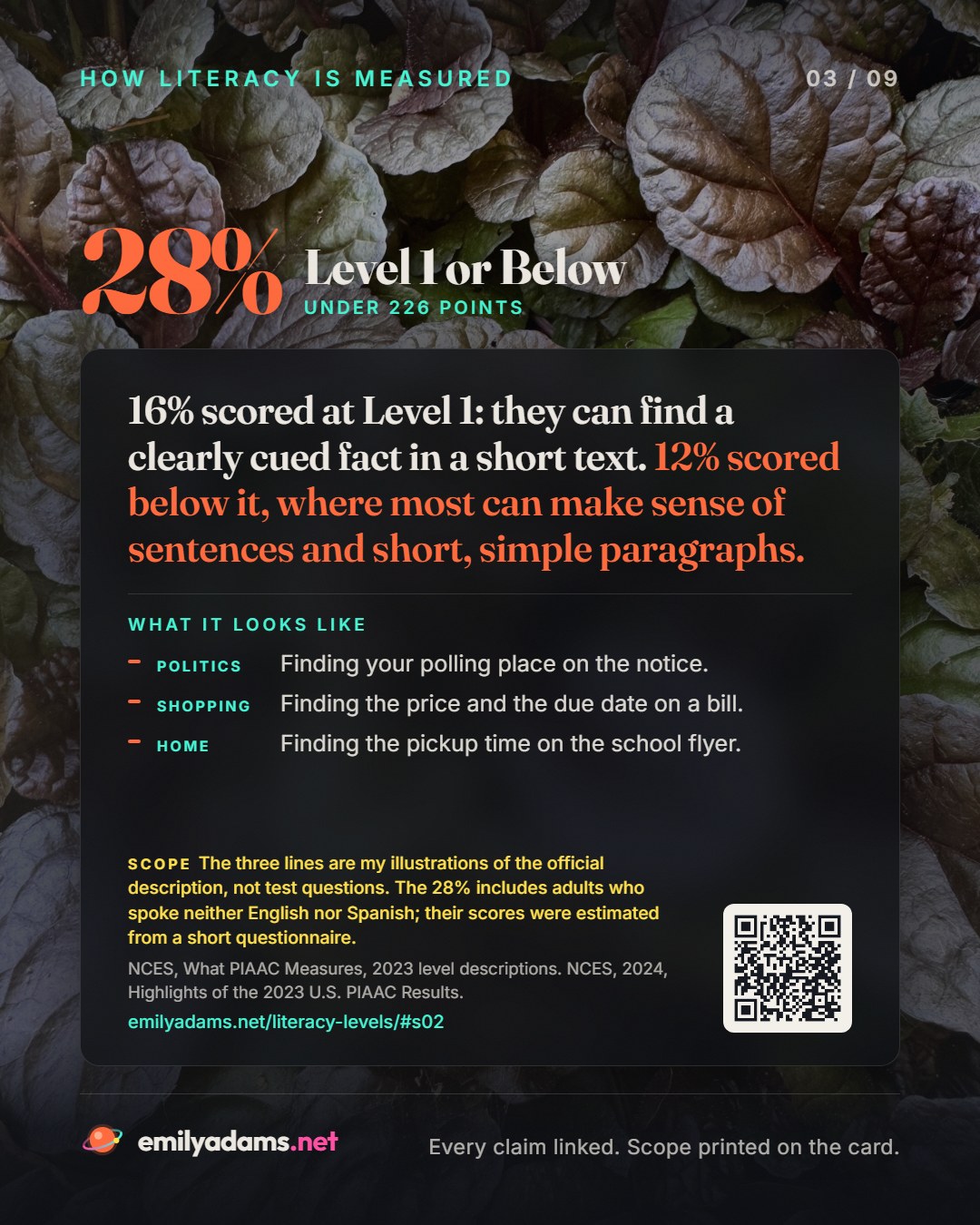
Level 1 or Below: 28%. 16% scored at Level 1: they can find a clearly cued fact in a short text. 12% scored below it, where most can make sense of sentences and short, simple paragraphs.
  • PoliticsFinding your polling place on the notice.
  • ShoppingFinding the price and the due date on a bill.
  • HomeFinding the pickup time on the school flyer.
SCOPE The three lines are my illustrations of the official description, not test questions. The 28% includes adults who spoke neither English nor Spanish; their scores were estimated from a short questionnaire.
Sources and linksCard 3
Card 04 of 09
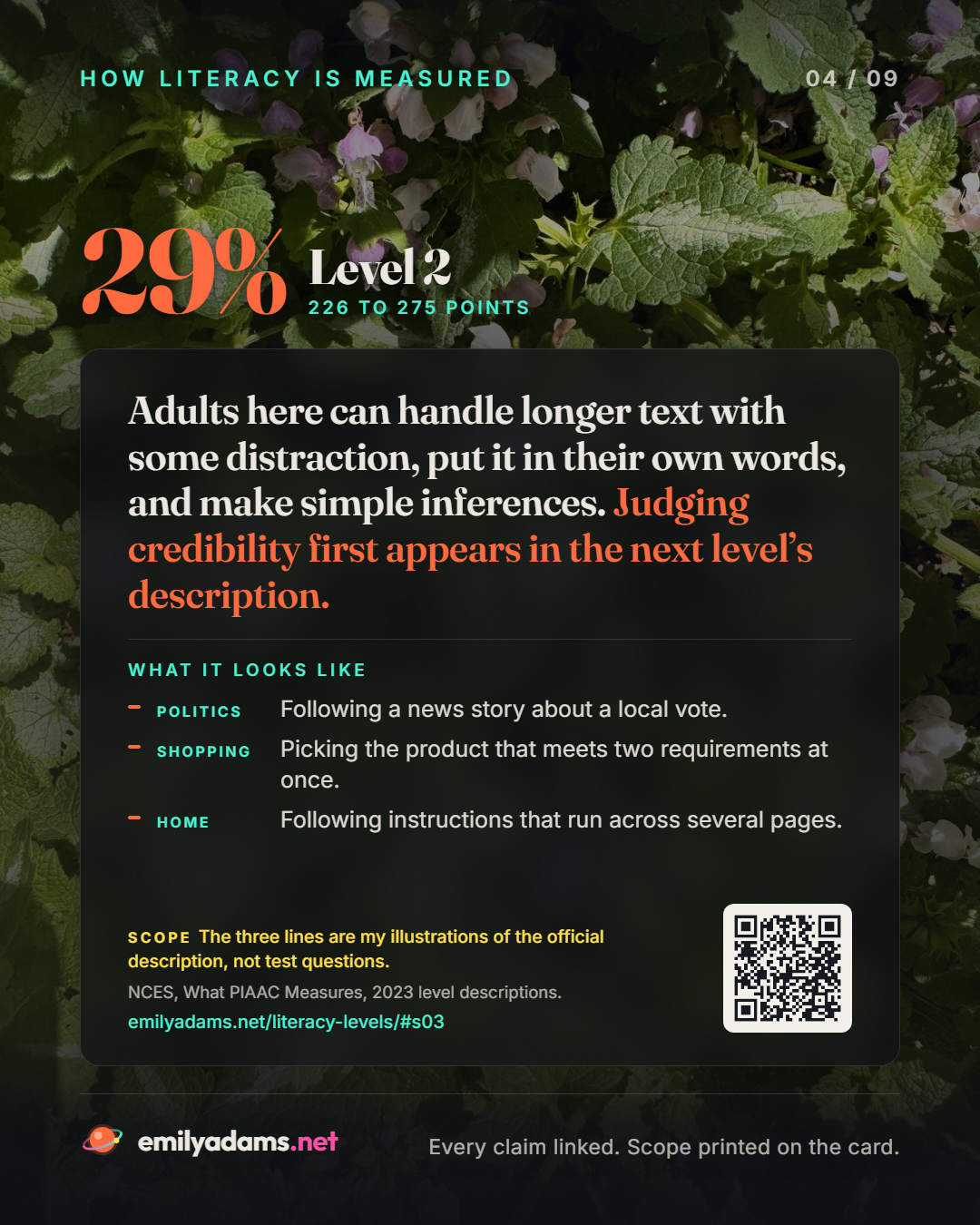
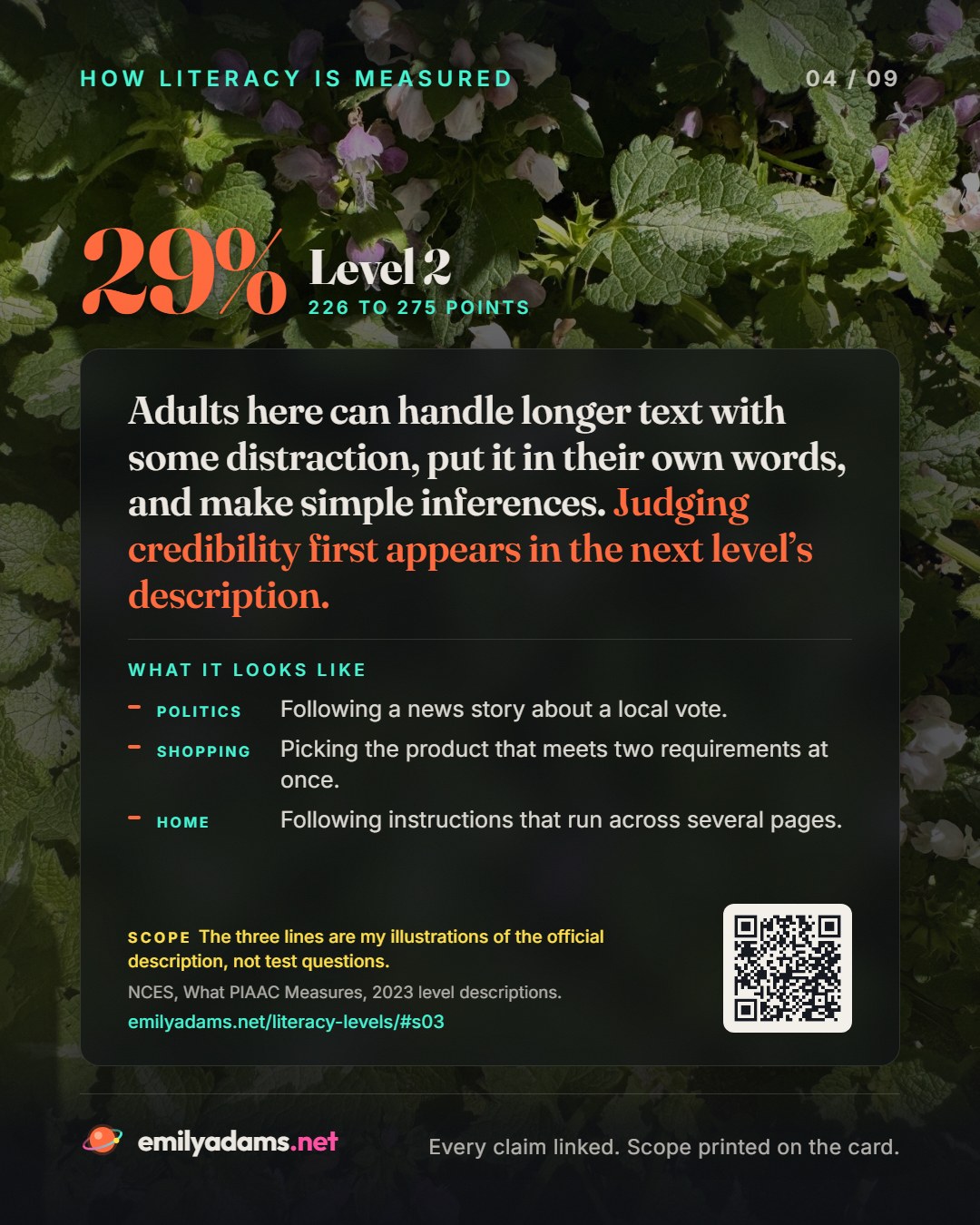
Level 2: 29%. Adults here can handle longer text with some distraction, put it in their own words, and make simple inferences. Judging credibility first appears in the next level’s description.
  • PoliticsFollowing a news story about a local vote.
  • ShoppingPicking the product that meets two requirements at once.
  • HomeFollowing instructions that run across several pages.
SCOPE The three lines are my illustrations of the official description, not test questions.
Sources and linksCard 4
Card 05 of 09
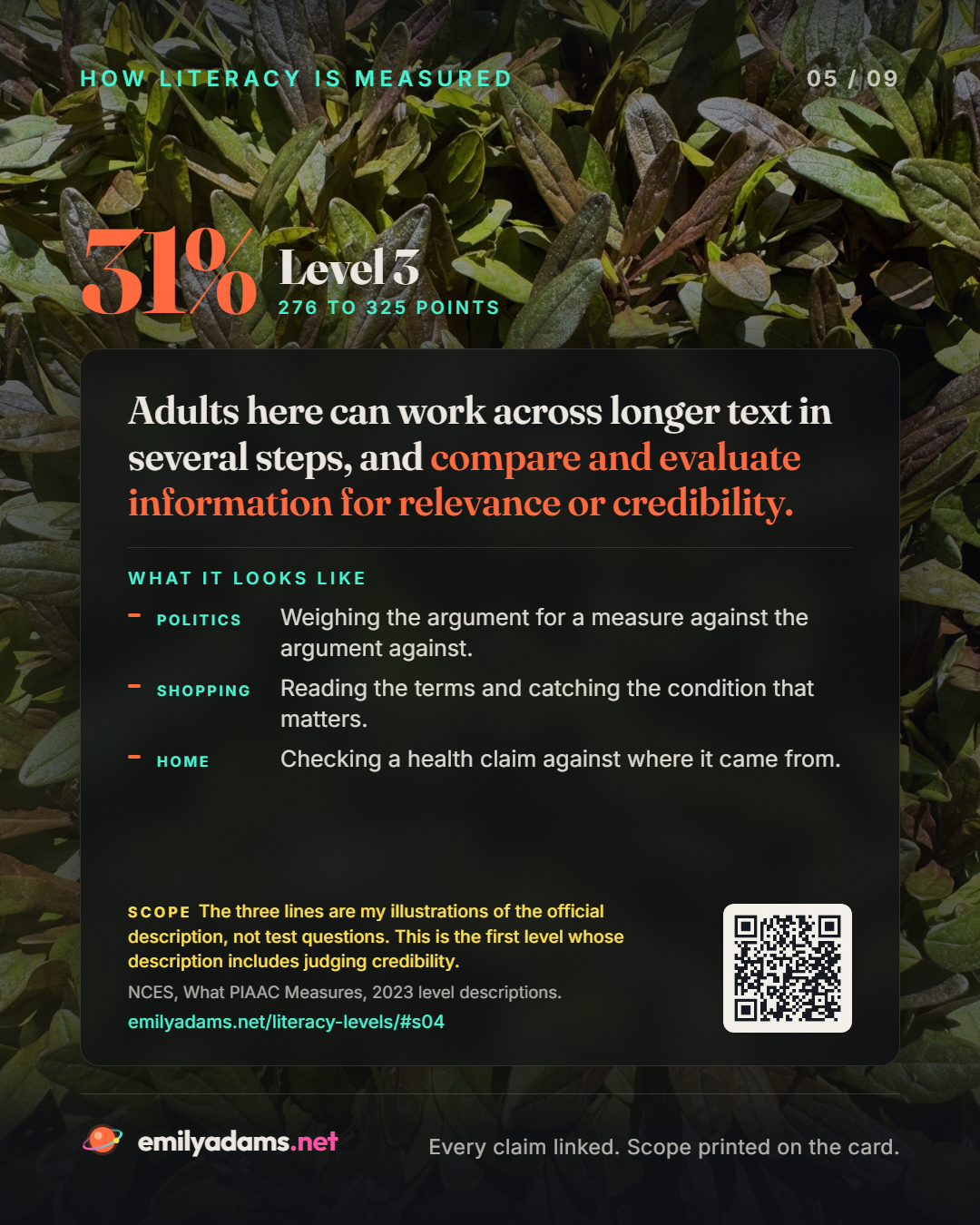
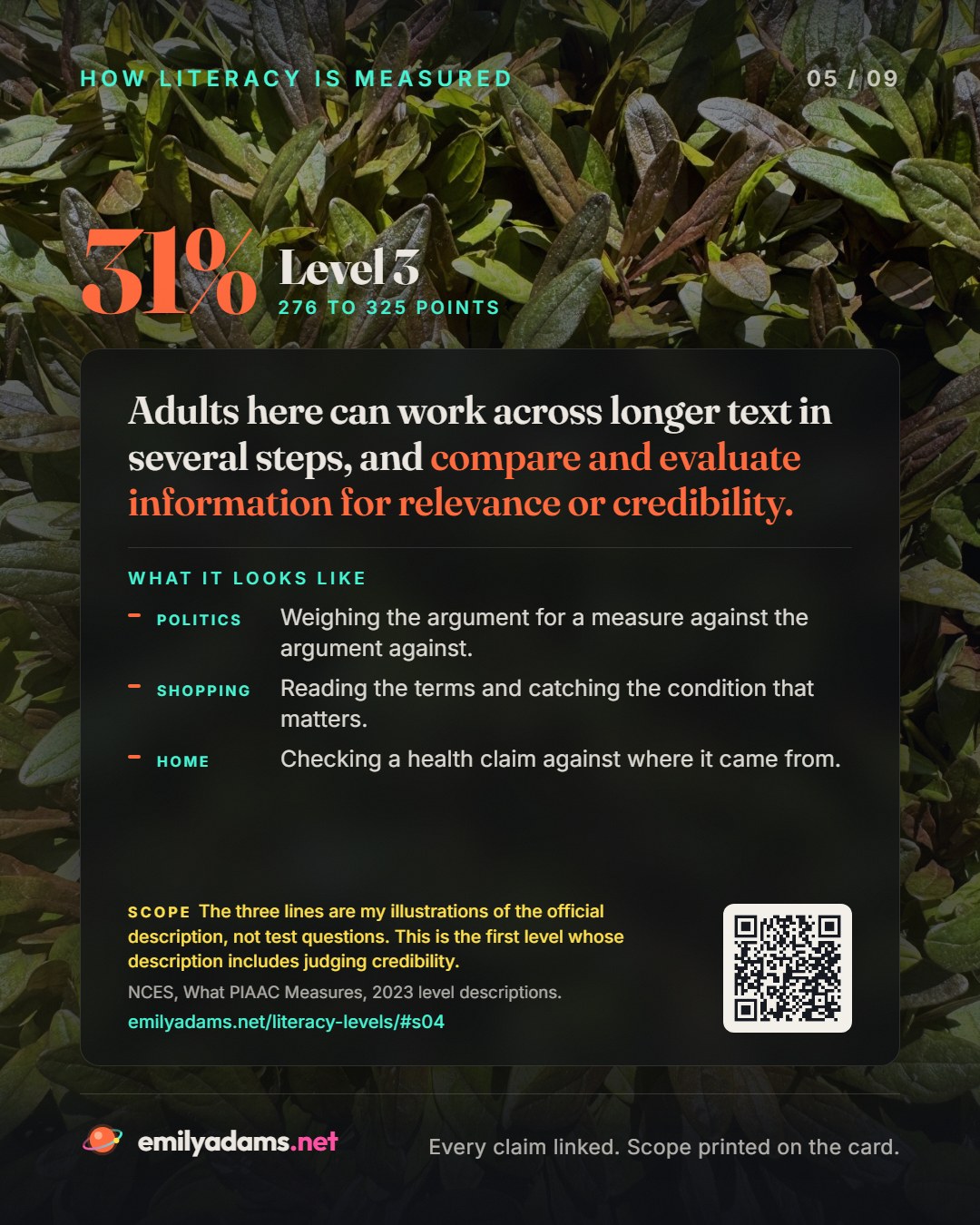
Level 3: 31%. Adults here can work across longer text in several steps, and compare and evaluate information for relevance or credibility.
  • PoliticsWeighing the argument for a measure against the argument against.
  • ShoppingReading the terms and catching the condition that matters.
  • HomeChecking a health claim against where it came from.
SCOPE The three lines are my illustrations of the official description, not test questions. This is the first level whose description includes judging credibility.
Sources and linksCard 5
Card 06 of 09
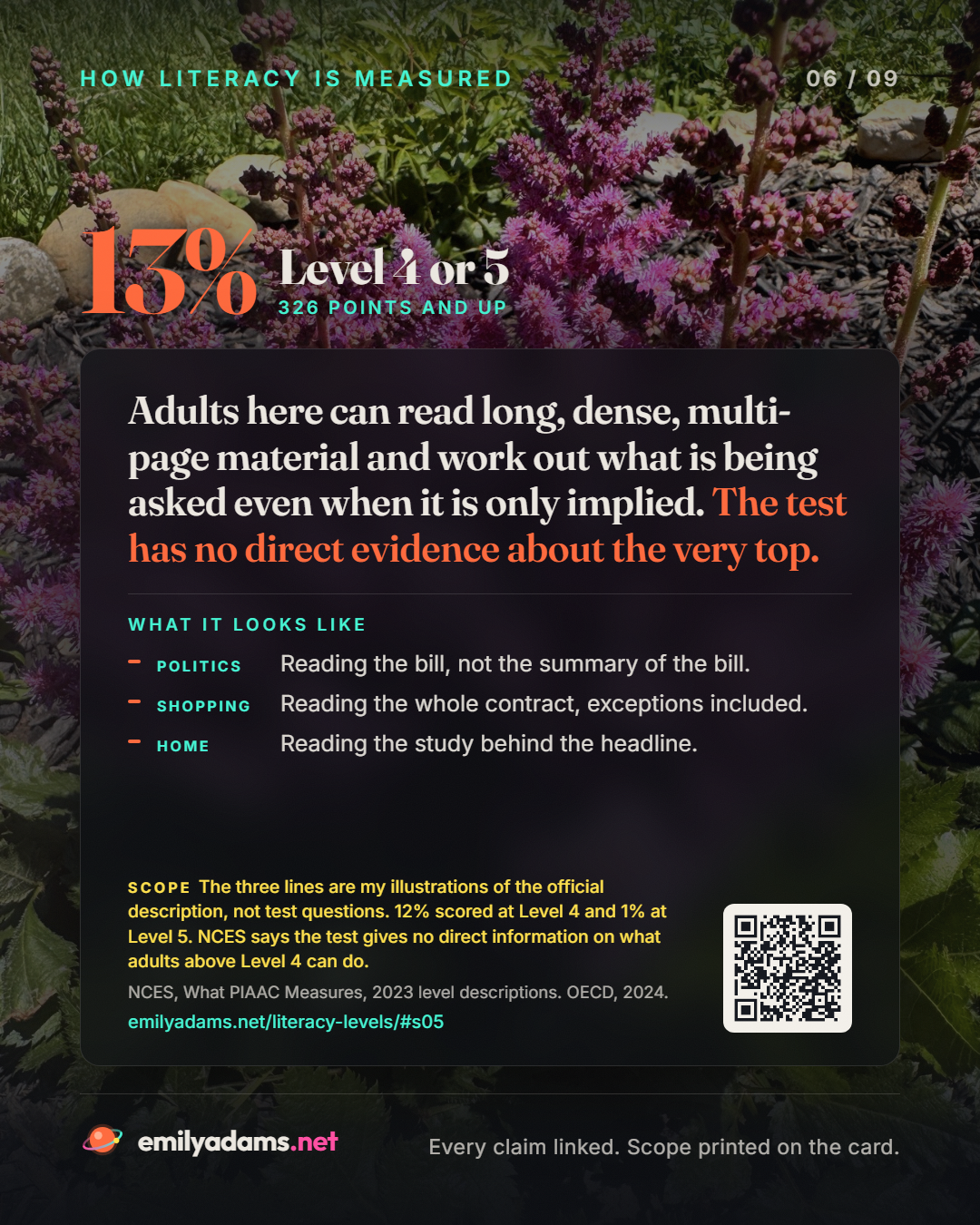
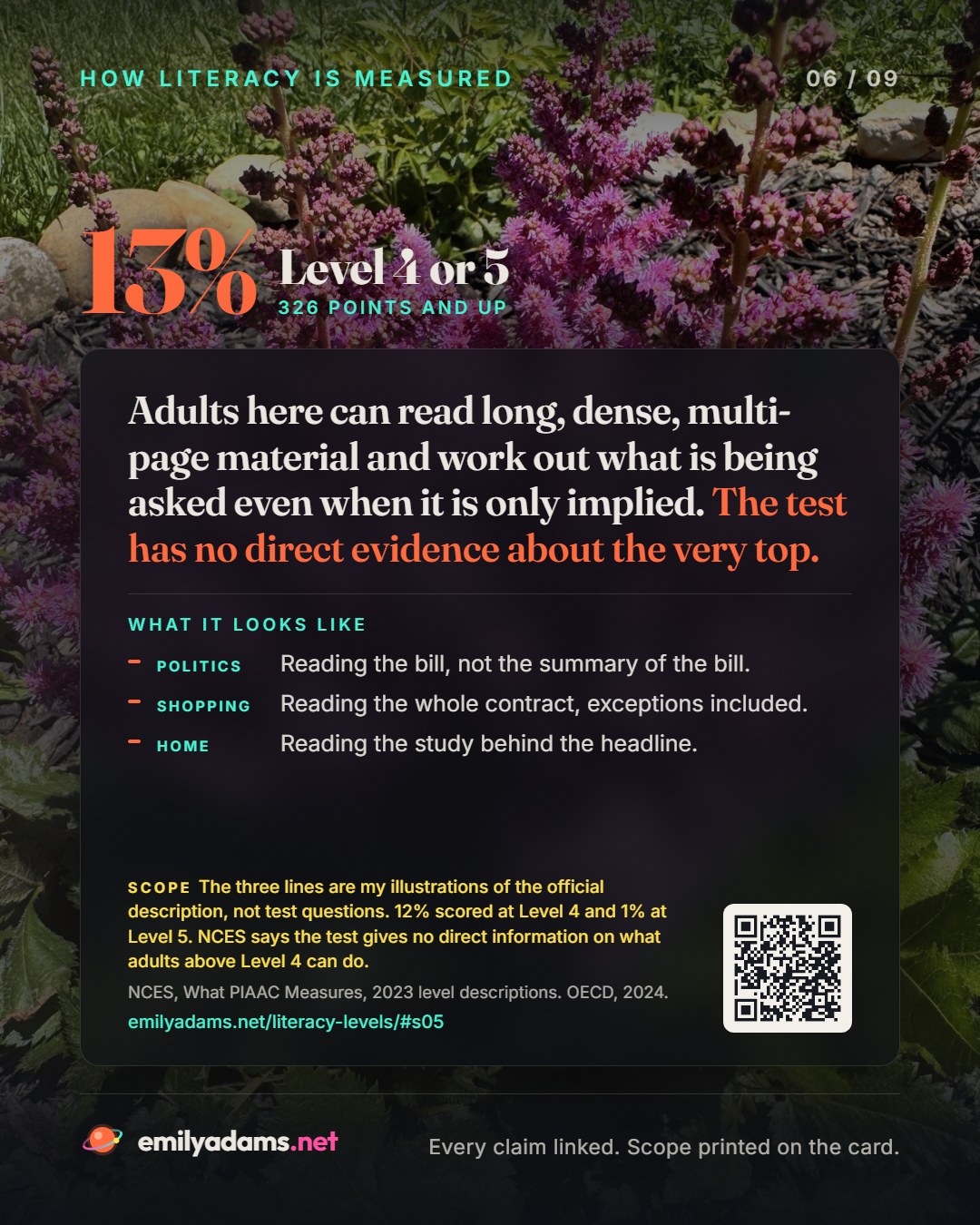
Level 4 or 5: 13%. Adults here can read long, dense, multi-page material and work out what is being asked even when it is only implied. The test has no direct evidence about the very top.
  • PoliticsReading the bill, not the summary of the bill.
  • ShoppingReading the whole contract, exceptions included.
  • HomeReading the study behind the headline.
SCOPE The three lines are my illustrations of the official description, not test questions. 12% scored at Level 4 and 1% at Level 5. NCES says the test gives no direct information on what adults above Level 4 can do.
Sources and linksCard 6
Card 07 of 09
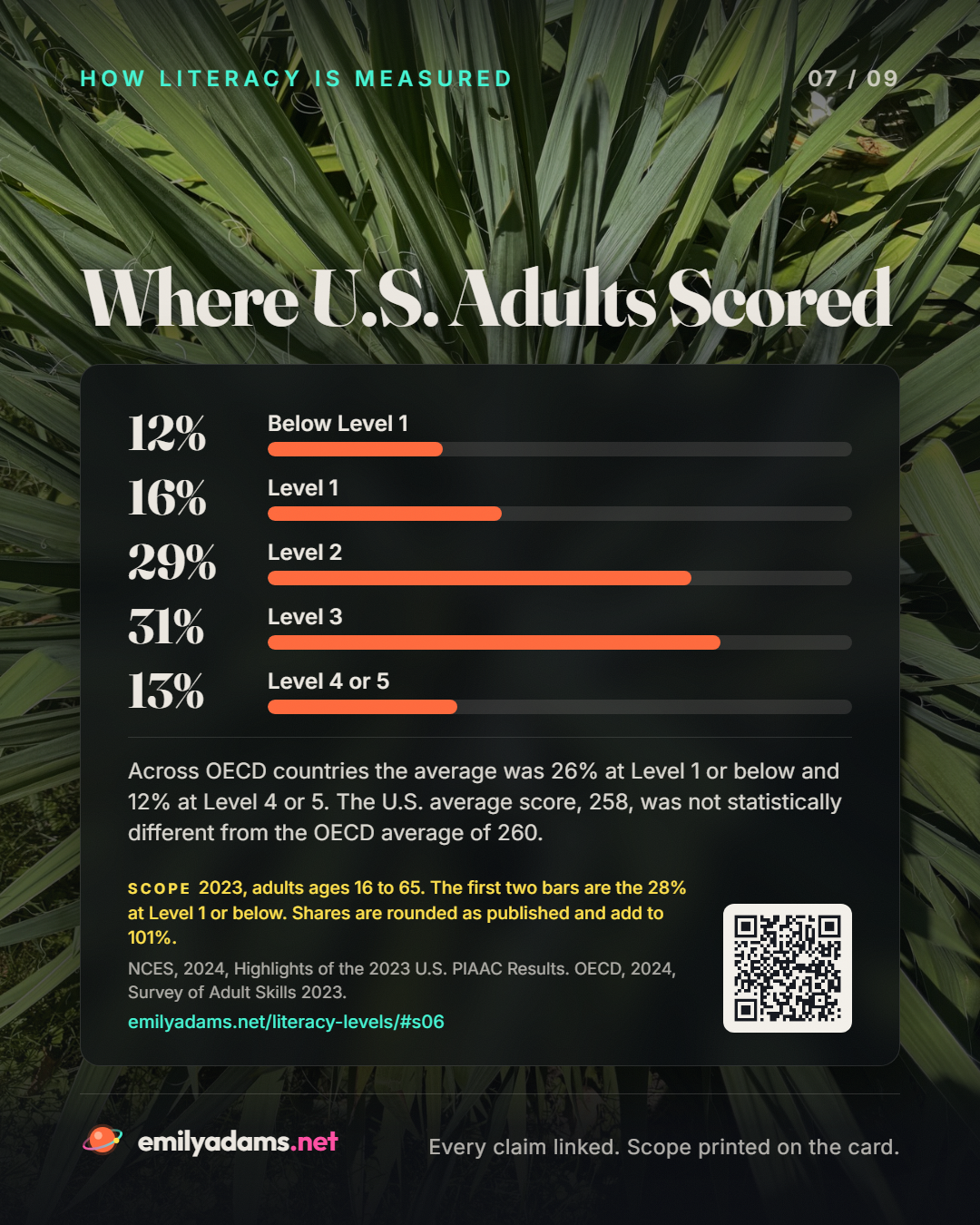
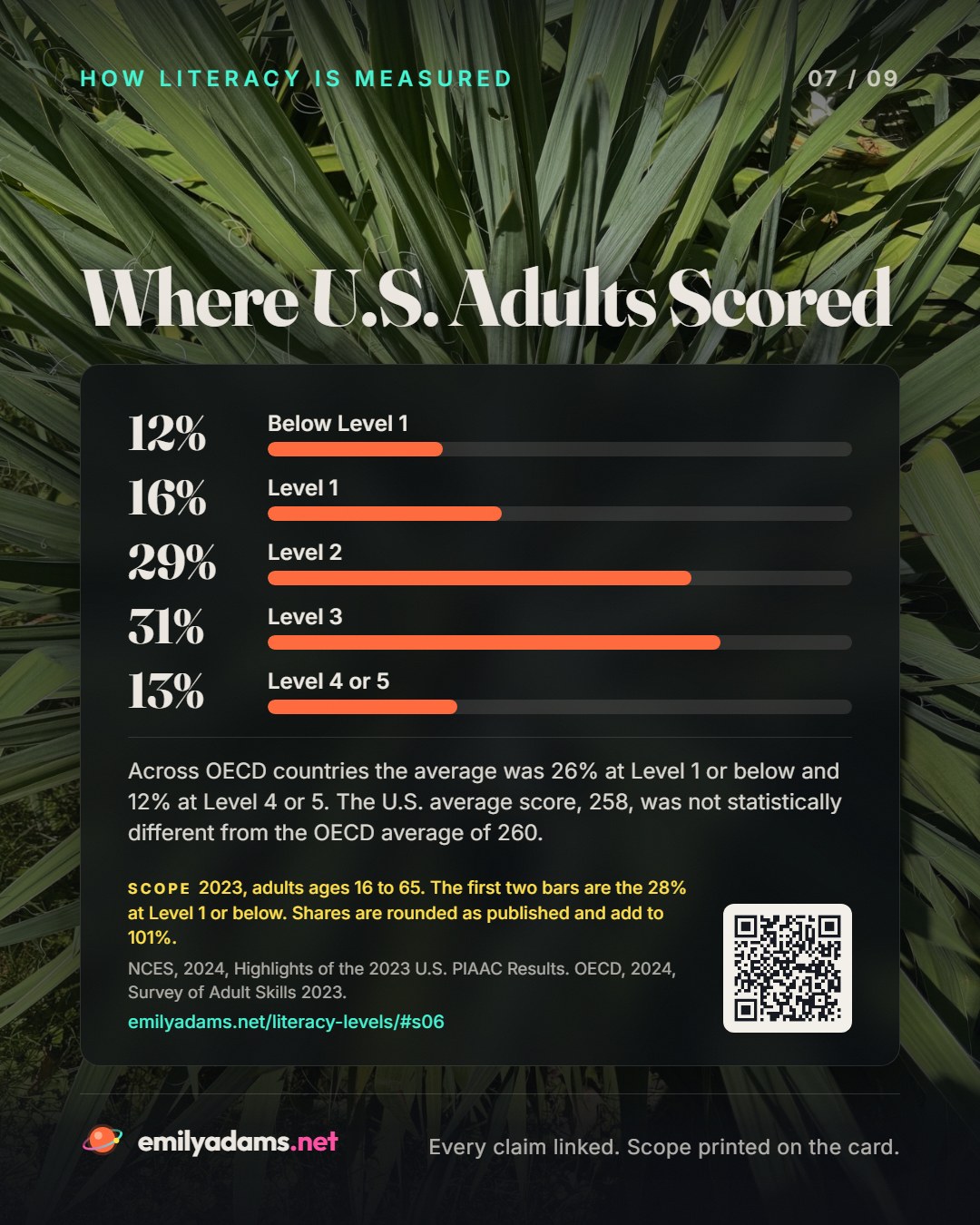
Where U.S. Adults Scored
  • 12% Below Level 1
  • 16% Level 1
  • 29% Level 2
  • 31% Level 3
  • 13% Level 4 or 5
  • Across OECD countries the average was 26% at Level 1 or below and 12% at Level 4 or 5. The U.S. average score, 258, was not statistically different from the OECD average of 260.
SCOPE 2023, adults ages 16 to 65. The first two bars are the 28% at Level 1 or below. Shares are rounded as published and add to 101%.
Sources and linksCard 7
Card 08 of 09
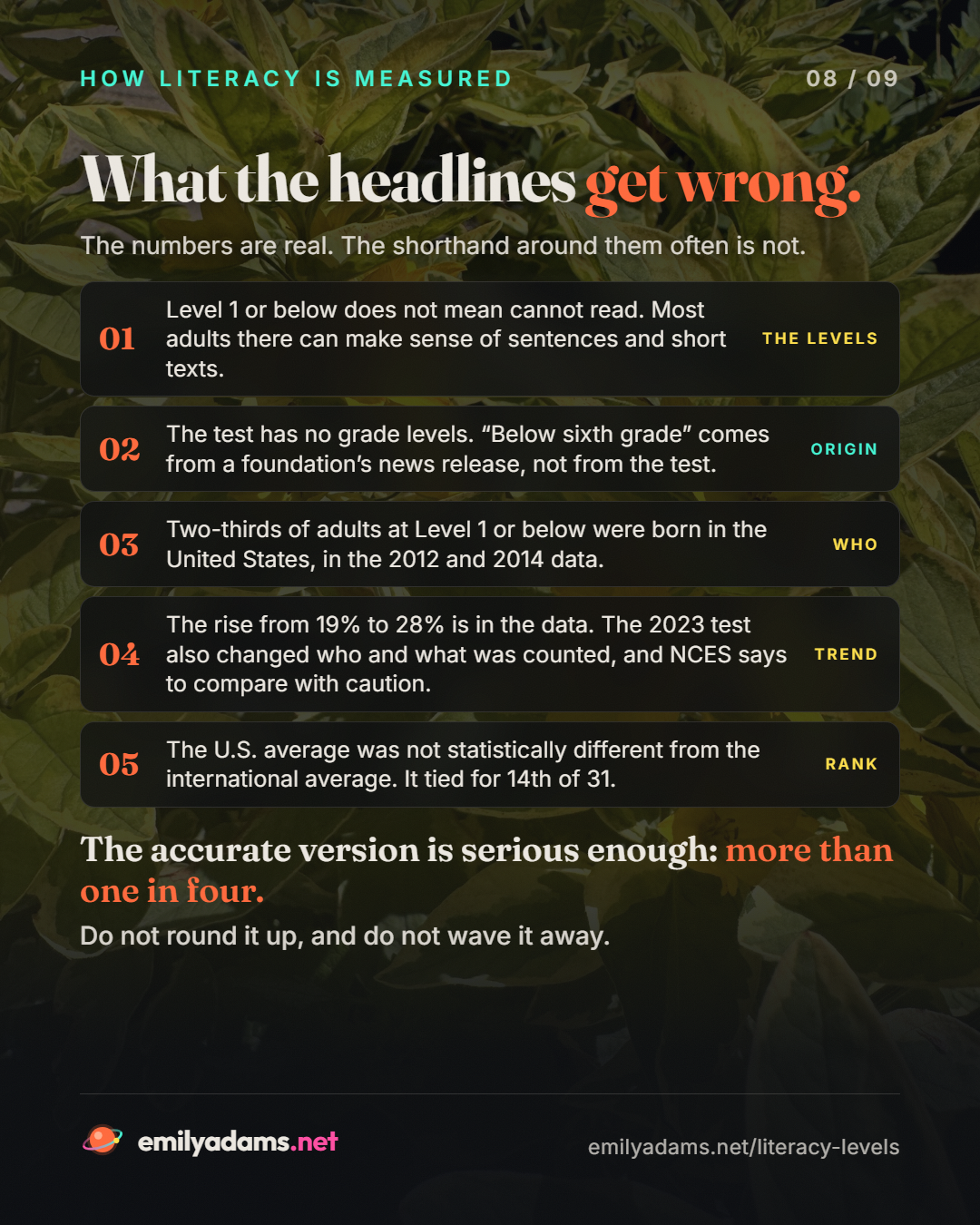
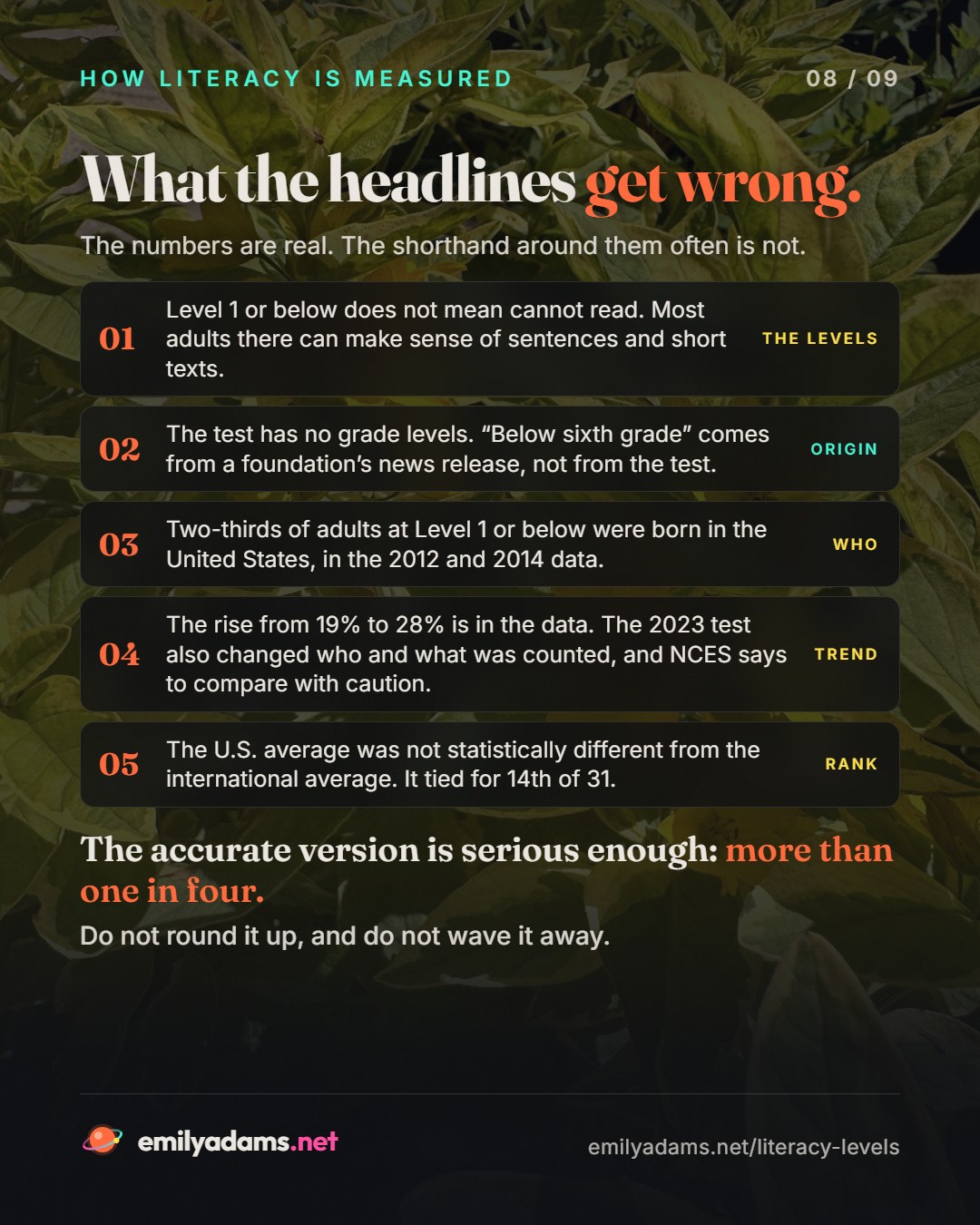
What the headlines get wrong.
  • The numbers are real. The shorthand around them often is not.
  • Level 1 or below does not mean cannot read. Most adults there can make sense of sentences and short texts. The levels
  • The test has no grade levels. “Below sixth grade” comes from a foundation’s news release, not from the test. Origin
  • Two-thirds of adults at Level 1 or below were born in the United States, in the 2012 and 2014 data. Who
  • The rise from 19% to 28% is in the data. The 2023 test also changed who and what was counted, and NCES says to compare with caution. Trend
  • The U.S. average was not statistically different from the international average. It tied for 14th of 31. Rank
The accurate version is serious enough: more than one in four. Do not round it up, and do not wave it away.
Sources and linksCard 8
Card 09 of 09
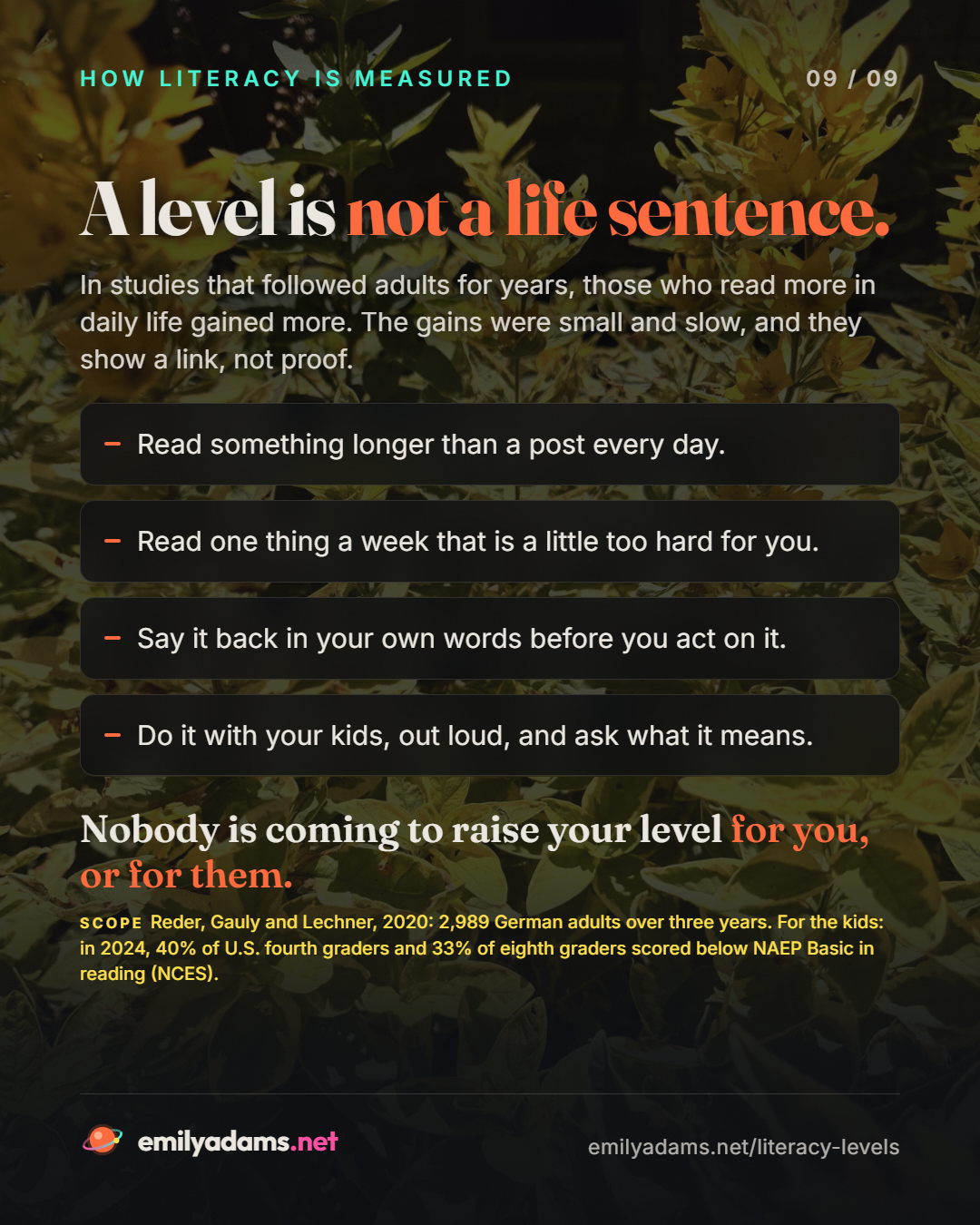
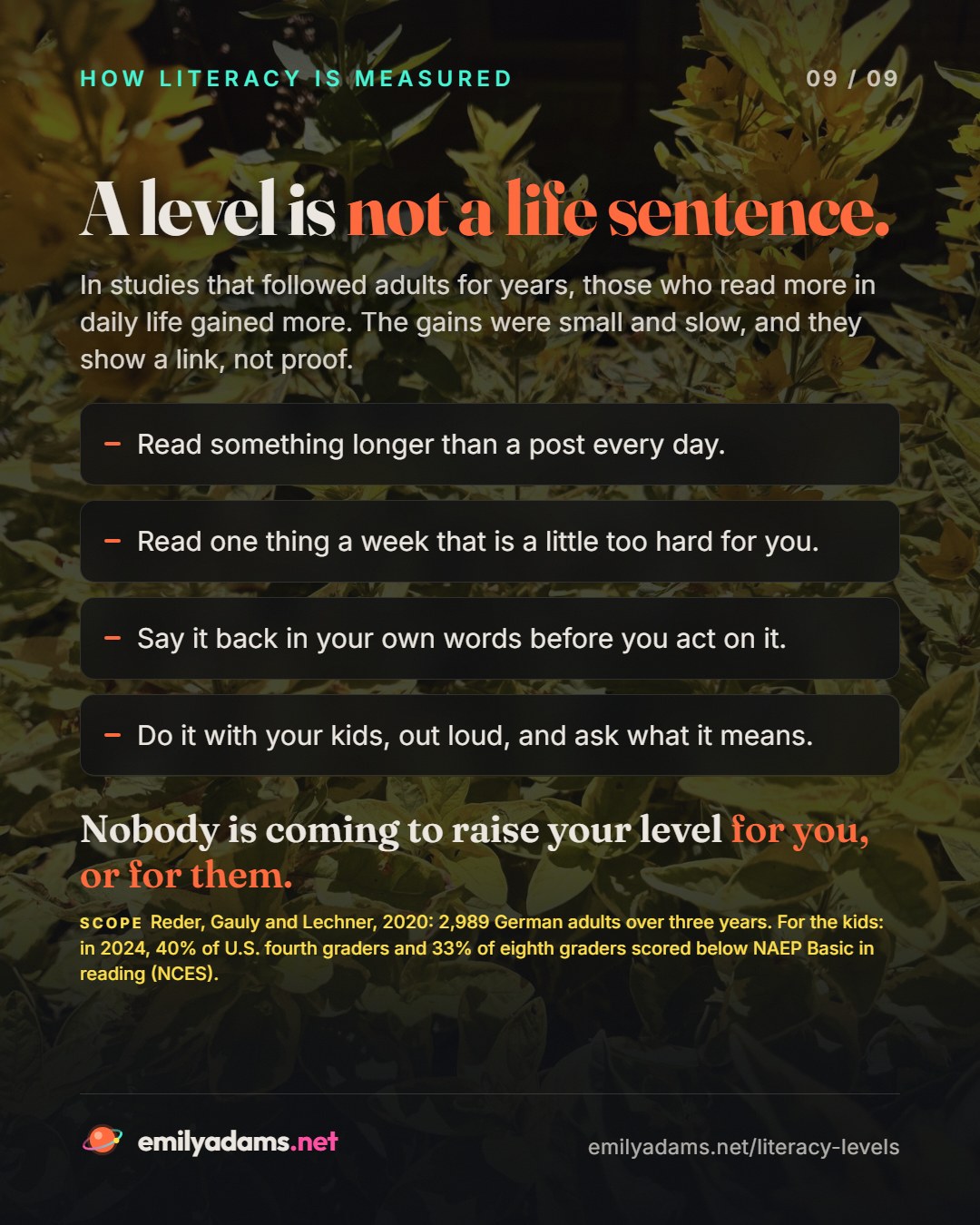
A level is not a life sentence.
  • In studies that followed adults for years, those who read more in daily life gained more. The gains were small and slow, and they show a link, not proof.
  • Read something longer than a post every day.
  • Read one thing a week that is a little too hard for you.
  • Say it back in your own words before you act on it.
  • Do it with your kids, out loud, and ask what it means.
Nobody is coming to raise your level for you, or for them.
SCOPE Reder, Gauly and Lechner, 2020: 2,989 German adults over three years. For the kids: in 2024, 40% of U.S. fourth graders and 33% of eighth graders scored below NAEP Basic in reading (NCES).
Sources and linksCard 9
Closing card
Next: the first move. “It was just a joke.”
  • Parts one through three were the ground: why reading matters, what it is, and how it is scored. Part four opens the playbook, starting with how a joke carries an idea past your guard.
Closing card

The Sources

Grouped by card. Each source has a summary of what it says, a scope line saying how far it reaches, and a link to the original.

Card 2

How the Test Works

On card 2

What PIAAC Measures: Literacy Proficiency Levels

National Center for Education Statistics · NCES, U.S. Department of Education

The Program for the International Assessment of Adult Competencies (PIAAC) is the OECD’s survey of adult skills, given in the United States by NCES to adults ages 16 to 65. Literacy is scored from 0 to 500 and reported in six levels, from Below Level 1 to Level 5. A person whose score matches a question’s difficulty has a 67 percent chance of getting it right. The average person at a level completes that level’s tasks about two-thirds of the time; someone at the bottom of the level, about half the time; someone at the top, about 80 percent of the time.

Scope  A level is a probability, not a ceiling. Adults also get harder questions right, less often.
On card 2

Survey of Adult Skills 2023: United States

OECD, 2024 · OECD country note, December 10, 2024

Thirty-one countries and economies took part in the 2023 round. In the United States, 3,765 adults ages 16 to 65 participated, a sample drawn to represent about 213 million people.

Scope  The U.S. response rate was 28%. NCES says readers should be aware of the potential for bias, and also says its checks found no indications of serious concerns in the final estimates.
Card 3

Level 1 or Below

On card 3

What PIAAC Measures: Level 1 and Below Level 1

National Center for Education Statistics · NCES, U.S. Department of Education; 2023 level descriptions, from the OECD’s 2023 Survey of Adult Skills

In 2023, 28% of U.S. adults scored at Level 1 or below: 16% at Level 1 (176 to 225 points) and 12% below it. NCES describes adults at Level 1 as able to locate information on a text page, find a relevant link on a website, and identify relevant text when it is explicitly cued. They understand short texts and how lists are organized. Most adults below Level 1 can process meaning at the sentence level and read short, simple paragraphs.

Scope  The descriptions say what these adults can do. They do not say these adults cannot read. The 2023 figure includes adults who spoke neither English nor Spanish; they answered a short questionnaire and their proficiency was estimated.
Card 4

Level 2

On card 4

What PIAAC Measures: Level 2

National Center for Education Statistics · NCES, U.S. Department of Education; 2023 level descriptions, from the OECD’s 2023 Survey of Adult Skills

In 2023, 29% of U.S. adults scored at Level 2 (226 to 275 points). NCES describes adults here as able to access and understand information in longer texts with some distracting information, move through simple multi-page digital texts, understand by paraphrasing or making inferences from single or adjacent pieces of information, and weigh more than one criterion in choosing a response.

Scope  The Level 2 description does not mention evaluating. The OECD notes that the easiest evaluation question on the test sits at Level 2, so some evaluation happens here. It enters the descriptions at Level 3.
Card 5

Level 3

On card 5

What PIAAC Measures: Level 3

National Center for Education Statistics · NCES, U.S. Department of Education; 2023 level descriptions, from the OECD’s 2023 Survey of Adult Skills

In 2023, 31% of U.S. adults scored at Level 3 (276 to 325 points). NCES describes adults here as able to construct meaning across larger chunks of text or carry out multi-step operations, to identify, interpret, or evaluate pieces of information, often using inference, and to compare and evaluate multiple pieces of information based on their relevance or credibility.

Scope  NCES reports Level 3 or above as its top category: 44% of U.S. adults in 2023, down from 48% in 2017.
Card 6

Level 4 or 5

On card 6

What PIAAC Measures: Levels 4 and 5

National Center for Education Statistics · NCES, U.S. Department of Education; 2023 level descriptions, from the OECD’s 2023 Survey of Adult Skills

In 2023, 12% of U.S. adults scored at Level 4 (326 to 375 points) and 1% at Level 5; the OECD reports the two together as 13%. NCES describes adults at Level 4 as able to read long and dense texts presented on multiple pages, to infer what a task is asking from complex or implicit statements, and to produce knowledge-based inferences.

Scope  Above Level 4, NCES says, the assessment provides no direct information on what adults can do. Its Level 5 description is hedged for that reason.
Card 7

Where U.S. Adults Scored

On card 7

Highlights of the 2023 U.S. PIAAC Results

National Center for Education Statistics, 2024 · NCES 2024-202, Figure 1-B and the data table behind it

The 2023 literacy distribution for U.S. adults ages 16 to 65: 12% below Level 1, 16% at Level 1, 29% at Level 2, 31% at Level 3, 12% at Level 4, and 1% at Level 5. NCES prints the combined figures as 28% at Level 1 or below, 29% at Level 2, and 44% at Level 3 or above. The average score was 258, against 271 in 2017.

Scope  Whole numbers as published; they add to 101% because of rounding, and NCES publishes no decimals for these shares.
On card 7

Survey of Adult Skills 2023: United States, and the International Report

OECD, 2024 · OECD country note and Do Adults Have the Skills They Need to Thrive in a Changing World?, December 2024

Across OECD countries, 26% of adults scored at Level 1 or below and 12% at Levels 4 or 5. The U.S. average of 258 was not statistically different from the OECD average of 260. Finland scored highest at 296, followed by Japan at 289, Sweden at 284, and Norway at 281.

Scope  The OECD’s trend chart shows 27%, not 28%, for the United States, because it leaves out adults who were given only the short questionnaire. Both numbers are correct, for different groups.
Card 8

What the Headlines Get Wrong

On card 8

PIAAC Frequently Asked Questions: Grade Levels

National Center for Education Statistics · NCES, U.S. Department of Education

NCES says PIAAC proficiency levels do not specifically correspond to measures such as grade levels at school, and that neither NCES nor the OECD has an official mapping between the two.

Scope  NCES adds that grade-level equivalents may be unsuitable for describing adults, whose skills often develop unevenly across areas.
On card 8

Assessing the Economic Gains of Eradicating Illiteracy Nationally and Regionally in the United States

Rothwell, 2020 · Gallup, for the Barbara Bush Foundation for Family Literacy, September 8, 2020

The report states that 54% of U.S. adults ages 16 to 74, about 130 million people, lack literacy proficiency. It uses 2012 to 2017 data and draws the line at Level 3. The report itself never mentions grade levels. The phrase about reading below a sixth-grade level appears in the Foundation’s news release about the report, with no method given.

Scope  The 54% answers a different question from the 28%: adults below Level 3, a line the report’s author chose, in older data and a wider age range.
On card 8

Adult Literacy in the United States

Mamedova and Pawlowski, 2019 · NCES Data Point, NCES 2019-179

Using 2012 and 2014 data, NCES reported that U.S.-born adults make up two-thirds of adults with low levels of English literacy skills. Adults born outside the United States were 34% of that group, against 15% of the population.

Scope  Older data, and the split leaves out adults who could not take part. NCES has not published the same figure for 2023. It does report 2023 rates within each group: 22% of U.S.-born adults and 49% of adults born elsewhere scored at Level 1 or below.
On card 8

PIAAC Cycle 2 Methodology and Technical Notes

National Center for Education Statistics, 2024 · NCES 2024-225

The share of U.S. adults at Level 1 or below was 19% in 2017 and 28% in 2023. NCES says comparisons of 2023 with earlier rounds need to be made with caution because the assessment and its scoring changed. In 2023 the test was given entirely on a tablet, basic-skills tasks counted toward the overall score for the first time, and adults who spoke neither English nor Spanish were included through a short questionnaire.

Scope  The earlier figures cover only adults who could respond in English or Spanish, so the two years do not measure quite the same group.
On card 8

U.S. Adults Score on Par With International Average in Literacy Skills

National Center for Education Statistics, 2024 · NCES press release, December 10, 2024

The United States tied for 14th in literacy among the 31 countries and subnational economies that took part in 2023. Its average was not statistically significantly different from the international average of 260.

Scope  Thirteen participants scored higher, 14 lower, and 3 were not measurably different. The same release reports the United States below average in numeracy.
Card 9

A Level Is Not a Life Sentence

On card 9

Practice Makes Perfect: Practice Engagement Theory and the Development of Adult Literacy and Numeracy Proficiency

Reder, Gauly and Lechner, 2020 · International Review of Education, 66, 267 to 288

The researchers followed 2,989 native German-speaking adults who took the adult skills test in 2012 and again in 2015. Adults who reported reading more in daily life in 2012 gained more literacy by 2015: about five points on the 500-point scale for each standard deviation of reading engagement. On average, scores did not change over the three years.

Scope  An observational study. Nobody was assigned to read more, so it shows a link and not proof of cause. The authors call the effect relatively small. The adults were German, not American.
On card 9

The Impact of ABS Program Participation on Long-Term Literacy Growth

Reder, 2014 · U.S. Department of Education research brief on the Longitudinal Study of Adult Learning

The Longitudinal Study of Adult Learning randomly sampled about 1,000 high school dropouts in the Portland, Oregon, area and followed them from 1998 to 2007. Its author reports that adults who engaged more in reading practices showed later gains in proficiency.

Scope  Also observational, in one metropolitan area, with a small sample. I relied on the Department of Education abstract and the author’s published summaries, not the full study.
On card 9

The Nation’s Report Card: 2024 NAEP Reading Assessment

National Center for Education Statistics, 2025 · NCES, national achievement-level trends

In 2024, 40% of U.S. fourth graders and 33% of eighth graders scored below NAEP Basic in reading, up from 37% and 30% in 2022 and from 34% and 27% in 2019. The eighth-grade figure is the highest in NCES’s trend table, which goes back to 1992.

Scope  A different test from the adult one, given to students. The fourth-grade figure is not a record; it was 41% in 2000. NCES says its achievement levels should be interpreted with caution.

What These Cards Cannot Tell You

The numbers are rounded. NCES and the OECD publish whole numbers, and the 2023 shares add to 101%. The cards print them as published.
A level is a probability. Being at a level means the average person there gets that level’s tasks right about two times in three. It does not mean a person cannot do anything harder.
The Politics, Shopping, and Home lines are mine. They illustrate the official level descriptions. They are not test questions, and nobody has measured who can do each one.
2023 is not a clean comparison with 2017. The 2023 test changed how it was given and scored, and it counted adults the earlier rounds left out. The rise from 19% to 28% is real in the published data, and NCES says to compare with caution.
The response rate was low. About 28% of sampled U.S. adults took part. NCES says to be aware of the potential for bias, and also says its checks found no indications of serious concerns in the final estimates.
Reading more is linked to gains, not proven to cause them. The studies behind card 9 followed adults over time without assigning anyone to read more. The gains they found were small and slow.

Why I wanted the real number.

I kept seeing the same two claims: that a quarter of American adults cannot read, and that half of us read below a sixth-grade level. Both would have made a strong card. So I went looking for where they came from.

The 28% is real, and it means something narrower than the posts say. It is the share of adults who scored at the two lowest levels of one test, and most of them can read short texts. The sixth-grade line is not in the test at all. It came from a news release.

I think the accurate version is more useful than the scary one. More than one in four adults scored at the lowest levels, in a country that runs on fine print. Fewer than half scored at the level where the test’s description first mentions judging whether something is credible.

That is the opening every manipulator needs, and it is also something each of us can work on. A score is not a verdict, and nobody is coming to raise mine or my kids’ for us.