Security Risk
In the 1950s, the U.S. government purged gay men and lesbians from federal jobs by calling them a “security risk.” A Navy study found no data behind the claim, and the Navy kept it secret for almost 20 years.
The Graphics
Swipe through the slides as they appear on Instagram and Facebook. Tap any slide to open it full size.
The Carousel
Ninety-One Cases, Sir

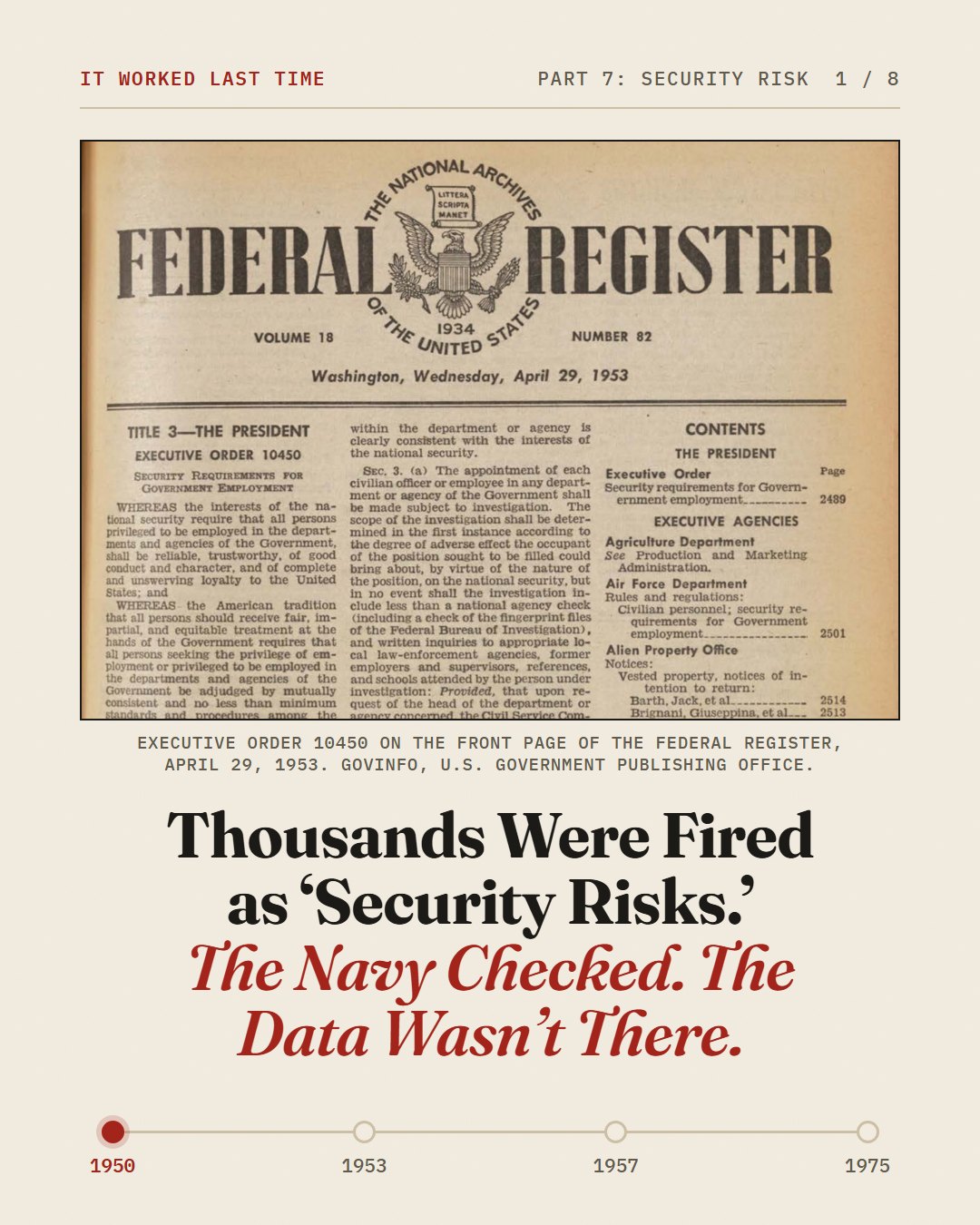
On February 28, 1950, Secretary of State Dean Acheson and his deputy for administration, John Peurifoy, sat before a Senate Appropriations subcommittee to defend the State Department’s budget1,6. Senator Styles Bridges, a New Hampshire Republican, asked how many employees had left while under investigation as security risks4,1.
Peurifoy, who ran the department’s security program, answered: “In this shady category that you referred to earlier, there are 91 cases, sir”1,2,3. Bridges pressed him: “What do you mean by ‘shady category’?” Peurifoy tried another phrase: “We are talking about people of moral weaknesses and so forth”1. The subcommittee’s chairman, Senator Pat McCarran, a Nevada Democrat, cut in: “Now, will you make your answer a little clearer, please”1,2. Peurifoy gave up the euphemisms. “Most of these were homosexuals”1,2,3,4.
The hearing came in the middle of a panic. On February 9, Senator Joseph McCarthy, a Wisconsin Republican, had claimed to have a list of 205 communists working at the State Department, and on February 20 he described cases on the Senate floor as “unsafe risks,” two of them involving homosexuality5. Five weeks before the hearing, a jury had convicted former State Department official Alger Hiss of perjury6. The fear of Soviet spies inside the government was real.
The department had been quietly removing gay employees since 1947, under a 1946 budget rider that gave the Secretary of State broad power to dismiss employees for national security5. Peurifoy’s number, arriving right after McCarthy’s speeches, “sparked a press frenzy and public outcry,” in the words of a National Archives history5. Historian David K. Johnson calls the hearing “a political performance orchestrated by a congressional tag team intent on assisting Senator McCarthy and embarrassing Acheson’s State Department and the entire Truman administration”6,1.
Notice what the label did. The 91 were not accused of being communists. TIME later summed up Peurifoy’s slip as telling Congress that the 91 “were not Communists, just homosexuals”23. But once they had been counted inside the “security risk” category, removing a gay clerk sounded like defending the country rather than punishing a private life. By April, the chairman of the Republican National Committee, Guy Gabrielson, was writing in a party newsletter that “sexual perverts” in government were “perhaps as dangerous as the actual Communists”9.
The Senate wanted to know how far it went. In June 1950 it authorized a full investigation7.
A Senate Report Supplies the Reason
The investigation went to a subcommittee chaired by Senator Clyde Hoey, a North Carolina Democrat. The other members were three Democrats, James Eastland, John McClellan and Herbert O’Conor, and three Republicans, Karl Mundt, Andrew Schoeppel and Margaret Chase Smith5. Every witness testified behind closed doors7.
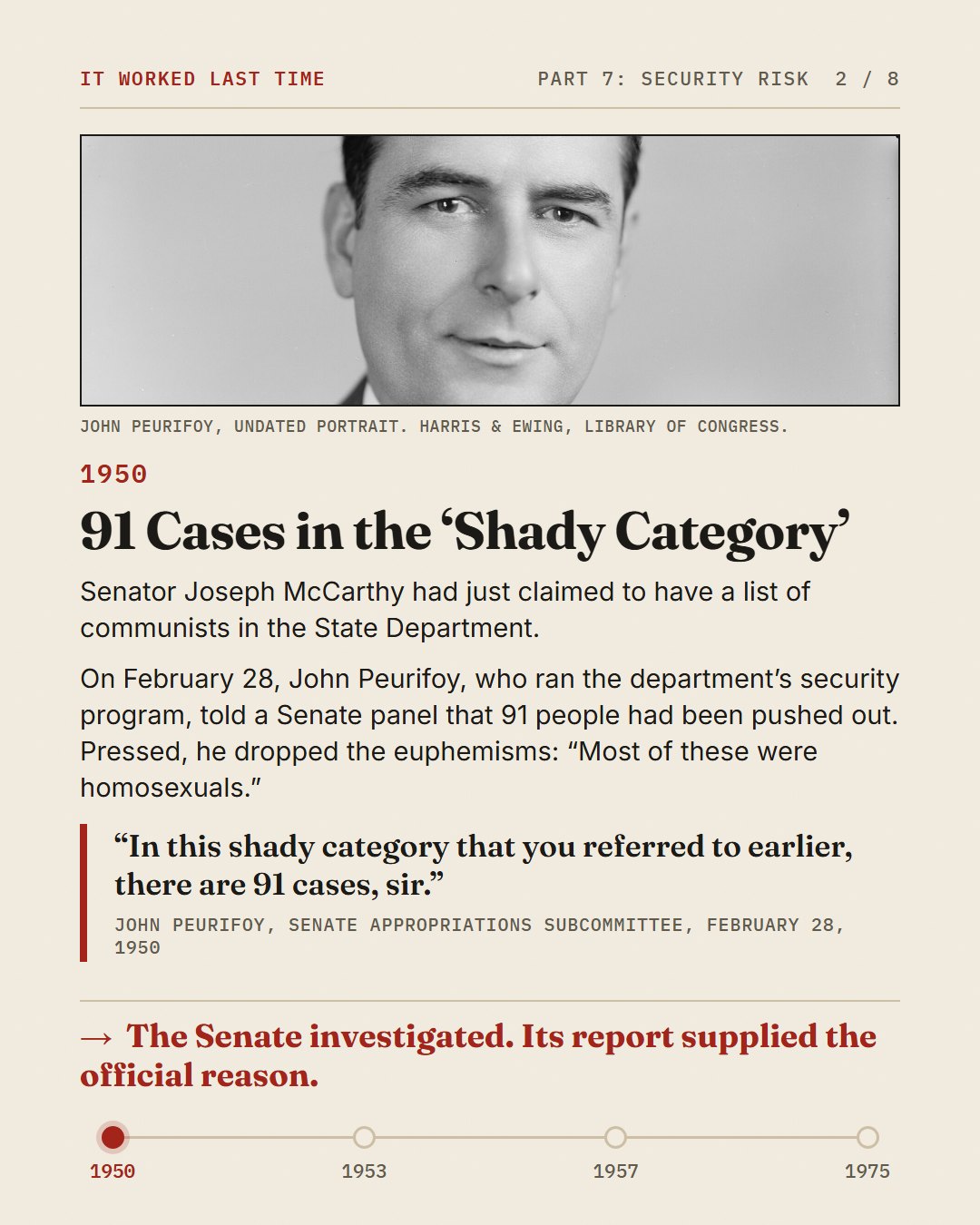
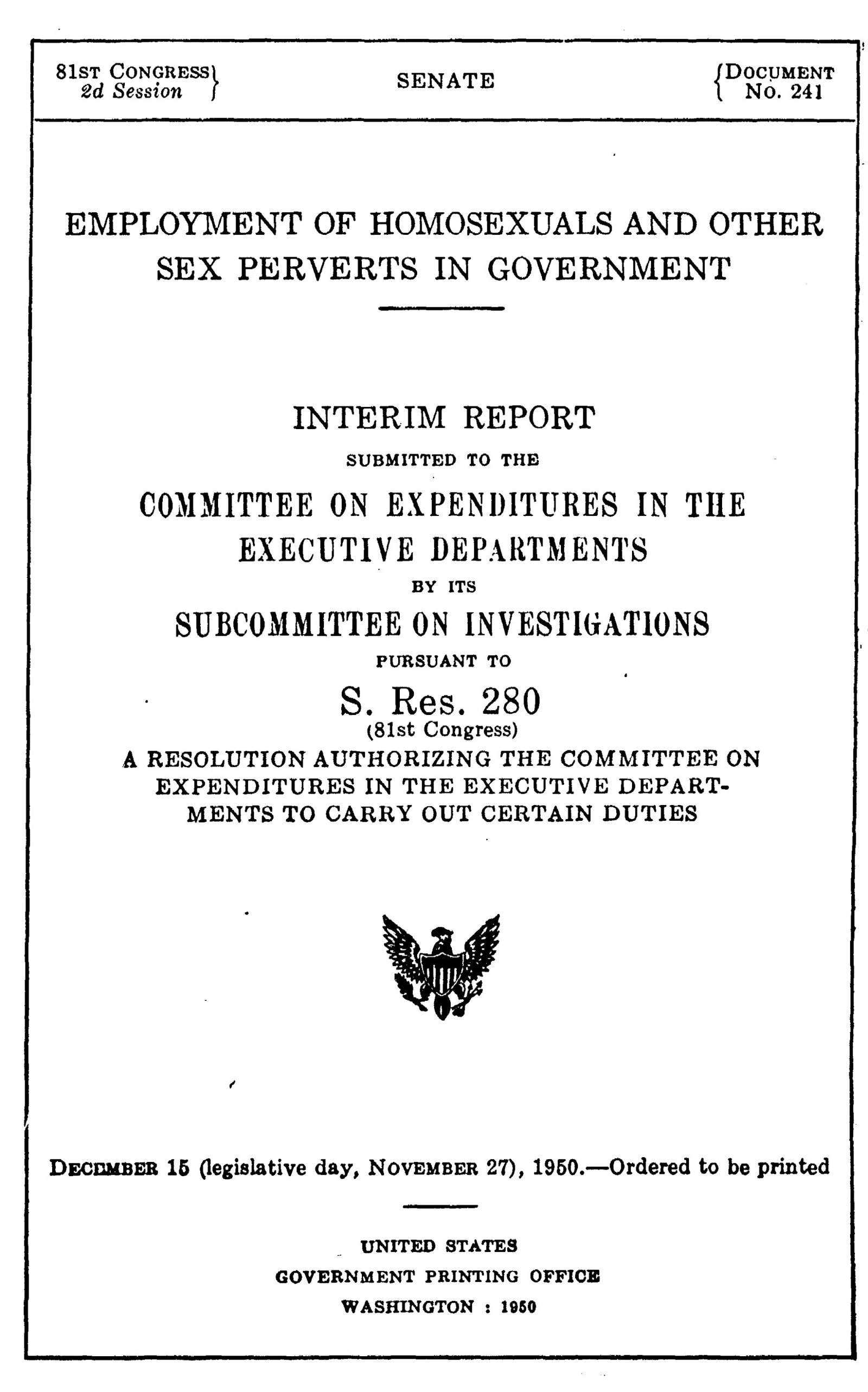
On December 15, 1950, the subcommittee released Senate Document 241, “Employment of Homosexuals and Other Sex Perverts in Government”7. Its verdict was that gay people “are not proper persons to be employed in Government for two reasons; first, they are generally unsuitable, and second, they constitute security risks”7,8.
The first reason was moral. The report said such employees lacked “the emotional stability of normal persons,” and it warned: “One homosexual can pollute a Government office”7,8. The second reason carried more weight, because it sounded like national defense. The report said the FBI, the CIA and the intelligence services of the Army, Navy and Air Force “are in complete agreement that sex perverts in Government constitute security risks”7.
The mechanism was blackmail. “The pervert is easy prey to the blackmailer,” the report said, and “espionage agents can use the same type of pressure to extort confidential information”7,8.
For proof, the report named one case. It told the story of “Captain Raedl,” chief of Austrian counterintelligence in 1912, whom Russian agents caught and blackmailed7. That was 38 years earlier, in another country, before a world war. The report mentioned “other cases” without names or numbers7. Johnson found that CIA Director Roscoe Hillenkoetter, the only official who gave the committee concrete evidence for the blackmail argument, had “manipulated and exaggerated elements of the Redl story”1. An official from the Office of Naval Intelligence told a committee staffer that “there was too much stress on blackmail in connection with homosexuals”1.
Decent people had reasons to believe the report anyway. Police told the subcommittee about gangs of blackmailers who preyed on gay men7. Every intelligence agency, the report said, agreed. A reader in 1950 had no way to know that the agreement rested on opinion rather than counted cases.
The report’s own logic also ran in a circle. Blackmail worked, it explained, because “the social stigma attached to sex perversion is so great” that people hid it7. The government’s answer was to make exposure cost people their jobs, which made the secret more valuable to a blackmailer.
The report counted its own results. In the seven months after the inquiries began, agencies acted on 382 civilian cases, compared with 192 in the three years before7. From January 1947 to October 1950, the armed services and civilian agencies handled 4,954 cases, and about 1,700 job applicants were turned away7. By early 1952, TIME reported, the State Department had fired 126 people “as identifiable homosexuals” in 13 months23.
Security Requirements for Government Employment
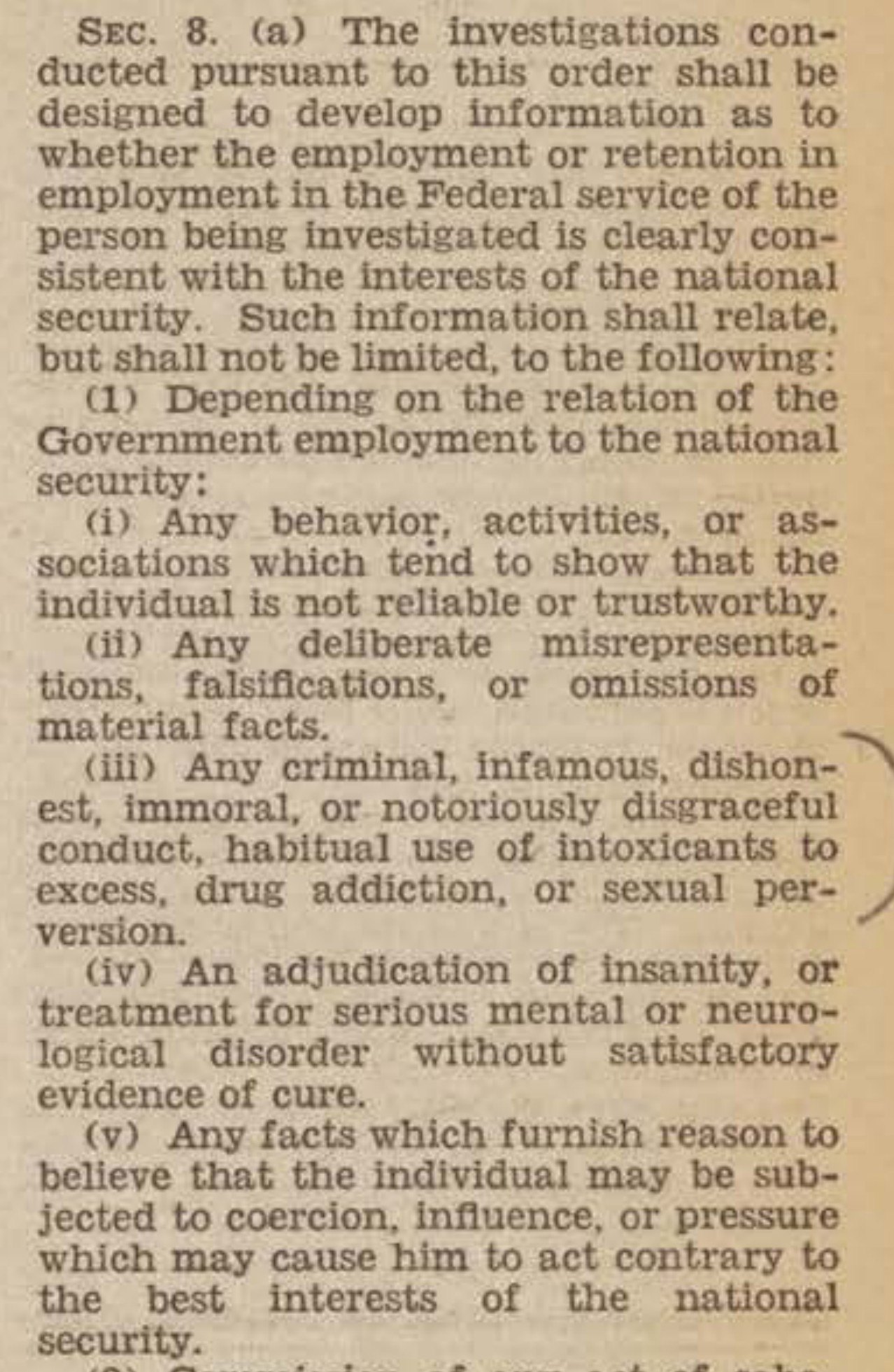
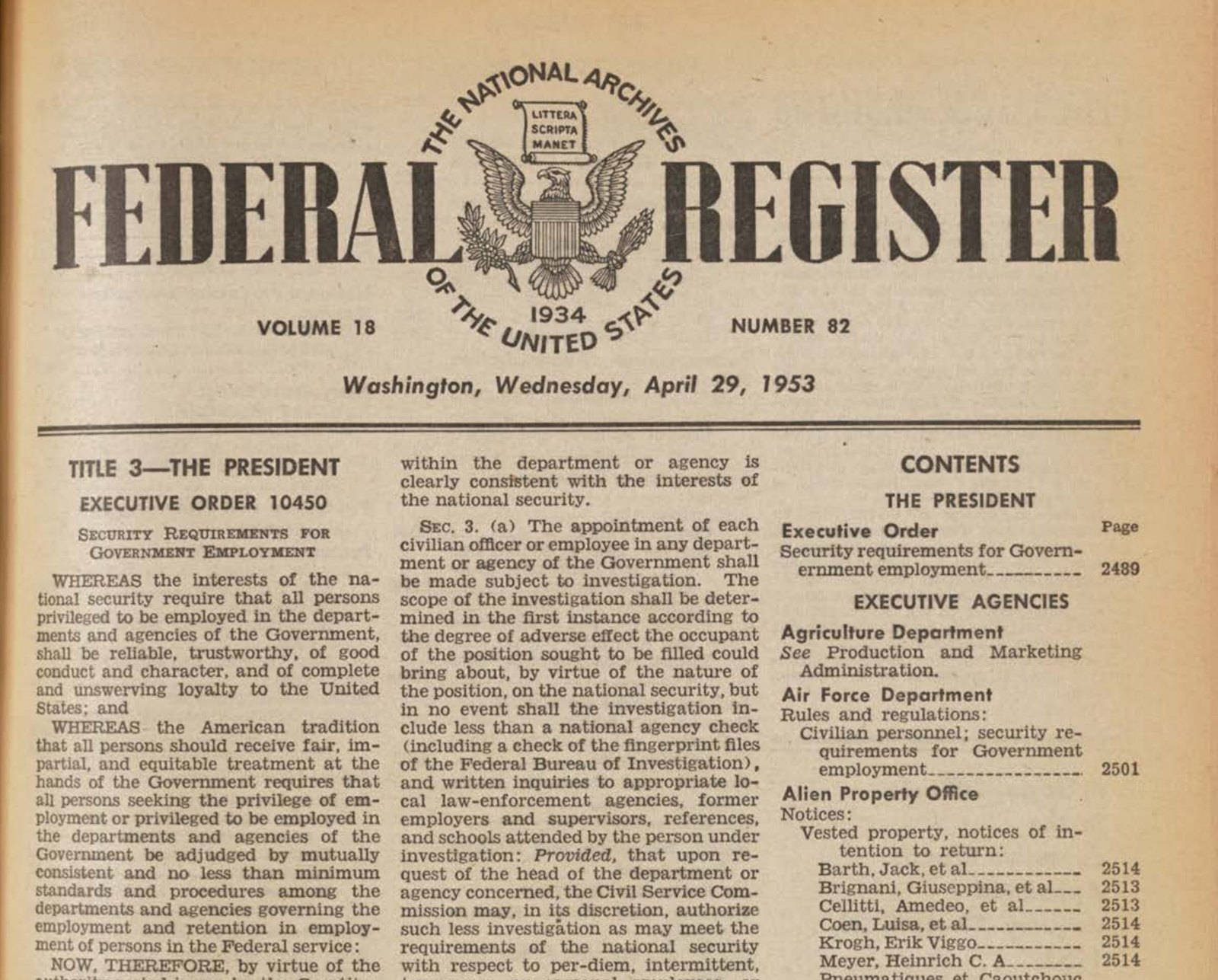
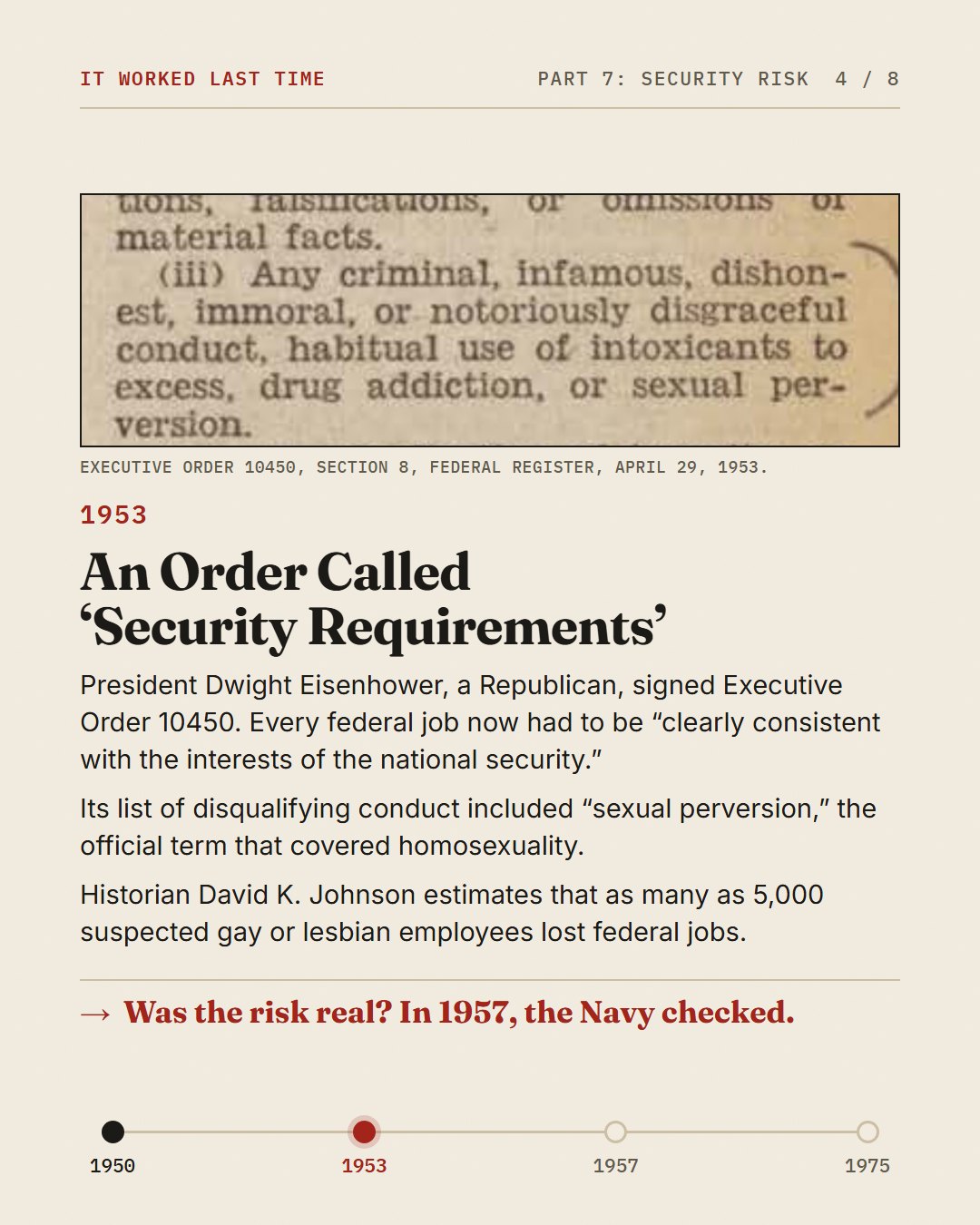
On April 27, 1953, President Dwight D. Eisenhower, a Republican, signed Executive Order 1045010. Its title was “Security Requirements for Government Employment.” It required every agency head to make sure that employing each person was “clearly consistent with the interests of the national security,” and it gave every department the power to suspend and fire employees under a 1950 national security law10.
Section 8 listed what investigators should look for, from sabotage and treason to this clause: “Any criminal, infamous, dishonest, immoral, or notoriously disgraceful conduct, habitual use of intoxicants to excess, drug addiction, or sexual perversion”10. In the official language of the time, gay people were “sexual perverts,” and “sexual perversion” was the term that covered them9,7.
The order never had to argue the point. The Senate had already declared gay employees security risks, so a security order could list them without a word of explanation.
No one knows how many people lost their jobs. Johnson estimates that “as many as five thousand suspected gay or lesbian employees may have lost their jobs with the federal government during the early days of the Cold War”1. A National Archives history puts the range at “somewhere between 5,000 and tens of thousands”5, and a 2014 report by the federal Merit Systems Protection Board cites an estimate of 7,000 to 10,000 in the 1950s alone9. When a court asked the Civil Service Commission in 1973 how many people it fired each year for homosexual conduct, the commission refused to say, calling the request “burdensome and oppressive”9.
The rule outlasted the people who wrote it. During the Kennedy years, Civil Service Commission Chairman John W. Macy answered a gay rights group in two sentences: “It is the established policy of the Civil Service Commission that homosexuals are not suitable for appointment to or retention in positions in the Federal service. There would be no useful purpose served in meeting with representatives of your Society”17.
Had anyone tested whether the risk was real? One part of the government did, in 1957.
The Navy Checks the Evidence
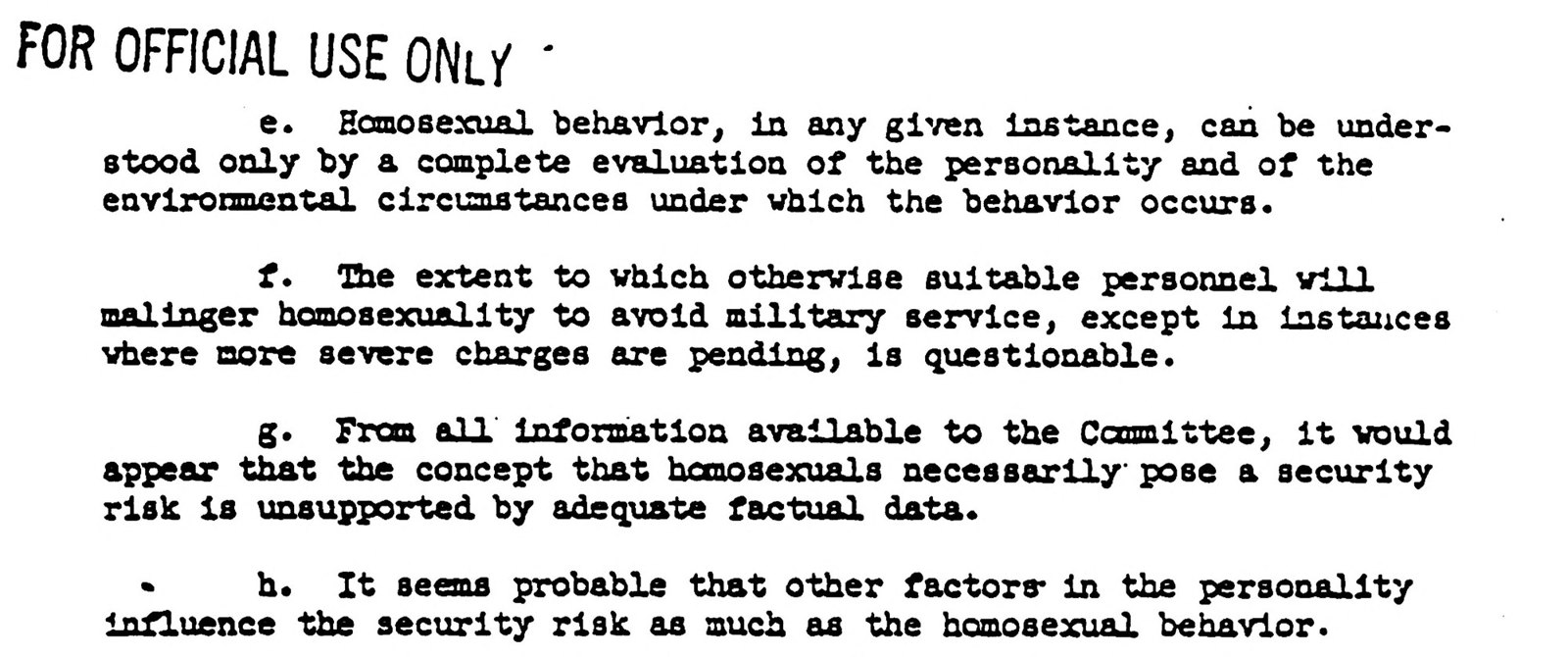
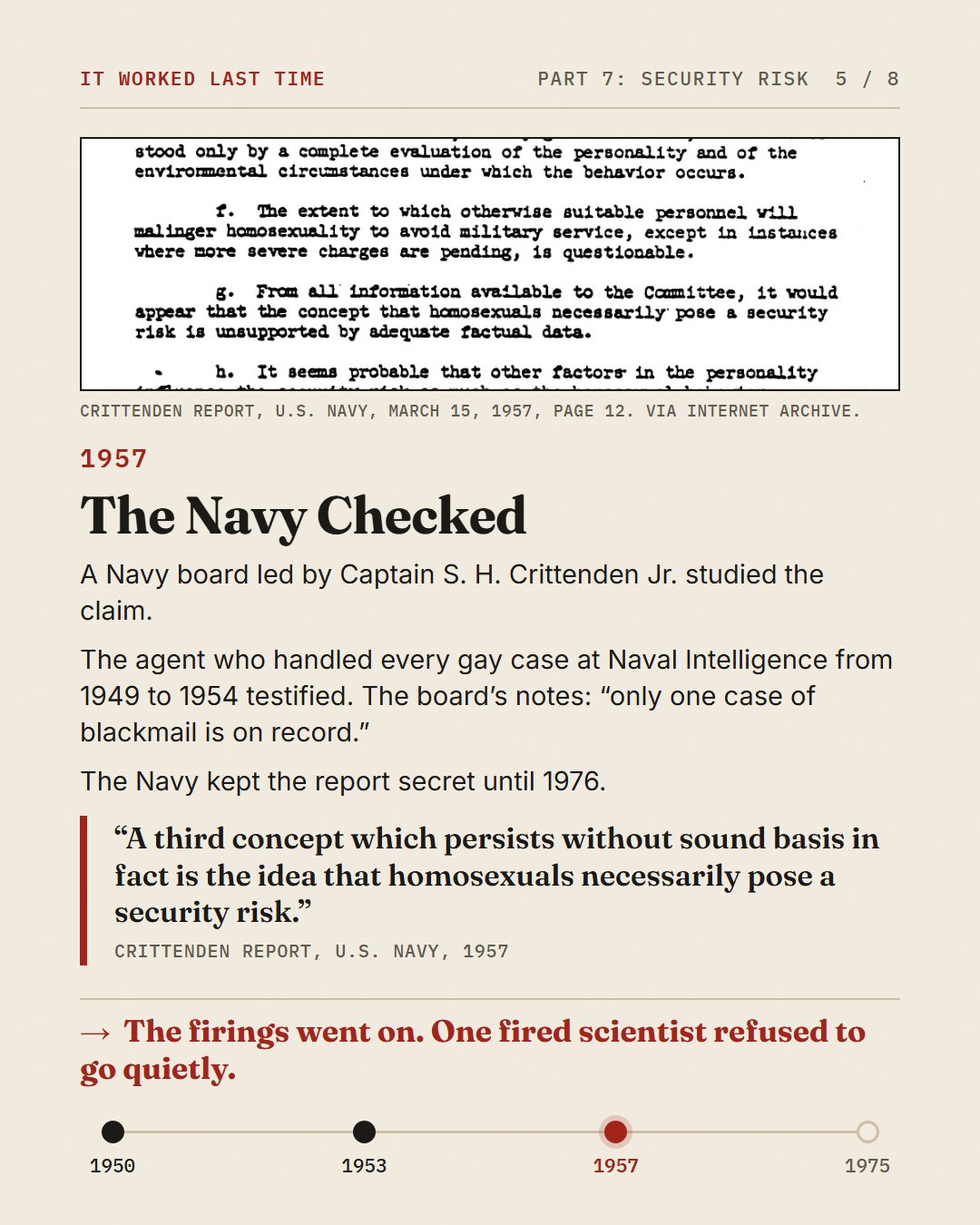
In December 1956, the Secretary of the Navy appointed a board, chaired by Captain S. H. Crittenden Jr., to review the Navy’s policies on gay service members. It submitted its report on March 15, 195711.
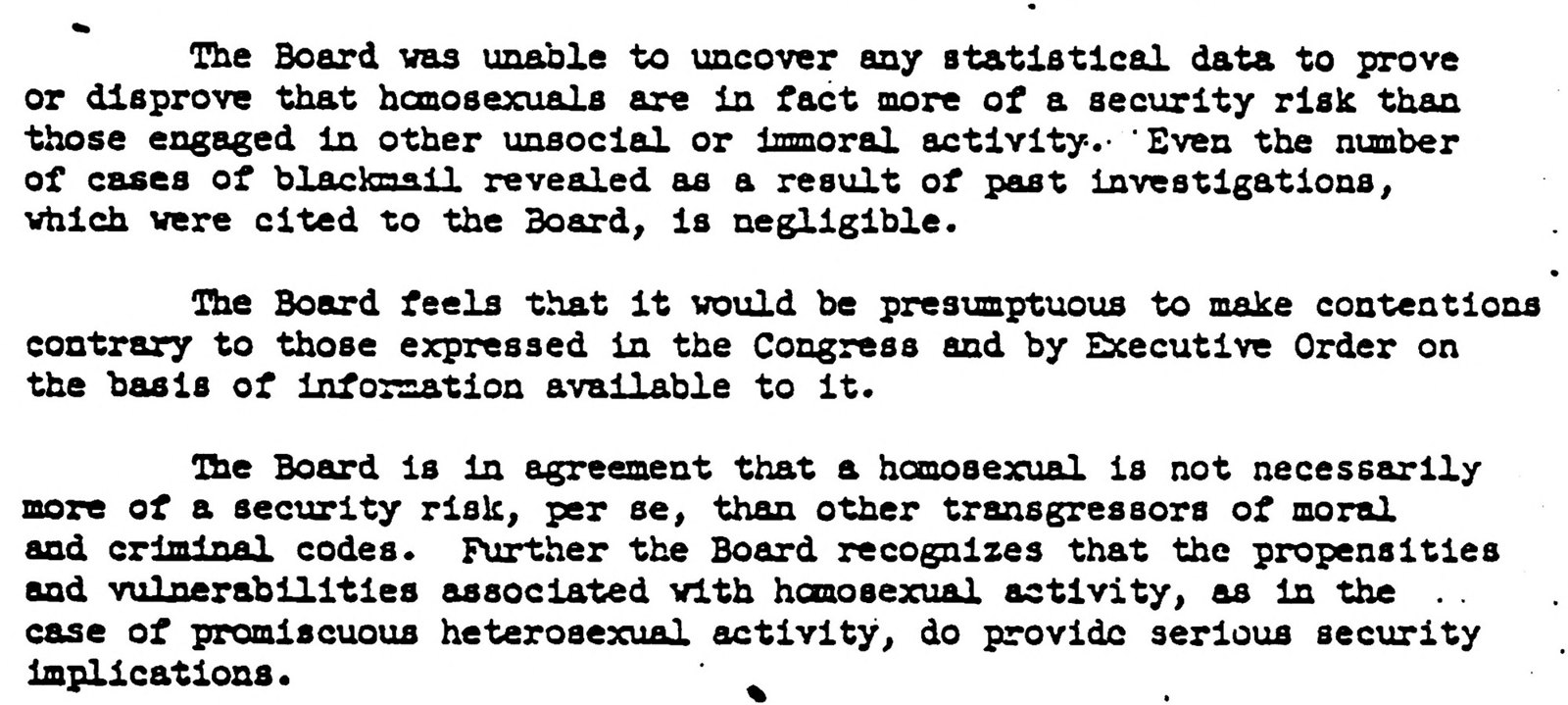
The board went looking for the security risk and could not find the data. “A third concept which persists without sound basis in fact is the idea that homosexuals necessarily pose a security risk,” it wrote11. It traced the idea to the 1950 Senate report and noted that “no intelligence agency, as far as can be learned, adduced any factual data before that Committee with which to support these opinions”11. One of its formal findings: “the concept that homosexuals necessarily pose a security risk is unsupported by adequate factual data”11.
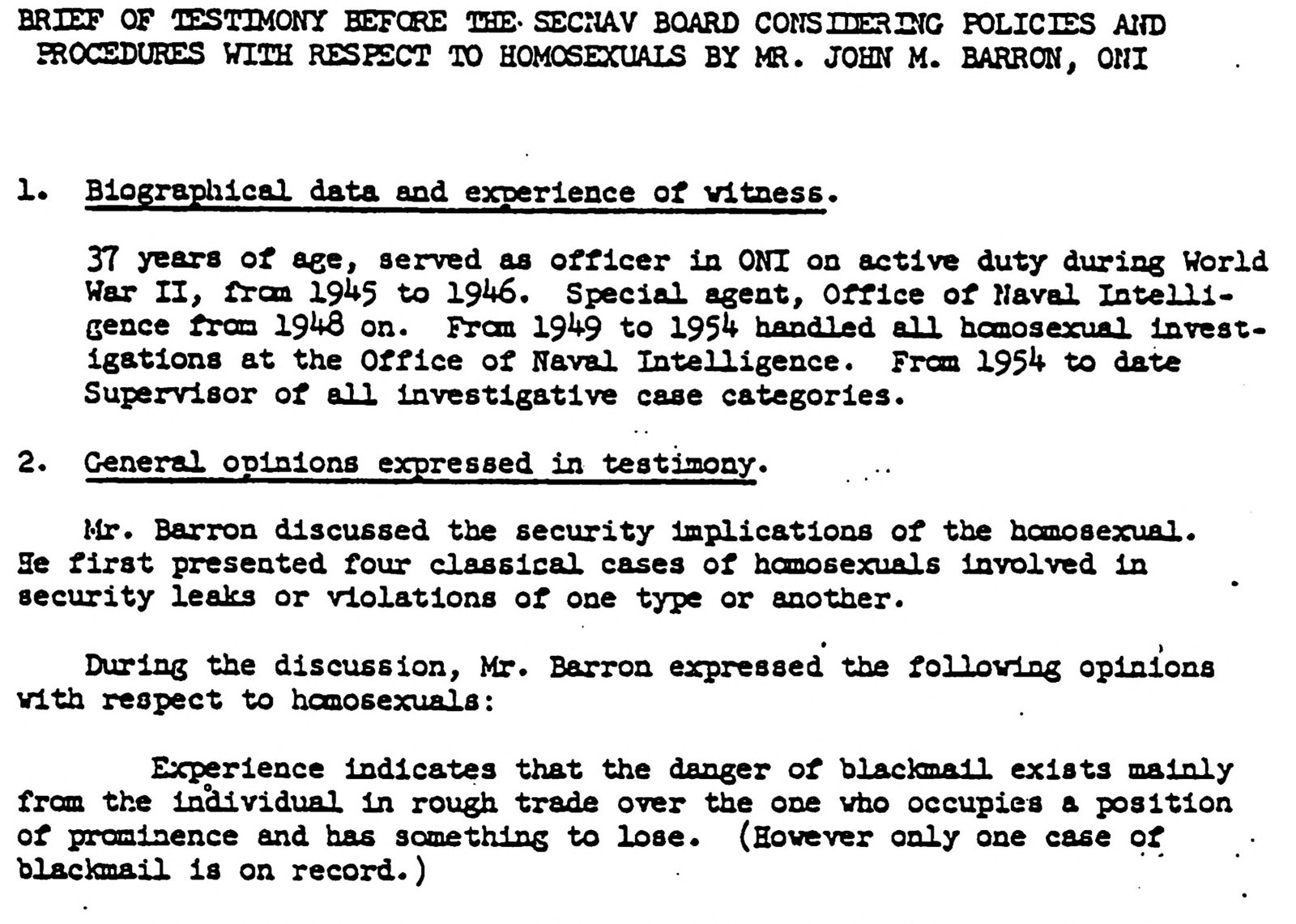
The board also looked for the base rate, the number that tells you how often something actually happens. “The Board was unable to uncover any statistical data to prove or disprove that homosexuals are in fact more of a security risk than those engaged in other unsocial or immoral activity,” it wrote, and the number of blackmail cases cited to it “is negligible”11. One witness was John M. Barron, the Office of Naval Intelligence agent who handled all of that office’s homosexual investigations from 1949 to 1954. The board’s summary of his testimony includes this note: “(However only one case of blackmail is on record.)”11. Barron still regarded gay people as a security risk. The record he worked from held one blackmail case.
The board found evidence in the other direction, too. Eight enlisted men at one station, all with Top Secret clearances, had been found to be gay, “and there was no evidence that any of them had broken security”11. Some intelligence officers, it added, considered a senior officer having an affair with a junior officer’s wife “much more of a security risk than the ordinary homosexual”11.
The board did not recommend ending the ban. It said it would be “presumptuous” to contradict the views “expressed in the Congress and by Executive Order,” and a 1992 review by the General Accounting Office noted that the report “did not question the underlying premise of DOD’s policy”11,12.
The Navy did not publish it. Johnson writes that the Pentagon “kept the Crittenden Report secret and repeatedly denied its existence”1. The report surfaced in 197613,24, and historian Allan Bérubé found that it and other Navy studies were released only under a federal judge’s order in 197714.
The Astronomer Who Would Not Go Quietly
The year the Navy board wrote its report, the government hired Frank Kameny. He was a World War II Army veteran with a new doctorate in astronomy, and the Army Map Service took him on as an astronomer on July 15, 195717,15. On his application he had listed a 1956 arrest in San Francisco15. Investigators asked about his relationships with men, and he refused to answer, saying these were “matters of his own personal life”17.
The Army Map Service dismissed him on December 20, 1957, officially for alleged falsification of his job application15,16. On January 15, 1958, the Civil Service Commission declared him unsuitable for federal work “on grounds of immoral conduct” and barred him for three years15,16.
Fired workers often denied being gay and hoped the matter would fade17. Kameny took a different route. In January 1961, filing his own petition to the Supreme Court, he argued that the policy itself was the wrong: “The Commission’s policies against the employment of homosexuals constitute a discrimination no less illegal and no less odious than discrimination based upon religious or racial grounds”15. He reminded the Court where he had been in 1945: “In World War II, petitioner did not hesitate to fight the Germans, with bullets, in order to help preserve his rights and freedoms and liberties, and those of others”15. On March 20, 1961, the Court declined to hear the case15.
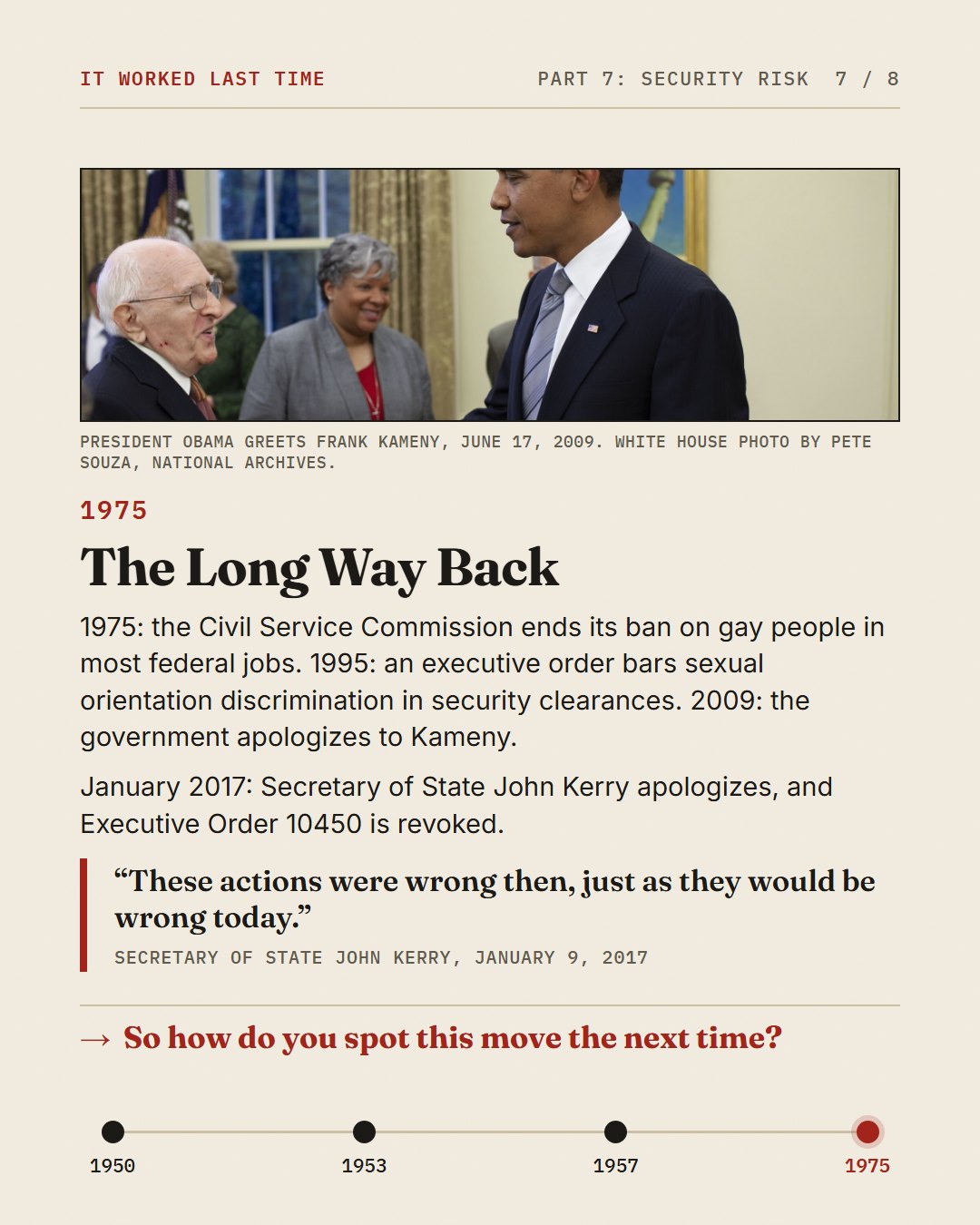
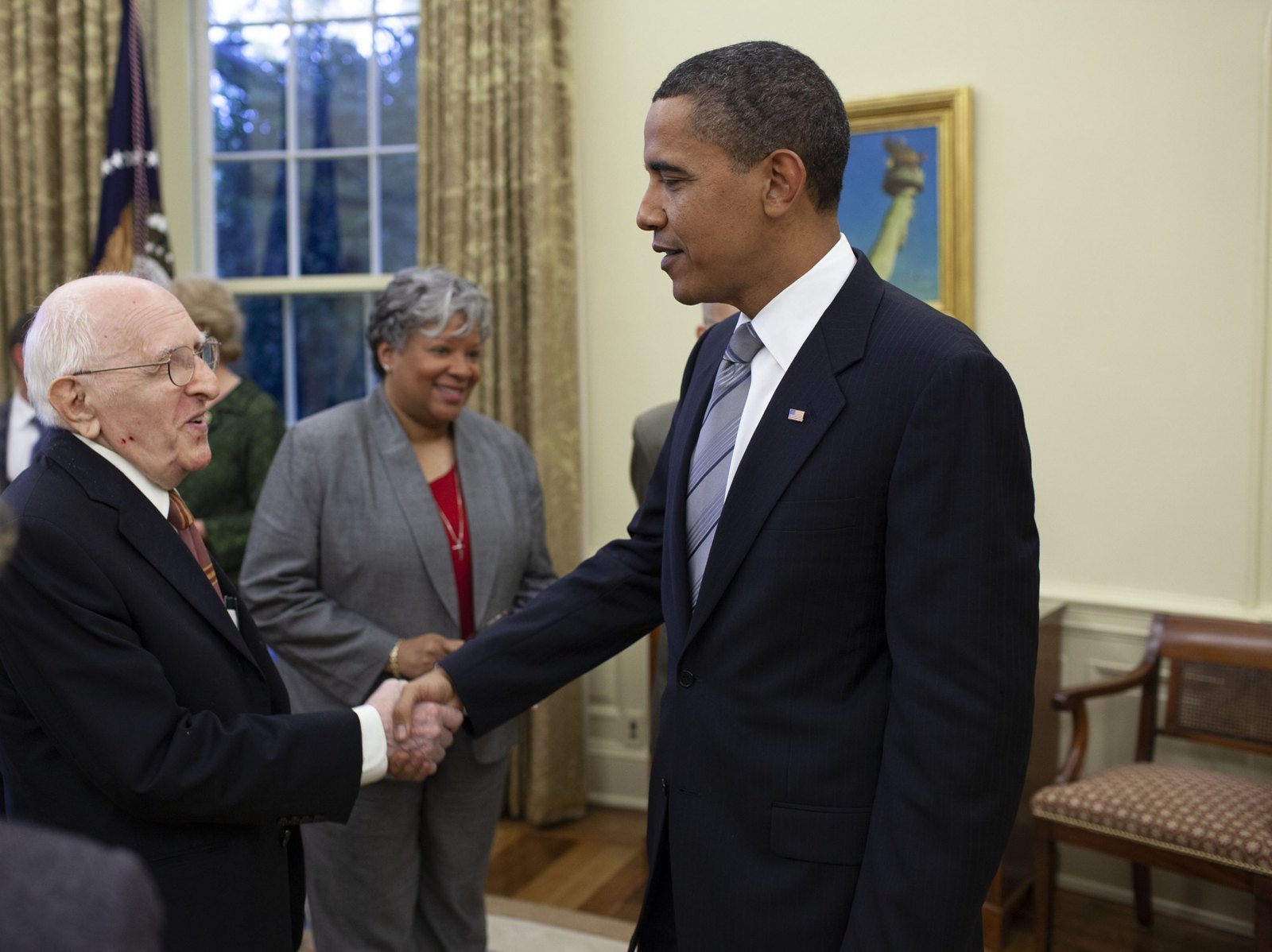
That year he co-founded the Mattachine Society of Washington5,17. He wrote to President Kennedy and the White House staff, and in 1965 he organized the first protest for gay rights in front of the White House17. He never worked as a professional astronomer again17. When the federal government formally apologized to him in 2009, he said that “in a sense, it took 50 years,” but “I won my case”17.
The rule itself came apart slowly, one court case and one executive order at a time.
The Long Way Back
Courts moved first. In 1969, in Norton v. Macy, a federal appeals court held that an employee could be dismissed for “immoral” behavior only if it actually impaired the efficiency of the service9. In 1973, in Society for Individual Rights v. Hampton, a federal court in California found that the Civil Service Commission had not even tried to meet that standard9.
In July 1975, the commission issued new suitability guidelines. Applicants could no longer be found unsuitable based on “unsubstantiated conclusions concerning possible embarrassment for the Federal service”9. The FBI and the CIA were exempt9. The State Department ended its ban in the Foreign Service in 197718.
Security clearances took longer. On August 2, 1995, President Bill Clinton signed Executive Order 12968, which says: “The United States Government does not discriminate on the basis of race, color, religion, sex, national origin, disability, or sexual orientation in granting access to classified information”19. A 1998 order, Executive Order 13087, ended limitations on federal employment related to sexual orientation18.
On January 9, 2017, Secretary of State John Kerry apologized for the department’s discrimination “against employees and job applicants on the basis of perceived sexual orientation, forcing some employees to resign or refusing to hire certain applicants in the first place.” He wrote: “These actions were wrong then, just as they would be wrong today. On behalf of the Department, I apologize to those who were impacted by the practices of the past”21. Eight days later, on January 17, Executive Order 13764 revoked Executive Order 1045020.
Kameny did not live to see either. He died in 2011, two years after his own apology17.
The Pattern
Strip away the names and dates and the move is simple. Take a group that much of the public already treats as outcasts7. Give its members an official label, “security risk,” that moves the question from private morals to national defense. Support the label with one vivid case and the agreement of experts who offer no count. After that, doubting the policy sounds like doubting national security.
The label works because it turns exclusion into caution. The 1950 Senate report said so directly: “in the case of doubt the American people are entitled to have errors of judgment on the part of their officials, if there must be errors, resolved on the side of caution”7. Under that rule, doubt alone could cost a person a career.
The scale of the response and the scale of the evidence never matched. Thousands of people lost federal jobs17,1. On the other side of the ledger, the Senate named one blackmail case, from 1912. The board’s summary of testimony from the Navy intelligence agent who handled gay cases for five years noted that “only one case of blackmail is on record.” The Navy board called the blackmail cases cited to it “negligible”7,11.
Real cases did exist. In Britain, an Admiralty clerk named John Vassall was photographed with men at a KGB-arranged party in Moscow in 1954 and, by his own account, blackmailed into spying for the Soviet Union until his arrest in 196225. A real case is worth taking seriously. But one case, however terrible, is a story. It is not a rate, and it does not justify removing everyone who shares a trait with the victim.
And part of the danger was made by the policy. Blackmail needs a secret that costs something when it is told. The government made sure the secret would cost a career.
Their Defense
The Hoey subcommittee insisted it was not guessing: “The conclusion of the subcommittee that a homosexual or other sex pervert is a security risk is not based upon mere conjecture”7. It rested that conclusion on the opinions of the intelligence agencies, and it asked that removals be carried out “in a manner consistent with the traditional American concepts of justice and fair play,” with notice of the charges, time to answer and a proposed appeal board7.
The Navy’s board, after finding no data, deferred to Congress and the President rather than contradict them11. When the General Accounting Office reported in 1992 that the Crittenden Report had found the security premise unsupported, the Defense Department replied, in GAO’s summary, that “the Crittenden report clearly supported the policy”12.
By then, the stated reason had shifted. Defending the military’s ban in July 1991, Secretary of Defense Dick Cheney told Congress: “I think there have been times in the past when it has been generated on the notion that somehow there was a security risk involved, although I must say I think that is a bit of an old chestnut.” The question, he said, turned instead on “the need of the department to maintain the combat-effectiveness of our military units”12. The reason changed. The ban did not.
Even the 2017 apology carried a defense. Kerry’s statement placed the State Department “among many public and private employers that discriminated”21. Johnson, who welcomed the apology, objected that “the State Department was unique in its level of homophobia”22.
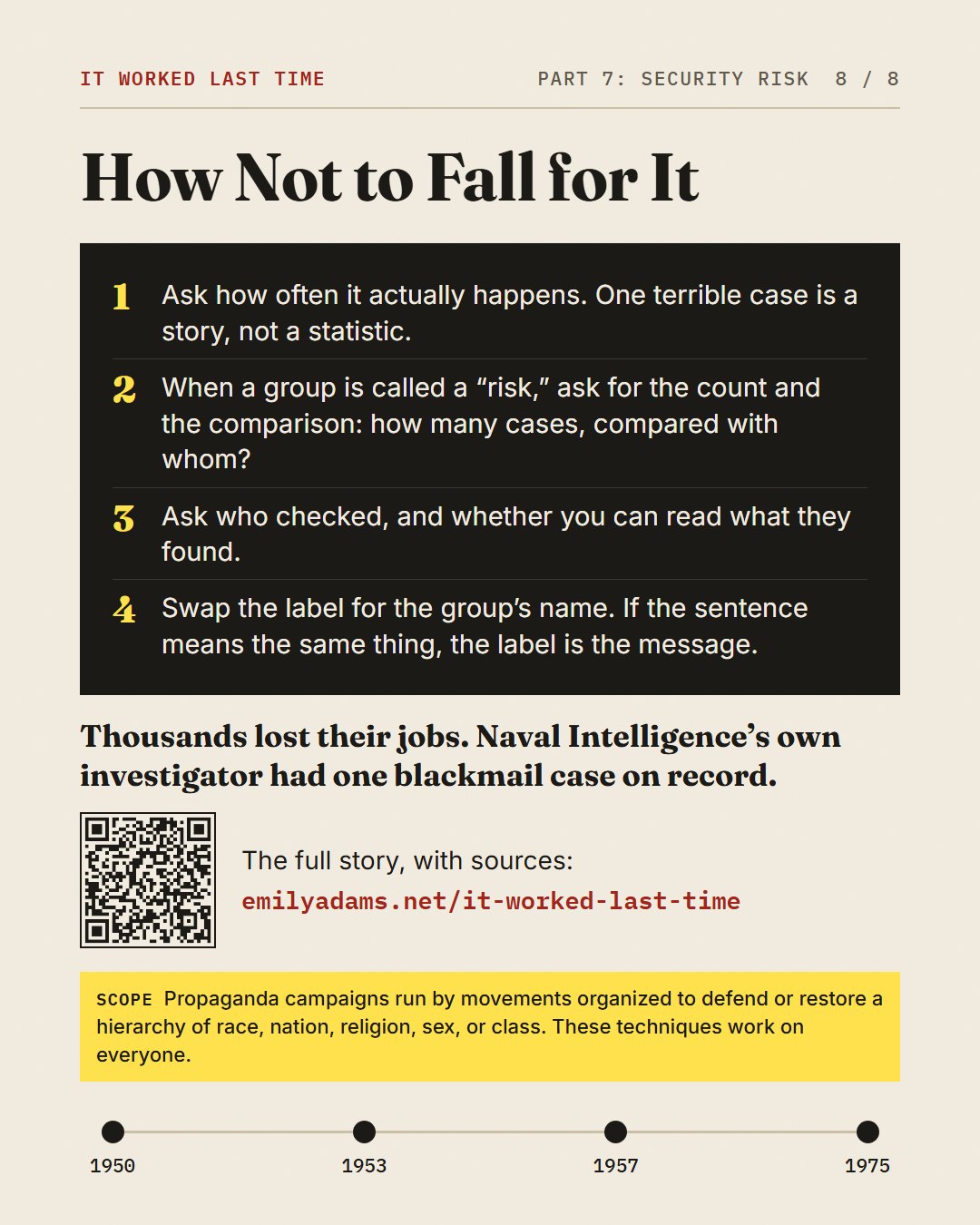
How Not to Fall for It
Ask how often it actually happens. One terrible case is a story, not a statistic. In 1950, the Senate’s one named case was 38 years old.
When a group is called a “risk,” ask for the count and the comparison. The Navy board asked whether gay sailors broke security more often than anyone else, and no one had the numbers11.
Ask who checked, and whether you can read what they found. The Navy’s 1957 study of the claim stayed out of public view for almost 20 years1,13.
Swap the label for the group’s name. In 1950, “security risk” often meant “gay employee.” If the sentence keeps its meaning after the swap, the label is the message.
Thousands of people lost their jobs. Naval Intelligence’s own investigator had one blackmail case on record.
Sources
- 1The Lavender Scare: The Cold War Persecution of Gays and Lesbians in the Federal Government. University of Chicago Press (David K. Johnson). 2004. archive.org/details/lavenderscarecol00john_0
- 2Fragmented Citizens: The Changing Landscape of Gay and Lesbian Lives. New York University Press (Stephen M. Engel). 2016. archive.org/details/fragmentedcitize0000enge
- 3Manufacturing Hysteria: A History of Scapegoating, Surveillance, and Secrecy in Modern America. Pantheon Books (Jay Feldman). 2011. archive.org/details/manufacturinghys0000feld_p4i3
- 4Gay American History: Lesbians and Gay Men in the U.S.A.. Thomas Y. Crowell (Jonathan Katz). 1976. archive.org/details/gayamericanhisto0000katz_g7x8
- 5"These People Are Frightened to Death": Congressional Investigations and the Lavender Scare. Prologue, U.S. National Archives (Judith Adkins). 2016. archives.gov/publications/prologue/2016/summer/lavender.html
- 6NASA Historical Investigation into James E. Webb's Relationship to the Lavender Scare, Final Report. NASA (Brian C. Odom, Chief Historian). 2022. nasa.gov/wp-content/uploads/2022/11/nasa_historical_investigation_jame
- 7Employment of Homosexuals and Other Sex Perverts in Government (Senate Document 241, 81st Congress). U.S. Senate, Committee on Expenditures in the Executive Departments, Subcommittee on Investigations. 1950-12-15. archive.org/details/glassgovernment-senate-doc-241-hoey-1950
- 8Employment of Homosexuals and Other Sex Perverts in Government (text). PBS Frontline. 1950-12-15. pbs.org/wgbh/pages/frontline/shows/assault/context/employment.html
- 9Sexual Orientation and the Federal Workplace: Policy and Perception. U.S. Merit Systems Protection Board. 2014-05. nasa.gov/wp-content/uploads/2023/10/mspbpolicyonsxoandfederalworkplace
- 10Executive Order 10450: Security Requirements for Government Employment (18 FR 2489). Federal Register, Vol. 18, No. 82, via GovInfo. 1953-04-29. govinfo.gov/app/details/FR-1953-04-29
- 11Report of the Board Appointed to Prepare and Submit Recommendations to the Secretary of the Navy for the Revision of Policies, Procedures and Directives Dealing with Homosexuals (Crittenden Report). U.S. Navy (scan of the Harvard Law Library copy, via Internet Archive). 1957-03-15. archive.org/details/gay-history-us-crittenden-report-1957
- 12Defense Force Management: DOD's Policy on Homosexuality (GAO/NSIAD-92-98). U.S. General Accounting Office. 1992-06. archive.org/details/gay-history-us-do-d-policy-1992_202212
- 13Gay Rights. Lucent Books (Judith C. Galas). 1996. archive.org/details/gayrights00gala
- 14Coming Out Under Fire: The History of Gay Men and Women in World War Two. Plume (Allan Bérubé). 1990. archive.org/details/comingoutunderfi00beru
- 15Kameny v. Brucker: Petition for a Writ of Certiorari. Equality Before the Law, University of Nebraska (transcription of National Archives, RG 267). 1961-01-27. teachinglegalhistory.unl.edu/s/oer/item/2421
- 16Kameny v. Brucker: Motion for Extension of Time to File Petition for Certiorari. National Archives, via Wikimedia Commons. 1960-11-18. commons.wikimedia.org/wiki/File:Kameny_v_Brucker_005.jpg
- 17Frank Kameny, JFK, & the Case for LGBTQ+ Rights. John F. Kennedy Presidential Library, National Archives (Stacey Flores Chandler). 2021-06-02. jfk.blogs.archives.gov/2021/06/02/kameny-jfk-lgbtq-rights/
- 18LGBTQIA+ Federal Employment in the Records at the National Archives. U.S. National Archives. 2022-10-25. archives.gov/research/lgbt/federal-employment
- 19Executive Order 12968: Access to Classified Information (60 FR 40245). Federal Register. 1995-08-02. federalregister.gov/documents/1995/08/07/95-19654/access-to-classified
- 20Executive Order 13764 (82 FR 8115). Federal Register. 2017-01-17. federalregister.gov/documents/2017/01/23/2017-01623/amending-the-civil
- 21Apology for Past Discrimination toward Employees and Applicants based on Sexual Orientation. U.S. Department of State (John Kerry), archived. 2017-01-09. web.archive.org/web/2017/https://2009-2017.state.gov/secretary/remarks
- 22State Department Apologizes For Decades Of Anti-LGBT Discrimination. NPR. 2017-01-09. npr.org/sections/thetwo-way/2017/01/09/508966318/state-department-apol
- 23The Administration: Housecleaning. TIME. 1952-04-07. content.time.com/time/magazine/article/0,9171,816257,00.html
- 24Dying for Joe McCarthy's Sins: The Suicide of Wyoming Senator Lester Hunt. WordsWorth (Rodger McDaniel). 2013. archive.org/details/dyingforjoemccar0000mcda
- 25John Vassall. Wikipedia (secondary). 2026. en.wikipedia.org/wiki/John_Vassall

Image Credits
- Federal Register, Vol. 18, No. 82, front page with Executive Order 10450 (cropped). Office of the Federal Register, National Archives; printed by the U.S. Government Printing Office. 1953-04-29. Public domain (U.S. government work), via GovInfo. Source
- Executive Order 10450, Section 8(a), Federal Register page 2491 (cropped). Office of the Federal Register, National Archives; printed by the U.S. Government Printing Office. 1953-04-29. Public domain (U.S. government work), via GovInfo. Source
- PEURIFOY, JOHN E. (portrait). Harris & Ewing, photographer. Undated (Library of Congress dates the collection 1905 to 1945). No known restrictions on publication (Library of Congress, Harris & Ewing Collection). Source
- Employment of Homosexuals and Other Sex Perverts in Government, Senate Document 241, title page. U.S. Senate, Committee on Expenditures in the Executive Departments. 1950-12-15. Public domain (U.S. government work), via Internet Archive. Source
- Crittenden Report, page 12, findings (e) to (h) (cropped). U.S. Navy board chaired by Capt. S. H. Crittenden Jr.. 1957-03-15. Public domain (U.S. government work), via Internet Archive. Source
- Crittenden Report, Enclosure 1(g): brief of testimony by John M. Barron, ONI (cropped). U.S. Navy board chaired by Capt. S. H. Crittenden Jr.. 1957. Public domain (U.S. government work), via Internet Archive. Source
- Crittenden Report, page 46 (cropped). U.S. Navy board chaired by Capt. S. H. Crittenden Jr.. 1957-03-15. Public domain (U.S. government work), via Internet Archive. Source
- President Barack Obama Greets Frank Kameny in the Oval Office (cropped). Pete Souza, White House Photo Office. 2009-06-17. Public domain (U.S. government work), Barack Obama Presidential Library, National Archives. Source