Protect the Home
Twice in the 20th century, campaigns told women that legal equality would cost them the privileges that protected their homes, and recruited women to carry the warning. Women won the vote anyway in 1920; the Equal Rights Amendment died three states short in 1982.
The Graphics
Swipe through the slides as they appear on Instagram and Facebook. Tap any slide to open it full size.
The Carousel


Five Men at a Window
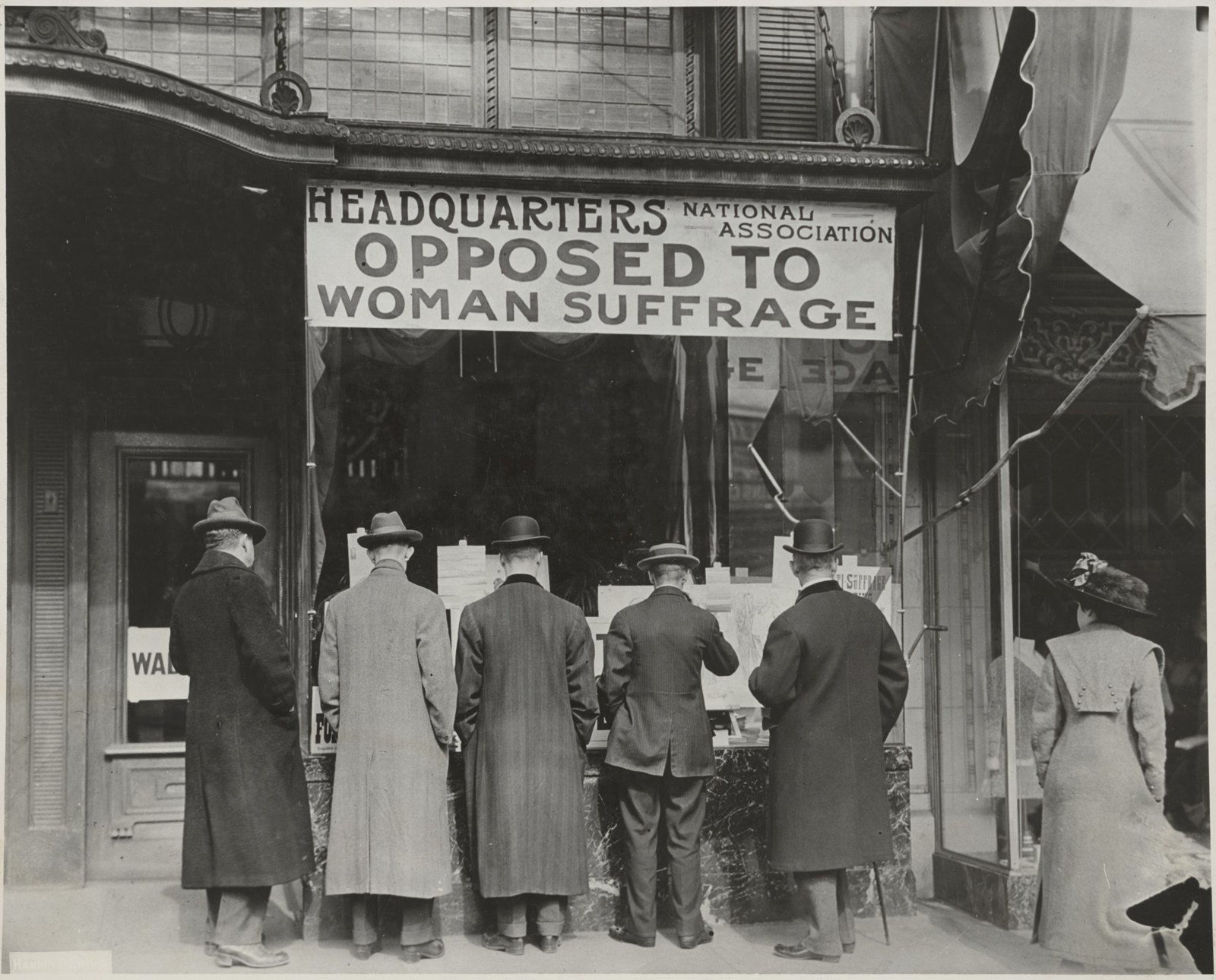
Five men in long coats and hats stand on a sidewalk, reading papers posted in a shop window. A woman in a large hat walks past them. Above the glass hangs a banner: “Headquarters National Association Opposed to Woman Suffrage.” The Washington studio Harris & Ewing took the picture around 19141.
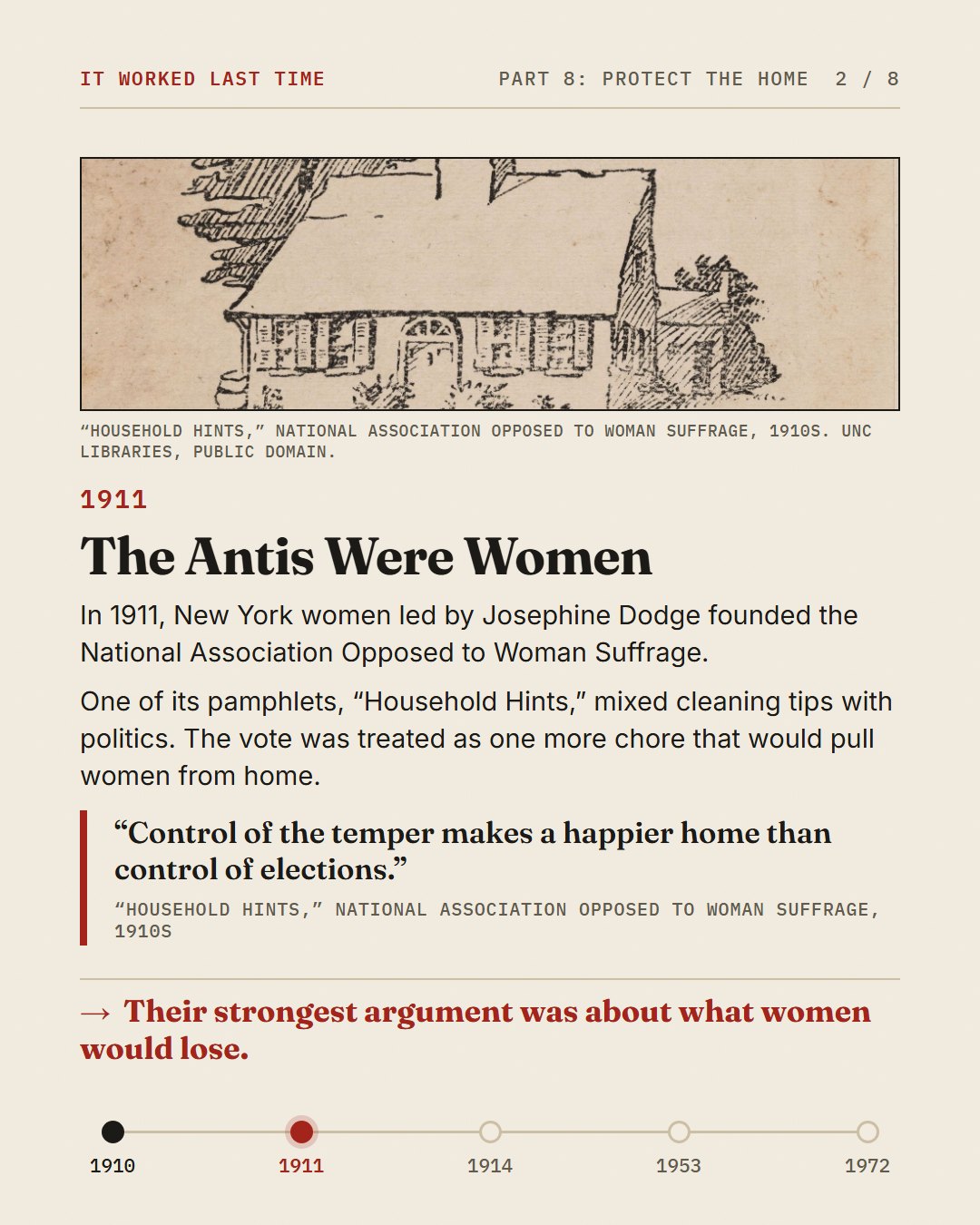
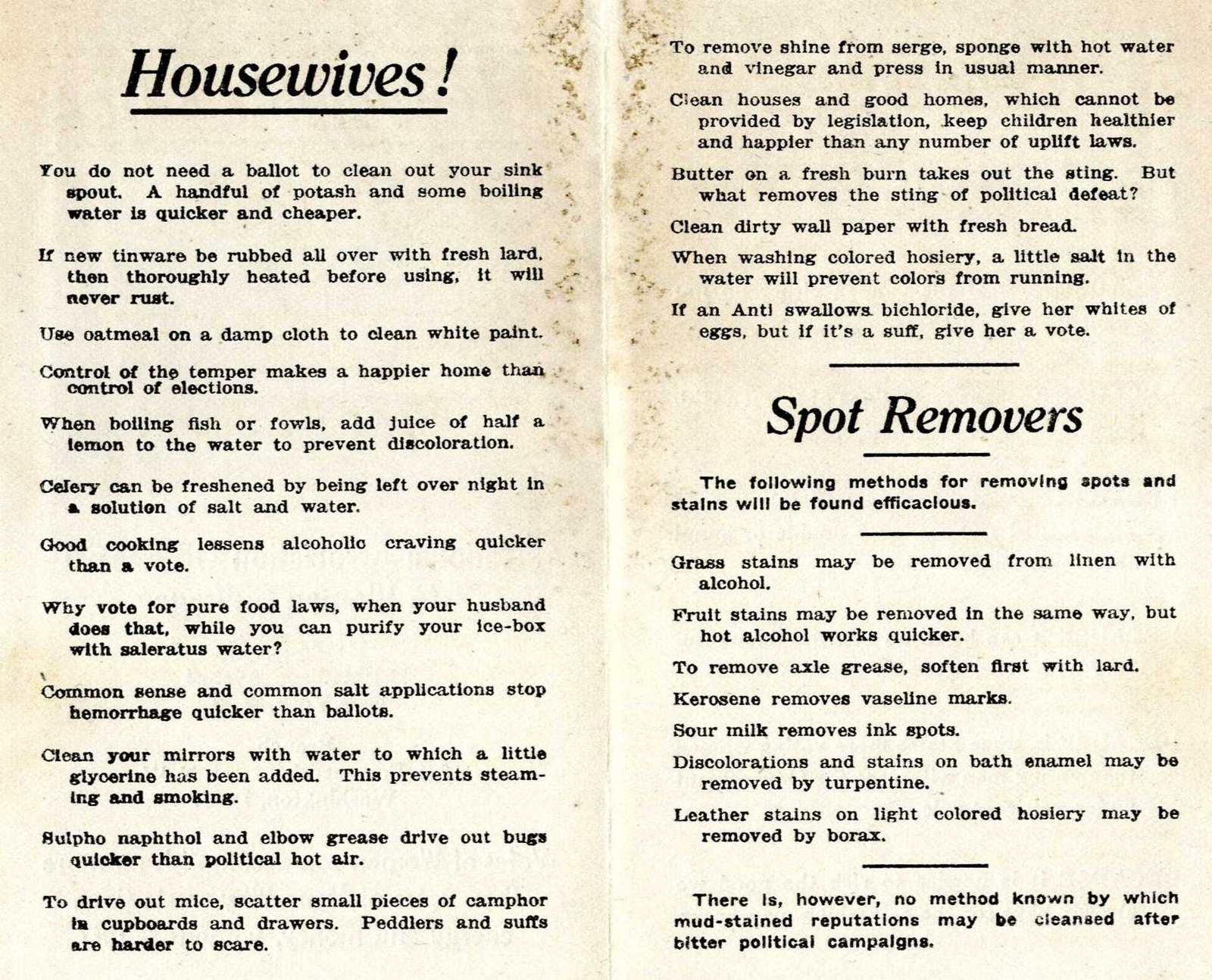
The organization behind that banner was founded and run by women2. One of its pamphlets, “Household Hints,” had a drawing of a cottage on the cover. Inside, between tips for rustproofing tinware and freshening celery, sat the politics: “You do not need a ballot to clean out your sink spout.” And: “Control of the temper makes a happier home than control of elections.”45
The promise was that keeping women’s legal status as it was would protect women, the home, and the family. Sixty years later, a campaign against the Equal Rights Amendment made the same promise, built on the same word: privileges. Both times, women carried the message to other women.
1911: The Antis

In the early 1900s, the fight over women’s votes was waged state by state, often in referendums where only men could vote. Colorado women had been voting for years; the antis’ own flier pointed to “a test of seventeen years” there7. In New York, opponents had organized since the 1890s, and by 1914 the New York State Association Opposed to Woman Suffrage claimed 30,000 members2.
In 1911, Josephine Jewell Dodge, president of the New York group, left to found the National Association Opposed to Woman Suffrage. Its first meeting was in her Park Avenue home. It published a magazine, The Woman’s Protest2. Dodge was not a stranger to working women: she had founded day nurseries for the children of working mothers and led the Association of Day Nurseries of New York City3. She served as the national group’s president from 1911 to 19173.
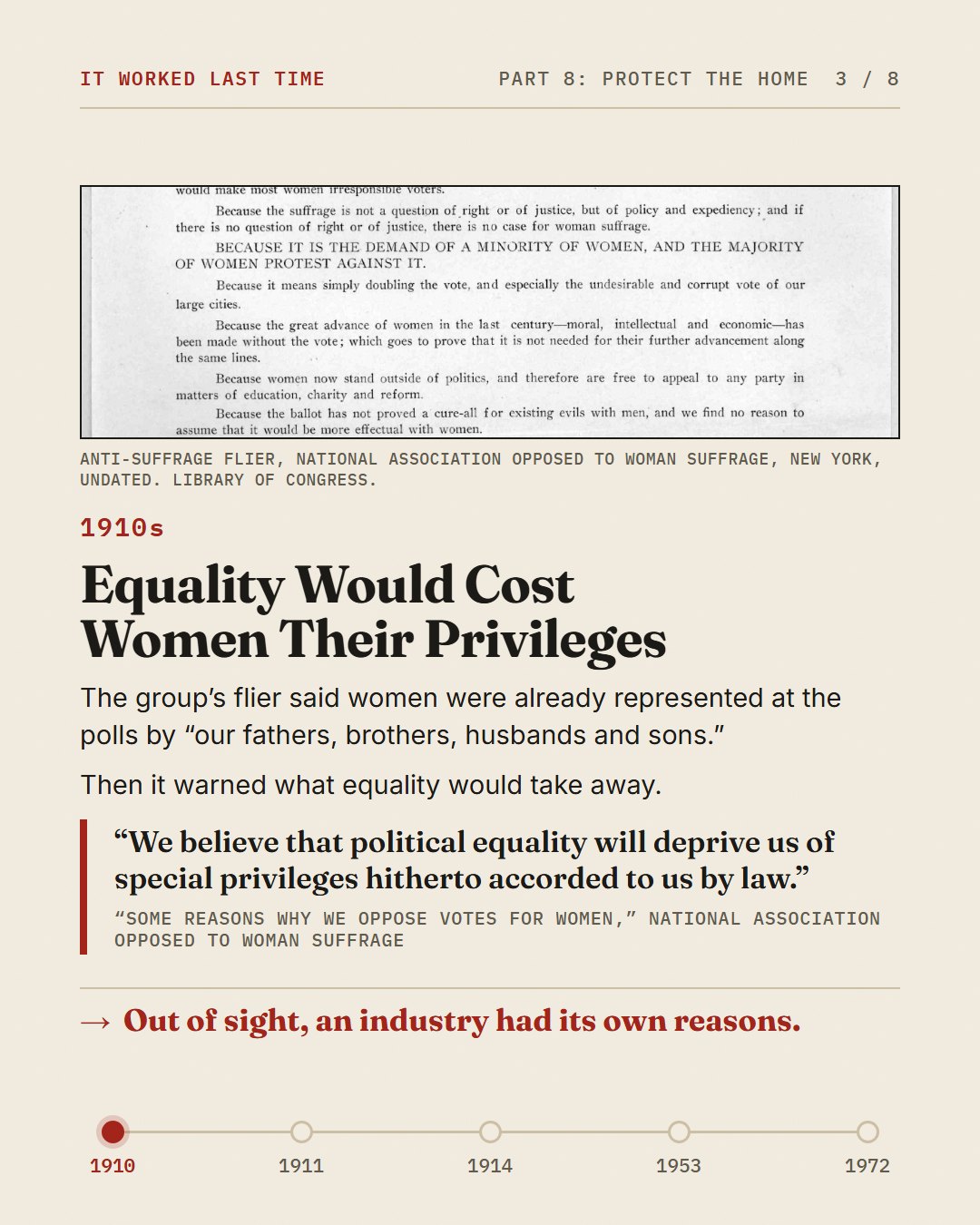
The group’s flier, “Some Reasons Why We Oppose Votes for Women,” laid out the case. Women did not need the vote, it said, “Because it is our fathers, brothers, husbands and sons who represent us at the ballot-box.” It warned that suffrage “means simply doubling the vote, and especially the undesirable and corrupt vote of our large cities.” It said women’s “present duties fill up the whole measure of our time and ability.” And it ended with a warning: “We believe that political equality will deprive us of special privileges hitherto accorded to us by law.”7
The back of “Household Hints” made the same case in shorter lines, including “Because 80% of the women eligible to vote are married and can only double or annul their husbands’ votes.”6
Here is how it worked. Nothing in these fliers said “keep women out.” They said three things a contented wife could believe: you are already represented, the vote is one more chore, and equality has a price. The target was every woman’s right to vote. The audience was the woman the pamphlet addressed directly as “Housewives!”4 And the flier asked her to spread it: “will you not send your name to us and pass our appeal on to some one else?”7
Not everyone who wanted women kept from the polls wanted to be seen saying so.
The Brewers’ Letter
The brewing industry had a specific fear: women voters would help ban alcohol. A memo in the brewers’ own files put it bluntly: suffrage would spread, and “In some of the suffrage States prohibition will come.”9
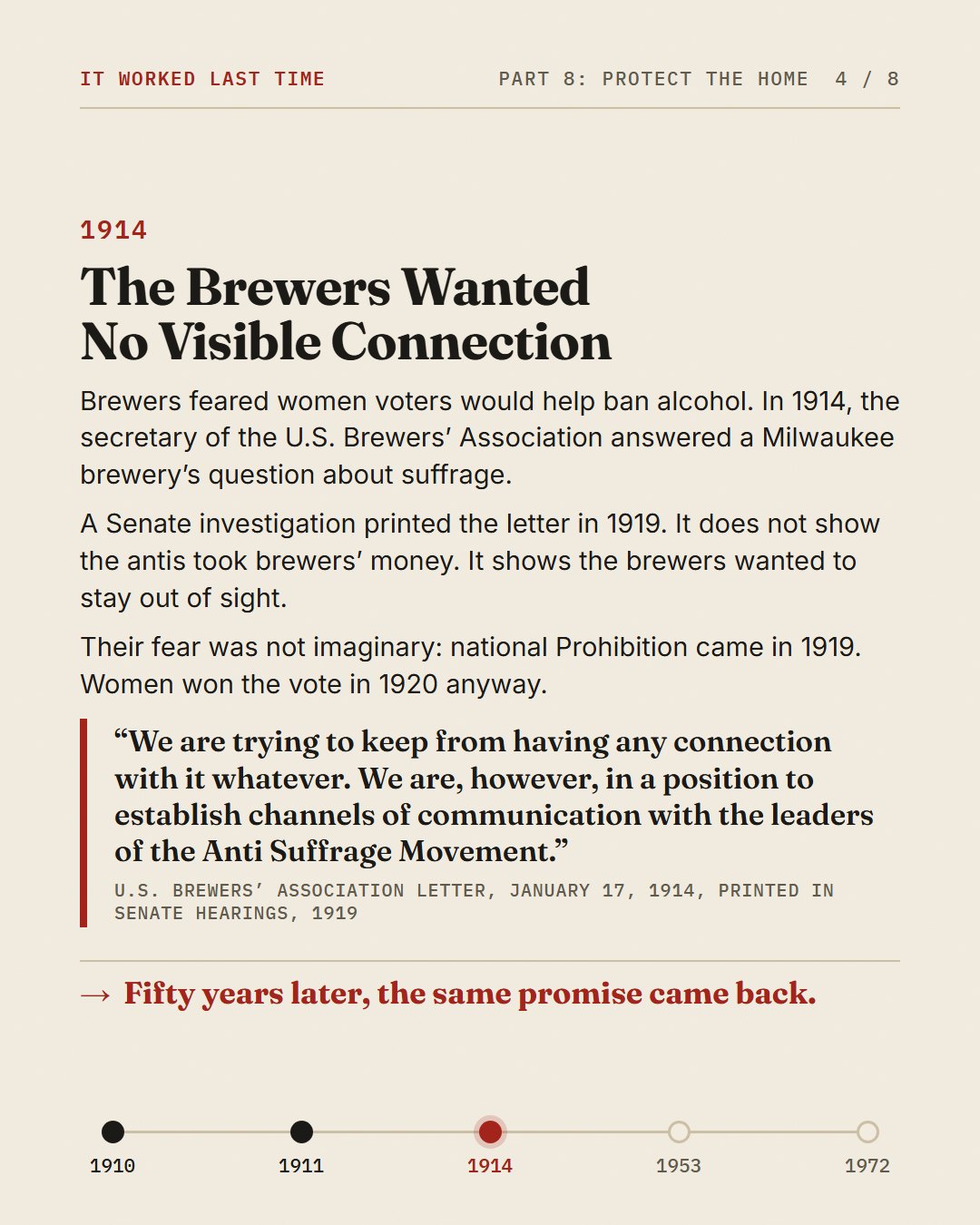
In January 1914, the Fred Miller Brewing Company of Milwaukee asked the U.S. Brewers’ Association what it was doing about woman suffrage in Illinois. The association’s secretary replied on January 17 in a letter marked “Confidential”: “In regard to the matter of woman suffrage, we are trying to keep from having any connection with it whatever. We are, however, in a position to establish channels of communication with the leaders of the Anti Suffrage Movement for our friends in any State where suffrage is an issue.” The same letter said, “I consider it most dangerous to have the retailers identified or active in any way in this fight, as it will be used against us everywhere.”8
Another memo in the same files, signed M. Michelson and addressed to the association’s secretary, argued that open hostility was backfiring: “The work of a publicity man would be ten times easier if it were not for the hostility of the brewers toward suffrage.” It described “the Texas brewers, who masquerading under the name of Farmers’ Union et al attack woman suffrage.”9
These papers became public because the U.S. Senate investigated the brewing industry during World War I and printed its files in 19198. The record has limits. It does not show that the National Association Opposed to Woman Suffrage took brewers’ money. What it shows is an industry that opposed women’s votes, wanted no visible connection to the fight, and worked through other names.
The brewers’ fear was not imaginary. National Prohibition was added to the Constitution in 191910, a year before women won the vote nationwide. Their fight against women’s votes did not save them, and it did not stop what came next.
1920: The Vote, and What It Left Out
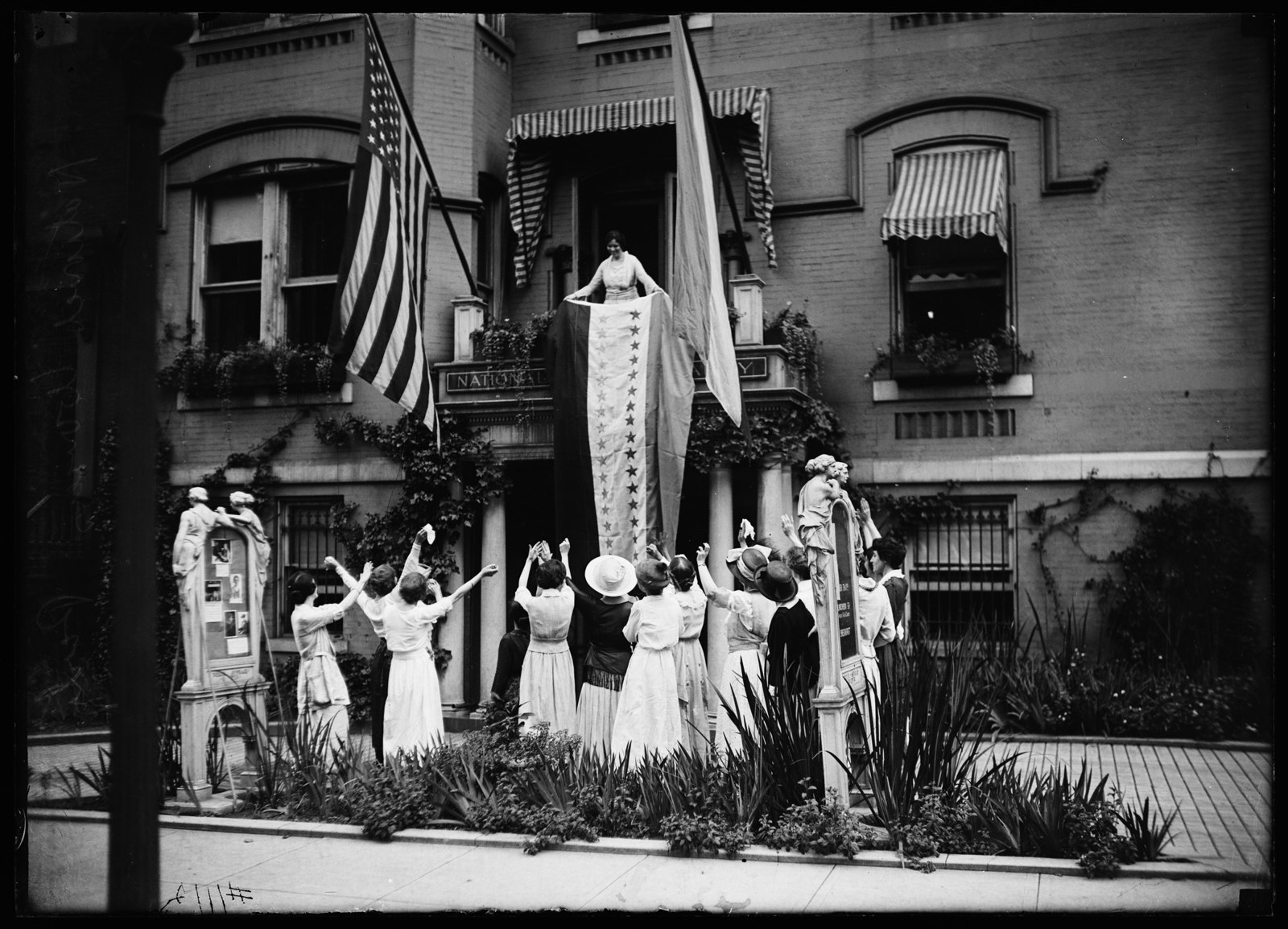
On August 18, 1920, Tennessee became the 36th state to ratify the 19th Amendment, the last one needed11. One of the votes came from Harry Burn, a young legislator who had received a letter from his mother: “Hurrah and vote for suffrage and don’t keep them in doubt.” He voted aye12. That day in Washington, Alice Paul of the National Woman’s Party unfurled a ratification banner from the party’s headquarters13. The amendment was certified on August 2611. Its key sentence: “The right of citizens of the United States to vote shall not be denied or abridged by the United States or by any State on account of sex.”11
The amendment covered the ballot box. It did not cover the jury box, the bank, or the deed to the family home.
In 1957, Hillsborough County, Florida, built a jury list of 10,000 names. Florida put a woman on jury lists only if she had registered for service. About 220 women in the county had registered; 10 made the list14. Gwendolyn Hoyt, charged with killing her husband with a baseball bat, was convicted by an all-male jury. In 1961, the U.S. Supreme Court upheld the system and explained why: “woman is still regarded as the center of home and family life.”14 The state could excuse her from the “civic duty of jury service” unless she chose it14. The Court did not abandon that reasoning until 1975, in a Louisiana case where women were 53 percent of the people eligible for jury service15.
The home was again the reason given for keeping a woman’s legal status different. Fifty-two years after the 19th Amendment, Congress tried to cover the rest.
1972: Twenty-Four Words and a Stop Sign

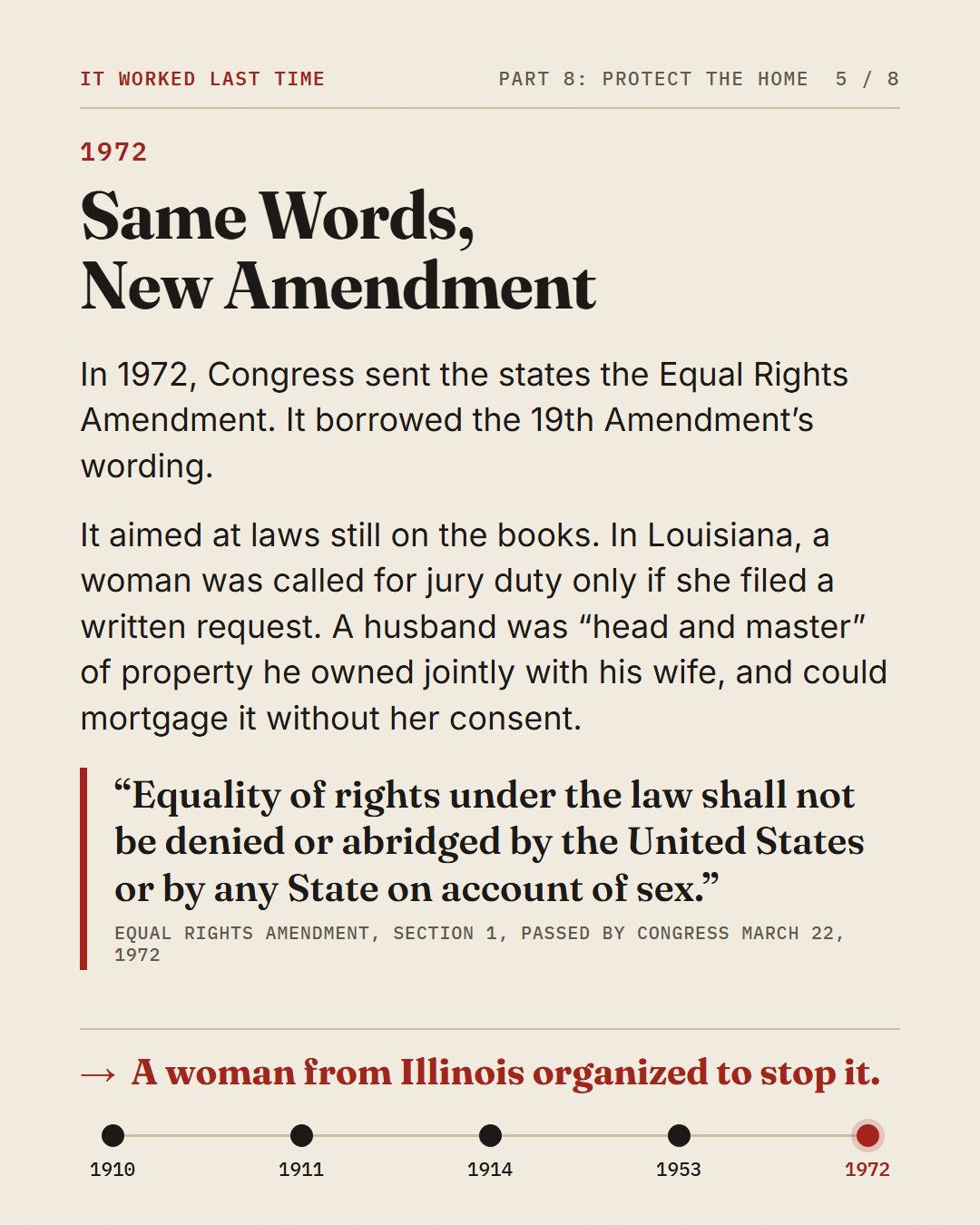
Alice Paul, a leader of the suffrage fight, proposed an equal rights amendment in 192319. Congress finally passed one in 1971 and 1972: 354 to 24 in the House and 84 to 8 in the Senate, on March 22, 197219. Its first section is 24 words long, and it reused the 19th Amendment’s own phrase: “Equality of rights under the law shall not be denied or abridged by the United States or by any State on account of sex.”18 Hawaii ratified it the same day. By the end of 1972, 22 states had19.
The laws it would have reached were not abstractions. In Louisiana, a woman was called for jury duty only if she had filed a written request15. Louisiana law also said: “The husband is the head and master of the partnership or community of gains.” In 1974, Joan Feenstra filed a criminal complaint charging her husband with molesting their daughter. From jail, he mortgaged their jointly owned home to pay his lawyer, without her knowledge, and the lawyer later moved to foreclose16. These cases were not rare events. They tested rules that covered every married couple and every woman in Louisiana. Nationwide, mortgage lenders “often discounted a married woman’s income, especially if she was of childbearing age,” until Congress passed the Equal Credit Opportunity Act in October 197417.
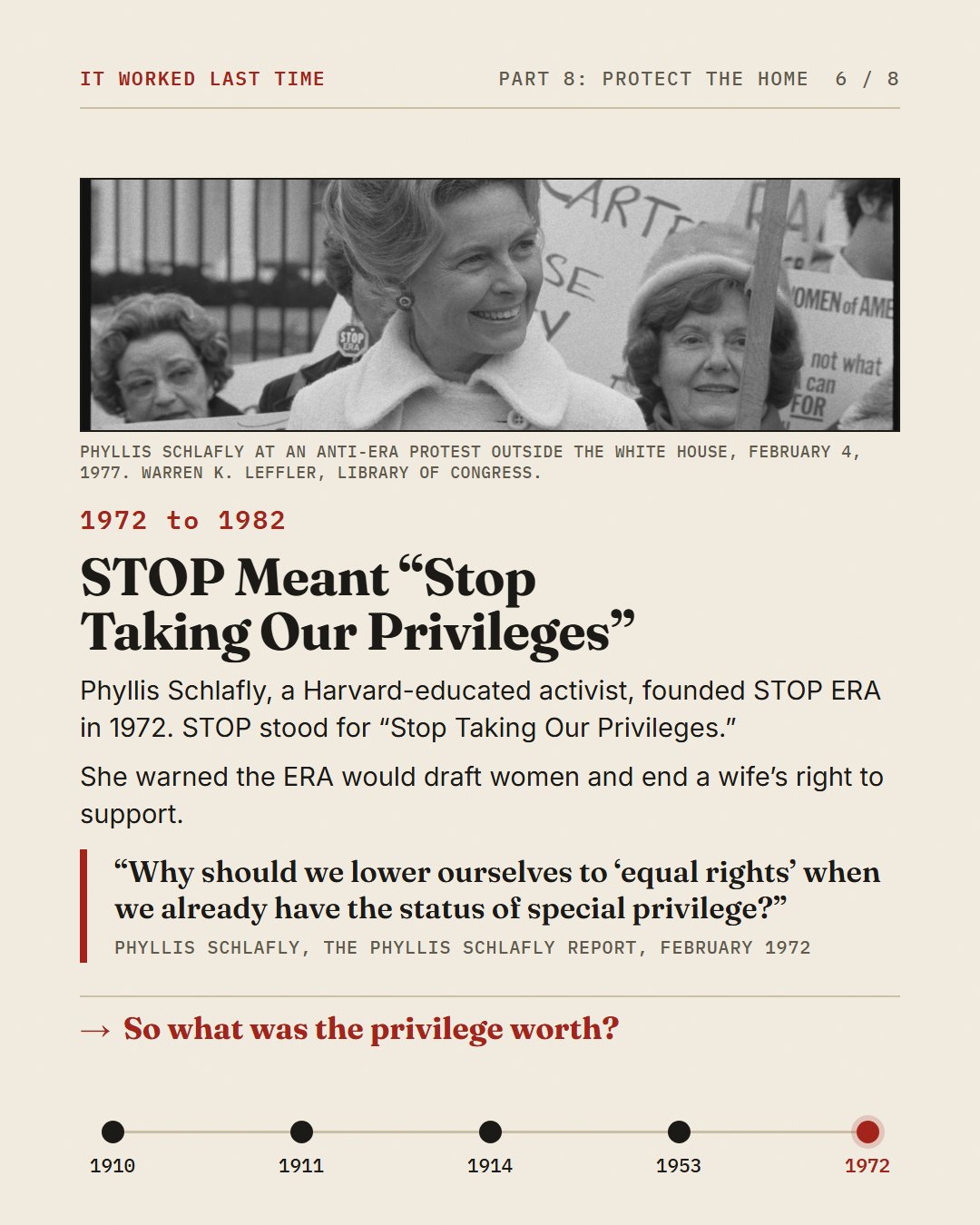
Phyllis Schlafly of Alton, Illinois, already had a political career. She held a master’s degree from Harvard and had run for Congress in 195229. In February 1972, her newsletter ran “What’s Wrong With ‘Equal Rights’ for Women?” It opened: “Of all the classes of people who ever lived, the American woman is the most privileged.” It said “The family gives a woman the physical, financial and emotional security of the home” and asked, “Why should we lower ourselves to ‘equal rights’ when we already have the status of special privilege?”20
That September she founded STOP ERA22. STOP stood for “Stop Taking Our Privileges”21. The 1910s flier had warned that equality would “deprive us of special privileges”7. The phrase came back almost word for word.
Her claims were specific. “This Amendment will absolutely and positively make women subject to the draft.” And: “it will abolish a woman’s right to child support and alimony.”20 Opponents also raised public restrooms. A 1971 Yale Law Journal analysis of the amendment had already said such examples “are dramatic but are diversions from the major issues”24.
The messengers were women. Schlafly trained volunteers at conferences on how to speak, debate, and appear on camera22. They brought homemade bread to lawmakers21. On February 4, 1977, she and other women protested outside the White House23. At the time, some argued that business interests did more than Schlafly to defeat the amendment29.
Each of her claims can be checked against the law of the time.
What the Privileges Were Worth
Start with the draft, because there she had a point. The 1971 Yale Law Journal analysis that ERA supporters relied on said plainly: “Women will be subject to the draft.”24 But Congress amended the draft law in 1973 to preclude conscription, and registration stopped in 1975. When it resumed in 1980, it covered men only, and in 1981 the Supreme Court upheld that, because women were then excluded from combat27. After 1973, no one was drafted at all.
The restroom claim had no such basis. The same legal analysis said “the right of privacy would permit the separation of the sexes in public rest rooms.”24
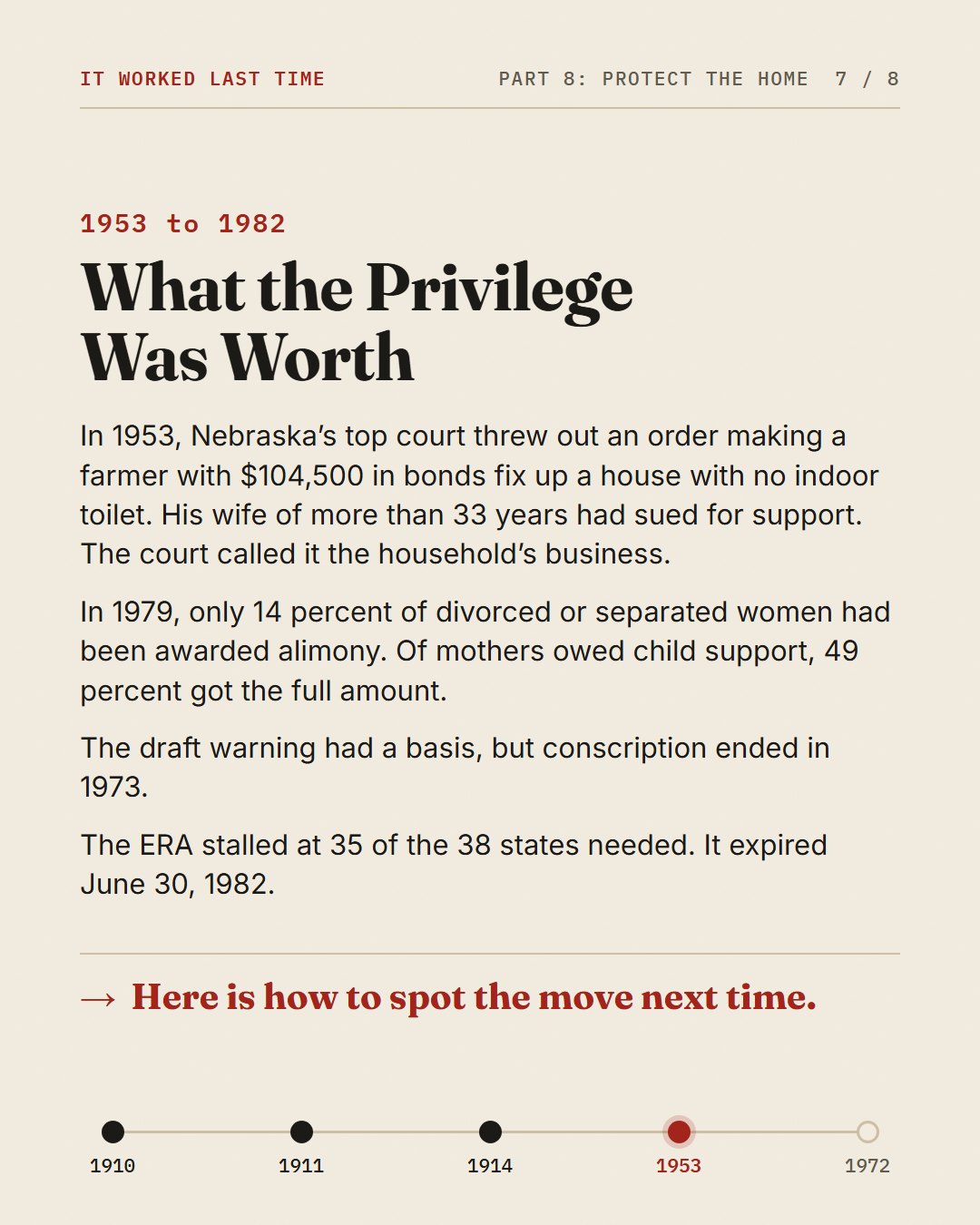
Then the right to be supported. In 1953, Lydia McGuire of Wayne County, Nebraska, sued her husband of more than 33 years. He owned about 400 acres and $104,500 in government bonds. Their house had no bathroom, no inside toilet, and no kitchen sink, and the furnace had not worked properly in years25. A trial court ordered him to pay for repairs, furniture, and appliances. The Nebraska Supreme Court threw the order out: “The living standards of a family are a matter of concern to the household, and not for the courts to determine.” As long as the couple lived together, the court said, “it may be said that the husband is legally supporting his wife.”25
After divorce, the numbers were no better. In spring 1979, the Census Bureau found that “Only about 14 percent of the 14.3 million ever-divorced or separated women were awarded or had an agreement to receive alimony.” Of women supposed to receive child support in 1978, “49 percent received the full amount that they were due.”26 The amendment’s legal analysts said support laws that bound only husbands could not stand as written; to survive, they would have to apply to both spouses24.
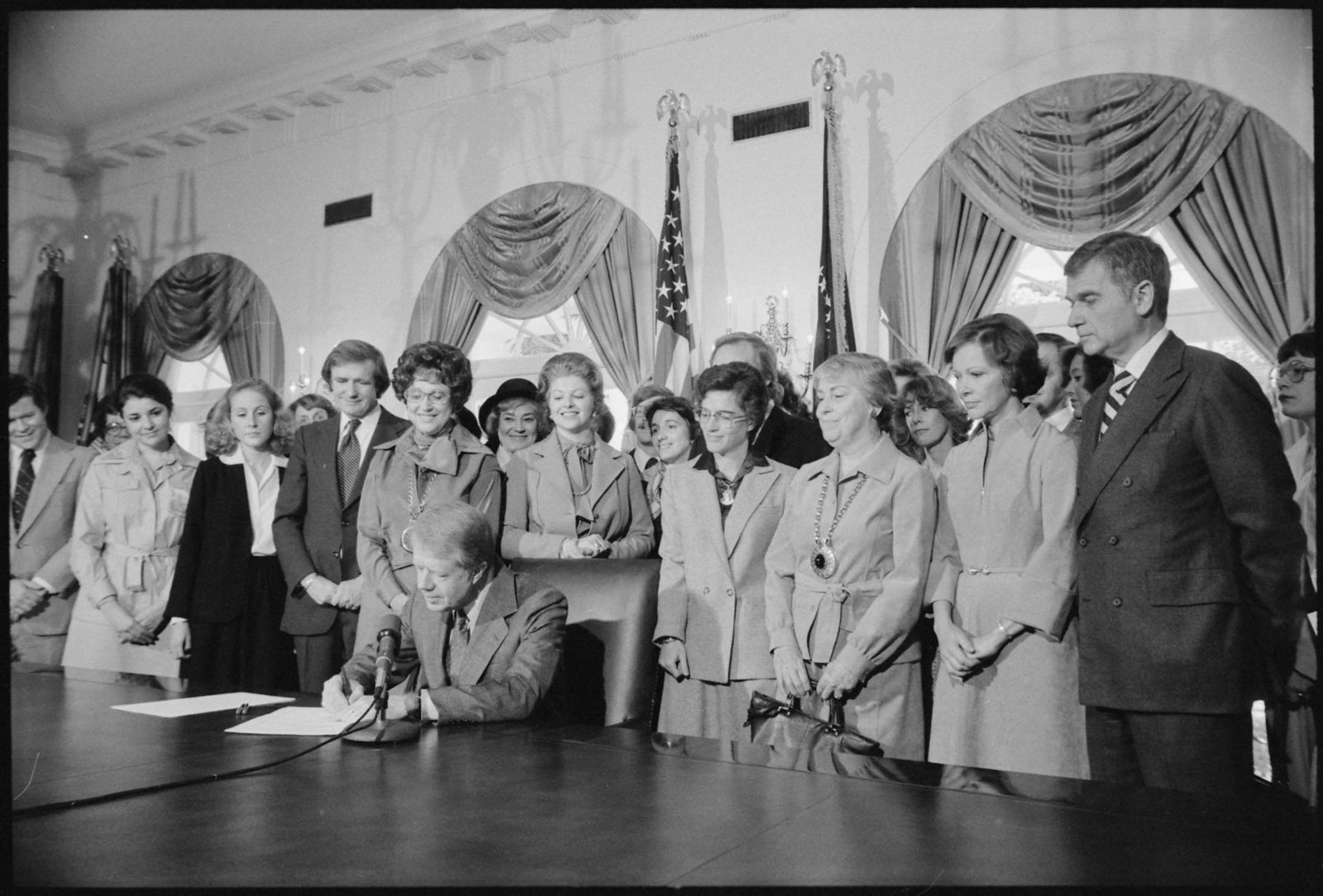
The campaign worked anyway. After 1972, ratifications slowed: 8 states in 1973, 3 in 1974, and 1 each in 1975 and 1977, for 35 of the 38 needed. Five states voted to rescind. Congress extended the deadline, and President Carter signed the extension on October 20, 19781928. No other state ratified. The ERA expired on June 30, 1982, even though public approval never fell below 54 percent and a Gallup poll in August 1981 found 63 percent support19. Schlafly planned an “Over the Rainbow” celebration in Washington for the amendment’s last hours29.
Put the two campaigns side by side, and the move is plain.
The Pattern
The move has three parts. First, take a legal inequality: no vote, no jury duty, no say over jointly owned property. Second, rename it a protection or a privilege, and tie it to the home. Third, have the people bound by the inequality deliver the message, because a housewife warning other housewives is more believable than a brewer or a legislator.
The words barely changed. In the 1910s: “political equality will deprive us of special privileges hitherto accorded to us by law”7. In 1961, from the Supreme Court: “woman is still regarded as the center of home and family life”14. In 1972: “Why should we lower ourselves to ‘equal rights’ when we already have the status of special privilege?”20
Here is why it works. A privilege sounds like more than a right. But a privilege is granted by someone else, and it lasts as long as that person keeps granting it. Lydia McGuire had the “privilege” of support, and no court would enforce it25. Joan Feenstra had a home, and her husband could mortgage it without asking her16. Decent women believed the promise because, for many of them, it held: their husbands were generous. The argument asked them to assume every woman was as lucky.
The idea that a household should have one vote, cast by the husband, is not only history.
The Rerun
In August 2025, CNN aired a report on pastor Doug Wilson and the Communion of Reformed Evangelical Churches, a denomination he helped found. In the segment, pastor Toby Sumpter said: “In my ideal society, we would vote as households.” Asked whether he would support repealing the 19th Amendment, pastor Jared Longshore said: “I would support that.”3031
Defense Secretary Pete Hegseth, whose church is affiliated with that denomination, reposted the segment on X with the caption “All of Christ for All of Life.” The fact-checking site Lead Stories confirmed on August 8, 2025, that he had shared the video30.
Asked about it on August 14, Pentagon press secretary Kingsley Wilson said: “Of course, the secretary thinks that women should have the right to vote.” She added: “The secretary very much appreciates many of Mr. Wilson’s writings and teachings.”3132
The record shows two pastors describing their ideal, a repost, a caption, and a statement that Hegseth supports women’s voting rights. It does not show any change in the law, and it does not show what Hegseth intended. What it does show is an old argument in new words. In the 1910s the flier said women were represented by “our fathers, brothers, husbands and sons”7. In 2025 the phrase was “vote as households.”30
Every campaign in this story had an answer for its critics.
Their Defense
The antis said they spoke for most women. Their flier called suffrage “THE DEMAND OF A MINORITY OF WOMEN” and said “THE MAJORITY OF WOMEN PROTEST AGAINST IT.” It described the group’s work as “a purely educational campaign.”7
Schlafly’s answer to critics who pointed out that she had a career of her own was direct. In 1982 she told The Christian Science Monitor: “I can do it all without the ERA.” Then: “The ERA is not going to do anything but draft my daughter.” And: “Home, husband, family, and children have come first in my life. Everything else came afterward.”29
Parts of their case were real. The brewers were right that Prohibition was coming10. Schlafly was right that ERA supporters expected women to be subject to any draft24. Many women in both campaigns were sincere about the value of their work at home.
But the promise at the center of both campaigns was that the law already protected women at home. The court records and the Census numbers show what that protection was worth when a woman tried to collect2526.
How Not to Fall for It
When someone tells you equality will cost you a privilege, ask what that privilege is worth in court. If no judge will enforce it, it is a favor, not a right.
Ask who is paying for the message and who is delivering it. The brewers wrote that they were “trying to keep from having any connection with it whatever”8. A trusted messenger can carry someone else’s interest.
Replace “protect the home” with the exact law being defended. “Protect the home” becomes “let a husband mortgage the house without his wife’s consent.” Then decide whether you still agree.
Ask how often it actually happens. One terrible case is a story, not a statistic. In 1979, only 14 percent of divorced or separated women had been awarded alimony26.
Sources
- 1National anti-suffrage association [Headquarters, National Association Opposed to Woman Suffrage]. Library of Congress, Prints and Photographs Division (Harris & Ewing). 1914. loc.gov/item/97500067/
- 2Suffragist Ancestors: Anti-Suffrage. New York Public Library research guide. libguides.nypl.org/suffragistancestors/anti
- 3Josephine Jewell Dodge. Wikipedia (secondary). en.wikipedia.org/wiki/Josephine_Jewell_Dodge
- 4Household Hints 1 (inside pages). UNC Libraries, Bennehan Cameron Papers, Southern Historical Collection. 1910s. exhibits.lib.unc.edu/items/show/6415
- 5Household Hints (cover). UNC Libraries, Bennehan Cameron Papers, Southern Historical Collection. 1910s. exhibits.lib.unc.edu/items/show/6228
- 6Household Hints 2 (back page, Vote NO on Woman Suffrage). UNC Libraries, Bennehan Cameron Papers, Southern Historical Collection. 1910s. exhibits.lib.unc.edu/items/show/6506
- 7Some reasons why we oppose votes for women. National Association Opposed to Woman Suffrage; Library of Congress, Printed Ephemera Collection. undated (cataloged as 1894). loc.gov/item/rbpe.1300130c/
- 8Brewing and Liquor Interests and German Propaganda: Hearings before a Subcommittee of the Committee on the Judiciary, U.S. Senate, 65th Congress, Exhibit No. 780, p. 1082. Government Printing Office, via Internet Archive. 1919. archive.org/details/brewingandliquo01assogoog
- 9Same hearings, memo signed M. Michelson to Mr. Fox, pp. 779 to 780. Government Printing Office, via Internet Archive. 1919. archive.org/details/brewingandliquo01assogoog
- 10Constitution of the United States (amendment list). U.S. Senate. senate.gov/about/origins-foundations/senate-and-constitution/constitut
- 1119th Amendment to the U.S. Constitution: Women's Right to Vote (1920). National Archives. archives.gov/milestone-documents/19th-amendment
- 12Harry T. Burn. National Park Service. nps.gov/people/harry-t-burn.htm
- 13When Tennessee, the 36th state, ratified on Aug 18, 1920, Alice Paul ... unfurled the ratification banner. Library of Congress (Harris & Ewing). 1920. loc.gov/item/2016885217/
- 14Hoyt v. Florida, 368 U.S. 57. U.S. Supreme Court, via Cornell Legal Information Institute. 1961-11-20. law.cornell.edu/supremecourt/text/368/57
- 15Taylor v. Louisiana, 419 U.S. 522. U.S. Supreme Court, via Cornell Legal Information Institute. 1975-01-21. law.cornell.edu/supremecourt/text/419/522
- 16Kirchberg v. Feenstra, 450 U.S. 455. U.S. Supreme Court, via Cornell Legal Information Institute. 1981-03-23. law.cornell.edu/supremecourt/text/450/455
- 17What you need to know about the Equal Credit Opportunity Act and how it can help you. Consumer Financial Protection Bureau. 2016-10-31. consumerfinance.gov/about-us/blog/what-you-need-know-about-equal-credi
- 18Proposed Amendment to the Constitution of the United States (H.J. Res. 208), 86 Stat. 1523. U.S. Statutes at Large, via GovInfo. 1972-03-22. govinfo.gov/content/pkg/STATUTE-86/pdf/STATUTE-86-Pg1523.pdf
- 19The Proposed Equal Rights Amendment: Contemporary Ratification Issues (R42979). Congressional Research Service (Thomas H. Neale). 2019-12-23. everycrsreport.com/files/20191223_R42979_7fdb2904b1bf0368c41fb9e18fb1f
- 20What's Wrong With "Equal Rights" for Women? The Phyllis Schlafly Report, Vol. 5, No. 7. Phyllis Schlafly (scan hosted by Phyllis Schlafly Eagles). 1972-02. phyllisschlafly.com/Company_Images/PDF/Phyllis%20Schlafly%20Report%201
- 21Phyllis Schlafly (biography). National Women's History Museum. womenshistory.org/education-resources/biographies/phyllis-schlafly
- 22The End of the Equal Rights Amendment. Boundary Stones, WETA. 2022-04-20. boundarystones.weta.org/2022/04/20/end-equal-rights-amendment
- 23Activist Phyllis Schlafly wearing a "Stop ERA" badge, demonstrating with other women against the Equal Rights Amendment in front of the White House. Library of Congress, U.S. News & World Report collection (Warren K. Leffler). 1977-02-04. loc.gov/item/2011648744/
- 24The Equal Rights Amendment: A Constitutional Basis for Equal Rights for Women, 80 Yale L.J. 871. Yale Law Journal (Brown, Emerson, Falk, Freedman), via openYLS. 1971-04. openyls.law.yale.edu/entities/publication/37879b5a-7c91-4981-9c39-4751
- 25McGuire v. McGuire, 157 Neb. 226, 59 N.W.2d 336. Nebraska Supreme Court, via Caselaw Access Project (Harvard Law School). 1953-06-26. static.case.law/neb/157/cases/0226-01.json
- 26Child Support and Alimony: 1978 (Advance Report), Current Population Reports, Series P-23, No. 106. U.S. Census Bureau. 1980-09. www2.census.gov/library/publications/1980/demographics/p23-106.pdf
- 27Rostker v. Goldberg, 453 U.S. 57. U.S. Supreme Court, via Cornell Legal Information Institute. 1981-06-25. law.cornell.edu/supremecourt/text/453/57
- 28Photograph of Jimmy Carter Signing Extension of Equal Rights Amendment (ERA) Ratification, 10/20/1978. National Archives, Jimmy Carter Library. 1978-10-20. catalog.archives.gov/id/181981
- 29Phyllis Schlafly: wife, politician who 'does it all without the ERA'. The Christian Science Monitor (Julia Malone). 1982-06-25. csmonitor.com/1982/0625/062535.html
- 30Fact Check: Defense Secretary Pete Hegseth DID Share Video In Which Pastors Say Women Should Not Vote. Lead Stories (Alan Duke). 2025-08-08. leadstories.com/hoax-alert/2025/08/fact-check-hegseth-did-share-video-
- 31Pentagon says Hegseth supports women's right to vote despite sharing video saying otherwise. CNN (Haley Britzky), via KTVZ. 2025-08-15. ktvz.com/politics/cnn-us-politics/2025/08/15/pentagon-says-hegseth-sup
- 32Hegseth supports women's right to vote, Pentagon says. Military Times (Carla Babb). 2025-08-14. militarytimes.com/news/pentagon-congress/2025/08/14/hegseth-supports-w
Image Credits
- National anti-suffrage association [Headquarters, National Association Opposed to Woman Suffrage]. Harris & Ewing. 1914 (LOC date from negative shelflist). No known restrictions on publication (Library of Congress); cropped to the photograph from its mount. Source
- Household Hints (cover). National Association Opposed to Woman Suffrage. 1910s, undated. Public domain (UNC Libraries: 'In the public domain and may be used without copyright restriction'; published before 1931). Source
- Household Hints 1 (inside pages). National Association Opposed to Woman Suffrage. 1910s, undated. Public domain (UNC Libraries: 'In the public domain and may be used without copyright restriction'; published before 1931). Source
- Some reasons why we oppose votes for women. National Association Opposed to Woman Suffrage. Undated (LOC catalogs it as [1894]; the association was founded in 1911). Public domain in the U.S. (published before 1931); Library of Congress Printed Ephemera Collection. Source
- When Tennessee, the 36th state, ratified on Aug 18, 1920, Alice Paul ... unfurled the ratification banner from suffrage headquarters, Washington, DC. Harris & Ewing. 1920-08-18. No known restrictions on publication (Library of Congress). Source
- Activist Phyllis Schlafly wearing a "Stop ERA" badge, demonstrating with other women against the Equal Rights Amendment in front of the White House, Washington, D.C.. Warren K. Leffler, U.S. News & World Report. 1977-02-04. No known restrictions on publication (Library of Congress, U.S. News & World Report collection). Source
- Photograph of Jimmy Carter Signing Extension of Equal Rights Amendment (ERA) Ratification, 10/20/1978. White House Staff Photographers. 1978-10-20. Public domain (U.S. federal government work; National Archives, Jimmy Carter Library), via Wikimedia Commons. Source