The Cards
The full text of every card, in order, with the card itself under each one.
Card 01 of 9
2,689 young men were asked anonymously. 95.1% said yes.
- Yes to using at least one of 36 strategies, in the past four years, to get sex from a woman they had just met who did not want it, or acted like she did not want it. That is 2,557 men in one survey. It is not all men. The next cards are what they reported, and what the number does and does not mean.
SCOPE One online panel of sexually active men ages 18 to 34 in the U.S. and Canada, surveyed in 2023. Not a random sample. O’Sullivan and Ronis, 2026.
Study and link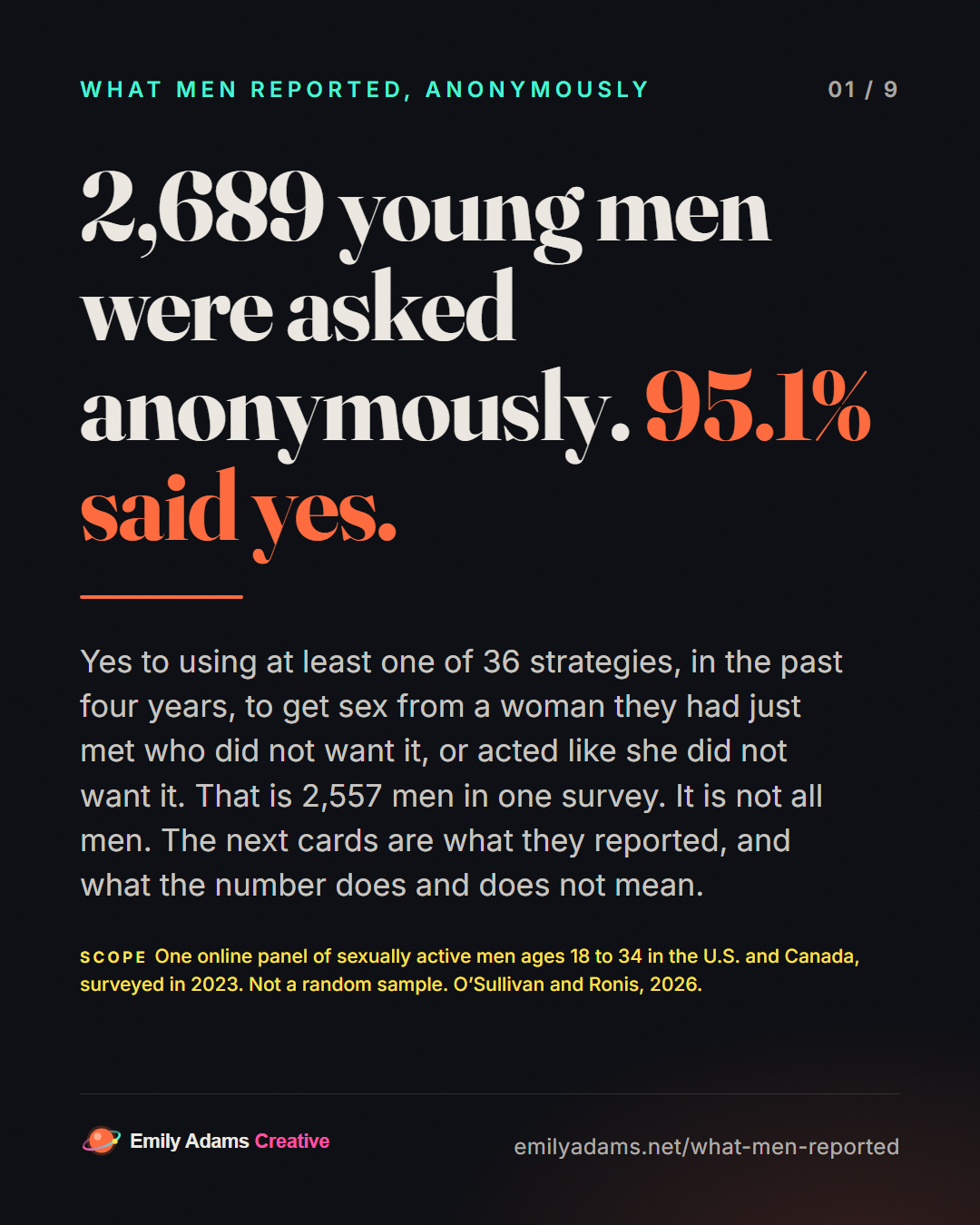
Card 02 of 9
The question they answered.
- “In the past four years, how many times have you used any of the following strategies to get (or try to get) a woman to have some type of sex when she did not want to have sex or acted like she did not want to have sex?” Only women they had recently met. Then a list of 36 strategies, built from what men say to each other online.
SCOPE Men 18 to 34 who had sex with a woman in the past two years; 85.9% U.S., 14.1% Canada; 10.2% students. A paid Qualtrics panel, promised anonymity. 3,011 recruited, 322 removed for incomplete, patterned, or inattentive answers.
Study and link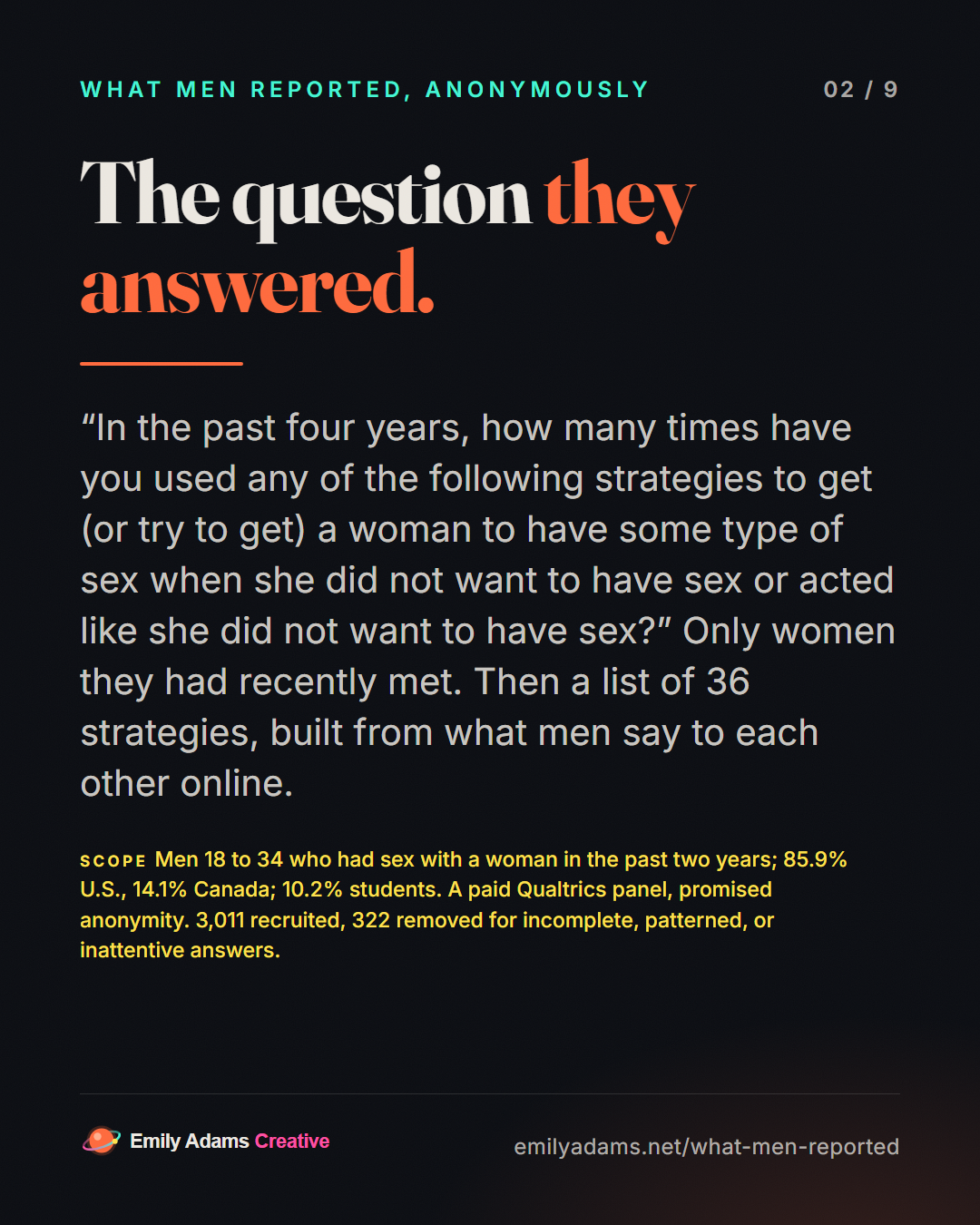
Card 03 of 9
95.1% is not 95.1% reporting rape. It is 95.1% reporting at least one of 36 things, from telling her what she wanted to hear to holding her down.
- “If she is making excuses, she is saying no. That was the most common way these men said they knew, and they kept going.”
- “Reluctant is not a starting position. It is the answer.”
- “Talking someone into sex she does not want is not romance. Researchers call it coercion, and so do I.”
SCOPE 2,557 of 2,689 men. The 36 items run from verbal pressure to force and drugs; 62.6% reported none of the 12 the authors class as most forceful. Self-reported and unverifiable.
Study and link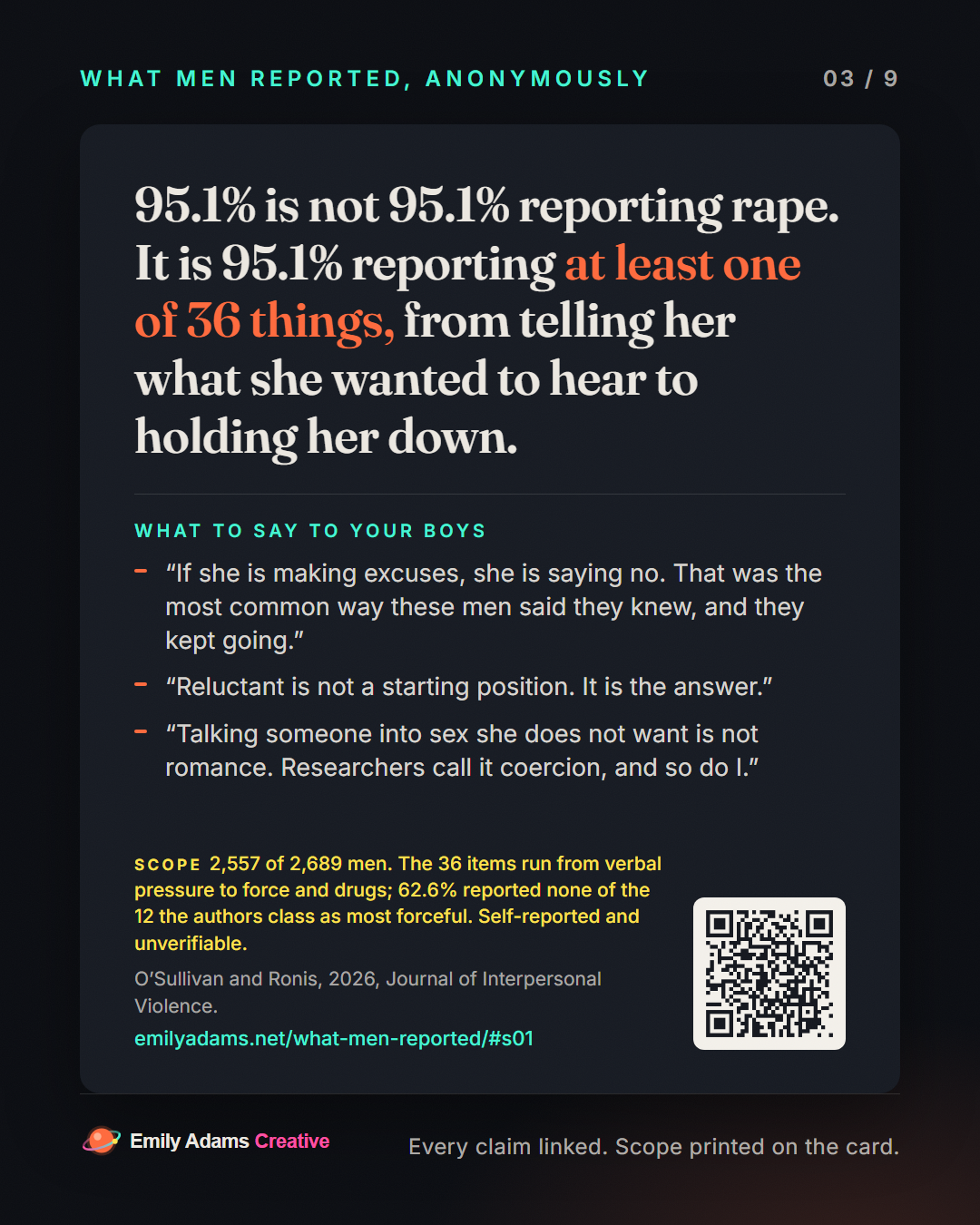
Card 04 of 9
The most common tactics were pressure, persistence, and help from friends.
SCOPE Percent of the 2,689 men who reported using each at least once in four years, with a woman who did not want sex or acted like she did not. Table 2.
Full table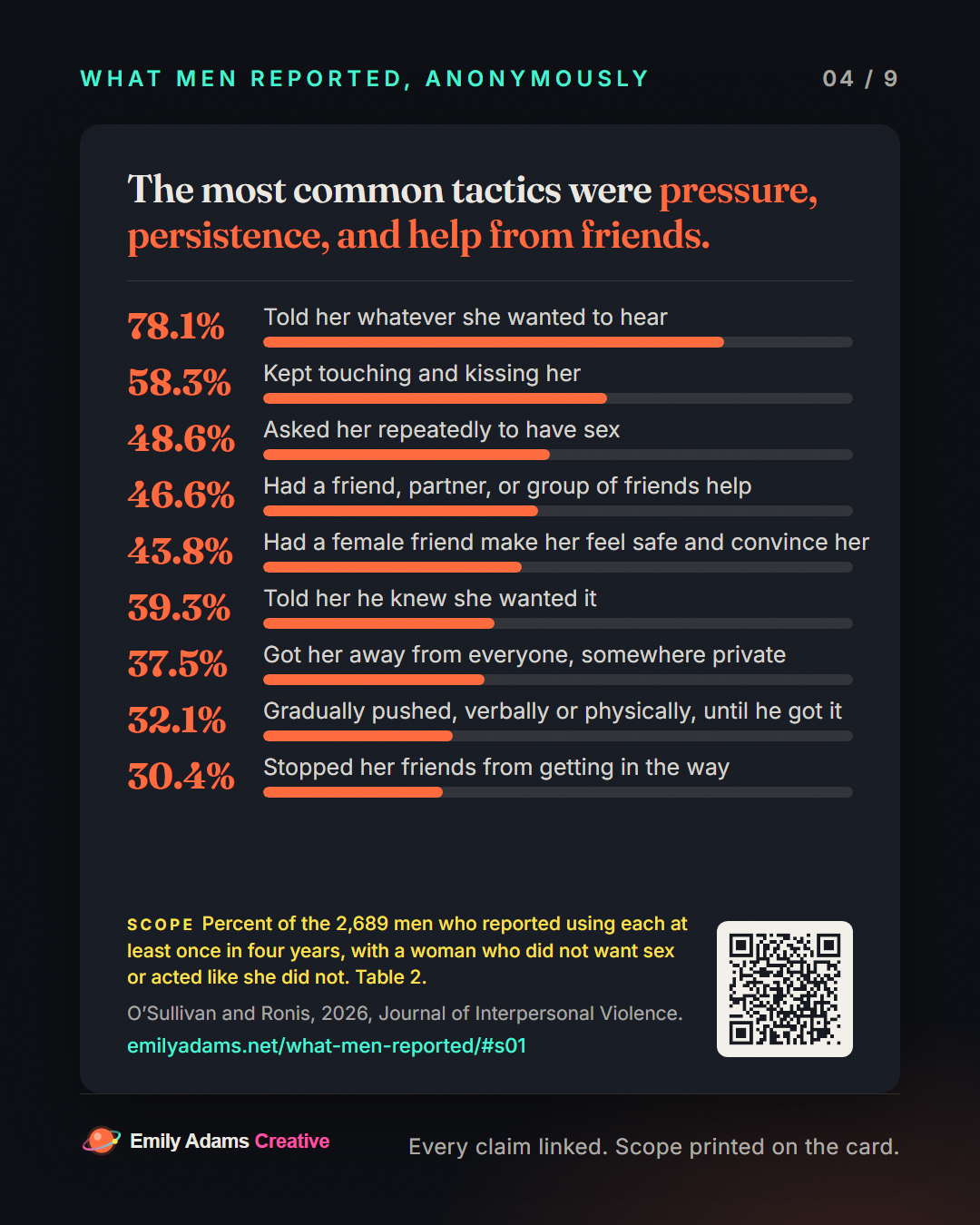
Card 05 of 9
Overt force was less common. The authors’ words: “but not uncommon.” 37.4% reported at least one of the 12 most forceful strategies.
SCOPE Same scale as the last card. 62.6% reported none of the 12-item forceful subscale; not every item shown here is in it. 10.0% of this sample is 270 men.
Full table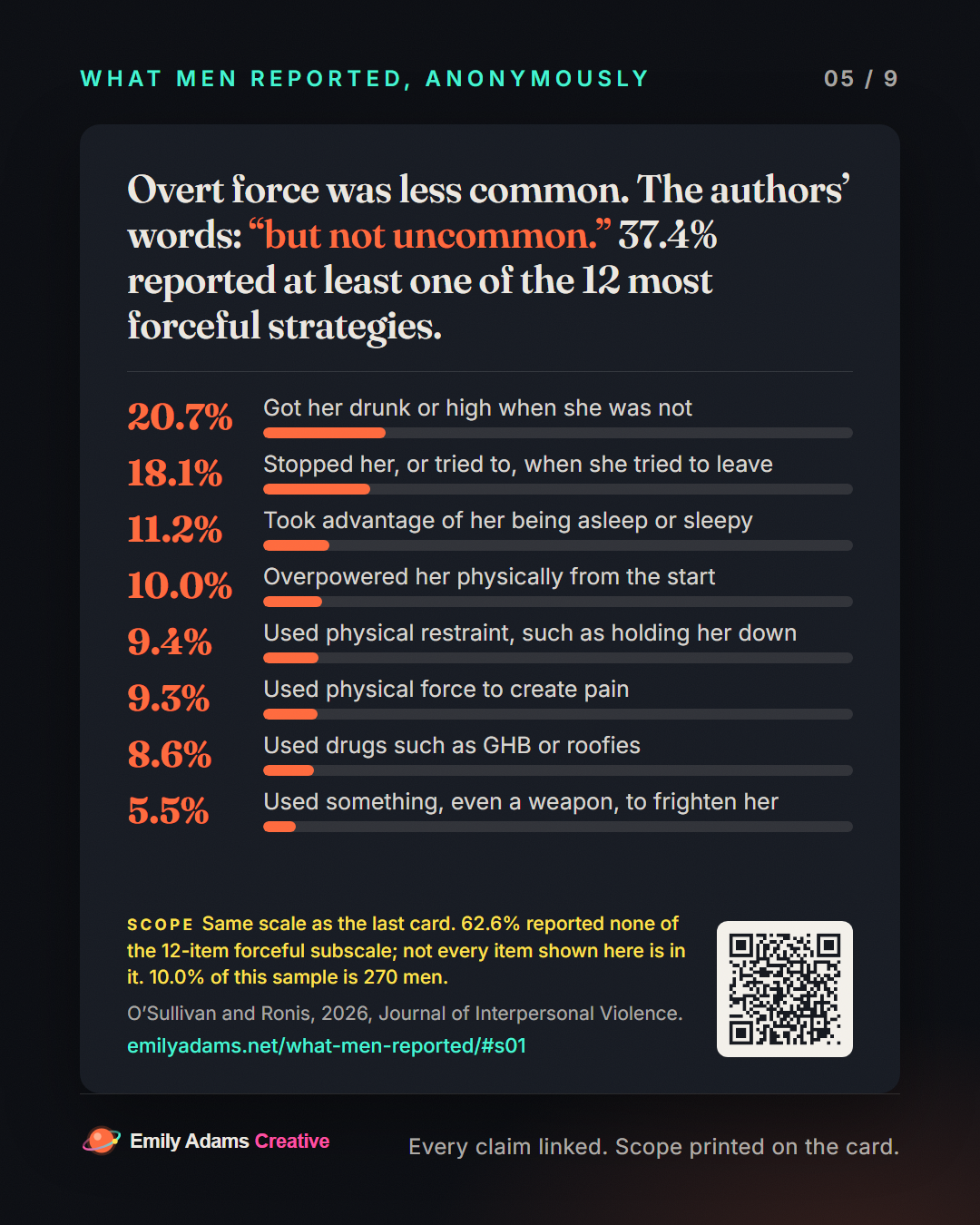
Card 06 of 9
Men said it worked. They reported getting the sex they wanted on 64.6% of the occasions they used one of these strategies.
- “If you had to wear her down, you did not get a yes. You got her to stop saying no.”
- “Sex she did not want is not a win. It is harm, and you are the one who did it.”
- “The only yes that counts is one she is still glad she gave the next morning.”
SCOPE Men’s own ratings, strategy by strategy. They were asked to recall a recent or vivid occasion, which the authors say may favor the ones that ended in sex. Women were not surveyed.
Study and link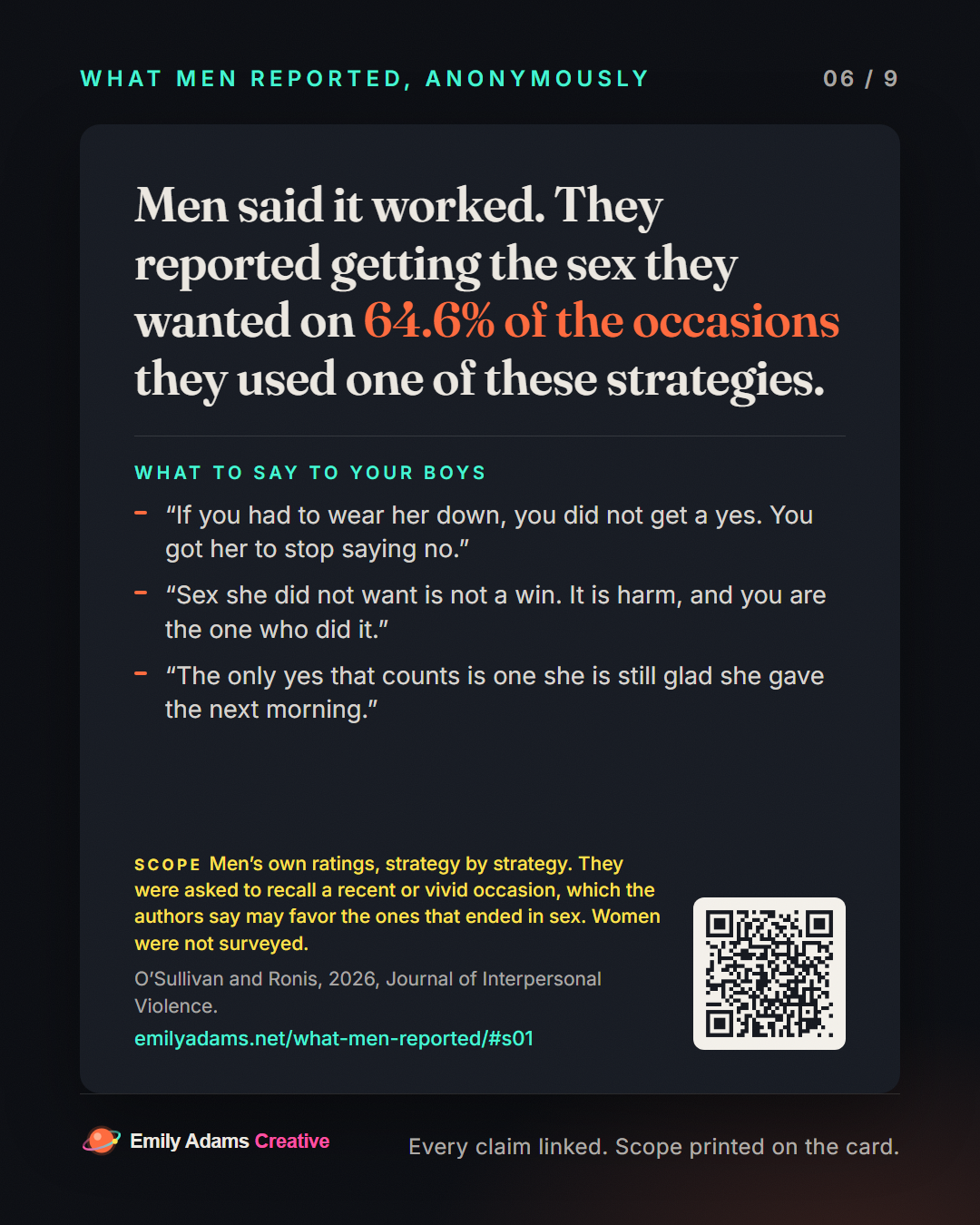
Card 07 of 9
It was rarely one thing. The average number of different strategies reported was 8.94. The paper’s title is the pattern: isolate, inebriate, intimidate, repeat.
- “Getting her alone, getting her drunk, and not letting it go is not flirting. It is a method, and people can see you doing it.”
- “In this survey, the men who rated themselves best at getting sex also reported more force. Do not admire that guy.”
- “If a friend asks you to help get a girl alone, the answer is no. Then you go find her friends.”
SCOPE Standard deviation 7.98, so the spread is wide. 76.2% called their efforts unplanned; 15.5% a deliberate plan. Self-rating and forceful strategies were correlated (r = .247), not shown as cause.
Study and link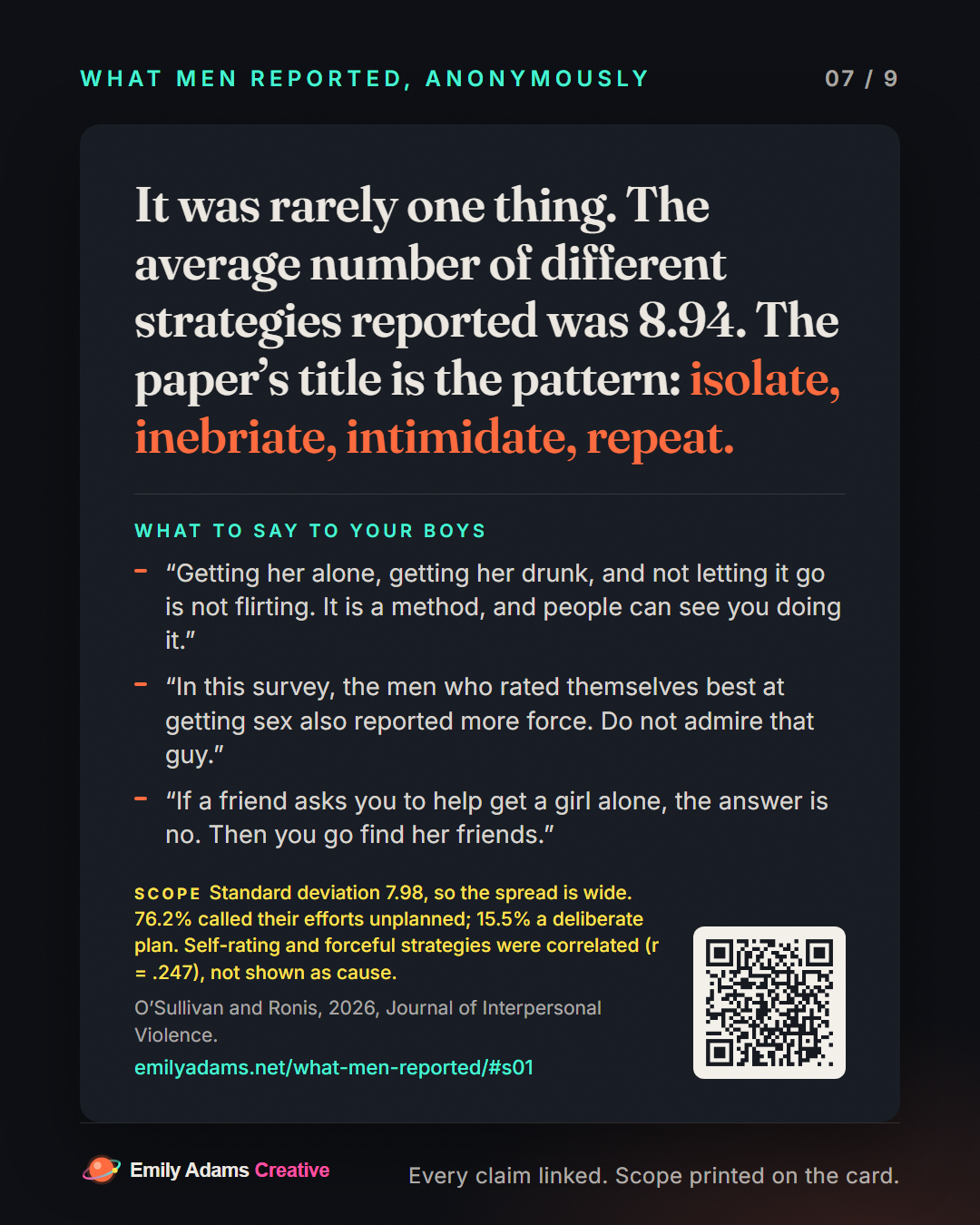
Card 08 of 9
Other people were around 80.4% of the time. About 70% of the men said nothing bad came of it. One said someone stepped in.
- “Someone is almost always there. Be the someone.”
- “Nothing happening to him afterward does not mean nothing happened to her.”
- “Seven men mentioned that she was traumatized. When a guy tells the story, notice who is missing from it.”
SCOPE Open-ended answers about a recent or vivid occasion: 1,903 men wrote only “no” when asked if anything bad resulted; 3 of 2,254 cited rape accusations or charges. Men were not asked directly whether anyone intervened.
Study and link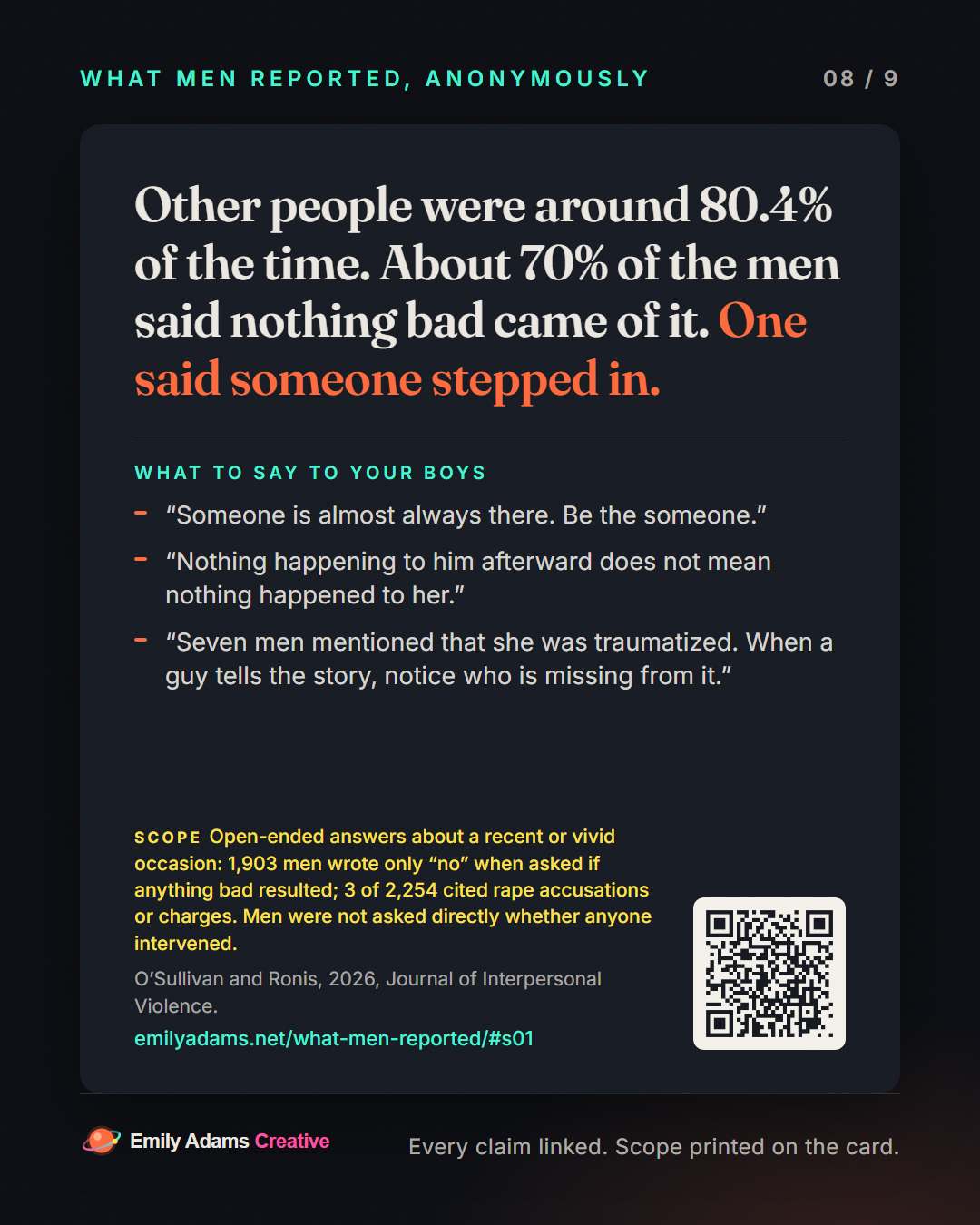
Card 09 of 9
What this study cannot tell you.
- It is not 95% of all men. It is 95.1% of one paid online panel of sexually active men, 18 to 34. Sample
- It is not 95% admitting rape. 62.6% reported none of the 12 most forceful strategies. Range
- It is self-report. Nobody can verify it, and the women were not asked. Method
- Wording moves the number. Surveys where men are identifiable find 8 to 24%. Wording
- Men recalled a recent or vivid occasion, which may favor the ones that ended in sex. Recall
- It is one study. The authors themselves call for replication. One study
Do not round it up. The real number is bad enough. Information accuracy is ridiculously important when talking about serious issues. Don’t be the dumbass sharing inaccurate stats.
The limits in full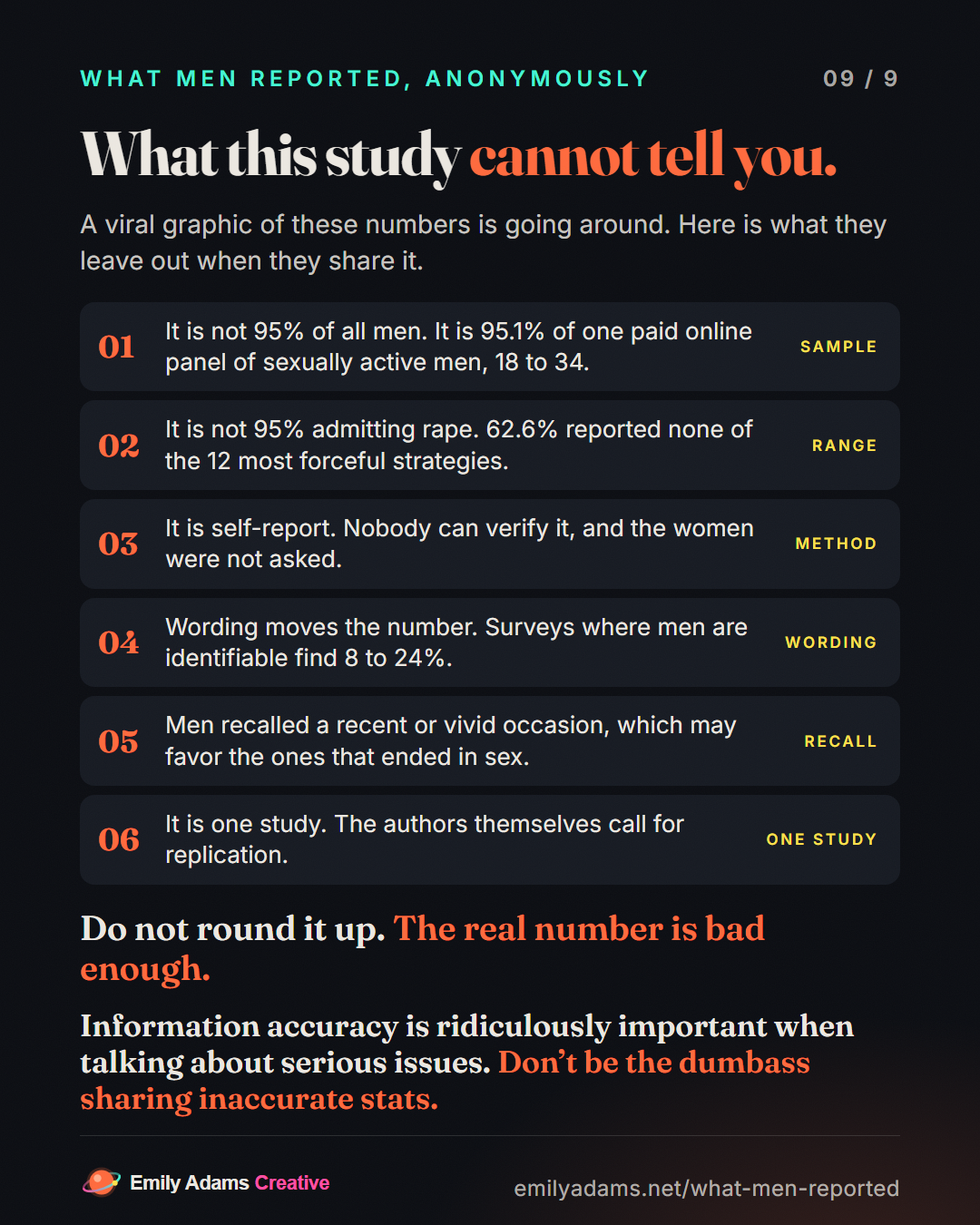
Closing card
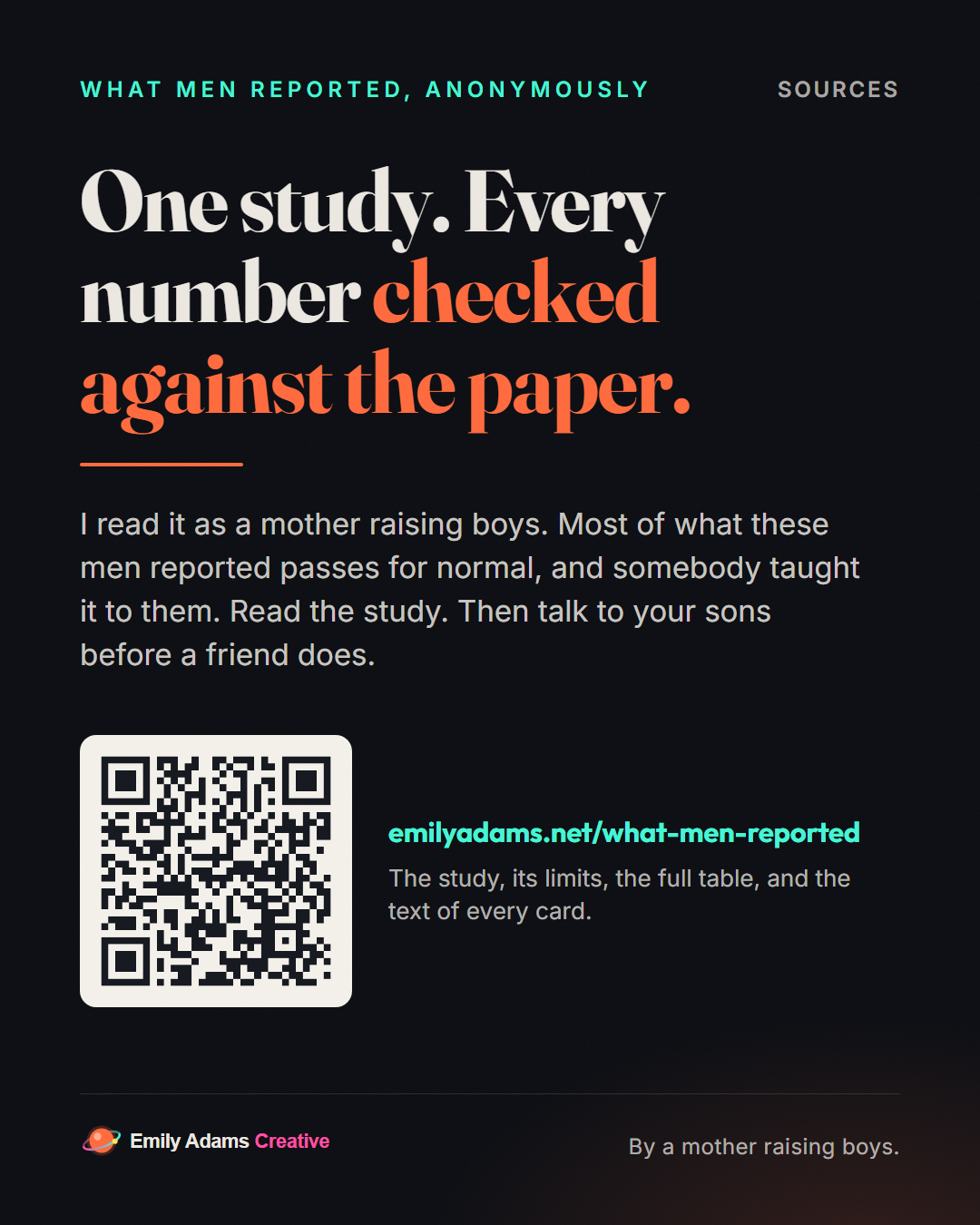
One study. Every number checked against the paper.
- I read it as a mother raising boys. Most of what these men reported passes for normal, and somebody taught it to them. Read the study. Then talk to your sons before a friend does.