The Cards
The full text of all fourteen cards, in order, with the card itself under each one. Each research card links to its study below.
Card 01 of 15
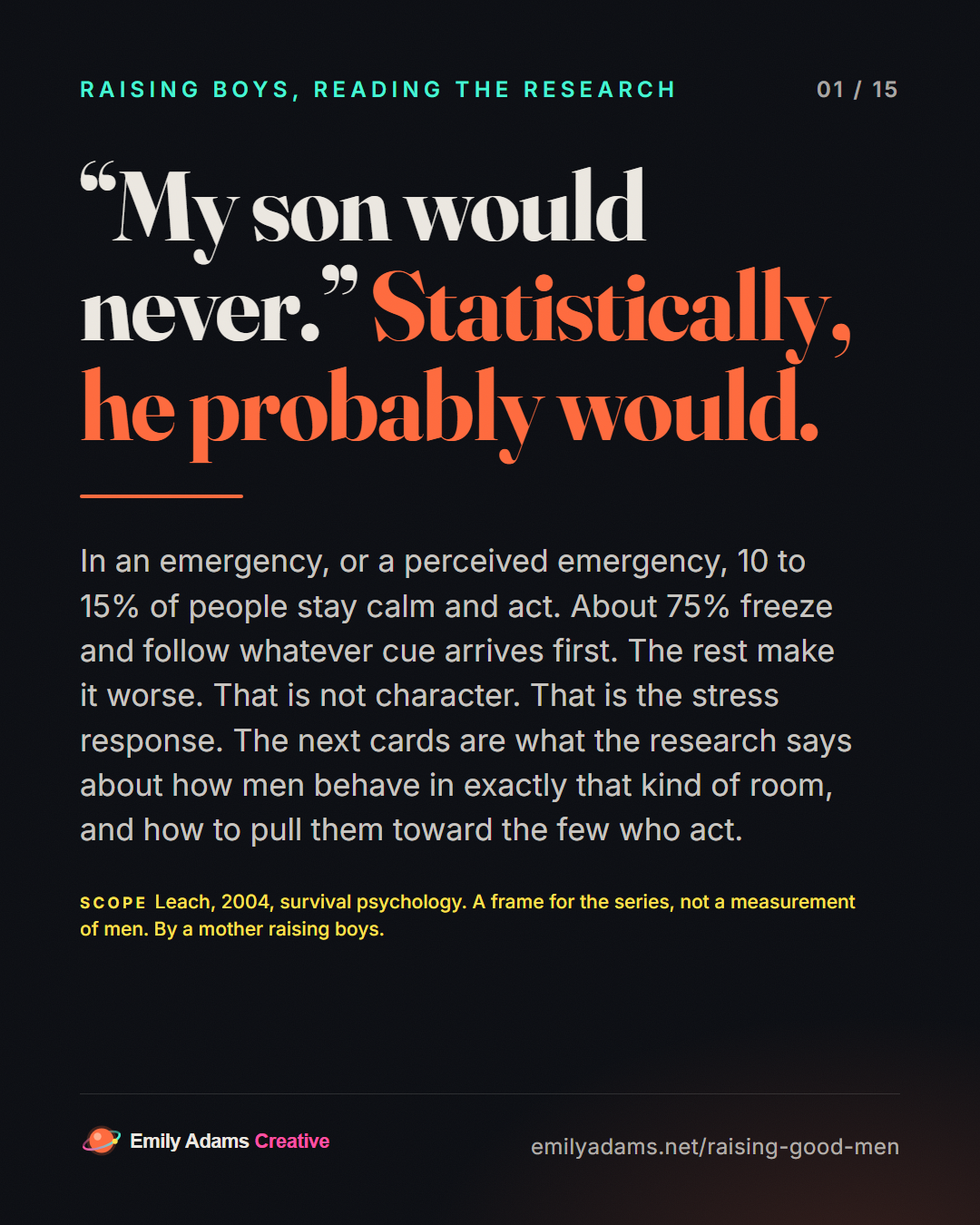
“My son would never.” Statistically, he probably would.
- In an emergency, or a perceived emergency, 10 to 15% of people stay calm and act. About 75% freeze and follow whatever cue arrives first. The rest make it worse. That is not character. That is the stress response. The next cards are what the research says about how men behave in exactly that kind of room, and how to pull them toward the few who act.
SCOPE Leach, 2004, survival psychology. A frame for the series, not a measurement of men. By a mother raising boys.
Card 02 of 15
In an emergency, 10 to 15% of people stay calm and act. About 75% freeze and follow the first cue. 10 to 15% make it worse.
- “Most people freeze. That is normal. So we decide now what you do, before you ever need it.”
- “If something feels wrong, you are allowed to be the first one to say so. Someone has to be first. Let it be you.”
- “You do not have to fix it. You have to break the silence. Say ‘this is not okay’ and leave. That is the whole job.”
SCOPE Survival psychology: responses to unfolding disasters, reviewing earlier emergency studies. Not a study of men, social pressure, or morality. A frame, not a statistic about any group.
Study and link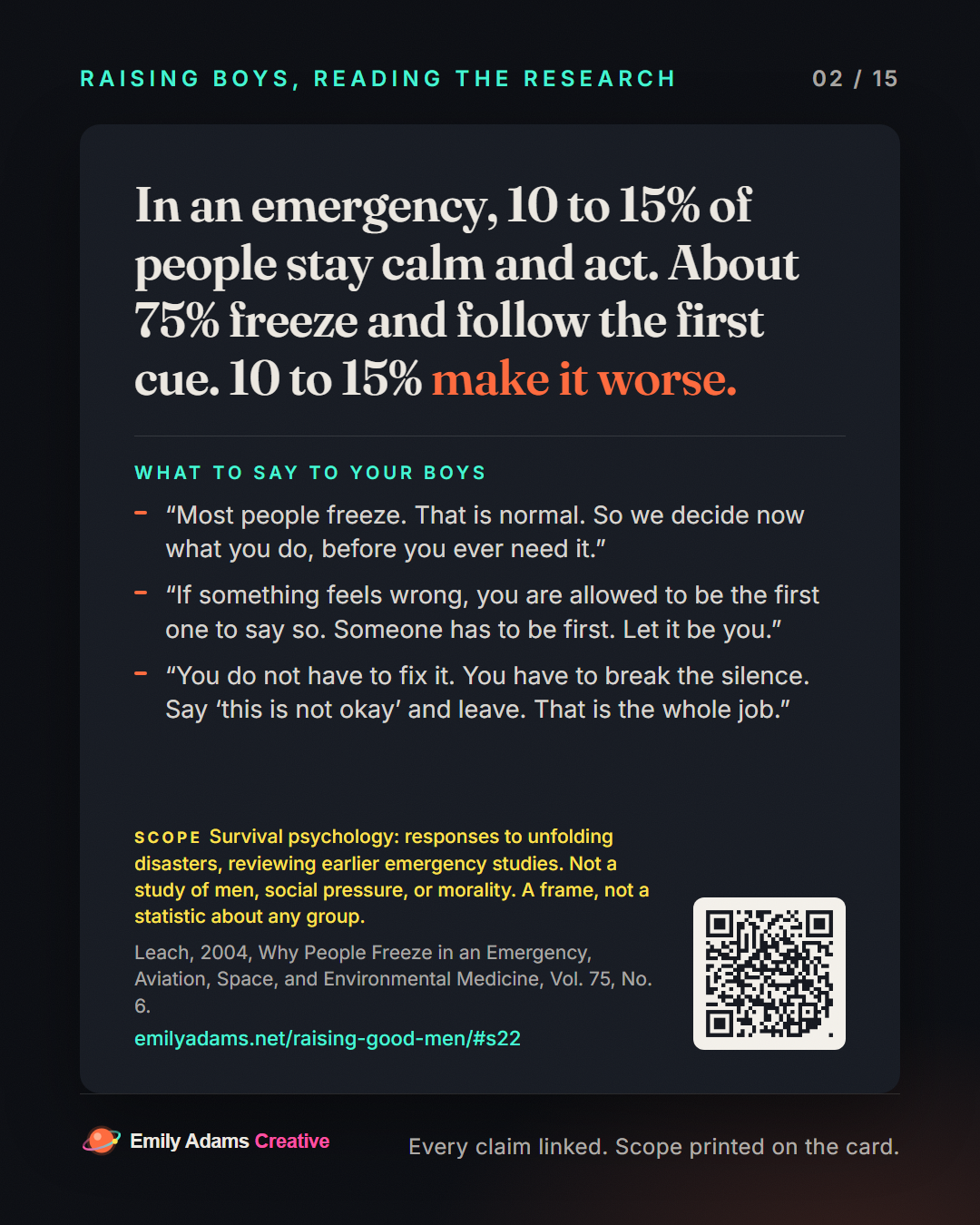
Card 03 of 15
A crowd produces dangerous indifference. Across 105 studies, the more people present, the less likely any one of them was to help.
- “A room full of people is not safety. It is a room full of people waiting for someone else to go first.”
- “If you notice it, it is yours. Do not count heads. Count on yourself.”
- “A group chat is a crowd. Everyone reading and nobody answering is the same as nobody there.”
SCOPE Meta-analysis of 105 effects, more than 7,700 participants, 2011. General population, not men specifically. The effect weakened in clearly dangerous emergencies, and other bystanders sometimes supported intervention.
Study and link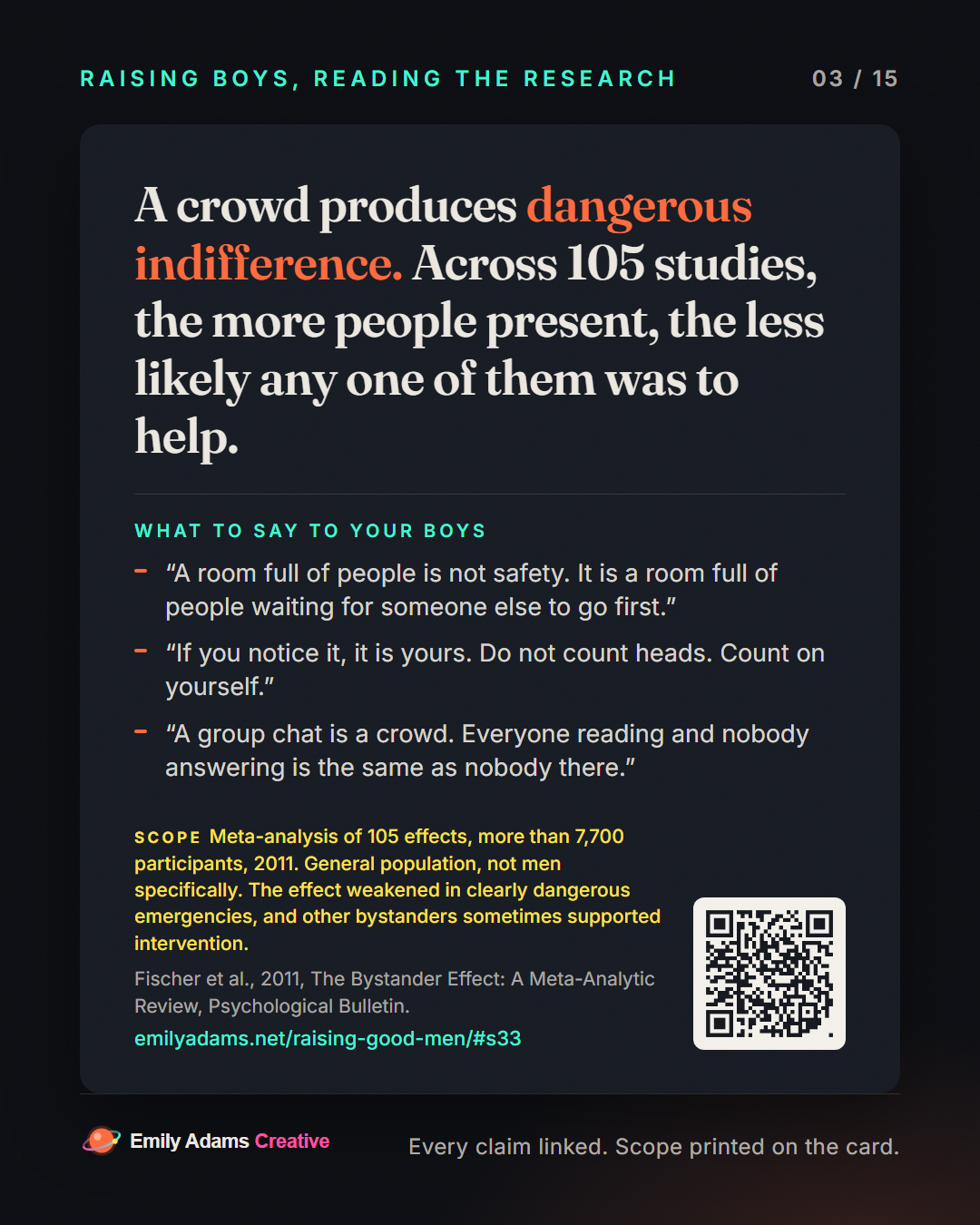
Card 04 of 15
Men think other men are worse than they are. Men in these studies privately valued caring more than they believed other men did.
- “Most of the guys agree with you. They are waiting for someone to say it first.”
- “When someone says ‘everybody thinks that,’ ask him how he knows. Usually he does not.”
- “You will never be the only one in the room who is uncomfortable. You might be the only one who says so.”
SCOPE Two 2018 studies: a sample of men on communal roles, and a mixed-gender workplace sample. Perceived norms diverged from private beliefs. Neither measured aggression.
Study and link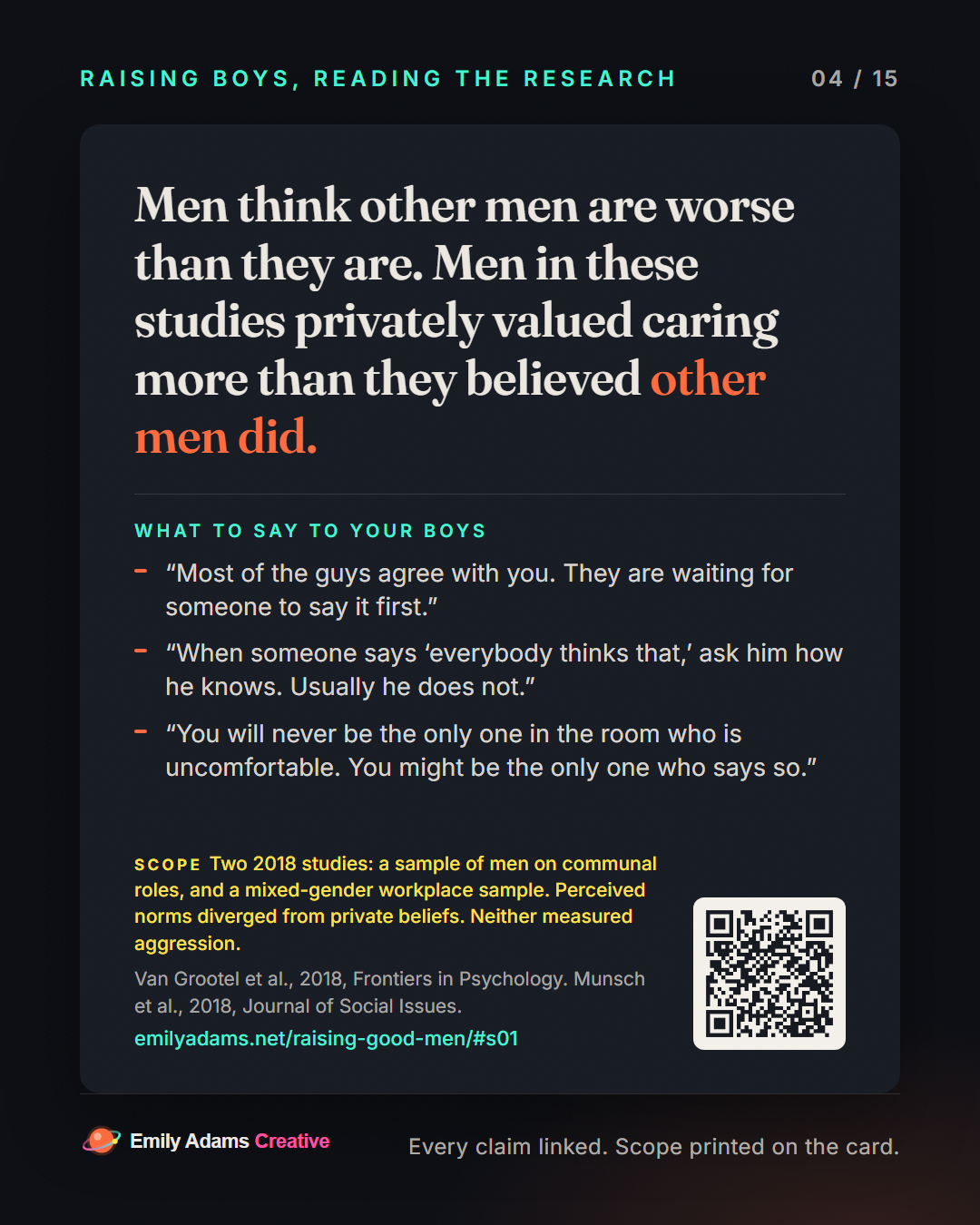
Card 05 of 15
Men overestimate what other men want. Men in this sample thought adversarial, impersonal sex was far more typical of other men than it was.
- “The locker room is a performance. Most of the guys in it do not want what they are claiming.”
- “You are allowed to not want that. So are most of them.”
- “Talking about a girl like she is a prize is a tell, not a flex. Notice who does it.”
SCOPE 497 heterosexually active men, national U.S. sample, 2020. Misperceptions differed by the men's own histories. Perceptions were measured, not behavior.
Study and link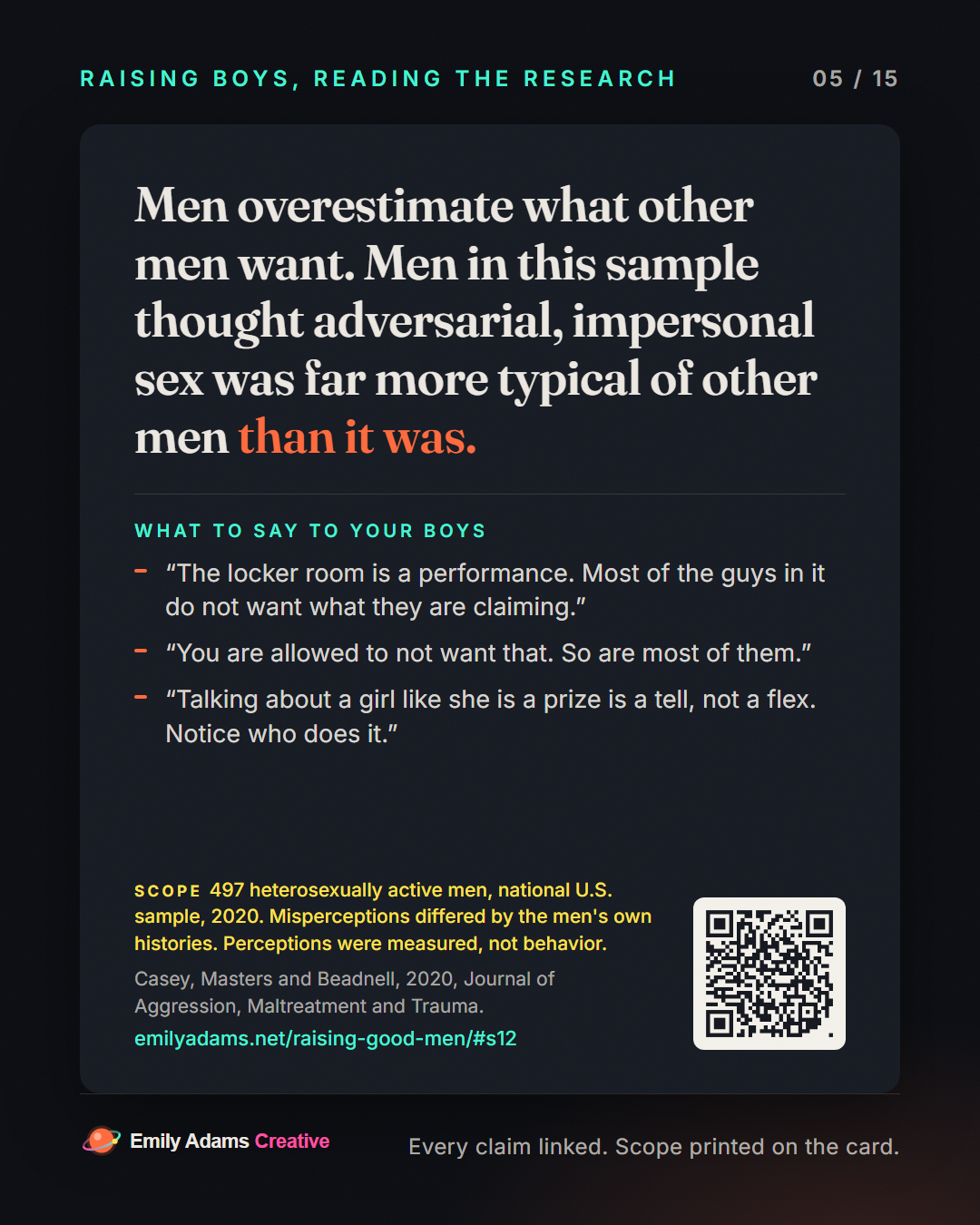
Card 06 of 15
One room can change what a man does. When nearby men signaled contempt for women, men in this study were less likely to step in.
- “Pick the room before you pick the night. If the talk about girls is ugly at nine, the night is ugly at one.”
- “The guy who interrupts that talk is the strongest one there. Be him. Back him when it is someone else.”
- “You can leave. Leaving is a decision, and it is yours.”
SCOPE 104 heterosexual men, ages 18 to 35, one laboratory scenario, 2019. An experiment, not a population estimate.
Study and link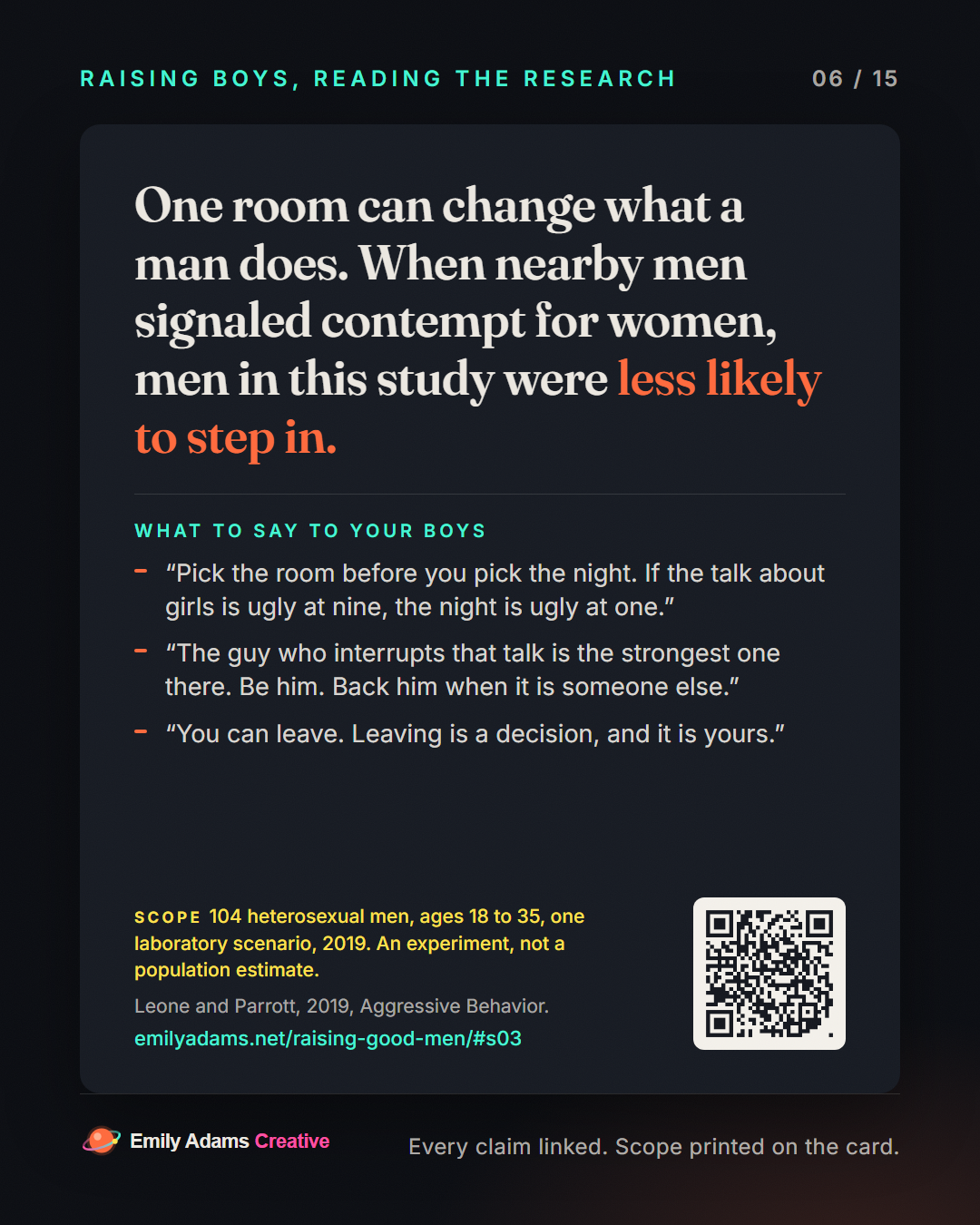
Card 07 of 15
The quiet man is the most reachable. Telling men their peers approved of stepping in moved intentions most among the men least inclined to act.
- “I know you are the one who goes quiet. Quiet is fine. Silent is not. Here is the sentence: ‘Hey. Not cool. She is wasted.’”
- “If you step in, more of them will back you than you think. The research says so, and so do I.”
- “You do not need to be brave. You need a sentence you have already said out loud at home.”
SCOPE 332 men, quasi-experiment, 2016. Outcomes were intentions, not observed behavior. A second program with 635 college men paired norms education with bystander training.
Study and link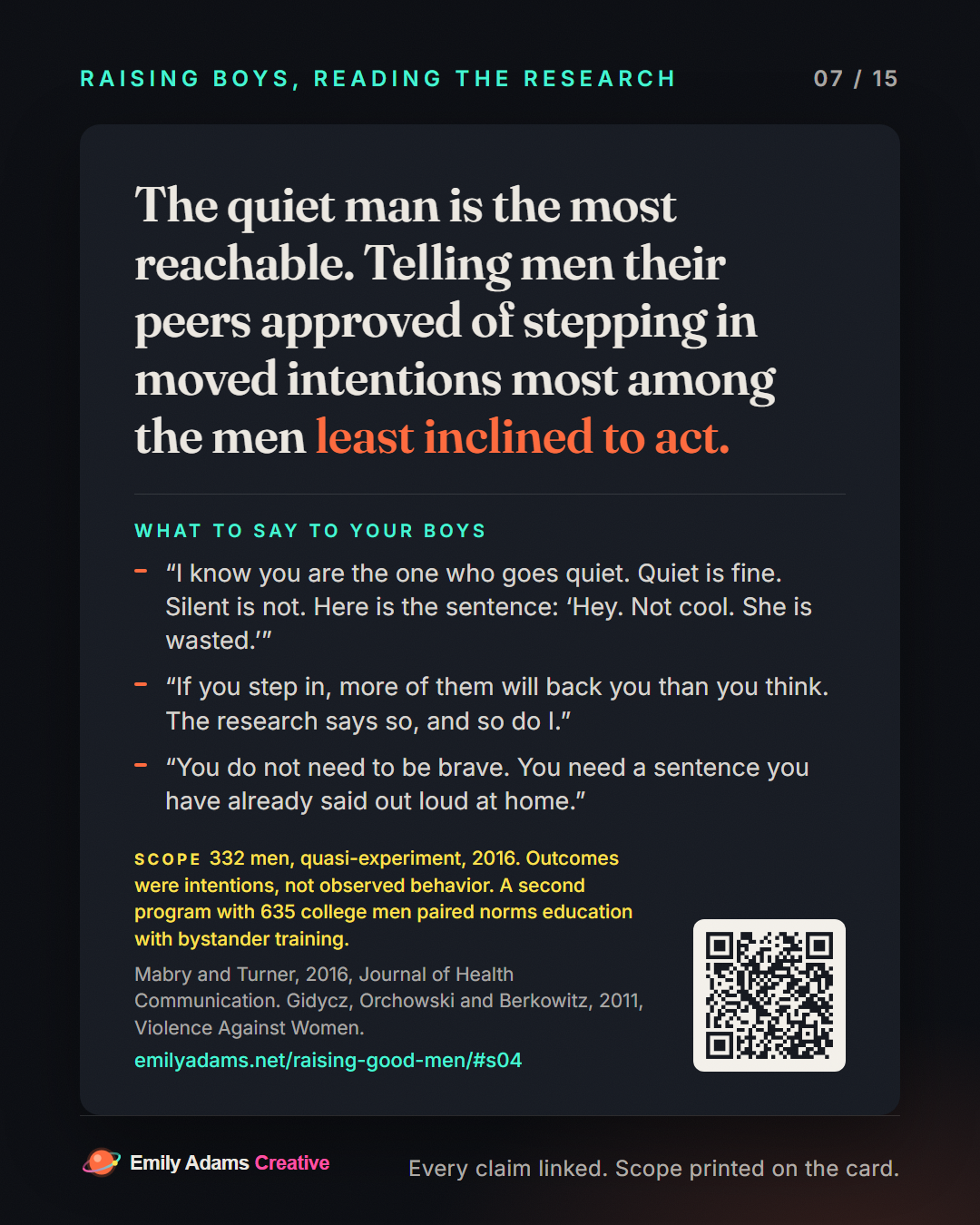
Card 08 of 15
“Be a man” is a threat, and it works. Across 123 studies, threats to manhood produced distress and self-doubt more than outward aggression.
- “Anyone who says ‘man up’ is trying to move you. Notice it. Then decide for yourself.”
- “A man who has to prove he is a man is being played. You do not have to take the test.”
- “Being a man is taking care of people. That is the whole definition in this house.”
SCOPE Synthesis of 123 studies, 19,448 mostly Western heterosexual men, average effect d = 0.45 across mixed outcomes. A 2026 review rates the field's replicability as moderate.
Study and link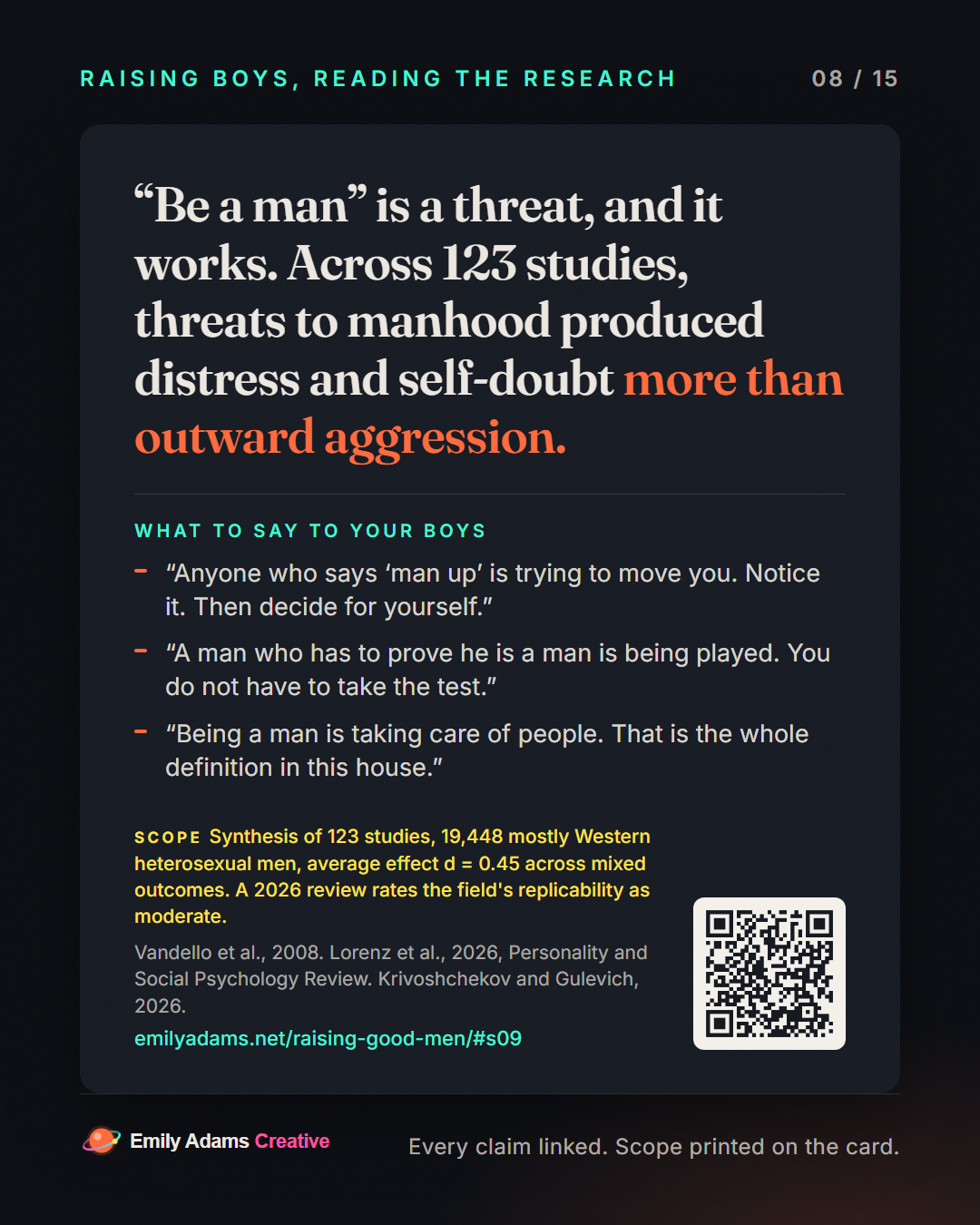
Card 09 of 15
“Power over women” is a specific belief, not men being men. Of the masculine norms measured, it was among those tied to worse outcomes and barroom aggression.
- “Wanting respect is fine. Wanting control over a girl is the one belief that ends lives. Do not carry it.”
- “Listen to how a guy talks about women when none are around. That is who he is.”
- “Her no is the end of the conversation. Not the start of a negotiation.”
SCOPE Meta-analysis of 78 samples, 19,453 participants, 2017, plus 322 young Australian men, 2016. Associations, not causes.
Study and link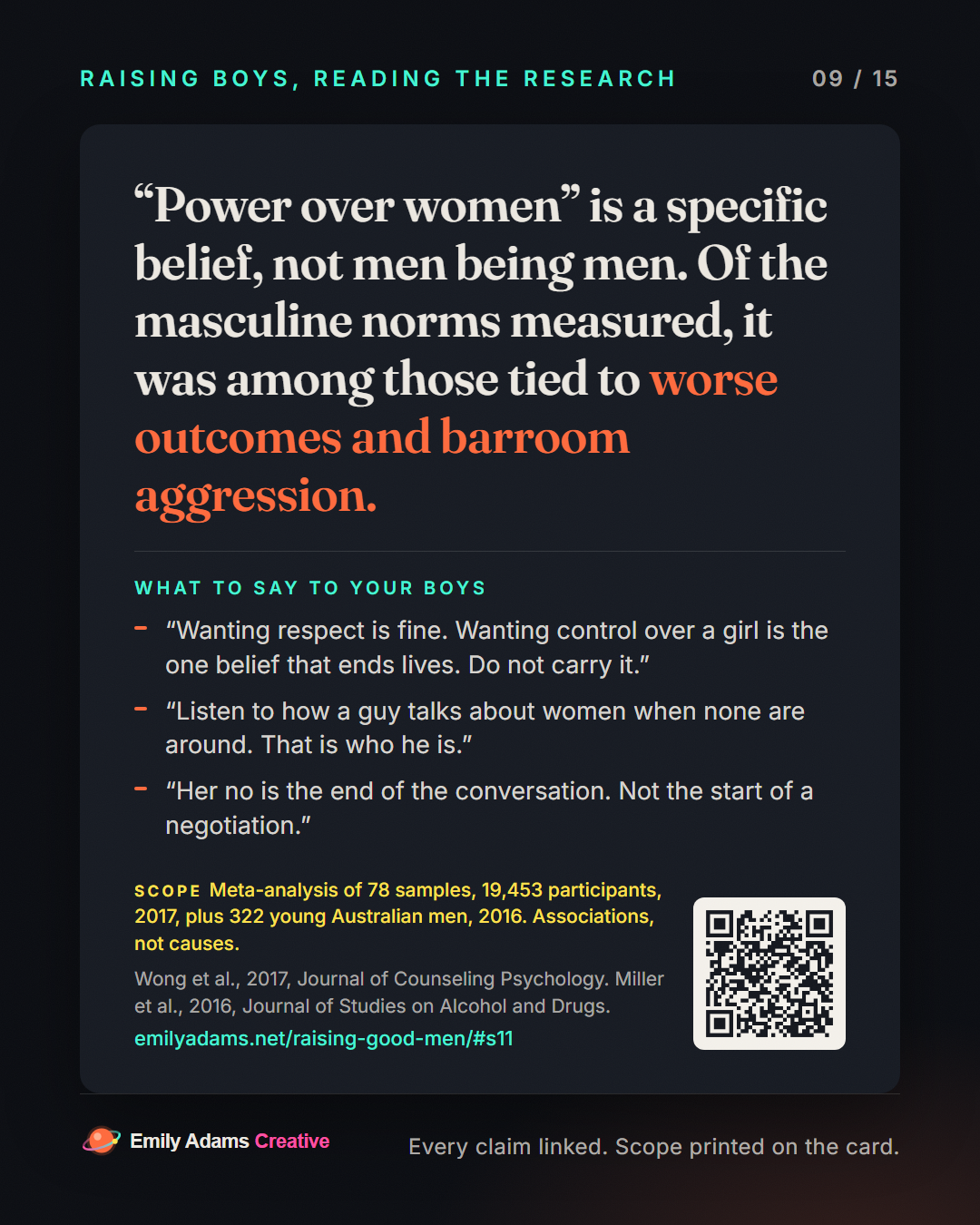
Card 10 of 15
Who gets called out and who gets protected. Men who wanted to do the right thing still aimed it at outsiders and protected friends and popular men.
- “The hardest version is when it is your friend. That is the only version that counts.”
- “Loyalty means you stop him. It does not mean you cover for him.”
- “If a group makes you prove yourself by hurting someone, the group is the problem. Walk.”
SCOPE Ethnography of undergraduate men at one campus, 2019. A separate study followed 772 men from before college; fraternity membership was associated with later perceived peer sexual aggression.
Study and link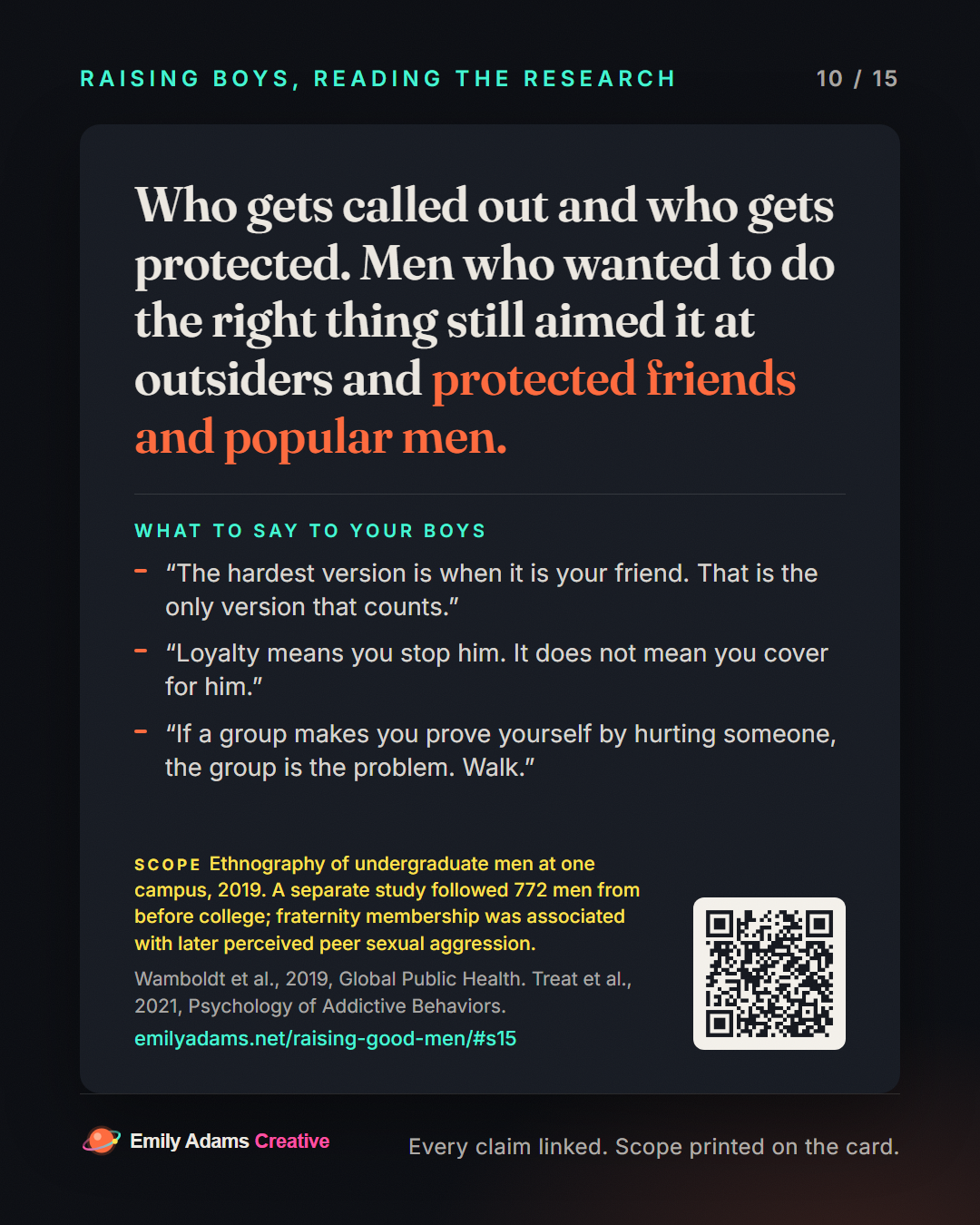
Card 11 of 15
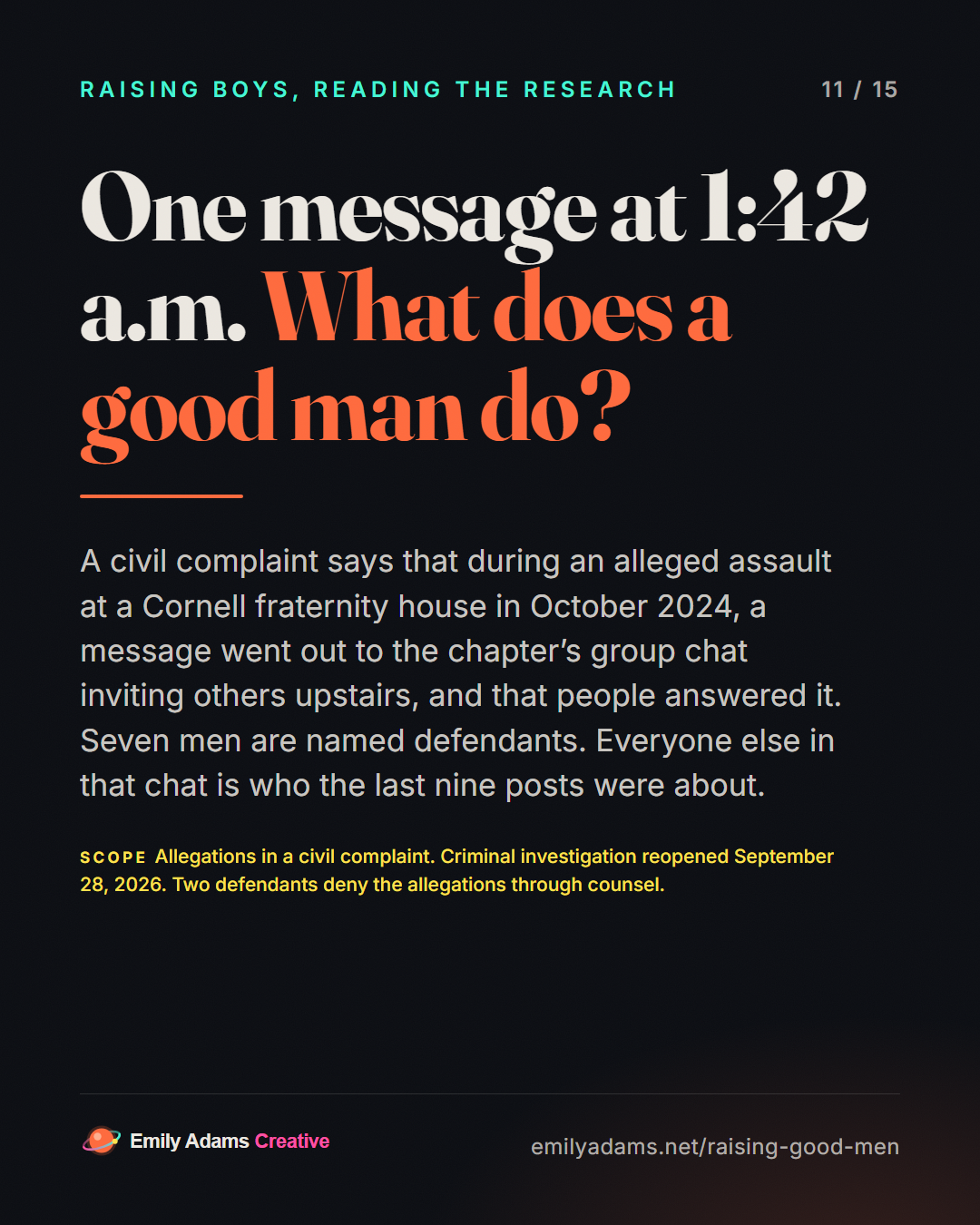
One message at 1:42 a.m. What does a good man do?
- A civil complaint says that during an alleged assault at a Cornell fraternity house in October 2024, a message went out to the chapter’s group chat inviting others upstairs, and that people answered it. Seven men are named defendants. Everyone else in that chat is who the last nine posts were about.
SCOPE Allegations in a civil complaint. Criminal investigation reopened September 28, 2026. Two defendants deny the allegations through counsel.
Card 12 of 15
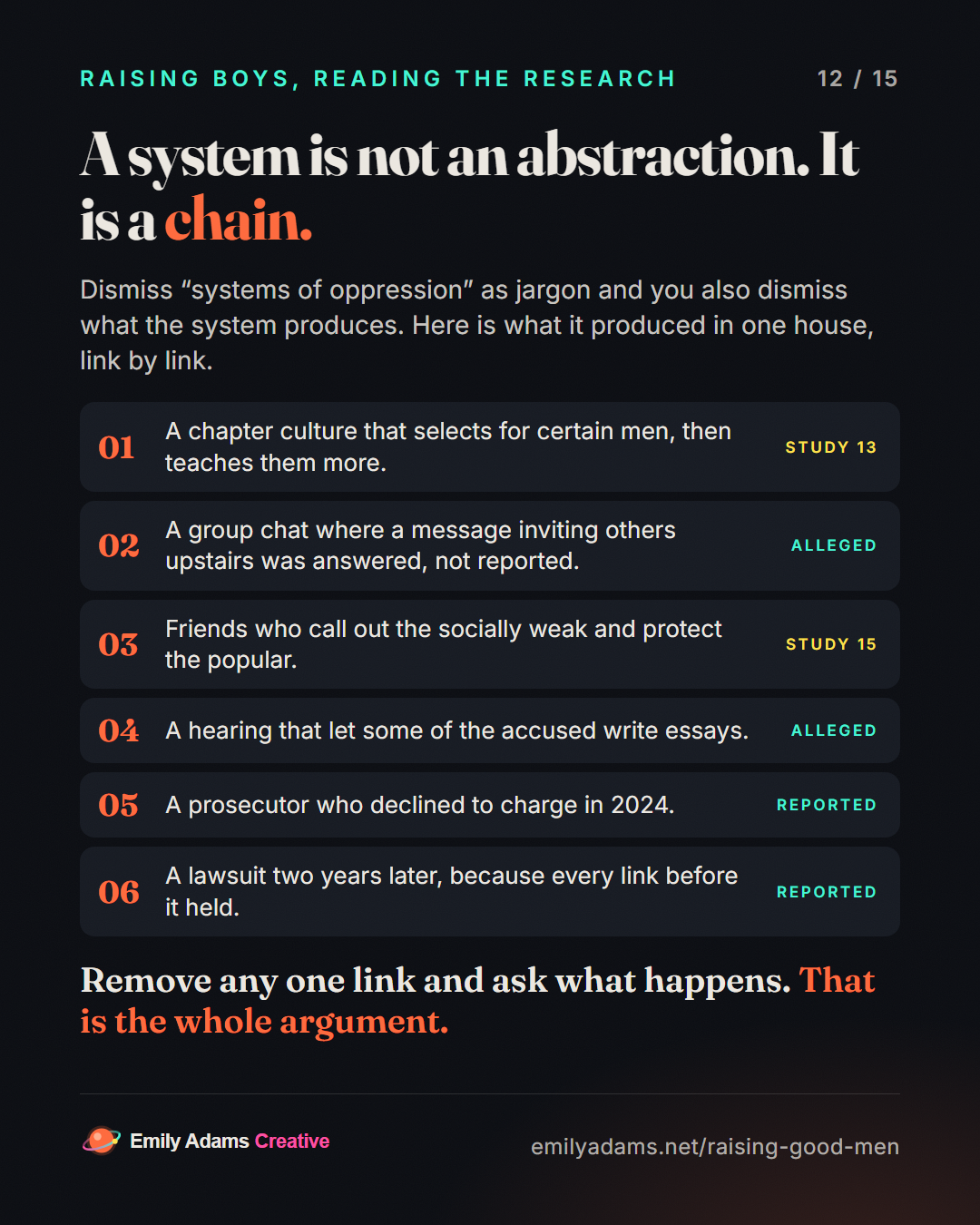
A system is not an abstraction. It is a chain.
- A chapter culture that selects for certain men, then teaches them more. Study 13
- A group chat where a message inviting others upstairs was answered, not reported. Alleged
- Friends who call out the socially weak and protect the popular. Study 15
- A hearing that let some of the accused write essays. Alleged
- A prosecutor who declined to charge in 2024. Reported
- A lawsuit two years later, because every link before it held. Reported
Remove any one link and ask what happens. That is the whole argument.
Card 13 of 15
Repeating a false claim to argue with it makes it feel truer. Prior exposure raised the perceived accuracy of false headlines even in people who knew better.
- “When the gross take lands in the chat, do not forward it to dunk on it. Say what happened. Say it was wrong. Then name what he is doing.”
- “The first sentence wins. Lead with what is true, not with what you are against.”
- “You can call out the move without repeating the line: ‘That is him blaming her so nobody looks at the chat.’”
SCOPE Online and lab samples, U.S. adults; effects on perceived accuracy, not behavior. Inoculation: teaching the manipulation technique first improved recognition of it. The truth-first sequencing is a communications protocol, not a study.
Study and link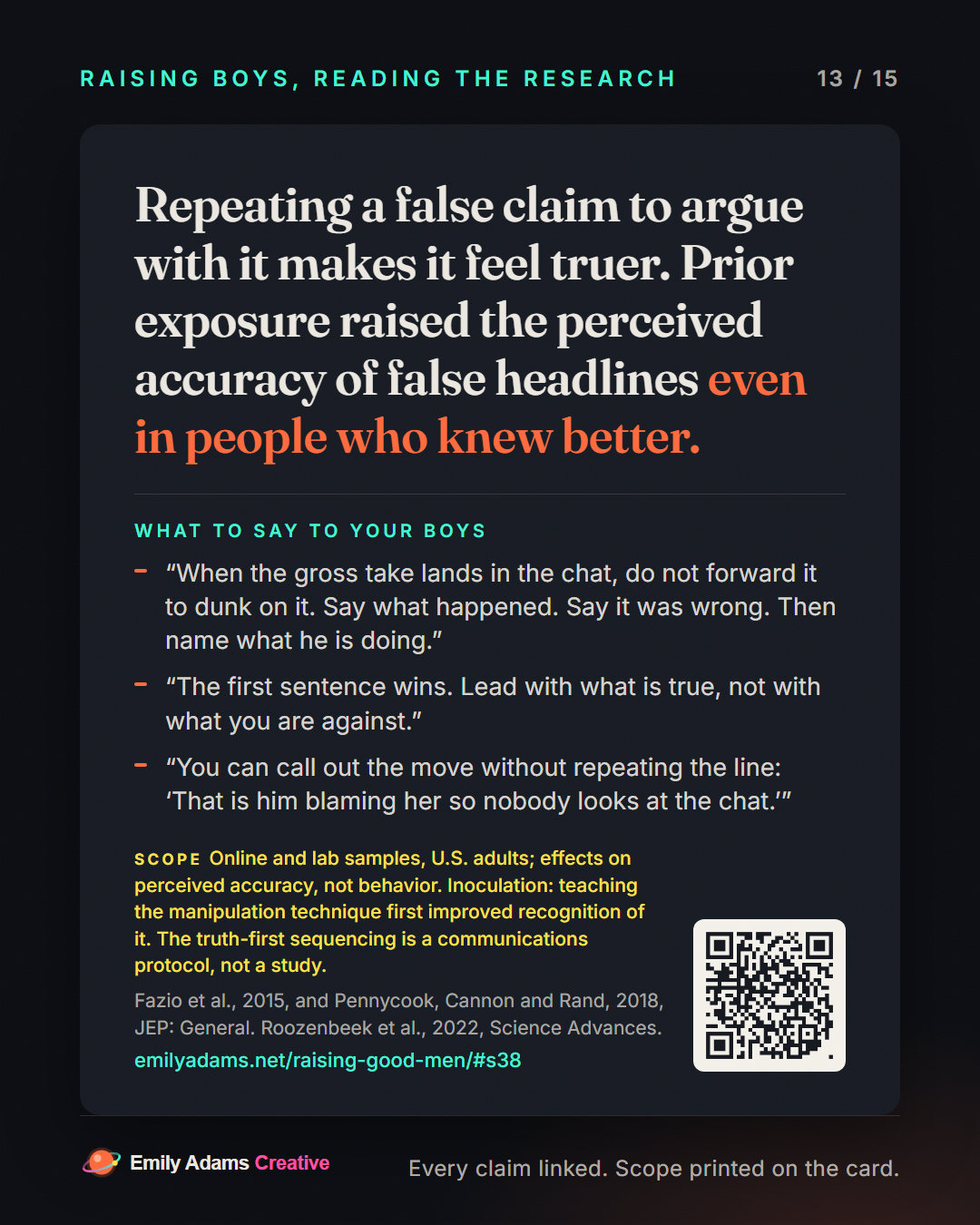
Card 14 of 15
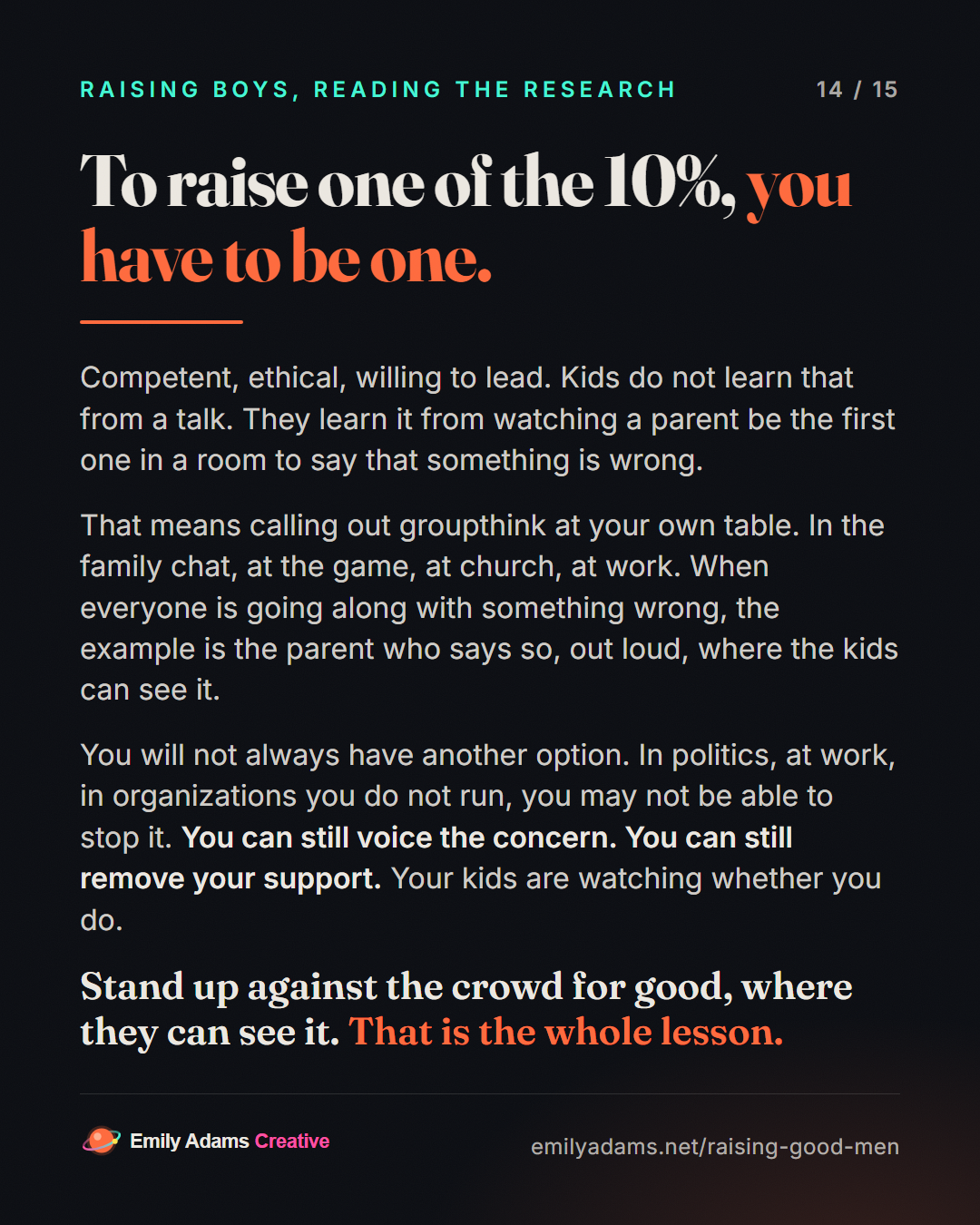
To raise one of the 10%, you have to be one.
- Competent, ethical, willing to lead. Kids do not learn that from a talk. They learn it from watching a parent be the first one in a room to say that something is wrong.
- That means calling out groupthink at your own table. In the family chat, at the game, at church, at work. When everyone is going along with something wrong, the example is the parent who says so, out loud, where the kids can see it.
- You will not always have another option. In politics, at work, in organizations you do not run, you may not be able to stop it. You can still voice the concern. You can still remove your support. Your kids are watching whether you do.
- Stand up against the crowd for good, where they can see it. That is the whole lesson.
Card 15 of 15
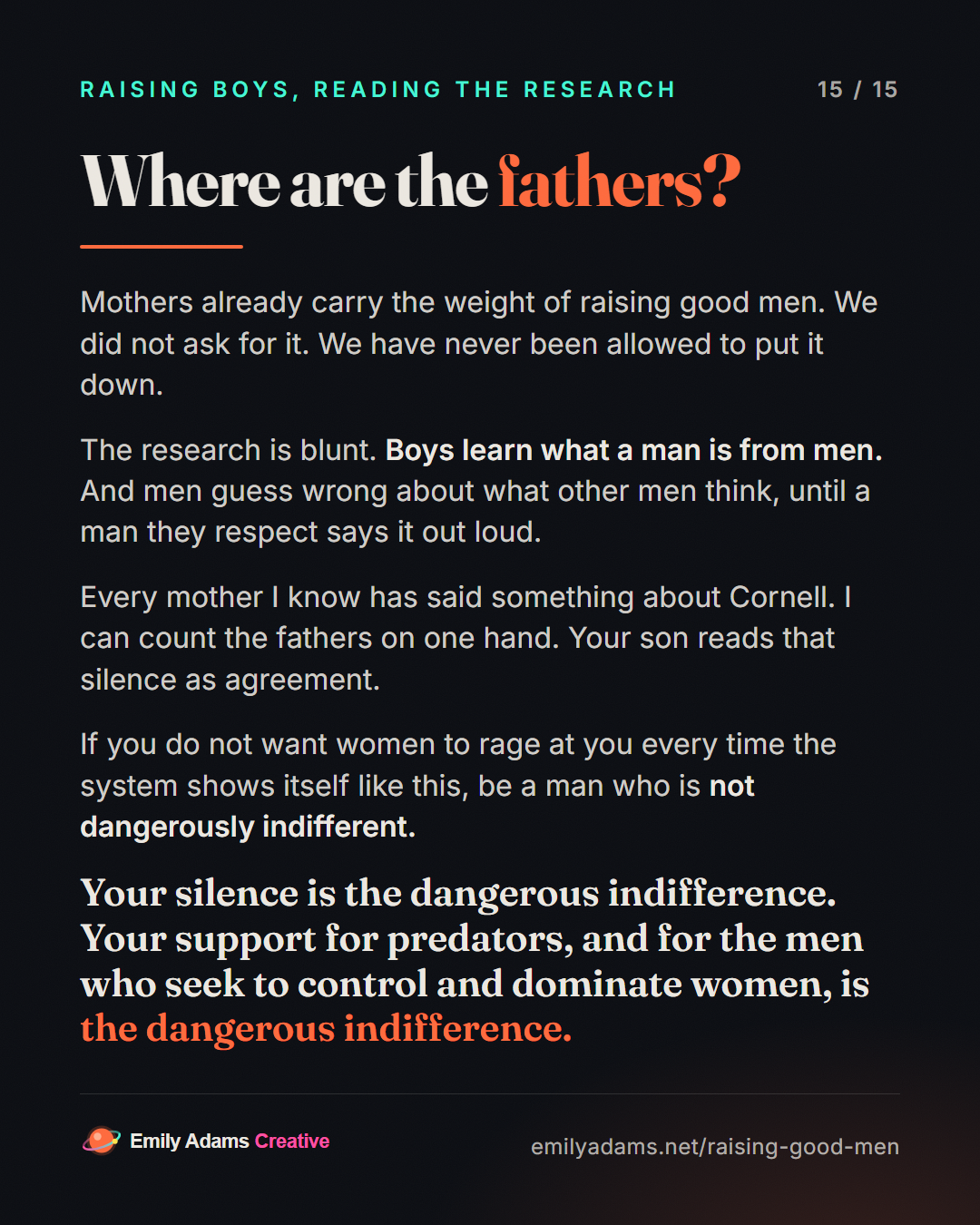
Where are the fathers?
- Mothers already carry the weight of raising good men. We did not ask for it. We have never been allowed to put it down.
- The research is blunt. Boys learn what a man is from men. And men guess wrong about what other men think, until a man they respect says it out loud.
- Every mother I know has said something about Cornell. I can count the fathers on one hand. Your son reads that silence as agreement.
- If you do not want women to rage at you every time the system shows itself like this, be a man who is not dangerously indifferent.
- Your silence is the dangerous indifference. Your support for predators, and for the men who seek to control and dominate women, is the dangerous indifference.