The only war on Christmas that ever made it into law was fought by Christians.
Not atheists. Not “the liberals.” Not a department store that said “Happy Holidays.” In 1647 England’s Parliament abolished Christmas outright, along with Easter and every other feast day. Twelve years later, the Puritan colony of Massachusetts Bay made celebrating it a finable offense. The people who did this weren’t hostile to Jesus. They were some of the most devout Protestants who ever lived, and they had read their Bibles closely enough to notice something awkward: there’s no December 25 in it.12
That’s the thing about Christmas. Almost everything people “know” about it is half right. It’s not a pagan holiday with a Jesus sticker slapped on top, and it’s not an unbroken Christian tradition handed down from the manger either. It’s two thousand years of borrowing, arguing, banning, rebranding, marketing and making things up, and the receipts are surprisingly good. So let’s open them.
What the Scholars Actually Say
Start with the people who study this for a living, because the internet version and the academic version are not the same story.
The internet version goes like this: Christians stole December 25 from the Roman sun god, stole the tree from the Druids, stole the gifts from Saturnalia, stole Santa from Odin, and called it a day. It makes a great meme. It’s also mostly a Victorian idea, popularized by folklorists like James Frazer, who saw ancient pagan survivals hiding behind every village custom. The historian Ronald Hutton spent a career checking those claims against the actual records, and his conclusion in The Stations of the Sun is blunt: a lot of the “ancient” customs turn out to be medieval, early modern, or younger than your great-grandmother.3
The other side has its own myth: that Christmas has always been a quiet, family-centered, church-first celebration, and that anyone who changes it is attacking something timeless. That one falls apart even faster. For most of its history Christmas was loud, drunk, and a little dangerous. The cozy version is about 200 years old, and we know exactly who built it.
Here’s where the serious scholarship actually lands:
- Nobody knows when Jesus was born. Not the year, not the month, not the day. The Gospels don’t say, and the early church didn’t claim to know.4
- December 25 shows up as Christmas in Rome by 336. The record survives in a Roman almanac compiled in 354.5
- Why that date is genuinely debated. One camp says the church picked it to compete with a Roman sun festival. Another says early Christians calculated it from the date they believed Jesus died. Both camps have evidence, and neither has a smoking gun.67
- Midwinter feasting really is ancient and really is everywhere. Romans had Saturnalia and the Kalends of January. Northern Europeans had Yule. People in the dark half of the year have always thrown a party. But two customs looking alike doesn’t prove one came from the other.3
- Most of what Americans picture as “Christmas” was assembled in the 1800s, by a small group of New York writers, an English novelist, a German-born cartoonist, and a whole lot of advertisers.8
Keep one rule in your pocket for the rest of this: a parallel is not a pedigree. Romans gave gifts in December. So do we. That’s a parallel. Proving that we do it because Romans did it requires a chain of evidence, and for most customs, that chain has gaps. Where the chain is solid, it’s solid. Where it isn’t, nobody should pretend otherwise.
Was Jesus Born on December 25?
Short answer: almost certainly not, and nobody in the early church thought they knew.
Only two of the four Gospels tell a birth story at all. Mark starts with Jesus as an adult. John starts with the cosmos. Matthew and Luke give us the Nativity, and they don’t tell quite the same story. Matthew has the Magi, the star, Herod’s massacre and a flight to Egypt. Luke has the census, the manger, the shepherds and the angels. Neither one gives a date.910
What they do give us are clues, and the clues don’t line up neatly.
Clue one: Herod. Matthew says Jesus was born while Herod the Great was king. Based on the historian Josephus, most scholars put Herod’s death around 4 BCE. So Jesus was probably born a few years before that, somewhere around 6 to 4 BCE. Yes, that means Jesus was born “Before Christ.” Blame a sixth-century monk named Dionysius Exiguus, who set up the AD numbering system and missed by a few years.4
Clue two: the census. Luke says Mary and Joseph traveled to Bethlehem because of a census ordered by Augustus while Quirinius governed Syria. The trouble is that the census of Quirinius we know about from Josephus happened in 6 CE, about a decade after Herod died. Scholars have spent a very long time trying to make Matthew and Luke agree on this, and they still argue about it.10
Clue three: the shepherds. Luke says shepherds were out in the fields at night. People love to argue that sheep wouldn’t be out in a Judean December, so the birth must have been in spring. Others point out Judean winters are mild enough. It’s a fun debate that proves nothing. A story detail is not a calendar.
Clue four: the star. Matthew’s star has launched a thousand planetarium shows. The astronomer Johannes Kepler suggested a conjunction of Jupiter and Saturn in 7 BCE. Others have proposed comets, novas and planetary alignments. Nobody has settled it, and Matthew wasn’t writing an astronomy report.9
Here’s the part that surprises people: early Christians mostly didn’t care. Around the year 200, Clement of Alexandria noted that some Christians in Egypt calculated the birth to a day in what we’d call May, and others to April. He reported these guesses with a raised eyebrow, the way you’d mention that your uncle has a theory. Around the same time, the theologian Origen sneered at birthday parties altogether. In the Bible, he pointed out, the people who throw birthday celebrations are Pharaoh and Herod, and somebody ends up dead at both of them.4
Christians in the East, meanwhile, settled on January 6 to celebrate Jesus’ birth and baptism together as the Epiphany. The Armenian Apostolic Church still celebrates Christmas on January 6 today. And many Orthodox churches celebrate on January 7, which is simply December 25 on the old Julian calendar they still use for church dates.4
So when someone says Jesus “wasn’t really born on December 25,” they’re right. When they say this means Christmas is a fraud, they’ve missed the point. The church never claimed to have his birth certificate. December 25 was always a chosen date. The real question is why they chose it.
So Why December 25?
The oldest surviving evidence comes from a single remarkable book. In 354, a wealthy Roman Christian commissioned a deluxe almanac from a calligrapher named Filocalus. Historians call it the Chronography of 354. It’s a grab bag: a public calendar, lists of consuls and popes, the dates Roman Christians honored their martyrs, and more.11
Two entries matter here, and they sit in different sections of the same book.
The public Roman calendar marks December 25 as N INVICTI CM XXX: the birthday of the Unconquered One, celebrated with thirty chariot races. “The Unconquered” means Sol Invictus, the Unconquered Sun.12
The Christian list of martyrs opens with a line saying Christ was born in Bethlehem of Judea on the eighth day before the Kalends of January, which is December 25. Because that list was put together using information from 336, historians use 336 as the earliest firm date for Christmas on December 25 in Rome.5
So on the same day, in the same city, in the same book, one entry celebrates the birth of the sun and another celebrates the birth of the Son. Everyone agrees on that much. What they fight about is which came first, and whether one caused the other.
Theory One: Christians Picked the Sun God’s Birthday
This is the version you’ve probably heard. In 274 the emperor Aurelian built a grand new temple to Sol in Rome and gave the sun god a bigger role in official religion. A festival of the sun’s birth on December 25, right around the winter solstice when the days start getting longer again, would have been a big public holiday. Christians, the theory goes, set their own celebration on top of it, offering a Christian alternative and slowly absorbing the crowd.4
There’s real support for this. Christians already used sun imagery for Jesus. The prophet Malachi had promised a “Sun of righteousness,” and Christian writers leaned into it. By the late 300s and 400s, church leaders were worried about the overlap. Augustine told his congregation to celebrate the day because of the one who made the sun, not because of the sun. Pope Leo the Great complained that some Christians climbing the steps of St. Peter’s would turn around and bow to the rising sun before going in.7
And centuries later, a twelfth-century Syriac writer named Dionysius bar Salibi added a note to a manuscript claiming that church leaders had moved Christmas to December 25 because pagans celebrated the sun’s birthday that day and Christians were joining in. That note gets quoted a lot. It also comes roughly 800 years after the fact, which is a bit like a modern blogger explaining the motives of Charlemagne.4
The weak spot: nobody has found an early church document saying “let’s put Christmas on the sun festival.” And the evidence that the December 25 sun festival is older than Christmas is thinner than people assume. The Chronography is the earliest clear record of the sun’s birthday on December 25, and it’s the same book that gives us Christmas. The classicist Steven Hijmans has argued that the clean story of Christians copying a long-established solar holiday doesn’t hold up as neatly as the textbooks suggest, and that both groups were drawing on the same deep well of sun symbolism.7
Theory Two: Christians Did the Math
The second theory sounds strange at first, then oddly convincing.
Many early Christians believed great prophets died on the same date they were conceived. It’s sometimes called the “integral age” idea: a perfect life comes full circle. Around the year 200, the North African writer Tertullian dated the crucifixion to March 25. If Jesus died on March 25, the reasoning went, he was also conceived on March 25. Add nine months and you get December 25.4
This isn’t a modern reconstruction someone invented to rescue Christmas from paganism. The math is written down. A fourth-century Latin treatise, On Solstices and Equinoxes, lays out the March 25 conception and December 25 birth. Augustine repeats it in On the Trinity. And the same logic explains the East’s January 6: Christians in parts of Asia Minor used April 6 as the death date, and nine months later lands on January 6. The French historian Louis Duchesne proposed this explanation in 1889, and scholars like Andrew McGowan have argued for it since.4
The weak spot here: the early sources that connect the dots explicitly are mostly later than the date itself. The historian C. Philipp E. Nothaft reviewed the whole debate in Church History in 2012 and pointed out that the calculation theory’s evidence is not as strong as its fans claim either.6
What Both Sides Agree On
Strip away the fighting and you’re left with this:
- December 25 was a chosen date, not a remembered one.
- It sat near the winter solstice, and both Christians and non-Christians found that symbolism powerful.
- It was firmly in place in Rome by 336 and spread from there. Constantinople adopted it around 380. Preaching in Antioch in 386, John Chrysostom said the December celebration had come to his city less than ten years earlier. Jerusalem held out for January 6 for generations.4
- Once the date stuck, the customs around it kept changing for the next 1,600 years.
Here’s a twist almost nobody mentions. The loudest early modern voices insisting Christmas was “really pagan” weren’t skeptics. They were Puritans. The Boston minister Increase Mather argued in 1687 that the early church had set Christmas to match Saturnalia to win over pagans. He meant it as an accusation. If the holiday was pagan, Christians had a duty to quit it. The “Christmas is secretly pagan” argument started life as a Protestant weapon against Christmas, and it’s still being fired in both directions today.8
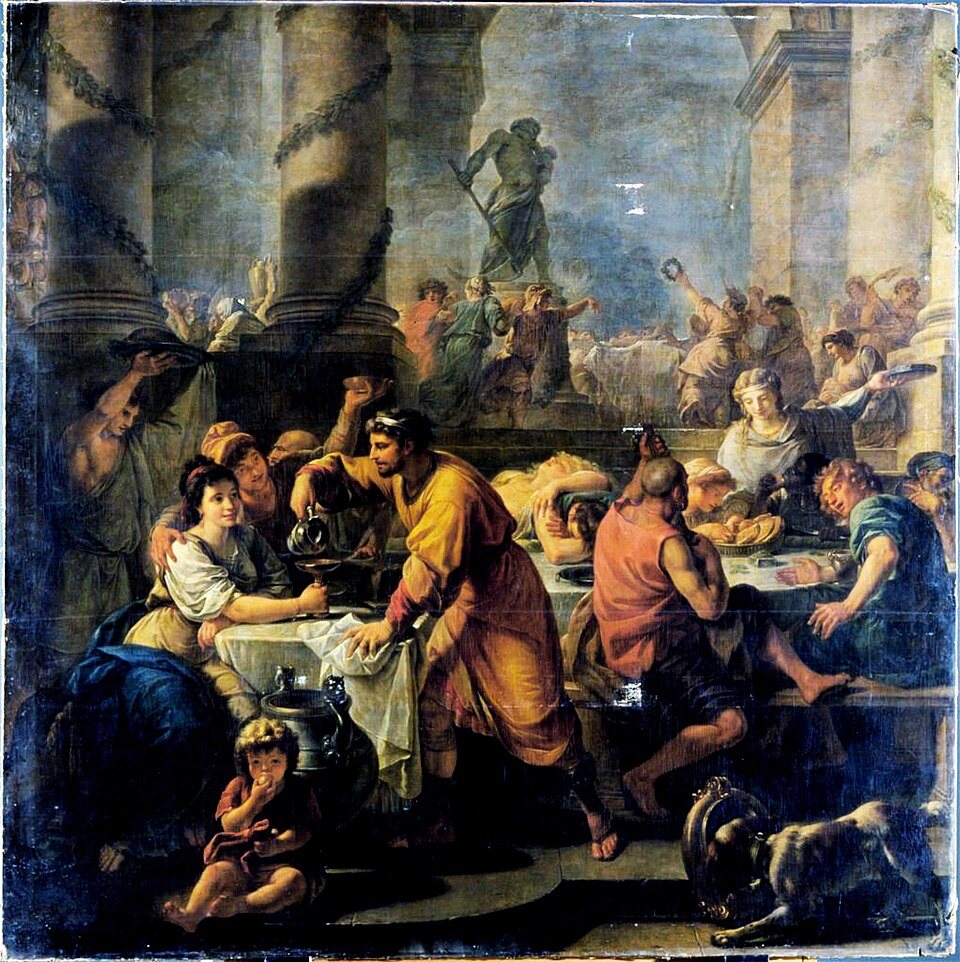
Saturnalia: The Party Rome Couldn’t Quit
If you want to understand why people keep linking Christmas to Rome, you have to understand that Saturnalia was the best party on the Roman calendar, and everyone knew it.
It honored Saturn, an old Roman god of agriculture and a lost golden age when there were no slaves, no private property and nobody had to work. Romans later said his temple in the Forum was dedicated around 497 BCE. The festival opened on December 17 with a sacrifice and a public banquet. The wool bindings on the feet of Saturn’s statue, which stayed tied the rest of the year, were loosened.13
Then Rome went sideways for a few days.
Officially Saturnalia was one day. Romans kept stretching it. The writer Macrobius said Augustus set it at three days and Caligula pushed it to five. By the late empire people were celebrating from December 17 through December 23. The poet Catullus called it the best of days.13
Here’s what happened during those days, and why it rings so many bells:
- The dress code flipped. Romans swapped the formal toga for a loose, colorful dinner outfit called the synthesis, and wore the pilleus, the felt cap usually given to freed slaves.
- The social order flipped, at least for show. Enslaved people could gamble, speak freely and, in some households, be served dinner by their enslavers. It was a pressure valve, not a revolution. Everyone went back to their places on December 24.
- Gambling was legal. Dice games normally banned in public were allowed.
- Everyone exchanged gifts. Small ones, mostly: wax candles called cerei, and little clay or pottery figurines called sigillaria, sold at a special holiday market. The poet Martial wrote two whole books of short verses meant to go with Saturnalia gifts, basically ancient gift tags, and some of them are as snarky as anything on a modern greeting card.
- Somebody got crowned. Households and dinner parties chose a mock king, the Saturnalicius princeps, who could order guests to sing, dance, or do something ridiculous.
- People shouted “Io Saturnalia!” in the streets, the ancient equivalent of yelling “Merry Christmas!” at strangers.13
And yes, people complained about it. The philosopher Seneca wrote to a friend that it was December and the whole city was in a sweat, as if the holiday had swallowed the calendar. Pliny the Younger built a soundproofed suite in his villa so he could keep working during Saturnalia while his household partied, which he presented as being considerate. The satirist Lucian wrote a whole comic dialogue imagining Saturn himself laying down the festival’s rules.13
So Is Christmas Just Saturnalia With Better Lighting?
No, and here’s why the honest answer is more interesting than the meme.
Saturnalia ended December 23. Christmas is December 25. Saturnalia didn’t celebrate a birth. And the specific customs we think of as most “Christmasy,” like trees, stockings, Santa and carols, don’t come from Rome at all. They show up more than a thousand years later in places Rome never cared about.
What Saturnalia does share with Christmas is a mood: winter feasting, gift-giving, candles, misrule and a few days when ordinary rules are suspended. Those things are real parallels. Some of them probably did flow into medieval Christmas through a long, messy, undocumented process of people simply continuing to party in December. But the cleanest Roman ancestor of a lot of Christmas behavior isn’t Saturnalia at all.
The Other Roman Holiday: The Kalends of January
The Romans had a second midwinter blowout that gets far less attention: the Kalends of January, the New Year.
The Kalends was when Romans gave each other gifts called strenae, hung greenery and lamps, feasted and wished each other a prosperous year. The fourth-century teacher Libanius described it as a festival where everyone was generous and the whole empire was in a good mood. Ronald Hutton argues that a lot of what later became Christmas gift-giving, decorating and feasting has a stronger claim to Kalends roots than to Saturnalia.3
How do we know Kalends customs survived into the Christian era? Because preachers spent centuries yelling about them. Bishops like Asterius of Amasea in the late 300s denounced the drinking, the gift-swapping and the masquerades. Church councils kept banning people from dressing up as animals or as the opposite sex at New Year’s. When a rule gets repeated for centuries, that’s the clearest possible sign people were ignoring it.3
That pattern, by the way, is going to keep coming up. Church authorities condemn a custom. People keep doing it anyway. Eventually the custom gets absorbed, or rebranded, or quietly tolerated. That’s how a lot of Christmas was built: not by a grand plan to swallow paganism, but by ordinary people refusing to give up a good party.
Yule, Jól and the Long Northern Night
Head north and the winter gets darker, longer and a lot more serious. In Scandinavia the sun barely clears the horizon in December. If any culture had a reason to throw a midwinter feast, it was this one.
And they did. The word Yule (Old Norse jól) is old and northern. The English monk Bede, writing around 725 in The Reckoning of Time, said the pagan English once called the two months around midwinter Giuli. He also said they began their year on the night we call Christmas Eve and called it Modranecht, the “Night of the Mothers,” though he admitted he didn’t know exactly what they did that night.14
What did Yule involve? Feasting, drinking, and in the pre-Christian period, sacrifices. The Swedish History Museum notes that what we know about Viking Age Yule comes largely from sources written down after Christianization, which means it’s filtered through Christian writers looking back.15
The most famous of those sources is Snorri Sturluson, an Icelandic writer who in the 1220s or 1230s wrote the saga of Hákon the Good, a tenth-century Norwegian king raised as a Christian in England. Snorri says Hákon passed a law moving the Yule feast to the same time Christians celebrated, and that everyone was required to brew a certain amount of ale and keep the holiday as long as the ale lasted. Whether Hákon actually did this is debated. Snorri was writing about 270 years later. But the story tells you what medieval Scandinavians believed had happened: Christmas and Yule merged, and the old name stuck.16
It stuck hard. In Danish, Norwegian and Swedish, Christmas is still jul. In Icelandic it’s jól. In Finnish it’s joulu. In English, “Yule” survived as a fancy synonym for Christmas, mostly in carols and log-shaped desserts.
Odin, the Wild Hunt and Other Midwinter Riders
Northern European folklore is full of things that ride through the winter sky. The best known is the Wild Hunt, a ghostly procession of riders, sometimes led by Odin, sometimes by other figures, that tears across the night during the dark season. The Norwegian painter Peter Nicolai Arbo painted The Wild Hunt of Odin in 1872, and it’s exactly as dramatic as it sounds.17
You’ll find plenty of internet posts claiming Santa is Odin: a bearded old man, flying at night, at midwinter, with an eight-legged horse that turned into eight reindeer. It’s a fun theory. It’s also mostly guesswork. Santa’s reindeer come from an 1823 American poem, and Santa’s look comes from Saint Nicholas, Dutch Sinterklaas and American illustrators, all of which we can trace. The Odin link isn’t impossible as a distant echo in winter folklore, but there’s no documented chain connecting them. Parallel, not pedigree.
The Yule Goat and the Yule Log
Two northern customs do have real records.
The Yule Goat (Swedish julbock) has played several roles over the centuries: a costumed figure that went door to door, a prankster, a gift-bringer, and now a straw decoration. The Swedish History Museum traces how the goat’s job kept changing. The most famous modern example is the giant straw goat built in the Swedish town of Gävle every year since 1966, which people have tried to burn down so many times that it’s practically its own holiday tradition.18
The Yule log was a big log burned in the hearth over Christmas. In England, written records of it start in the 1600s with the poet Robert Herrick, which makes it far younger than the “ancient pagan” label suggests. It survives now mostly as the French bûche de Noël, a cake shaped like a log, which is a much more sensible way to bring a tree trunk into the dining room.3
Saint Nicholas: The Bishop Behind the Beard
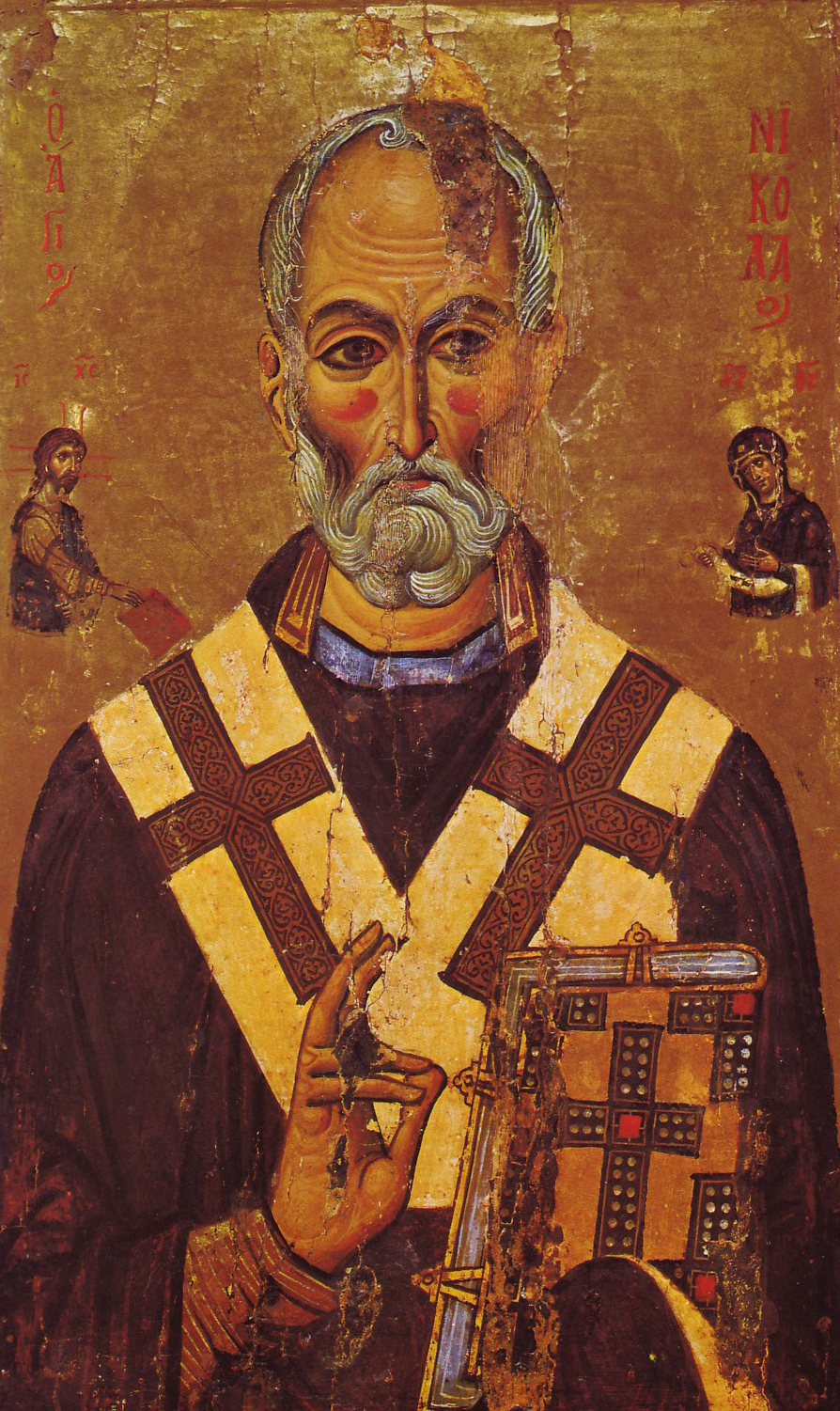
Every Santa Claus on every mall throne traces back, by a long and winding road, to a real Christian bishop in what is now southern Türkiye.
Nicholas was bishop of Myra, a town on the coast of Lycia, in the fourth century. Tradition dates his life to roughly 270 to 343. That’s about where the hard facts end. No document from his own lifetime mentions him. The St. Nicholas Center, which exists entirely to celebrate him, is upfront that the surviving evidence is late and that most stories about his life were written down centuries after he died.19
What survived was a reputation, and the reputation was generosity.
The Three Daughters
The story that made Nicholas famous goes like this. A man in Myra had three daughters and no money for their dowries. In that world, a young woman without a dowry might not be able to marry, and the story hints she could be forced into prostitution. Nicholas, who had inherited money, went to the house at night and tossed a bag of gold through the window. He did it again for the second daughter. On the third visit the father caught him, and Nicholas begged him to keep the secret.19
Later retellings have the gold landing in stockings drying by the fire, or in shoes. That’s one of the stories people give for why children hang stockings or set out shoes. It’s a legend about a legend, but it’s an unusually good one: a rich man quietly using his money to give women in a bad spot more choices, and not taking credit. Privilege with a purpose.20
Why Nicholas Got So Big
Nicholas became one of the most popular saints in all of Christianity, east and west. Sailors adopted him. So did children, merchants, brewers, and pawnbrokers, whose traditional sign of three gold balls is often linked to the three bags of gold.
In 1087, sailors from Bari in southern Italy took his remains from Myra and carried them home. The people of Bari call it a rescue. The people of Myra called it theft. Either way, it put Nicholas’s tomb in Western Europe and turned Bari into a pilgrimage center.19
By the Middle Ages, his feast day on December 6 had become a children’s holiday in much of Europe. Kids could expect treats or small gifts. In some places, schools elected a “boy bishop” who got to play church leader for a few weeks, which is very Saturnalia in spirit, if not in origin.3
Sinterklaas
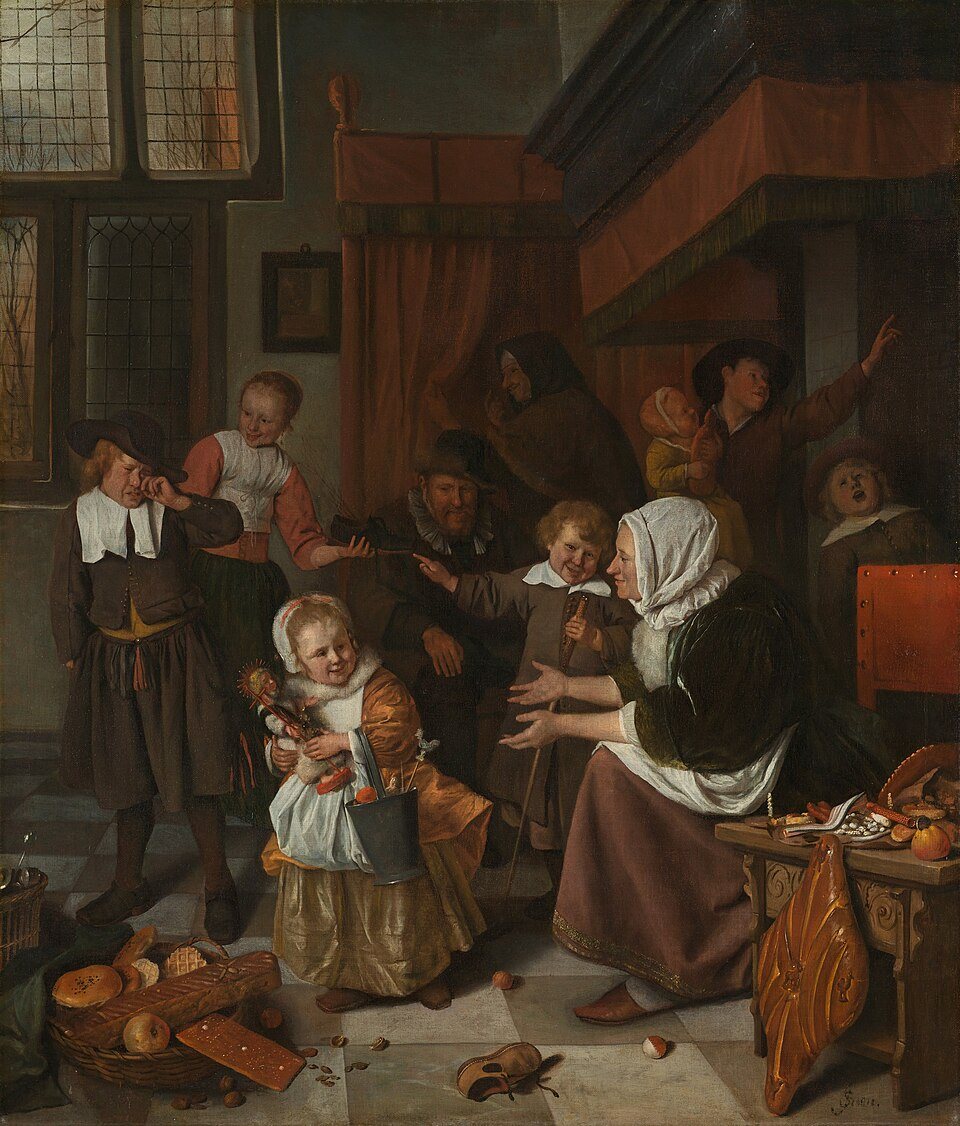
The Dutch kept Nicholas closer than almost anyone. Sinterklaas arrives in the Netherlands in mid-November, by tradition on a steamboat from Spain, and rides a white horse over the rooftops. Children leave out shoes, sometimes with a carrot for the horse, and find treats in the morning. The big night is December 5. Jan Steen’s painting The Feast of St Nicholas, from around 1665 to 1668, now in the Rijksmuseum, shows a Dutch household on the morning after: one delighted little girl with her presents, one sobbing boy who apparently got nothing, and a sister who is clearly enjoying his misery.21
Sinterklaas traditionally travels with helpers called Zwarte Piet, played for generations by white performers in blackface. Since the 2010s that part of the tradition has been fiercely debated in the Netherlands, and many towns and broadcasters have switched to “soot” Piets, with smudges instead of full black makeup.
When the Dutch settled New Netherland, the colony that became New York, they brought Nicholas stories with them. That turned out to matter a great deal.
The Reformation Moves the Gifts
In the 1500s, the Protestant Reformation tore Western Christianity in half, and Saint Nicholas got caught in the blast.
Many Protestant reformers objected to the cult of saints: praying to them, venerating relics, celebrating their feast days. Martin Luther and others encouraged families to shift gift-giving away from December 6 and toward Christmas itself, with the gifts coming from the Christ Child, the Christkind, rather than from a Catholic saint.3
It worked a little too well. The Christkind (or Christkindl) became a gift-bringer in much of Germany, Austria and beyond, often pictured not as baby Jesus but as a golden-haired, angel-like child. That’s where Nuremberg’s famous Christkindlesmarkt gets its name. And in a perfect example of how Christmas customs mutate, the word Christkindl crossed the Atlantic with German immigrants and slowly turned into... “Kris Kringle,” which Americans then used as another name for Santa Claus. The Protestant replacement for Saint Nicholas became a nickname for the guy based on Saint Nicholas.
Meanwhile in Catholic regions, Nicholas carried on. And in parts of the Alps, he picked up some very unsettling company.
The Puritans’ War on Christmas, Part One: England
Now for the people who actually canceled Christmas.
The Puritans were English Protestants who believed the Church of England hadn’t gone far enough in breaking from Rome. They wanted worship stripped down to what they could find in Scripture. Not tradition. Not custom. Scripture. And when they went looking for Christmas in the Bible, they had three big problems with it.22
Complaint one: “Where does the Bible say to do that?” The Gospels tell the story of Jesus’ birth. They give no date and no instruction to throw an annual birthday feast. For Puritans, a holy day invented by the church was a human addition to God’s law, and that was exactly the kind of thing they’d signed up to get rid of.
Complaint two: “It feels too Catholic.” Christmas came with a special Mass (the name literally means “Christ’s Mass”), saints’ days around it, and a church calendar Puritans associated with Rome. Their writers sometimes called it “Foolstide” or sneered at the “Mass” in the name.
Complaint three: “The parties are out of hand.” This was not a minor point. English Christmas in the 1500s and 1600s meant twelve days of eating, heavy drinking, gambling, dancing, mumming (going house to house in disguise), wassailing (going house to house demanding drinks and food), and installing a Lord of Misrule to preside over the chaos. In 1583 the Puritan writer Philip Stubbes complained in The Anatomie of Abuses about a Lord of Misrule’s gang dancing into church, bells jingling, in the middle of the service. To Puritans, Christmas was a twelve-day excuse to sin, and they weren’t exactly wrong about the drinking.3
When Puritan sympathizers took control of Parliament during the English Civil War, they acted on all three.
- 1644
Christmas Day happened to fall on the monthly fast day Parliament had set during the war, the last Wednesday of the month. Instead of moving the fast, Parliament ordered people to keep December 25 as a day of fasting and repentance for having previously celebrated it with “carnal and sensual delights.” Imagine being told to spend Christmas apologizing for every Christmas you ever had.2
- 1645
Parliament replaced the Book of Common Prayer with a new Directory for Public Worship, which kept Sunday as the only holy day and said nothing about festivals at all.22
- June 1647
Parliament passed an ordinance abolishing Christmas, Easter and Whitsun (Pentecost) as holy days. To soften the blow, it gave students, apprentices and servants the second Tuesday of every month off instead. A monthly day off, in exchange for Christmas. People were not impressed.232
People Fought Back, Sometimes Literally
The ban was wildly unpopular, and the pushback was immediate.
In Canterbury in December 1647, the mayor tried to enforce the new rules by ordering shops to open on Christmas Day. A crowd gathered, played football in the streets, smashed windows and attacked the shops that obeyed. The disturbance spread into a broader uprising in Kent the following year, part of the chain of events historians call the Second English Civil War. A fight over Christmas helped restart a war.2
Elsewhere, people simply ignored the law. Officials grumbled in their reports that shops stayed shut on December 25 no matter what they were told. Ministers who preached on Christmas Day were sometimes arrested. Families feasted behind closed doors.2
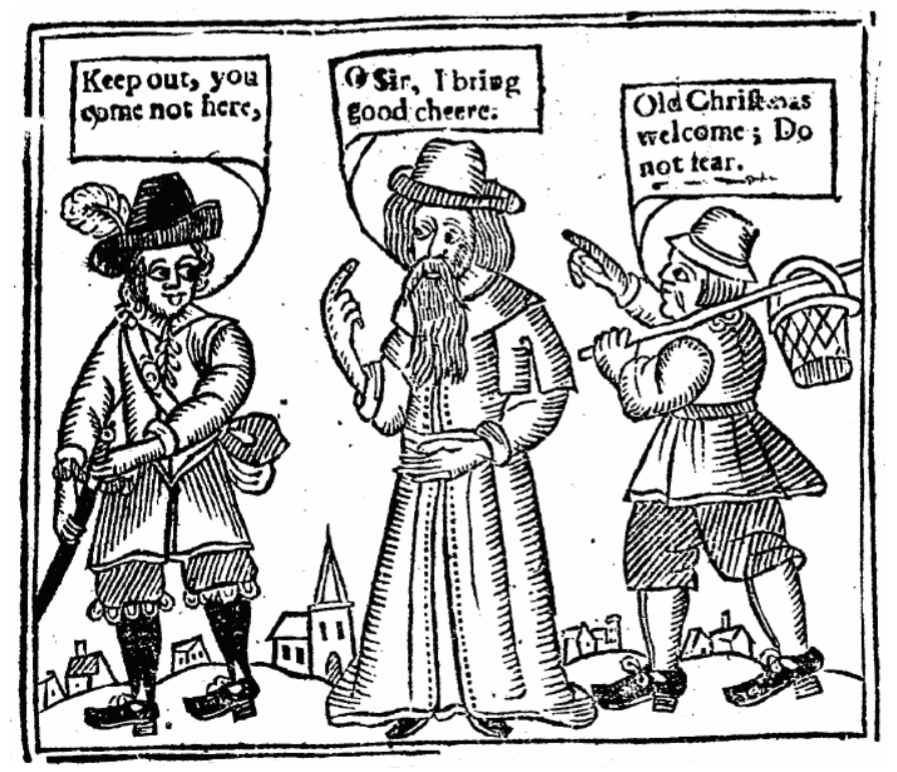
Writers fought back too. In 1652 the poet John Taylor published The Vindication of Christmas, a pamphlet in which Christmas himself is a character, wandering England, unwelcome everywhere, describing how he used to be greeted with feasts and is now shut out. Another pamphlet, Josiah King’s The Examination and Tryall of Old Father Christmas, imagined Father Christmas being put on trial. Father Christmas in England at that point wasn’t a gift-giver. He was a jolly old personification of feasting, drinking and good cheer, which is precisely why the Puritans found him so offensive and why his defenders made him a symbol.24
On Christmas Day 1657 the diarist John Evelyn went to a private Christmas service in London. Soldiers surrounded the chapel, and he wrote that they held their muskets against the worshippers as they came up to take communion. He was questioned and released. That’s how seriously some authorities took it by then.25
Did Oliver Cromwell Ban Christmas?
This is the big one, and the answer is: not exactly.
Cromwell gets the blame in nearly every pub quiz. But Parliament passed the main 1647 ordinance before Cromwell ran the country, and the Cromwell Museum points out that he wasn’t even in Parliament when it passed; he was with the army. What’s true is that the ban stayed in force throughout his years as Lord Protector, from 1653 to 1658, and his government enforced it. He didn’t start the war on Christmas, but he didn’t call it off either.22
The bans ended with the Restoration. When Charles II returned to the throne in 1660, the Puritan laws were swept away and Christmas came roaring back, along with theaters, maypoles and a lot of other things the Puritans had shut down.22
Scotland Held Out Much Longer
England got its Christmas back in 1660. Scotland didn’t, at least not officially.
The Scottish Reformation, led by the strict Calvinist Church of Scotland (the Kirk), had been discouraging Christmas since the 1560s, and in 1640 the Scottish Parliament abolished the old Yule holidays outright. The Scottish Parliament formally lifted the ban in 1712, but the Kirk’s disapproval kept Christmas a working day in Scotland for centuries. Christmas Day didn’t become a public holiday in Scotland until 1958. Boxing Day followed in 1974. That’s why Scots historically poured their midwinter energy into Hogmanay, the New Year, which the Kirk tolerated. When Scots tell you New Year’s is the real holiday, they’re carrying on a 400-year-old workaround.2627
The Puritans’ War on Christmas, Part Two: New England
The Puritans who sailed to America brought the same convictions, with even fewer people around to argue.
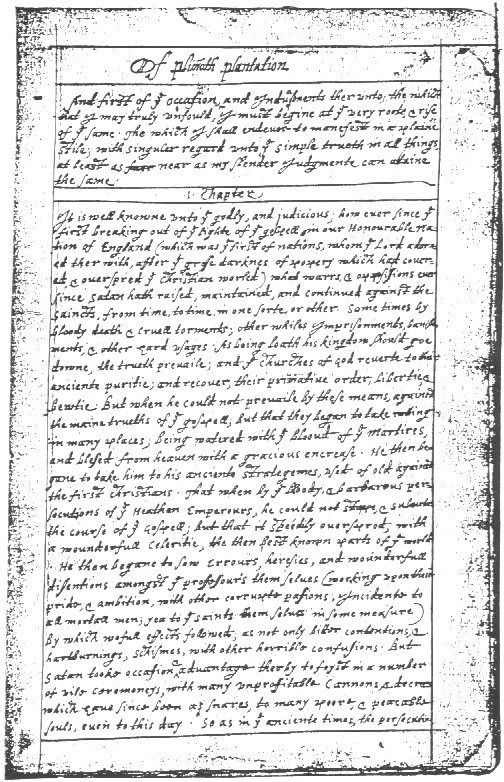
The first recorded Christmas fight in English America happened in Plymouth in 1621, the first winter after the Mayflower. Governor William Bradford wrote about it in his history Of Plimoth Plantation. On Christmas Day he called the men out to work as usual. Some newcomers who had just arrived said working on Christmas went against their conscience. Bradford, being reasonable, excused them until they were “better informed.” When he came back at noon, he found them in the street playing games, pitching the bar and playing stool-ball, a cousin of cricket. Bradford confiscated their equipment and told them it was against his conscience that they should play while others worked. If they wanted to keep the day as a matter of devotion, they could do it at home. There would be no gaming in the streets.28
In other words, the first Christmas dispute in New England wasn’t about Jesus. It was a boss catching his crew slacking off.
The Massachusetts Fine
The larger Massachusetts Bay Colony went further. In 1659 its General Court passed a law that anyone found observing Christmas “or the like, either by forbearing of labour, feasting, or any other way” would be fined five shillings for each offense. That’s real money in a colonial economy, and the law covered not just partying but simply taking the day off.1
The fine was repealed in 1681. Not because Massachusetts had a change of heart, but because the colony was in trouble with the crown. After the Restoration, Charles II’s government pressured the Puritan colony to fall in line with English law, and the Christmas ban was one of the things that had to go. The Massachusetts Trial Court Law Libraries, which hold the record, note that the debate over Christmas continued long after the fine was gone.1
And it did. In 1686 the royal governor Sir Edmund Andros, an Anglican appointed by the crown, held a Christmas service in Boston under guard. Puritan ministers kept preaching against the holiday for decades. In 1712, Cotton Mather complained that Christmas in New England was being spent “by mad mirth, by long eating, by hard drinking, by lewd gaming, by rude reveling.” Which tells you two things: Puritans still hated Christmas, and plenty of New Englanders were celebrating it anyway.8
How Long the Holdout Lasted
New England’s suspicion of Christmas lasted well into the 1800s. In parts of the region, schools, shops and markets still opened on December 25 around 1850, and plenty of mills and factories ran as usual.29
States began making Christmas a legal holiday one by one in the middle of the century. In June 1870, Congress passed a law making New Year’s Day, the Fourth of July, Thanksgiving and Christmas holidays in the District of Columbia, and President Ulysses S. Grant signed it. That law covered Washington, D.C., and federal workers there; it was not a national order for everyone to stop work.30
So for most of American history, Christmas was contested ground. The “traditional American Christmas” was, for a long stretch, the one where you went to work.
The Christmas Nobody Puts on a Card
Before Santa, you need to know what Christmas looked like to a lot of ordinary people in the 1700s and early 1800s, because it explains why somebody felt the need to reinvent it.
In England and America, Christmas was a carnival. The historian Stephen Nissenbaum, in The Battle for Christmas, describes a season when the usual hierarchy loosened and working people, apprentices, servants and the poor went out in noisy groups to the houses of the wealthy and demanded food, drink or money. The custom of wassailing literally worked this way: show up at the door, sing, and expect to be paid in hospitality. If the household refused, the visit could turn into vandalism.8
The old wassail songs are polite demands. Even “We Wish You a Merry Christmas” has a verse insisting on figgy pudding and announcing that the singers won’t go until they get some. That’s not a carol. That’s a shakedown with a tune.
By the 1820s and 1830s, in growing cities like New York, this tradition had taken an uglier shape. Gangs of young working-class men called “Callithumpians” roamed the streets on Christmas and New Year’s, banging pots and drums, firing guns, smashing windows and harassing the well-off. Nissenbaum describes Christmas season in New York as a time when respectable people genuinely worried about disorder.8
The upper class needed a Christmas they could live with. So they built one.
How New York Reinvented Christmas
A small circle of wealthy New Yorkers, sometimes called the Knickerbockers, set out to create a quieter, more respectable holiday centered on the family home and on children. They were writers, antiquarians and civic boosters, and they had a hometown mascot ready to go: Saint Nicholas, the patron of New Amsterdam, the Dutch colony that came before New York.8
- 1804
John Pintard, a merchant and history enthusiast, helped found the New-York Historical Society and promoted Saint Nicholas as the city’s patron saint.
- 1809
Washington Irving published A History of New York, a satirical, mostly made-up history of the city’s Dutch days written under the pen name Diedrich Knickerbocker. It’s full of Saint Nicholas references, including a jolly Nicholas riding over the treetops in a wagon and dropping presents down chimneys. Irving was joking. People took the jokes and ran.8
- 1823
Then came the poem. On December 23, 1823, the Troy Sentinel in upstate New York printed an anonymous poem called “A Visit from St. Nicholas,” better known by its first line, “’Twas the Night Before Christmas.” It gave America almost the whole Santa package in one shot: Christmas Eve, the sleigh, eight flying reindeer with names, the chimney entrance, the stockings, the round belly that shook “like a bowlful of jelly,” the pipe, and the twinkle in the eye. Nicholas in this poem isn’t a stern bishop. He’s a “right jolly old elf.” The Library of Congress holds an early edition.31
The poem is usually credited to Clement Clarke Moore, a wealthy biblical scholar who claimed it in 1837 and published it in his own collection in 1844. But the descendants of Henry Livingston Jr., a New York gentleman who died in 1828, long insisted he wrote it. The literary detective Don Foster argued for Livingston in 2000, and a 2016 statistical study of word patterns by MacDonald Jackson also pointed to Livingston. Other scholars defend Moore. The authorship of the most famous Christmas poem in American history is still disputed.8
Notice what the poem does. It takes Christmas off the streets and puts it inside the house. It happens at night while the children are asleep. The visitor who enters isn’t a gang of drunk wassailers demanding payment; it’s a benevolent old man who gives instead of takes. Nissenbaum’s reading is that the domestic, child-centered Christmas was, among other things, a solution to a class problem. The rowdy demand for gifts at the door was redirected into a parent’s gift to a child, delivered by a magical stranger.8
Santa Gets a Face
The poem gave Santa a personality. Artists gave him a body.
Thomas Nast Draws Santa Into the Civil War
Thomas Nast was a German-born cartoonist who became one of the most powerful political artists in American history. (He’s also the reason the Republican Party is an elephant.) For Harper’s Weekly he drew Santa Claus dozens of times between the 1860s and 1880s.32
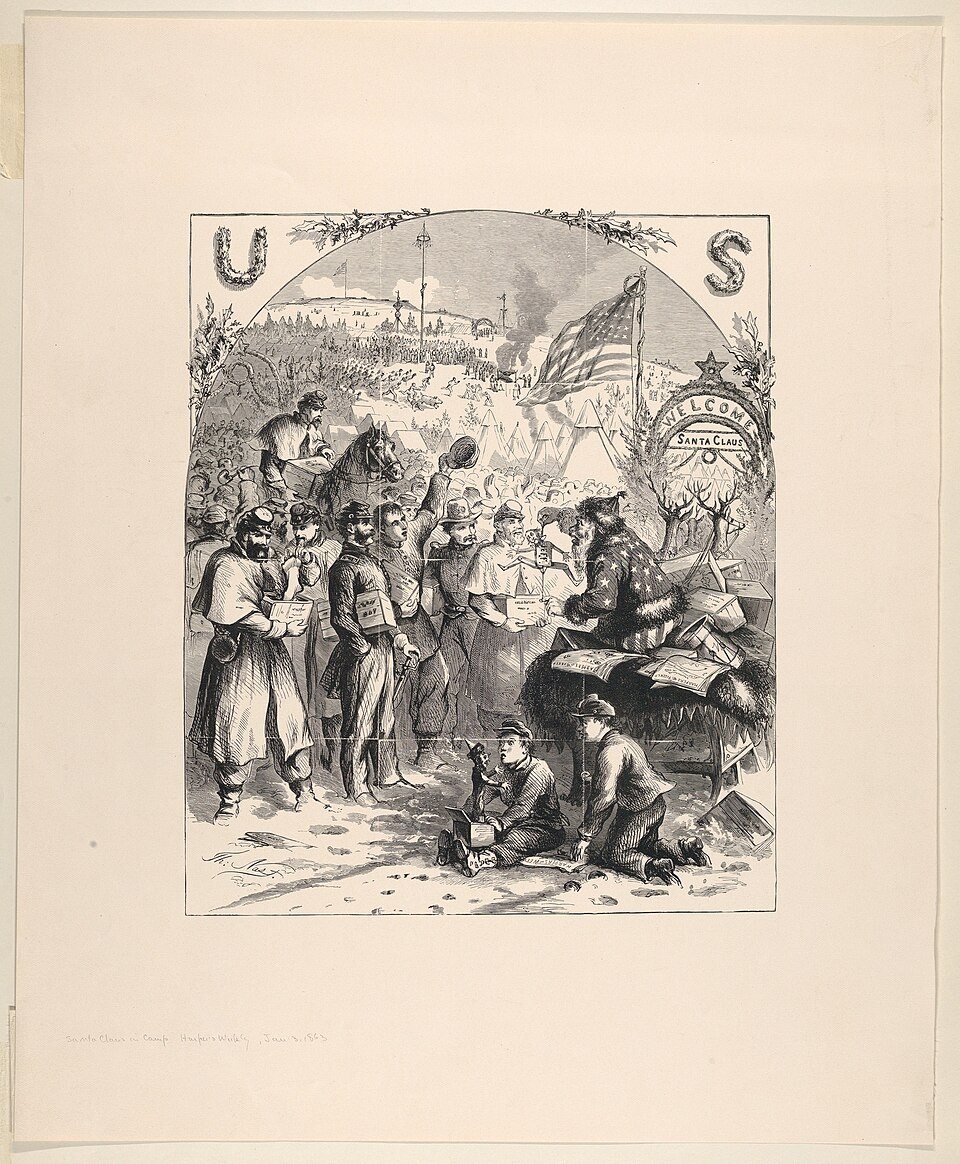
His first famous Santa appeared on January 3, 1863, in the middle of the Civil War. It’s called Santa Claus in Camp, and it is straight-up propaganda. Santa, dressed in a star-spangled jacket and striped pants, hands out gifts to Union soldiers. In his hands is a puppet of Confederate president Jefferson Davis with a rope around its neck. Santa was drafted into the war on the Union side before he ever got a workshop.32
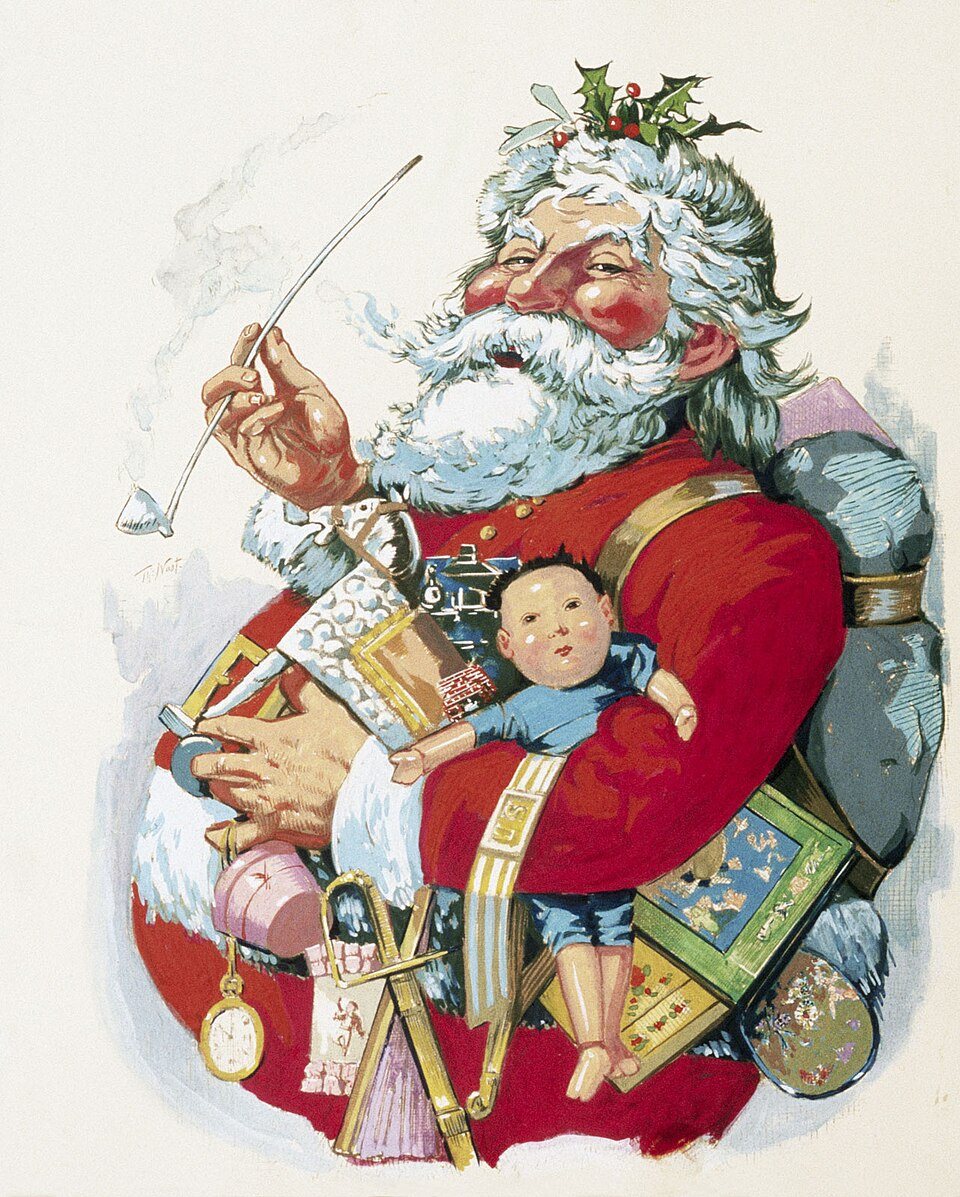
Nast went on to build a lot of the world around Santa. He gave him a home at the North Pole, a workshop, a list of good and bad children, and letters from kids. His 1881 drawing Merry Old Santa Claus became one of the defining images: round, bearded, cheerful, arms full of toys, pipe in mouth.32
No, Coca-Cola Did Not Make Santa Red
This myth refuses to die, so let’s kill it properly.
Starting in 1931, the illustrator Haddon Sundblom painted Santa for Coca-Cola’s holiday ads, and he kept doing it for more than 30 years. Those paintings are wonderful and wildly influential: a warm, human, grandfatherly Santa with rosy cheeks and a big laugh. They absolutely helped lock in the modern image.33
But Santa was wearing red long before Coca-Cola. Color prints of Nast’s Santa show him in red. Magazine covers in the early 1900s, including Puck, showed a red-suited Santa. The White Rock beverage company used a red Santa in ads in the 1910s and 1920s. Coca-Cola’s own archive says the company didn’t invent the red suit. What Sundblom did was standardize a look that was already winning. The myth survives because it’s a neat story about corporate power, and corporate power did shape Santa. Just not that particular detail.33
Rudolph Was an Ad, Too
In 1939, the Chicago department store chain Montgomery Ward asked a copywriter named Robert L. May to write a Christmas story it could give away to shoppers. May wrote Rudolph the Red-Nosed Reindeer, about a misfit reindeer who saves Christmas. The store handed out about 2.4 million copies that first year. A decade later May’s brother-in-law, the songwriter Johnny Marks, turned it into a song, and Gene Autry’s 1949 recording became one of the best-selling records of all time.34
So Santa’s most famous reindeer was invented to get people into a department store. That’s not a criticism. That’s just the honest genealogy of a lot of modern Christmas.
Father Christmas and Santa Merge
Meanwhile in England, Father Christmas had his own separate history. He started as a personification of feasting and good cheer, a jolly adult figure in a long robe who stood for hospitality, not gifts for kids. Over the 1800s, as American Santa stories crossed the Atlantic, the two characters slowly blended. The Library of Congress folklife blog traces how they converged until, for most people, the names now mean the same guy.24
Dickens, Cards and the Victorian Makeover
While New Yorkers were domesticating Christmas, the British were doing their own version, and they had a secret weapon: Charles Dickens.
A Christmas Carol was published on December 19, 1843. Dickens wrote it fast, partly because he needed the money. The first printing sold out by Christmas Eve. It’s a ghost story, a social protest novel and a redemption tale rolled into one, and its message is about as plain as it gets: the rich have obligations to the poor, generosity is the point of the season, and a man who hoards his money has wasted his life. Dickens didn’t invent Christmas, and he didn’t invent “Merry Christmas” either (the phrase shows up in a 1534 letter from Bishop John Fisher to Thomas Cromwell). But he gave the Victorian middle class a Christmas built around family, feasting, charity and warmth, and that version is still the one we’re all trying to recreate.35
The First Christmas Card
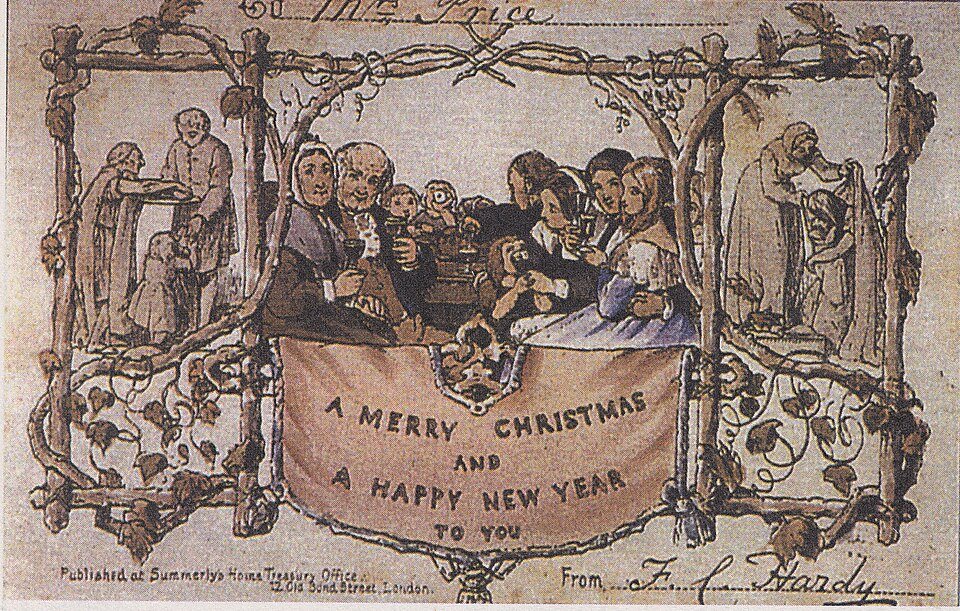
That same year, 1843, a London civil servant named Henry Cole had a problem: too many people to write holiday letters to. Cole, who also helped found the Victoria and Albert Museum and organized the Great Exhibition, asked the artist John Callcott Horsley to design a card he could print and send instead. About 1,000 copies were printed and sold for a shilling each.35
The card shows a family at a festive table, raising glasses of wine, with side panels of people feeding the hungry and clothing the poor. And here’s the best part: it was controversial. Temperance campaigners objected that a small child in the picture appears to be drinking wine. The very first commercial Christmas card started a culture war.35
Cards took off as printing got cheaper. In the United States, the German-born printer Louis Prang popularized them in the 1870s and is often called the father of the American Christmas card.
The Tree That Went Viral
The decorated Christmas tree has the clearest paper trail of almost any Christmas symbol, and it leads to German-speaking lands, not to Druids.
In the late Middle Ages, churches in Germany staged “paradise plays” on December 24, which was the feast of Adam and Eve on the medieval church calendar. The plays used a “paradise tree,” an evergreen hung with apples, to represent the Garden of Eden. Some historians think the paradise tree helped inspire the Christmas tree; it’s a plausible theory, not a proven one.3
Actual records of Christmas trees show up in the 1500s and 1600s in Alsace and the Rhineland. The town of Sélestat, in Alsace, points to a 1521 account entry paying guards to watch the forest at Christmas, which suggests people were cutting trees. A description from Strasbourg in 1605 says people set up fir trees in their parlors and decorated them with roses cut from paper, apples, wafers, gold foil and sweets. And yes, someone complained: in the 1640s the Strasbourg theologian Johann Conrad Dannhauer grumbled that families were fussing over Christmas trees instead of focusing on God’s word. Even the Christmas tree had its Puritan.3
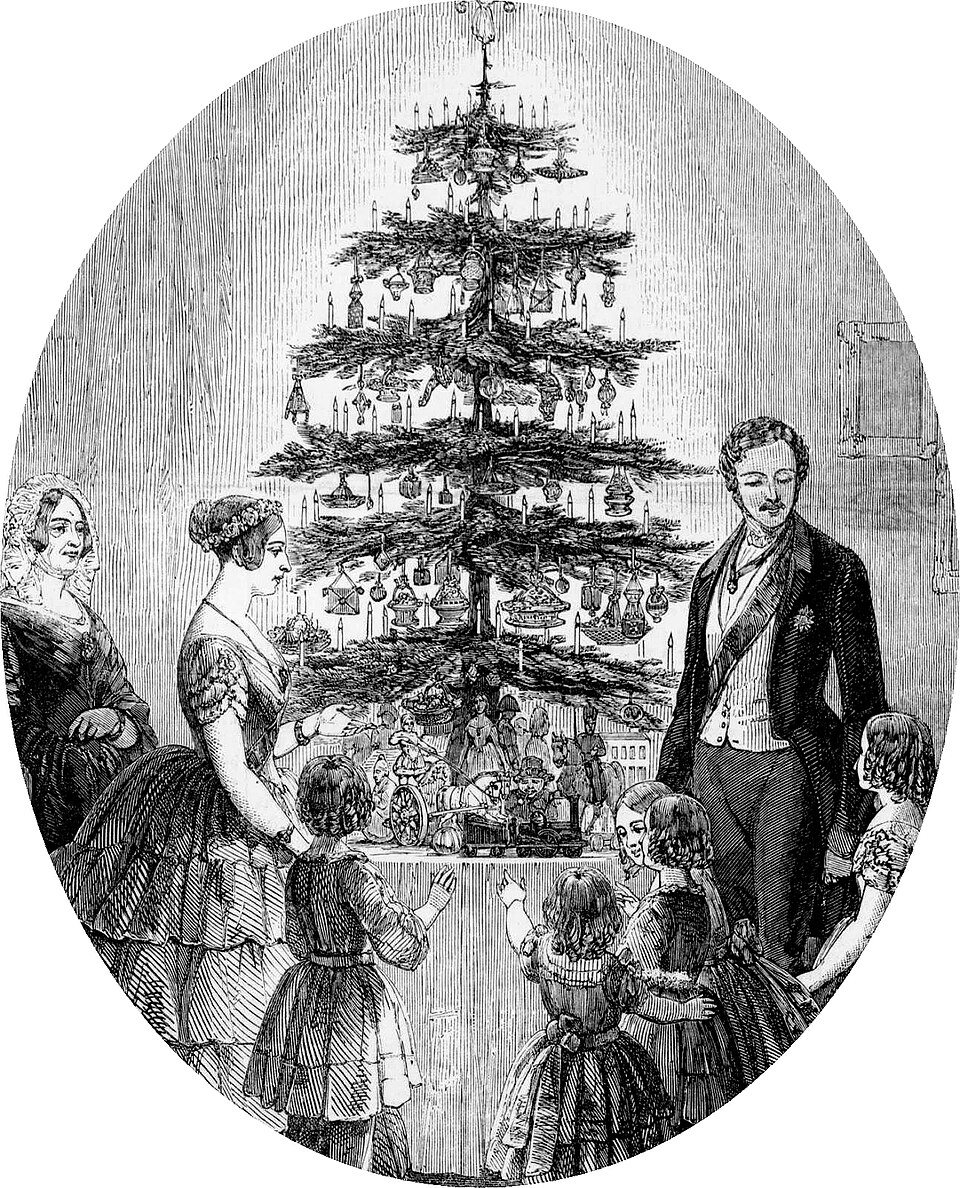
The tree spread slowly through German Protestant households and then through German nobility. Queen Charlotte, the German-born wife of George III, put up a tree for a children’s party at Windsor in 1800. But it went truly viral in 1848, when the Illustrated London News printed an engraving of Queen Victoria, her German husband Prince Albert and their children gathered around a decorated tree at Windsor Castle.3
Two years later, the American magazine Godey’s Lady’s Book reprinted the image for its readers, with a few edits. The engravers removed Victoria’s crown and Albert’s royal sash and mustache, turning the royal family into a generic well-off American family. It was, in effect, an influencer post with the branding scrubbed off, and it worked. The tree became a must-have in American homes.
You may have heard that Hessian soldiers introduced the Christmas tree to America during the Revolution, or that Martin Luther invented it after seeing stars through the branches on a walk. Both are charming. Neither has evidence behind it.
The Dark Side of December: Krampus and Friends
Here’s what the greeting-card version of Christmas leaves out: for centuries, a big part of the season was about scaring children into behaving.
Santa has a naughty list. That’s the polite American leftover of a much older, much scarier European habit. In a lot of places, the gift-bringer didn’t travel alone. He brought muscle.
Krampus
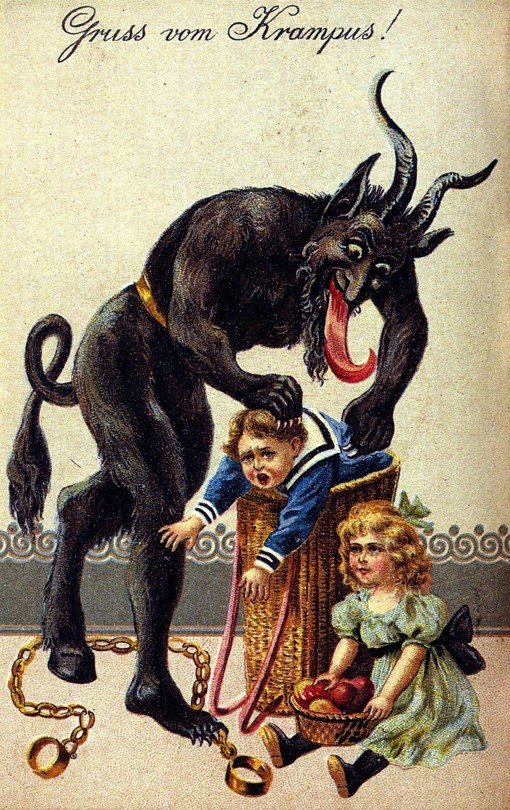
Krampus is the star of this crowd. In Austria, Bavaria, South Tyrol and neighboring Alpine regions, he travels with Saint Nicholas in early December. Nicholas rewards the good children. Krampus deals with the rest. He’s shaggy, horned and goat-legged, with a long red tongue, clanking chains and cowbells, and a bundle of birch switches called a Rute for swatting bad kids. In some versions he carries a basket or sack on his back for hauling the worst offenders away. His big night is December 5, Krampusnacht, the eve of Saint Nicholas’s Day.36
Where did he come from? Honestly, nobody’s sure, and that’s worth saying plainly because the internet is very sure. You’ll read that Krampus is a pre-Christian horned god, the son of Hel, a survival of ancient pagan winter rites. Those claims mostly trace back to nineteenth- and twentieth-century folklorists and enthusiasts, not to early records. What we can document is that devils and wild figures were part of Saint Nicholas plays and processions in the Alpine region by the early modern period, and that Krampus became firmly attached to Nicholas there. The anthropologists Matthäus Rest and Gertraud Seiser, writing about Krampus in Austria in 2018, treat it as a living local tradition whose earliest roots are genuinely unclear.36
What happened to Krampus more recently is better documented. Around 1900, Austrians mailed each other Krampuskarten, holiday postcards with greetings from Krampus, often wildly funny and sometimes surprisingly flirty. In recent decades the custom has boomed. Many Alpine towns hold a Krampuslauf (Krampus run), where groups of young men in hand-carved wooden masks and full fur suits charge through the streets ringing bells, swatting at spectators and terrifying children on purpose. Carving masks has become a serious craft and a serious business. And since the 2000s, Krampus has gone global, with Krampus parties and runs from Philadelphia to Portland and a 2015 Hollywood horror movie named after him.36
Perchta, Who Will Check Your Spinning
If Krampus is the muscle, Perchta is the inspector. In parts of Austria, southern Germany and the Alps, Perchta (or Berchta) roams during the Twelve Nights of Christmas, especially on the eve of Epiphany in early January. She rewards hardworking girls and servants who finished their spinning by the end of the year. For the lazy, the legends get graphic: she slits open your belly, pulls out your guts and stuffs you with straw and pebbles. Some versions specify that she does this if you skipped the traditional holiday meal, which is the most aggressive enforcement of a family dinner tradition ever recorded.
Late-medieval churchmen complained that people left food and drink out for Perchta on her night, which suggests she was being treated less like a fairy tale and more like someone you’d better keep happy. Today Alpine towns hold Perchtenläufe, processions of masked figures in two types: Schönperchten (beautiful Perchten) and Schiachperchten (ugly ones), the latter often hard to tell apart from Krampus.3
Iceland Has a Whole Murder Family
Iceland went all in.
Grýla is a giant ogress who comes down from the mountains at Christmas to collect naughty children, cook them in a stew and eat them. She appears in medieval Icelandic sources as a troll-woman and became attached to Christmas later. She was so effective at terrifying children that in 1746, a royal decree on household discipline in Iceland forbade parents from frightening children with tales of her and her kind. It didn’t work.
Her sons are the Yule Lads (Jólasveinar), thirteen trolls who arrive one per night in the thirteen nights before Christmas. Each has a name describing his particular crime: Spoon-Licker, Door-Slammer, Sausage-Swiper, Window-Peeper, Pot-Scraper and so on. Originally they were thieves and pranksters. These days they leave small gifts in shoes children put on the windowsill, or a potato if the child misbehaved. The number and names were fixed by the 1932 poem “The Yule Lads” by Jóhannes úr Kötlum, which every Icelandic kid learns.
And then there’s the Yule Cat (Jólakötturinn), Grýla’s enormous pet, which eats anyone who hasn’t received new clothes by Christmas. That sounds random until you realize it was a labor incentive. On Icelandic farms, workers who finished processing the autumn wool got new clothing as a reward. Those who slacked got nothing and, according to legend, got eaten. The Yule Cat is basically a performance review with fangs.
The Rest of the Rogues’ Gallery
Europe is crowded with these figures. A partial list:
- Knecht Ruprecht (Germany): a dark-robed servant of Saint Nicholas, carrying a switch and a sack, who asks children whether they can pray.
- Belsnickel (German regions and Pennsylvania Dutch country): a ragged, fur-clad gift-bringer who tosses candy on the floor and smacks the kids who dive for it too greedily. He crossed the Atlantic with German immigrants and survives in Pennsylvania.
- Père Fouettard (France and Belgium): “Father Whipper,” who travels with Saint Nicholas. In one legend he’s the butcher who murdered three boys and pickled them, until Nicholas brought them back to life, and he’s been working off the debt ever since.
- Hans Trapp (Alsace and Lorraine): a scarecrow-like bogeyman said to be based on a hated local nobleman.
- La Befana (Italy): a kind but sooty old woman on a broomstick who fills stockings on the eve of Epiphany, January 6, with sweets for good children and coal for bad ones. Less scary, more disappointed grandmother.
- Kallikantzaroi (Greece and the Balkans): goblins who spend the year sawing at the tree that holds up the world and come to the surface during the twelve days of Christmas to cause trouble. When they go back underground, the tree has healed and they have to start over.
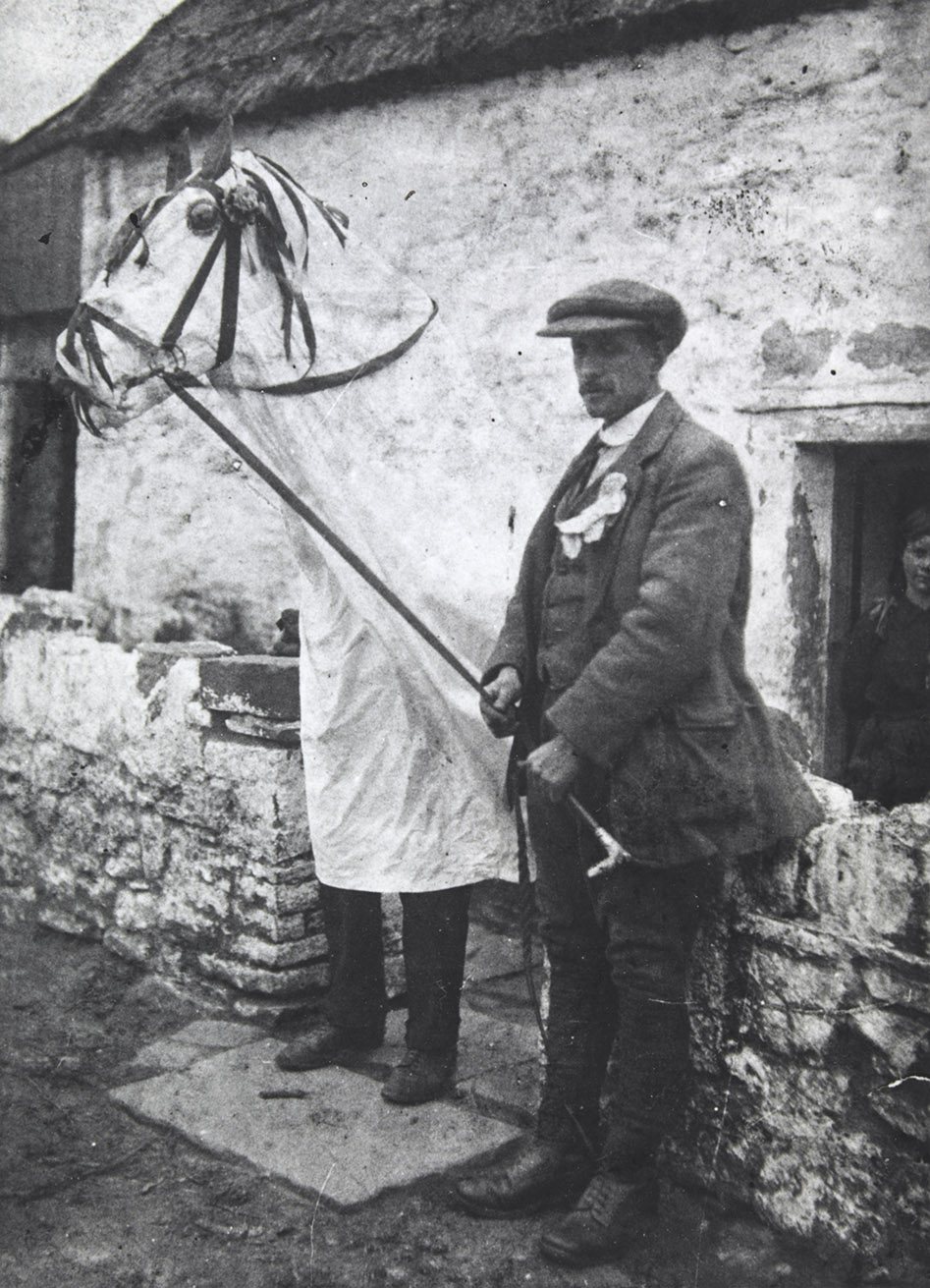
- The Mari Lwyd (Wales): a horse skull on a pole, draped in a white sheet, carried door to door at midwinter by a group who challenge the household to a battle of insulting rhymes before they’re let in. It is exactly as unsettling as it sounds.3
And because Catalonia refuses to be outdone, it contributes two of the strangest Christmas customs on earth. The Tió de Nadal is a log with a painted face and a little red hat. Children “feed” it for weeks, keep it warm under a blanket, then beat it with sticks on Christmas Eve while singing a song ordering it to poop out presents. And many Catalan nativity scenes include the Caganer, a small figure of a man squatting with his pants down, tucked in a corner of the manger scene. Modern caganers come in the shape of footballers, politicians and celebrities. Nobody fully agrees on why he’s there. Everyone agrees he belongs.
Why So Many Monsters?
The scary figures share a pattern, and it’s not a pagan conspiracy. Midwinter was the darkest, coldest, hungriest time of the year. The work of the year had to be finished: the wool spun, the food stored. Children had to be kept indoors and in line. The year was turning over. A season like that produces stories about who has been good and who hasn’t, about rewards and punishments, about uninvited visitors at the door. Santa’s list is the same idea with the monster removed. That’s a parallel, not a pedigree. Similar stories can grow in different places because people in different places face the same winter.
Ghost Stories by the Fire
Speaking of things English-speaking Christmas forgot: telling ghost stories used to be a core Christmas activity.
Shakespeare has a character in The Winter’s Tale say, “A sad tale’s best for winter: I have one of sprites and goblins.” Telling eerie stories around the fire on long winter nights was an old habit, and the Victorians made it a Christmas institution. A Christmas Carol is, after all, a ghost story with four ghosts in it. Magazines published special Christmas numbers stuffed with ghost stories. In 1891 the humorist Jerome K. Jerome joked that whenever five or six English people gather on Christmas Eve, they start telling each other ghost stories.
The tradition lasted into the twentieth century. The scholar M.R. James wrote some of the best ghost stories in English and read them aloud to friends at King’s College, Cambridge, at Christmas. The BBC ran a series called A Ghost Story for Christmas starting in 1971. And if you’ve ever wondered why a cheerful 1963 Christmas pop hit counts ghost stories among the joys of the season, that’s why. It wasn’t being weird. It was remembering.
Symbols: Shared, Borrowed or Just Similar?
Here’s what the evidence actually supports, symbol by symbol.
| Symbol | Where it really comes from | Verdict |
|---|---|---|
| Light and the sun | Romans honored the sun, especially under Aurelian. Christians called Jesus the light of the world and used sun imagery early. Midwinter is the darkest time of the year. | Parallel Both drew on the same symbolism; which influenced which is debated. |
| Candles | Romans gave wax candles at Saturnalia. Christians used candles in worship. Advent candles came much later. | Parallel Common to many celebrations. |
| Evergreens | Greenery stays alive in winter, and people across Europe brought it indoors. Romans decorated with greenery at the Kalends. | Debated A direct line from ancient practice to modern decorating is unproven. |
| Christmas tree | Records from Alsace and the Rhineland in the 1500s and 1600s. Spread through German Protestant homes, then royalty, then everyone. | Documented and German, not Druid. |
| Advent wreath | A Lutheran custom from nineteenth-century Germany, usually credited to the Hamburg pastor Johann Hinrich Wichern in 1839. | Documented and younger than you’d think. |
| Holly and ivy | Used in British winter decorating for centuries. The Christian reading (prickly leaves for the crown of thorns, red berries for blood) came later. | Documented use, later meaning. |
| Mistletoe | Pliny described Druids cutting it in a ceremony. In Norse myth it killed the god Baldr. Kissing under it appears in English sources in the 1700s; Washington Irving described the rule of plucking a berry for each kiss in 1820. | Debated Old plant, newer custom. |
| The star | Matthew’s Star of Bethlehem. | Documented source. What the star was is debated. |
| Gift-giving | Saturnalia and Kalends gifts. Saint Nicholas stories. The Christkind. Santa. | Parallel Several different histories feeding one habit. |
| Stockings and shoes | The Nicholas dowry legend, Dutch shoes for Sinterklaas, the 1823 poem. | Legend with a clear line to the modern custom. |
| Santa Claus | Saint Nicholas, Sinterklaas, Irving, the 1823 poem, Nast, Sundblom. | Documented Many artists and writers built him. |
| Krampus | Alpine Saint Nicholas customs. | Documented local tradition. Earliest origins unclear. |
| Yule log | English records begin in the 1600s. | Documented not ancient. |
| Bells | Church bells for services, sleigh bells on horses. | Parallel Two different uses that ended up in the same songs. |
Myths That Need to Go
A quick lightning round, because these come up every December.
Myth“Christmas is just a pagan holiday.”
VerdictNo. The date’s origin is debated, and some customs have pre-Christian parallels, but the holiday as a celebration of Jesus’ birth is Christian, and most of the specific customs are medieval or modern. The “it’s all pagan” claim was popularized first by Puritans who wanted to ban Christmas and later by Victorian folklorists who wanted to romanticize village life.
Myth“Coca-Cola made Santa red.”
VerdictNo. Santa was red before 1931, and Coca-Cola’s own archive says so.
Myth“Xmas is a secular plot to take Christ out of Christmas.”
VerdictNo. The X is the Greek letter chi, the first letter of Christos, the Greek word for Christ. English writers have used it as shorthand for Christ for centuries. A version spelled “X’temmas” shows up in 1551, and “Xmas” itself by 1721. It’s about as anti-Christian as writing “St.” for “Saint.”37
Myth“The candy cane is a shepherd’s crook, and upside down it’s a J for Jesus.”
VerdictIt’s a lovely devotional story, and there’s no early evidence for it. White sugar sticks are old, the familiar red stripes don’t show up in pictures until around 1900, and the Jesus symbolism is a modern addition.
Myth“The Christmas pickle is an old German tradition.”
VerdictMost Germans have never heard of it. It’s almost certainly an American invention, likely tied to the marketing of imported German glass ornaments.
Myth“Jingle Bells is a Christmas song.”
VerdictJames Lord Pierpont published it in 1857 as “One Horse Open Sleigh.” It never mentions Christmas. It’s a song about racing sleighs and, in a verse nobody sings, crashing one.
Myth“Alabama was the first state to make Christmas a legal holiday, in 1836.”
VerdictThis one shows up on trivia sites every year. The Alabama Department of Archives and History looked and found no record of it; the best guess is that someone misread a section number, 1836, in an 1867 law code.38
Myth“Oliver Cromwell banned Christmas.”
VerdictParliament did, in 1647, before he ran the country. He kept the ban going.
Myth“NORAD tracks Santa because of a military program.”
VerdictIt started with a wrong number. In 1955, a Sears ad in Colorado Springs invited kids to call Santa, and at least one call reached the operations desk of the Continental Air Defense Command instead. Whether the ad had a misprint or a child misdialed is still argued about. Colonel Harry Shoup played along and started giving children Santa’s location. NORAD has kept it up every year since.39
The Modern “War on Christmas”
Which brings it all back to the Puritans.
Every December, someone announces that Christmas is under attack. The usual evidence: a store says “Happy Holidays,” a coffee cup is too plain, a school concert calls itself a winter concert. It’s become as much a seasonal ritual as the tree.
The panic is older than most people realize, and its history is not flattering.
- 1920s: Henry Ford’s newspaper, the Dearborn Independent, ran a long antisemitic series later collected as The International Jew. Among its claims: that Jews were trying to remove Christ from Christmas. The “war on Christmas” story entered American life wrapped in conspiracy theories about a minority group.40
- 1959: The John Birch Society published a pamphlet warning that the United Nations was part of a communist plot to push religious symbols out of department-store Christmas decorations.41
- 2000s: The idea went mainstream on cable news. Fox News host Bill O’Reilly made it a recurring segment, and in 2005 Fox anchor John Gibson published a book titled The War on Christmas. The phrase had already been circulating for years on the fringe right.41
- 2015 and 2016: Starbucks released a plain red holiday cup, a viral video called it an attack on Christmas, and the cup became national news. Donald Trump told rally crowds that “we’re going to be saying Merry Christmas again.”41
Meanwhile, ordinary Americans mostly shrug. When Pew Research Center asked in 2017 how stores should greet holiday shoppers, about half said it didn’t matter to them.42
And “Happy Holidays” isn’t a new invention of anybody’s. The phrase has been around since at least the 1800s, because the season actually does include several holidays: Christmas, New Year’s, and for many Americans Hanukkah and Kwanzaa. Irving Berlin wrote a song called “Happy Holiday” for the 1942 movie Holiday Inn, the same movie that introduced “White Christmas.”
Here’s the thing the modern war-on-Christmas crowd never mentions. There was a real war on Christmas once. People really were fined for celebrating it. Soldiers really did break up Christmas services at gunpoint. Shops really were ordered to open on December 25. And every one of those things was done by devout Christians who believed the holiday was unbiblical, too Catholic and too drunk.
The people now claiming to defend “traditional Christmas” are defending the 1840s version. The Puritans were defending the first century. Both groups were sure they had the real thing.
So What Is Christmas, Really?
It’s a Christian feast placed on a date nobody can prove, in a season people were already celebrating, with customs borrowed from Roman households, German forests, Dutch shoes, English pubs, New York poets, Victorian printers, a German-born cartoonist and a Chicago department store. It’s been banned by Christians, rescued by rioters, tamed by the upper class, sold by soft drink companies and defended by people who don’t know its history.
None of that makes it fake. It makes it human.
Every generation has inherited Christmas, complained about how the last generation did it, and changed it anyway. The Romans had Saturnalia and grumbled about the noise. The Puritans looked at the drinking and the saints and said no. The Knickerbockers looked at the street gangs and said, let’s make it about children. Dickens looked at the poor and said, let’s make it about charity. Advertisers looked at all of it and said, let’s make it about shopping.
The one thing that stayed constant is the impulse underneath: in the darkest part of the year, people gather, light something, eat too much, give something away and tell stories. Some of the stories are true. Some are made up. A few are about monsters who will eat you if you don’t finish your spinning.
That’s not a corruption of the tradition. That is the tradition.
Sources
- Massachusetts Trial Court Law Libraries, Massachusetts Law Banning Christmas (1659, repealed 1681)
- The National Archives (UK), Christmas Is Cancelled: Education Resource and Transcripts
- Ronald Hutton, The Stations of the Sun: A History of the Ritual Year in Britain (Oxford University Press, 1996)
- Andrew McGowan, How December 25 Became Christmas, Biblical Archaeology Society
- The Chronography of 354, Part 12: Depositions of the Martyrs
- C. Philipp E. Nothaft, The Origins of the Christmas Date: Some Recent Trends in Historical Research, Church History 81, no. 4 (2012): 903 to 911
- Steven E. Hijmans, Usener's Christmas: A Contribution to the Modern Construct of Late Antique Solar Syncretism, Mouseion 3, no. 3 (2003): 377 to 398
- Stephen Nissenbaum, The Battle for Christmas: A Cultural History of America's Most Cherished Holiday (Knopf, 1996; Vintage, 1997)
- Gospel of Matthew, chapters 1 and 2 (USCCB New American Bible)
- Gospel of Luke, chapter 2 (USCCB New American Bible)
- The Chronography of 354, introduction and translation (Tertullian Project)
- The Chronography of 354, Part 6: The Calendar of Philocalus
- James Grout, Saturnalia, Encyclopaedia Romana, University of Chicago
- Bede, The Reckoning of Time, chapter 15, The English Months (c. 725), translation at the Tertullian Project
- Swedish History Museum, Christmas in the Viking Age and the Middle Ages
- Snorri Sturluson, Heimskringla I, Saga of Hákon the Good, chapter 13 (Viking Society for Northern Research translation)
- National Museum of Norway, Peter Nicolai Arbo, The Wild Hunt of Odin (1872)
- Swedish History Museum, History of Scandinavian Christmas Traditions
- St. Nicholas Center, Early Sources: The Evidence for Saint Nicholas
- Wellcome Collection, The Charity of Saint Nicholas (object record)
- Rijksmuseum, Jan Steen, The Feast of St Nicholas (1665 to 1668)
- The Cromwell Museum, Did Oliver Cromwell Ban Christmas?
- English Parliament, Ordinance Abolishing Festivals, June 1647 (transcription)
- Library of Congress, Folklife Today, In Comes I, Old Father Christmas: Surprising History of a Christmas Icon (2018)
- John Evelyn, The Diary of John Evelyn, ed. William Bray, Volume 1 (entry for December 25, 1657), Project Gutenberg
- National Trust for Scotland, Scottish Christmas Traditions
- Historic Environment Scotland, A Timeline of Christmas in Scotland (2016)
- Society for American Baseball Research, Pilgrim Stoolball and the Profusion of American Safe-Haven Ballgames (quotes Bradford's account of Christmas 1621)
- Mental Floss, When Americans Outlawed Christmas
- United States Congress, An Act Making the First Day of January, the Twenty-fifth Day of December, the Fourth Day of July, and Thanksgiving Day Holidays, 16 Stat. 168 (1870)
- Library of Congress, A Visit from St. Nicholas (later edition of the 1823 poem)
- The Metropolitan Museum of Art, Thomas Nast, Santa Claus in Camp, Harper's Weekly, January 3, 1863
- The Coca-Cola Company, Haddon Sundblom and the Coca-Cola Santas
- Smithsonian, Montgomery Ward Department Store Rudolph the Red-Nosed Reindeer Book, 1939
- Victoria and Albert Museum, The First Christmas Card
- Matthäus Rest and Gertraud Seiser, The Krampus in Austria: A Cultural Phenomenon, EthnoScripts 20, no. 1 (2018): 35 to 57
- Dictionary.com, Why Is Christmas Abbreviated as Xmas?
- Snopes, Was Alabama the First US State To Declare Christmas an Official Holiday?
- Smithsonian National Air and Space Museum, Why NORAD Tracks Santa (2020)
- Snopes, The War on Christmas (2017)
- Beacon Broadside, Claire Conner, The Making of the War on Christmas (2013)
- Pew Research Center, Americans Say Religious Aspects of Christmas Are Declining in Public Life (2017)
Image Credits
- Antoine-François Callet, Saturnalia, 1783. An eighteenth-century painter's idea of the Roman festival. Themadchopper, Antoine-François Callet · CC0 · Wikimedia Commons
- Thomas Nast, Merry Old Santa Claus, Harper's Weekly, January 1, 1881. Thomas Nast · Public domain · Wikimedia Commons
- A Gruss vom Krampus (Greetings from Krampus) postcard, early 1900s. Unknown author Unknown author · Public domain · Wikimedia Commons
- Frontispiece of John Taylor's pamphlet The Vindication of Christmas, 1652. John Taylor (1578 to 1653) · Public domain · Wikimedia Commons
- The Christmas Tree at Windsor Castle, Illustrated London News, 1848. Joseph Lionel Williams · Public domain · Wikimedia Commons
- The first commercial Christmas card, designed by John Callcott Horsley for Henry Cole, 1843. John Callcott Horsley, London · Public domain · Wikimedia Commons
- Thomas Nast, Santa Claus in Camp, Harper's Weekly, January 3, 1863. Thomas Nast · CC0 · Wikimedia Commons
- Saint Nicholas of Myra, icon from Saint Catherine's Monastery, Sinai, thirteenth century. Unknown author Unknown author · Public domain · Wikimedia Commons
- The title page of William Bradford's manuscript history, Of Plimoth Plantation. en:William Bradford (1590-1657) · Public domain · Wikimedia Commons
- The Mari Lwyd at Llangynwyd, Wales, in an early twentieth-century photograph. Thomas Christopher Evans (Cadrawd) · Public domain · Wikimedia Commons
- Jan Steen, The Feast of St Nicholas, about 1665 to 1668. Rijksmuseum, Amsterdam. Jan Steen · Public domain · Wikimedia Commons
The Winter Holiday Roots infographics are by Emily Adams; credits for the artwork inside them are on infographic 10.