What Democratic Socialism Is
Socialism pursued through elections and civil liberties, with the major businesses to be owned democratically by the public, workers or communities instead of private owners. Britannica defines it as an ideology that supports “a democratically run and decentralized form of socialist economy,” with the goal of abolishing capitalism rather than improving it through state regulation, the course social democrats prefer.
Its second half rejects Marxism-Leninism: Britannica says command economies hand power to a small bureaucracy. The word “socialism” has never had one meaning; a 1924 count by the scholar Rappoport found forty definitions, according to the Stanford Encyclopedia of Philosophy. The label democratic socialist took firm shape in the 20th century, and the 1951 Frankfurt declaration gave it a text: “Without freedom there can be no Socialism. Socialism can be achieved only through democracy.”
Who Owns It: Public, Cooperative and Social Ownership of the Big Firms
Democratic socialists say private control of large businesses is undemocratic. Britannica says they object that mixed economies “still leave the ownership of many businesses under private (and therefore undemocratic) control.” Their answer is public, cooperative or other social ownership of the major means of production. The philosopher John Rawls described a liberal democratic socialism with public ownership of “the preponderance of the means of production.”
They differ on how much and by what means. The 1951 declaration said planning does not require public ownership of everything, and left room for private farming, handicraft, retail and small and middle-sized industry. Some accept markets, provided firms are owned publicly, cooperatively or socially, a model called market socialism. Mondragon in Spain is the best-known worker cooperative. Labour’s old Clause IV was Britain’s best-known statement of the common-ownership goal. The Democratic Socialists of America say they want to collectively own key drivers such as energy production and transportation.
Who Rules: Voters, With Civil Liberties Intact
The ruling principle is democracy: elections, competing parties, courts and a free press, with no single party in permanent control. The Frankfurt declaration said communism “falsely claims a share in the Socialist tradition” and seeks “the dictatorship of a single party.” The tradition’s founders were less settled: Engels called a democratic republic “the specific form for the dictatorship of the proletariat,” and Marx praised the Paris Commune.
Whether reform can reach socialism at all has been argued since 1899. Eduard Bernstein said it could. Rosa Luxemburg replied that reformers chose “a different goal,” and Lenin called bourgeois democracy “a paradise for the rich.” The dispute, with Debs’s 1918 answer, is in Reform or Revolution.
What Democratic Socialists Believe
The diagnosis is that private capital holds power that voters cannot check. Albert Einstein put it in 1949 as “an oligarchy of private capital the enormous power of which cannot be effectively checked even by a democratically organized political society.” The remedy is to extend democratic principles into the economy, according to the economist Marc Fleurbaey, whom the Stanford Encyclopedia cites. Einstein’s essay also warned that a planned economy is not yet socialism and may bring “the complete enslavement of the individual.”
That warning is why the tradition is wary of the state. George Orwell wrote in 1946 that every line of his serious work since 1936 was “against totalitarianism and for democratic socialism, as I understand it” (Orwell). Following Bernstein, many hold that capitalism is not about to collapse, so socialism must be won by steady majorities and reforms, not a single break. On human nature there is no single view: the 1951 declaration said socialists may be Marxist, religious or humanitarian.
What Democratic Socialists Value
In rank order: freedom, because the 1951 declaration says socialism cannot exist without it; social justice, meaning a fair division of income, wealth and power; and solidarity. The Socialist International’s 1989 Stockholm declaration states them in one line: “Democratic socialism is an international movement for freedom, social justice and solidarity.”
What it will trade away is the rule of private owners over major firms and, in the version DSA describes, much of the market’s judgment over who gets what. DSA calls reforms such as Medicare for All and a Green New Deal “a transition.” What it will not trade is the vote and civil liberties: the Frankfurt text puts freedom first and treats any single-party shortcut as disqualifying.
A Short History of Democratic Socialism
Britannica says that as a discrete current it arose after Khrushchev’s 1956 secret speech, but its ancestors are older. Marx wrote on the Paris Commune in 1871, and in Germany Bebel and Liebknecht founded the Social Democratic Workers’ Party in 1869. The Second International formed in Paris in 1889. In Britain the Fabian Society of 1884 sought “a democratic socialist state.” Eduard Bernstein argued for gradual reform in 1899.
In France, Jean Jaures argued for democratic socialism in the newspaper L’Humanite from 1904 and united the French socialists in one party. In Germany the Social Democrats became the largest party in 1912.
In the United States, Eugene V. Debs won 900,370 votes, 6.0 percent, in 1912, and Milwaukee elected Socialist mayors and a congressman. The Socialist International was re-established at Frankfurt in 1951. The New Left of the late 1950s and 1960s, and the 1982 merger of the Democratic Socialist Organizing Committee and the New American Movement into DSA, then carried the label forward, and 2026 brought DSA’s largest electoral gains.
The Branches of Democratic Socialism
The family is broad. Fabian socialism pursued a democratic socialist state through the Society’s writing and the founding of the Labour Party. Revisionism, Bernstein’s school, rejected the labor theory of value and a coming collapse of capitalism. Guild socialism mixed state ownership with workers’ control. Christian socialism grew from British clergy after 1848. Market socialism is covered under ownership.
Austrian socialists built Red Vienna as municipal socialism. A last family overlaps with social democracy and is treated on its own line.
Where It Has Been Tried
Britain’s Labour government under Clement Attlee (1945 to 1951) nationalized major industries and founded the National Health Service. Sweden’s Social Democrats proposed wage-earner investment funds in the 1980s, which were enacted in 1983 and changed little. In France, Mitterrand nationalized banks and industries in 1981, then reversed course in 1983.
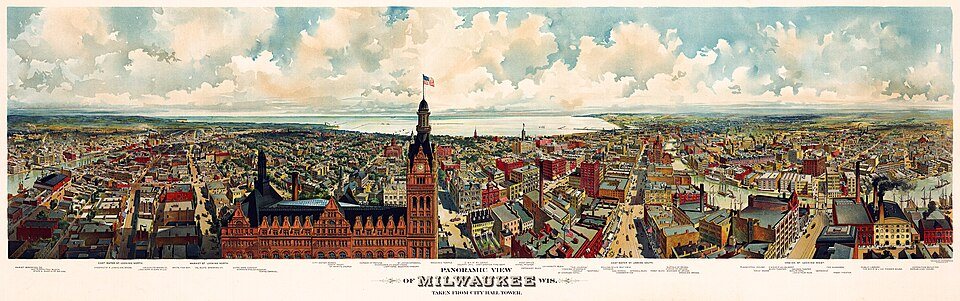
Chile’s Salvador Allende (1970 to 1973) tried it by election and was overthrown in a military coup. Venezuela under Hugo Chavez began in elections and ended as an authoritarian state. Closer to home, Milwaukee’s Socialist mayors governed from 1910 to 1960, and Vienna’s socialists governed that city between the wars. The record is mixed, and each case has a different cause.
The causes in Chile remain argued. Britannica cites inflation and shortages under Allende’s policies, while a Senate committee documented U.S. covert funding for his opponents and a 1970 effort to foment a coup. In Britain, France and Sweden the question was how far the reforms could go before voters or markets pushed back.
The Case for It and the Case Against It
“Denmark and Sweden are democratic socialist countries.”
Denmark’s prime minister said at Harvard in 2015: “Denmark is far from a socialist planned economy. Denmark is a market economy.” Bernie Sanders said the same year he does not believe government should own the means of production. Britannica calls the Nordic model social democracy, which regulates markets rather than replacing them.
Its defenders say markets alone leave economic power undemocratic, and that giving workers and the public a voice in major firms completes democracy. They cite Mondragon, Red Vienna and the postwar British health service, and polls showing growing support among the young.
Critics make two arguments. Friedrich Hayek held that the knowledge needed to plan an economy is dispersed and can be found only through market prices, and Ludwig von Mises argued in 1920 that socialism cannot calculate the value of resources (the calculation debate). Conservative analysts add that countries democratic socialists admire are market economies, not socialist ones. The Nordic question is the most argued example. From the left, Luxemburg held that reformers abandoned the real goal.
What Democratic Socialism Is Not
“Democratic socialism always ends in Venezuela.”
Venezuela’s rulers abandoned competitive elections, and the Carter Center said in 2024 its election could not be considered democratic. The democratic socialist test in the 1951 Frankfurt declaration is that without freedom there is no socialism. Britain, Sweden and Chile also tried reforms, with very different outcomes.
It is not social democracy, though the terms were reversed for decades, per Britannica. Social democrats regulate capitalism and fund a welfare state; democratic socialists aim to replace private ownership of the major firms, according to Britannica’s account. The line is blurred in practice. It is not communism either: command economies and one-party rule are what it rejects, and the Frankfurt declaration says so.
It is not Nazism, despite the party name, which Britannica answers with “No, not in any meaningful way, and certainly not after 1934” (National Socialism). The American right often applies the word broadly to Medicare for All and free college, and Sanders himself says he does not favor government ownership of the means of production.
Democratic Socialism Today
In the United States the term is tied to DSA, which won six House seats on November 3, 2026, and to Bernie Sanders, Alexandria Ocasio-Cortez and New York mayor Zohran Mamdani. Sanders won more than two-fifths of the 2016 Democratic primary vote and more than one-fourth in 2020, Britannica says, and Ocasio-Cortez and Rashida Tlaib were elected to the House in 2018. Public opinion has shifted: Gallup in August 2026 found 43 percent positive on socialism, the first reading above 39 percent since 2010.
In Britain, Jeremy Corbyn’s Your Party chose its leadership committee in February 2026. Worldwide, the Socialist International counts 132 member parties. The International says 34 of its member parties are in government.